
Oracle Critical Patch Update April 2026
Released April 2026 · Oracle's advisory ↗ · ← Critical Patch Update, January 2026 · Security Patch Update, May 2026 →
421 CVEs in this release, one square each
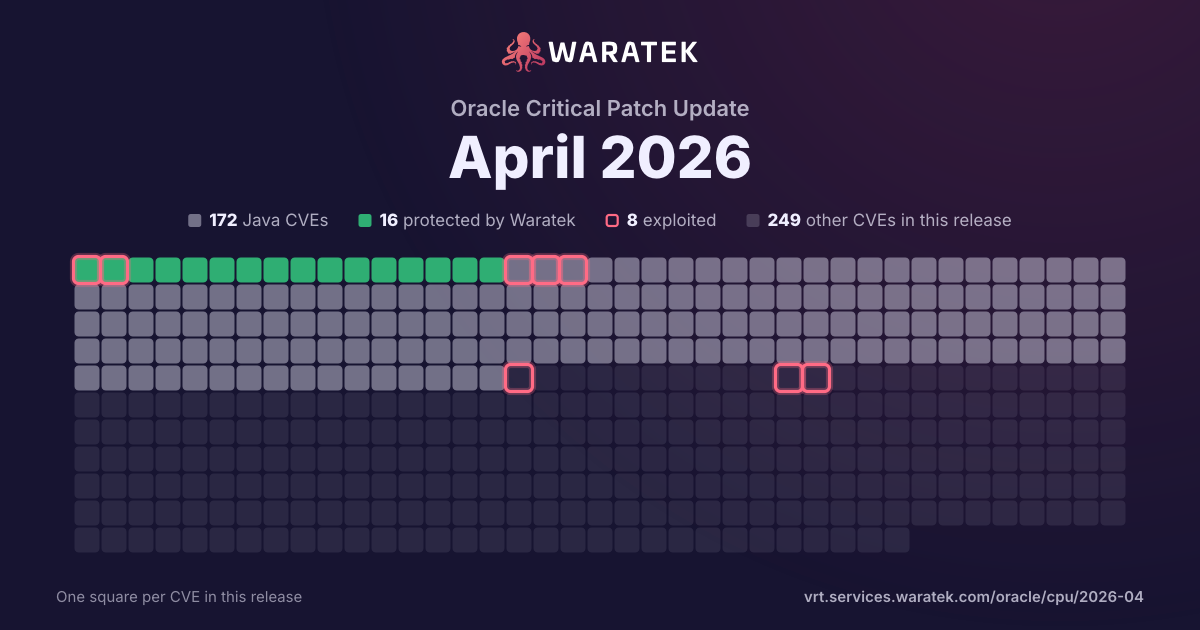
By status
13Protected by Waratek1Rule in development3Mitigation candidate157No exploit published6Outside Waratek scope241Not applicable
8Exploited, marked by the ring
No exploit published. For 51 of them, Oracle's security advisory is the source of public detail.
Protected by Waratek. Waratek RASP can block exploitation of these on systems that have not applied the patch yet.
Overview 4 matches · 0 protected · 0 exploited · 0 CISA KEV · 0 public PoC · 0 EPSS ≥ 0.5
4matches
0protected0.0%
0exploited0.0%
0CISA KEV0.0%
0public PoC0.0%
0EPSS ≥ 0.50.0%
Protected by Waratek
0
0.0%
Rule in development
0
0.0%
Mitigation candidate
0
0.0%
No exploit published
4
100.0%
blocked by ARMR today
0
0.0%
partly blocked
0
0.0%
not blocked
4
100.0%
not established
0
0.0%
unrecorded
0
0.0%
Exploited
0
0.0%
Working exploit published
0
0.0%
Proof of concept only
1
25.0%
Forecast only
0
0.0%
No public exploit
3
75.0%
| CVE | Severity | Published▾ | Status | Exploitation | Description |
|---|---|---|---|---|---|
| CVE-2025-68161 | Medium | 2025-12-18 | No exploit published | No public exploit | The Socket Appender in Apache Log4j Core versions 2.0-beta9 through 2.25.2 does not perform TLS hostname verification of the peer certificate, even when the verifyHostName https://logging.apache.org/log4j/2.x/manual/appenders/network.html#SslConfiguration-attr-verifyHostName configuration attribute or the log4j2.sslVerifyHostName https://logging.apache.org/log4j/2.x/manual/systemproperties.html#log4j2.sslVerifyHostName system property is set to true. This issue may allow a man-in-the-middle attacker to intercept or redirect log traffic under the following conditions: * The attacker is able to intercept or redirect network traffic between the client and the log receiver. * The attacker can present a server certificate issued by a certification authority trusted by the Socket Appender’s configured trust store (or by the default Java trust store if no custom trust store is configured). Users are advised to upgrade to Apache Log4j Core version 2.25.3, which addresses this issue. As an alternative mitigation, the Socket Appender may be configured to use a private or restricted trust root to limit the set of trusted certificates. |
| CVE-2025-12383 | Critical | 2025-11-18 | No exploit published | No public exploit | In Eclipse Jersey versions 2.45, 3.0.16, 3.1.9 a race condition can cause ignoring of critical SSL configurations - such as mutual authentication, custom key/trust stores, and other security settings. This issue may result in SSLHandshakeException under normal circumstances, but under certain conditions, it could lead to unauthorized trust in insecure servers (see PoC) |
| CVE-2024-31573 | Medium | 2025-10-17 | No exploit published | Proof of concept only | XMLUnit for Java before 2.10.0, in the default configuration, might allow code execution via an untrusted stylesheet (used for an XSLT transformation), because XSLT extension functions are enabled. |
| CVE-2025-41254 | Medium | 2025-10-16 | No exploit published | No public exploit | STOMP over WebSocket applications may be vulnerable to a security bypass that allows an attacker to send unauthorized messages. Affected Spring Products and VersionsSpring Framework: * 6.2.0 - 6.2.11 * 6.1.0 - 6.1.23 * 6.0.x - 6.0.29 * 5.3.0 - 5.3.45 * Older, unsupported versions are also affected. MitigationUsers of affected versions should upgrade to the corresponding fixed version. Affected version(s)Fix versionAvailability6.2.x6.2.12OSS6.1.x6.1.24 Commercial https://enterprise.spring.io/ 6.0.xN/A Out of support https://spring.io/projects/spring-framework#support 5.3.x5.3.46 Commercial https://enterprise.spring.io/ No further mitigation steps are necessary. CreditThis vulnerability was discovered and responsibly reported by Jannis Kaiser. |