
Oracle Critical Patch Update April 2026
Released April 2026 · Oracle's advisory ↗ · ← Critical Patch Update, January 2026 · Security Patch Update, May 2026 →
421 CVEs in this release, one square each
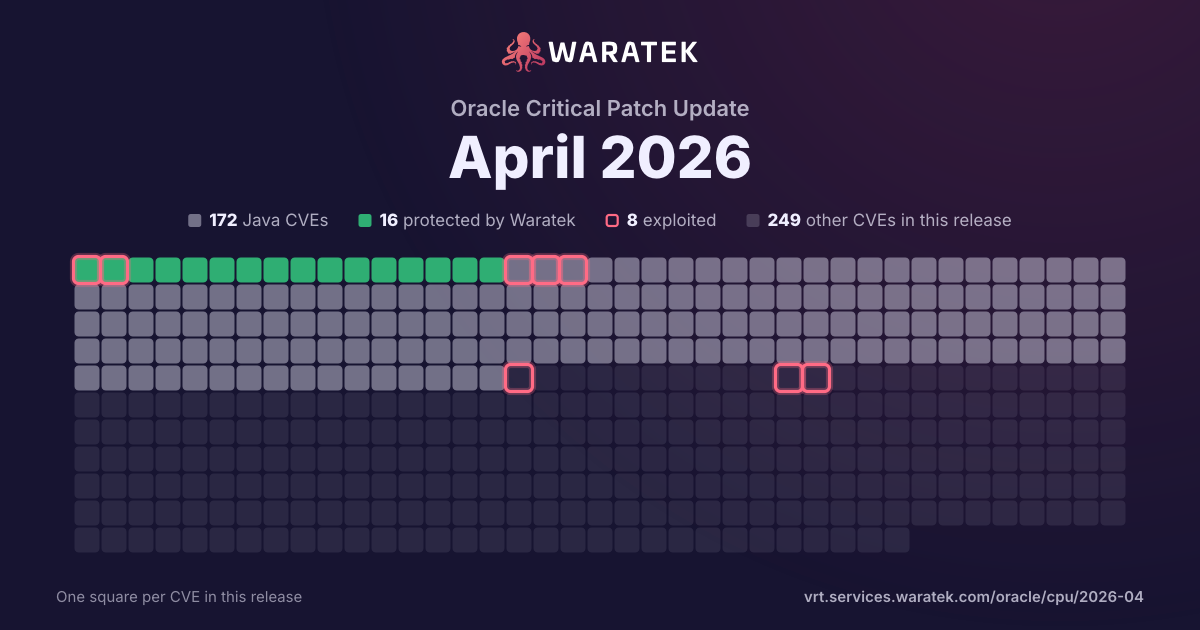
By status
13Protected by Waratek1Rule in development3Mitigation candidate157No exploit published6Outside Waratek scope241Not applicable
8Exploited, marked by the ring
No exploit published. For 51 of them, Oracle's security advisory is the source of public detail.
Protected by Waratek. Waratek RASP can block exploitation of these on systems that have not applied the patch yet.
Overview 2 matches · 0 protected · 0 exploited · 0 CISA KEV · 0 public PoC · 0 EPSS ≥ 0.5
2matches
0protected0.0%
0exploited0.0%
0CISA KEV0.0%
0public PoC0.0%
0EPSS ≥ 0.50.0%
Protected by Waratek
0
0.0%
Rule in development
0
0.0%
Mitigation candidate
0
0.0%
No exploit published
2
100.0%
blocked by ARMR today
0
0.0%
partly blocked
0
0.0%
not blocked
2
100.0%
not established
0
0.0%
unrecorded
0
0.0%
Exploited
0
0.0%
Working exploit published
0
0.0%
Proof of concept only
0
0.0%
Forecast only
0
0.0%
No public exploit
2
100.0%
split by
peak 1 / month
Mar 26Apr 26
| CVE | Severity | Published▾ | Status | Exploitation | Description |
|---|---|---|---|---|---|
| CVE-2026-22021 | Medium | 2026-04-21 | No exploit published | No public exploit | Vulnerability in the Oracle Java SE, Oracle GraalVM for JDK, Oracle GraalVM Enterprise Edition product of Oracle Java SE (component: JSSE). Supported versions that are affected are Oracle Java SE: 8u481, 8u481-b50, 8u481-perf, 11.0.30, 17.0.18, 21.0.10, 25.0.2, 26; Oracle GraalVM for JDK: 17.0.18 and 21.0.10; Oracle GraalVM Enterprise Edition: 21.3.17. Easily exploitable vulnerability allows unauthenticated attacker with network access via HTTPS to compromise Oracle Java SE, Oracle GraalVM for JDK, Oracle GraalVM Enterprise Edition. Successful attacks of this vulnerability can result in unauthorized ability to cause a partial denial of service (partial DOS) of Oracle Java SE, Oracle GraalVM for JDK, Oracle GraalVM Enterprise Edition. Note: This vulnerability can be exploited by using APIs in the specified Component, e.g., through a web service which supplies data to the APIs. This vulnerability also applies to Java deployments, typically in clients running sandboxed Java Web Start applications or sandboxed Java applets, that load and run untrusted code (e.g., code that comes from the internet) and rely on the Java sandbox for security. CVSS 3.1 Base Score 5.3 (Availability impacts). CVSS Vector: (CVSS:3.1/AV:N/AC:L/PR:N/UI:N/S:U/C:N/I:N/A:L). |
| CVE-2025-11143 | Medium | 2026-03-05 | No exploit published | No public exploit | The Jetty URI parser has some key differences to other common parsers when evaluating invalid or unusual URIs. Differential parsing of URIs in systems using multiple components may result in security by-pass. For example a component that enforces a black list may interpret the URIs differently from one that generates a response. At the very least, differential parsing may divulge implementation details. |