
Oracle Critical Patch Update April 2026
Released April 2026 · Oracle's advisory ↗ · ← Critical Patch Update, January 2026 · Security Patch Update, May 2026 →
421 CVEs in this release, one square each
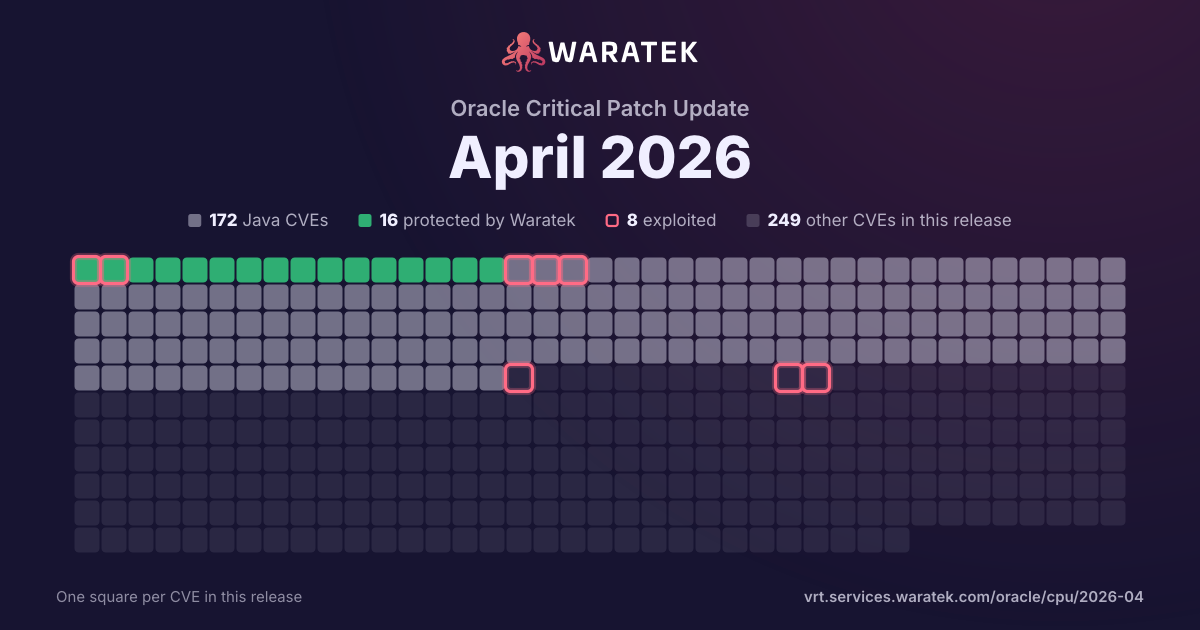
By status
13Protected by Waratek1Rule in development3Mitigation candidate157No exploit published6Outside Waratek scope241Not applicable
8Exploited, marked by the ring
No exploit published. For 51 of them, Oracle's security advisory is the source of public detail.
Protected by Waratek. Waratek RASP can block exploitation of these on systems that have not applied the patch yet.
Overview 14 matches · 0 protected · 1 exploited · 0 CISA KEV · 1 public PoC · 0 EPSS ≥ 0.5
Protected by Waratek
0
0.0%
Rule in development
0
0.0%
Mitigation candidate
1
7.1%
No exploit published
13
92.9%
blocked by ARMR today
0
0.0%
partly blocked
0
0.0%
not blocked
14
100.0%
not established
0
0.0%
unrecorded
0
0.0%
Exploited
1
7.1%
Working exploit published
0
0.0%
Proof of concept only
1
7.1%
Forecast only
0
0.0%
No public exploit
12
85.7%
split by
peak 4 / month
Sep 254
Mitigation candidate1
No exploit published3
Medium4
not blocked4
Exploited1
Proof of concept only1
No public exploit2
Oct 251
No exploit published1
Medium1
not blocked1
No public exploit1
Nov 250
Dec 254
No exploit published4
Medium4
not blocked4
No public exploit4
Jan 260
Feb 263
No exploit published3
Medium3
not blocked3
No public exploit3
Mar 261
No exploit published1
Medium1
not blocked1
No public exploit1
Apr 261
No exploit published1
Medium1
not blocked1
No public exploit1
Sep 25Oct 25Nov 25Dec 25Jan 26Feb 26Mar 26Apr 26
| CVE | Severity | Published▾ | Status | Exploitation | Description |
|---|---|---|---|---|---|
| CVE-2026-22021 | Medium | 2026-04-21 | No exploit published | No public exploit | Vulnerability in the Oracle Java SE, Oracle GraalVM for JDK, Oracle GraalVM Enterprise Edition product of Oracle Java SE (component: JSSE). Supported versions that are affected are Oracle Java SE: 8u481, 8u481-b50, 8u481-perf, 11.0.30, 17.0.18, 21.0.10, 25.0.2, 26; Oracle GraalVM for JDK: 17.0.18 and 21.0.10; Oracle GraalVM Enterprise Edition: 21.3.17. Easily exploitable vulnerability allows unauthenticated attacker with network access via HTTPS to compromise Oracle Java SE, Oracle GraalVM for JDK, Oracle GraalVM Enterprise Edition. Successful attacks of this vulnerability can result in unauthorized ability to cause a partial denial of service (partial DOS) of Oracle Java SE, Oracle GraalVM for JDK, Oracle GraalVM Enterprise Edition. Note: This vulnerability can be exploited by using APIs in the specified Component, e.g., through a web service which supplies data to the APIs. This vulnerability also applies to Java deployments, typically in clients running sandboxed Java Web Start applications or sandboxed Java applets, that load and run untrusted code (e.g., code that comes from the internet) and rely on the Java sandbox for security. CVSS 3.1 Base Score 5.3 (Availability impacts). CVSS Vector: (CVSS:3.1/AV:N/AC:L/PR:N/UI:N/S:U/C:N/I:N/A:L). |
| CVE-2025-11143 | Medium | 2026-03-05 | No exploit published | No public exploit | The Jetty URI parser has some key differences to other common parsers when evaluating invalid or unusual URIs. Differential parsing of URIs in systems using multiple components may result in security by-pass. For example a component that enforces a black list may interpret the URIs differently from one that generates a response. At the very least, differential parsing may divulge implementation details. |
| CVE-2026-27100 | Medium | 2026-02-18 | No exploit published | No public exploit | Jenkins 2.550 and earlier, LTS 2.541.1 and earlier accepts Run Parameter values that refer to builds the user submitting the build does not have access to, allowing attackers with Item/Build and Item/Configure permission to obtain information about the existence of jobs, the existence of builds, and if a specified build exists, its display name. |
| CVE-2026-24733 | Medium | 2026-02-17 | No exploit published | No public exploit | Improper Input Validation vulnerability in Apache Tomcat. Tomcat did not limit HTTP/0.9 requests to the GET method. If a security constraint was configured to allow HEAD requests to a URI but deny GET requests, the user could bypass that constraint on GET requests by sending a (specification invalid) HEAD request using HTTP/0.9. This issue affects Apache Tomcat: from 11.0.0-M1 through 11.0.14, from 10.1.0-M1 through 10.1.49, from 9.0.0.M1 through 9.0.112. Older, EOL versions are also affected. Users are recommended to upgrade to version 11.0.15 or later, 10.1.50 or later or 9.0.113 or later, which fixes the issue. |
| CVE-2026-23903 | Medium | 2026-02-09 | No exploit published | No public exploit | Authentication Bypass by Alternate Name vulnerability in Apache Shiro. This issue affects Apache Shiro: before 2.0.7. Users are recommended to upgrade to version 2.0.7, which fixes the issue. The issue only effects static files. If static files are served from a case-insensitive filesystem, such as default macOS setup, static files may be accessed by varying the case of the filename in the request. If only lower-case (common default) filters are present in Shiro, they may be bypassed this way. Shiro 2.1.0 and later has a new parameters to remediate this issue shiro.ini: filterChainResolver.caseInsensitive = true application.properties: shiro.caseInsensitive=true Shiro 3.0.0 and later makes this the default in shiro.ini-based configurations. Shiro 3.0.1 and later makes this the default in all configurations, including programmatic and Spring / Spring Boot. |
| CVE-2025-68161 | Medium | 2025-12-18 | No exploit published | No public exploit | The Socket Appender in Apache Log4j Core versions 2.0-beta9 through 2.25.2 does not perform TLS hostname verification of the peer certificate, even when the verifyHostName https://logging.apache.org/log4j/2.x/manual/appenders/network.html#SslConfiguration-attr-verifyHostName configuration attribute or the log4j2.sslVerifyHostName https://logging.apache.org/log4j/2.x/manual/systemproperties.html#log4j2.sslVerifyHostName system property is set to true. This issue may allow a man-in-the-middle attacker to intercept or redirect log traffic under the following conditions: * The attacker is able to intercept or redirect network traffic between the client and the log receiver. * The attacker can present a server certificate issued by a certification authority trusted by the Socket Appender’s configured trust store (or by the default Java trust store if no custom trust store is configured). Users are advised to upgrade to Apache Log4j Core version 2.25.3, which addresses this issue. As an alternative mitigation, the Socket Appender may be configured to use a private or restricted trust root to limit the set of trusted certificates. |
| CVE-2025-67638 | Medium | 2025-12-10 | No exploit published | No public exploit | Jenkins 2.540 and earlier, LTS 2.528.2 and earlier does not mask build authorization tokens displayed on the job configuration form, increasing the potential for attackers to observe and capture them. |
| CVE-2025-67637 | Medium | 2025-12-10 | No exploit published | No public exploit | Jenkins 2.540 and earlier, LTS 2.528.2 and earlier stores build authorization tokens unencrypted in job config.xml files on the Jenkins controller where they can be viewed by users with Item/Extended Read permission or access to the Jenkins controller file system. |
| CVE-2025-67636 | Medium | 2025-12-10 | No exploit published | No public exploit | A missing permission check in Jenkins 2.540 and earlier, LTS 2.528.2 and earlier allows attackers with View/Read permission to view encrypted password values in views. |
| CVE-2025-61795 | Medium | 2025-10-27 | No exploit published | No public exploit | Improper Resource Shutdown or Release vulnerability in Apache Tomcat. If an error occurred (including exceeding limits) during the processing of a multipart upload, temporary copies of the uploaded parts written to disc were not cleaned up immediately but left for the garbage collection process to delete. Depending on JVM settings, application memory usage and application load, it was possible that space for the temporary copies of uploaded parts would be filled faster than GC cleared it, leading to a DoS. This issue affects Apache Tomcat: from 11.0.0-M1 through 11.0.11, from 10.1.0-M1 through 10.1.46, from 9.0.0.M1 through 9.0.109. The following versions were EOL at the time the CVE was created but are known to be affected: 8.5.0 though 8.5.100. Other, older, EOL versions may also be affected. Users are recommended to upgrade to version 11.0.12 or later, 10.1.47 or later or 9.0.110 or later which fixes the issue. |
| CVE-2025-59476 | Medium | 2025-09-17 | No exploit published | No public exploit | Jenkins 2.527 and earlier, LTS 2.516.2 and earlier does not restrict or transform the characters that can be inserted from user-specified content in log messages, allowing attackers able to control log message contents to insert line break characters, followed by forged log messages that may mislead administrators reviewing log output. |
| CVE-2025-59475 | Medium | 2025-09-17 | No exploit published | No public exploit | Jenkins 2.527 and earlier, LTS 2.516.2 and earlier does not perform a permission check for the authenticated user profile dropdown menu, allowing attackers without Overall/Read permission to obtain limited information about the Jenkins configuration by listing available options in this menu (e.g., whether Credentials Plugin is installed). |
| CVE-2025-59474 | Medium | 2025-09-17 | Mitigation candidate | Exploited | Jenkins 2.527 and earlier, LTS 2.516.2 and earlier does not perform a permission check in the sidepanel of a page intentionally accessible to users lacking Overall/Read permission, allowing attackers without Overall/Read permission to list agent names through its sidepanel executors widget. |
| CVE-2025-58057 | Medium | 2025-09-04 | No exploit published | Proof of concept only | Netty is an asynchronous event-driven network application framework for rapid development of maintainable high performance protocol servers & clients. In netty-codec-compression versions 4.1.124.Final and below, and netty-codec versions 4.2.4.Final and below, when supplied with specially crafted input, BrotliDecoder and certain other decompression decoders will allocate a large number of reachable byte buffers, which can lead to denial of service. BrotliDecoder.decompress has no limit in how often it calls pull, decompressing data 64K bytes at a time. The buffers are saved in the output list, and remain reachable until OOM is hit. This is fixed in versions 4.1.125.Final of netty-codec and 4.2.5.Final of netty-codec-compression. |