
Oracle Critical Patch Update April 2026
Released April 2026 · Oracle's advisory ↗ · ← Critical Patch Update, January 2026 · Security Patch Update, May 2026 →
421 CVEs in this release, one square each
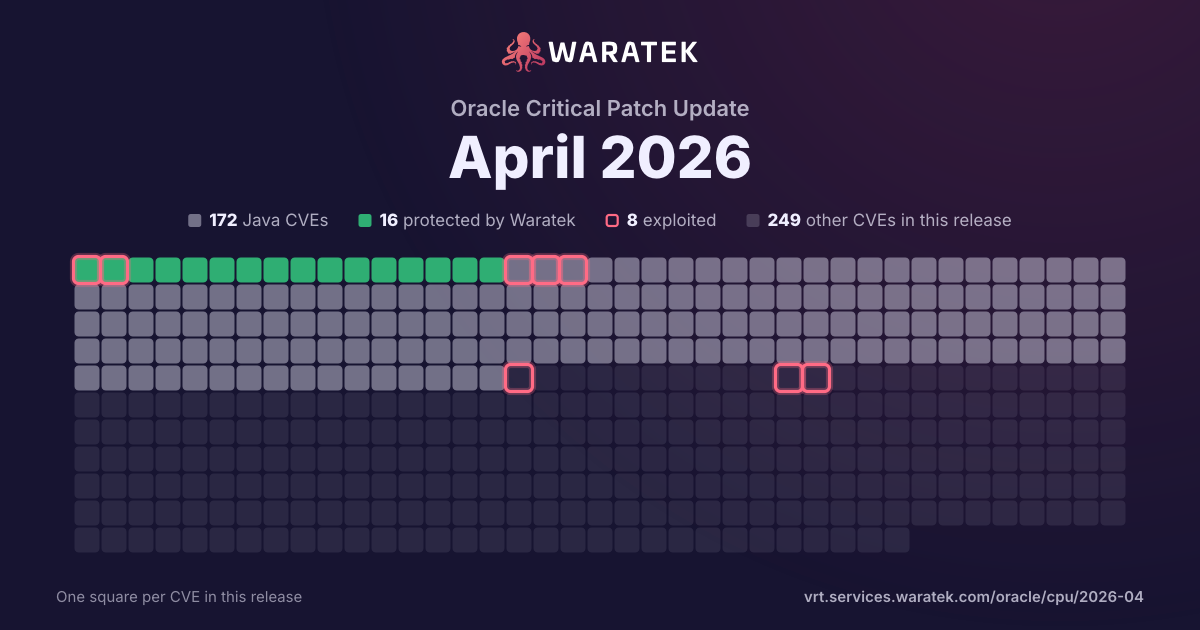
By status
16Protected by Waratek4Mitigation candidate152No exploit published10Outside Waratek scope239Not applicable
8Exploited, marked by the ring
No exploit published. For 51 of them, Oracle's security advisory is the source of public detail.
Protected by Waratek. Waratek RASP can block exploitation of these on systems that have not applied the patch yet.
Overview 4 matches · 1 exploited · 1 CISA KEV · 2 public PoC
Protected by Waratek
4
100.0%
Rule in development
0
0.0%
Mitigation candidate
0
0.0%
No exploit published
0
0.0%
blocked by ARMR today
4
100.0%
partly blocked
0
0.0%
not blocked
0
0.0%
not established
0
0.0%
unrecorded
0
0.0%
Exploited
1
25.0%
Working exploit published
0
0.0%
Proof of concept only
1
25.0%
Forecast only
2
50.0%
No public exploit
0
0.0%
| CVE | Severity | Published▾ | Status | Exploitation | Description |
|---|---|---|---|---|---|
| CVE-2022-23307 | High | 2022-01-18 | Protected by Waratek | Forecast only | CVE-2020-9493 identified a deserialization issue that was present in Apache Chainsaw. Prior to Chainsaw V2.0 Chainsaw was a component of Apache Log4j 1.2.x where the same issue exists. |
| CVE-2022-23305 | Critical | 2022-01-18 | Protected by Waratek | Proof of concept only | By design, the JDBCAppender in Log4j 1.2.x accepts an SQL statement as a configuration parameter where the values to be inserted are converters from PatternLayout. The message converter, %m, is likely to always be included. This allows attackers to manipulate the SQL by entering crafted strings into input fields or headers of an application that are logged allowing unintended SQL queries to be executed. Note this issue only affects Log4j 1.x when specifically configured to use the JDBCAppender, which is not the default. Beginning in version 2.0-beta8, the JDBCAppender was re-introduced with proper support for parameterized SQL queries and further customization over the columns written to in logs. Apache Log4j 1.2 reached end of life in August 2015. Users should upgrade to Log4j 2 as it addresses numerous other issues from the previous versions. |
| CVE-2022-23302 | High | 2022-01-18 | Protected by Waratek | Forecast only | JMSSink in all versions of Log4j 1.x is vulnerable to deserialization of untrusted data when the attacker has write access to the Log4j configuration or if the configuration references an LDAP service the attacker has access to. The attacker can provide a TopicConnectionFactoryBindingName configuration causing JMSSink to perform JNDI requests that result in remote code execution in a similar fashion to CVE-2021-4104. Note this issue only affects Log4j 1.x when specifically configured to use JMSSink, which is not the default. Apache Log4j 1.2 reached end of life in August 2015. Users should upgrade to Log4j 2 as it addresses numerous other issues from the previous versions. |
| CVE-2021-45046 | Critical | 2021-12-14 | Protected by Waratek | Exploited | It was found that the fix to address CVE-2021-44228 in Apache Log4j 2.15.0 was incomplete in certain non-default configurations. This could allows attackers with control over Thread Context Map (MDC) input data when the logging configuration uses a non-default Pattern Layout with either a Context Lookup (for example, $${ctx:loginId}) or a Thread Context Map pattern (%X, %mdc, or %MDC) to craft malicious input data using a JNDI Lookup pattern resulting in an information leak and remote code execution in some environments and local code execution in all environments. Log4j 2.16.0 (Java 8) and 2.12.2 (Java 7) fix this issue by removing support for message lookup patterns and disabling JNDI functionality by default. |