
Oracle Critical Patch Update April 2026
Released April 2026 · Oracle's advisory ↗ · ← Critical Patch Update, January 2026 · Security Patch Update, May 2026 →
421 CVEs in this release, one square each
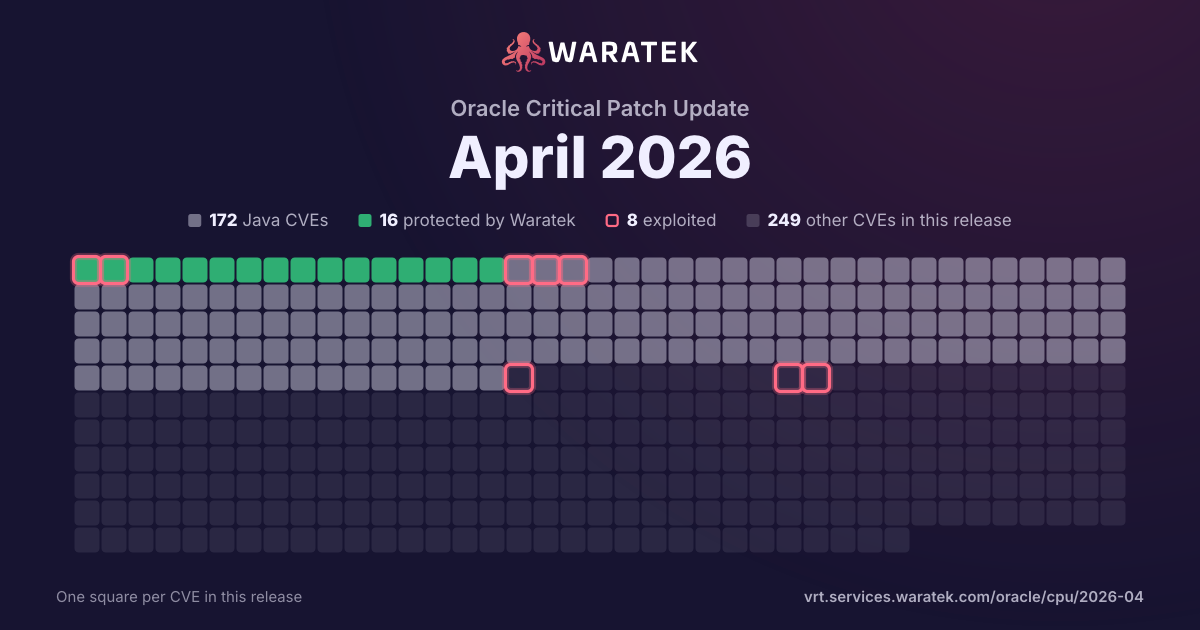
By status
16Protected by Waratek4Mitigation candidate152No exploit published10Outside Waratek scope239Not applicable
8Exploited, marked by the ring
No exploit published. For 51 of them, Oracle's security advisory is the source of public detail.
Protected by Waratek. Waratek RASP can block exploitation of these on systems that have not applied the patch yet.
Overview 3 matches · 0 exploited · 0 CISA KEV · 1 public PoC · 0 EPSS ≥ 0.5
Protected by Waratek
3
100.0%
Rule in development
0
0.0%
Mitigation candidate
0
0.0%
No exploit published
0
0.0%
blocked by ARMR today
3
100.0%
partly blocked
0
0.0%
not blocked
0
0.0%
not established
0
0.0%
unrecorded
0
0.0%
Exploited
0
0.0%
Working exploit published
1
33.3%
Proof of concept only
1
33.3%
Forecast only
0
0.0%
No public exploit
1
33.3%
split by
peak 1 / quarter
Q4 201
Protected by Waratek1
Medium1
blocked by ARMR today1
No public exploit1
Q1 210
Q2 210
Q3 210
Q4 210
Q1 220
Q2 220
Q3 220
Q4 220
Q1 230
Q2 230
Q3 230
Q4 230
Q1 240
Q2 240
Q3 240
Q4 240
Q1 250
Q2 250
Q3 251
Protected by Waratek1
Medium1
blocked by ARMR today1
Working exploit published1
Q4 251
Protected by Waratek1
Medium1
blocked by ARMR today1
Proof of concept only1
Q4 20Q2 21Q4 21Q2 22Q4 22Q2 23Q4 23Q2 24Q4 24Q2 25Q4 25
| CVE | Severity | Published▾ | Status | Exploitation | Description |
|---|---|---|---|---|---|
| CVE-2025-59419 | Medium | 2025-10-15 | Protected by Waratek | Proof of concept only | Netty is an asynchronous, event-driven network application framework. In versions prior to 4.1.128.Final and 4.2.7.Final, the SMTP codec in Netty contains an SMTP command injection vulnerability due to insufficient input validation for Carriage Return (\r) and Line Feed (\n) characters in user-supplied parameters. The vulnerability exists in io.netty.handler.codec.smtp.DefaultSmtpRequest, where parameters are directly concatenated into the SMTP command string without sanitization. When methods such as SmtpRequests.rcpt(recipient) are called with a malicious string containing CRLF sequences, attackers can inject arbitrary SMTP commands. Because the injected commands are sent from the server's trusted IP address, resulting emails will likely pass SPF and DKIM authentication checks, making them appear legitimate. This allows remote attackers who can control SMTP command parameters (such as email recipients) to forge arbitrary emails from the trusted server, potentially impersonating executives and forging high-stakes corporate communications. This issue has been patched in versions 4.1.129.Final and 4.2.8.Final. No known workarounds exist. |
| CVE-2025-41242 | Medium | 2025-08-18 | Protected by Waratek | Working exploit published | Spring Framework MVC applications can be vulnerable to a “Path Traversal Vulnerability” when deployed on a non-compliant Servlet container. An application can be vulnerable when all the following are true: * the application is deployed as a WAR or with an embedded Servlet container * the Servlet container does not reject suspicious sequences https://jakarta.ee/specifications/servlet/6.1/jakarta-servlet-spec-6.1.html#uri-path-canonicalization * the application serves static resources https://docs.spring.io/spring-framework/reference/web/webmvc/mvc-config/static-resources.html#page-title with Spring resource handling We have verified that applications deployed on Apache Tomcat or Eclipse Jetty are not vulnerable, as long as default security features are not disabled in the configuration. Because we cannot check exploits against all Servlet containers and configuration variants, we strongly recommend upgrading your application. |
| CVE-2020-17521 | Medium | 2020-12-07 | Protected by Waratek | No public exploit | Apache Groovy provides extension methods to aid with creating temporary directories. Prior to this fix, Groovy's implementation of those extension methods was using a now superseded Java JDK method call that is potentially not secure on some operating systems in some contexts. Users not using the extension methods mentioned in the advisory are not affected, but may wish to read the advisory for further details. Versions Affected: 2.0 to 2.4.20, 2.5.0 to 2.5.13, 3.0.0 to 3.0.6, and 4.0.0-alpha-1. Fixed in versions 2.4.21, 2.5.14, 3.0.7, 4.0.0-alpha-2. |