
Oracle Critical Patch Update April 2026
Released April 2026 · Oracle's advisory ↗ · ← Critical Patch Update, January 2026 · Security Patch Update, May 2026 →
421 CVEs in this release, one square each
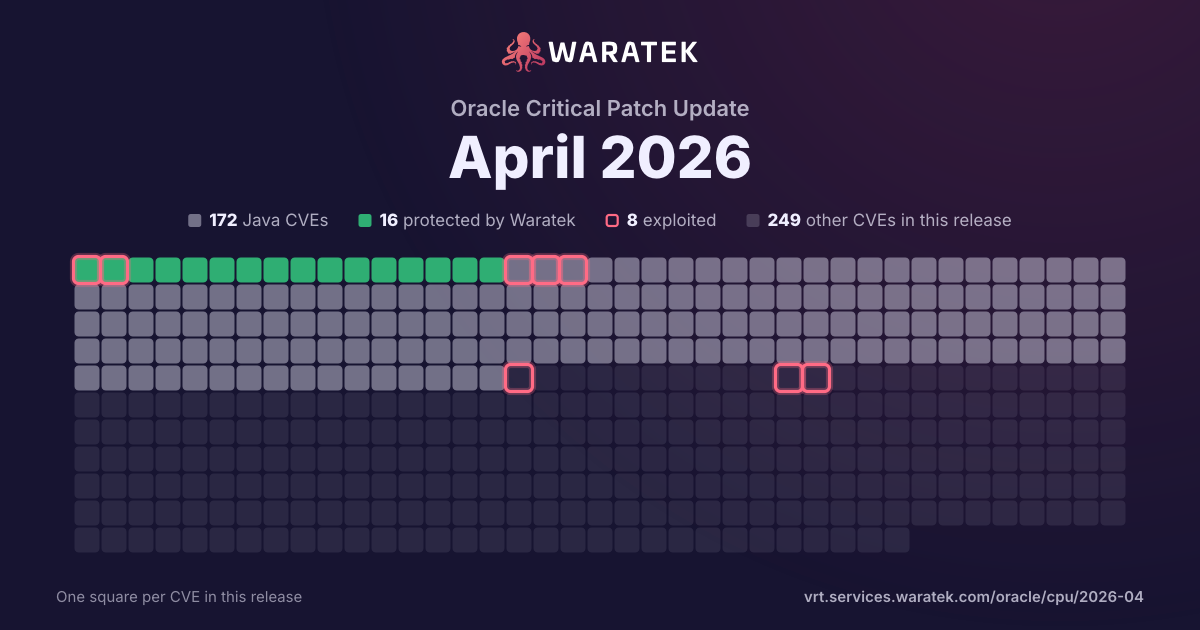
By status
16Protected by Waratek4Mitigation candidate152No exploit published10Outside Waratek scope239Not applicable
8Exploited, marked by the ring
No exploit published. For 51 of them, Oracle's security advisory is the source of public detail.
Protected by Waratek. Waratek RASP can block exploitation of these on systems that have not applied the patch yet.
Overview 187 matches · 75 in Waratek scope · 3 protected · 3 exploited · 0 CISA KEV · 4 public PoC · 2 EPSS ≥ 0.5
187matches
75in Waratek scope40.1%
3protected1.6%
3exploited1.6%
0CISA KEV0.0%
4public PoC2.1%
2EPSS ≥ 0.51.1%
Protected by Waratek
3
1.6%
Rule in development
0
0.0%
Mitigation candidate
2
1.1%
No exploit published
70
37.4%
Outside Waratek scope
4
2.1%
Not applicable
108
57.8%
Withdrawn CVE
0
0.0%
blocked by ARMR today
3
1.6%
partly blocked
0
0.0%
not blocked
184
98.4%
not established
0
0.0%
unrecorded
0
0.0%
split by
peak 67 / quarter
Q4 201
Protected by Waratek1
Medium1
blocked by ARMR today1
No public exploit1
Q1 210
Q2 211
No exploit published1
Medium1
not blocked1
No public exploit1
Q3 210
Q4 210
Q1 220
Q2 220
Q3 220
Q4 220
Q1 230
Q2 233
No exploit published3
Medium3
not blocked3
No public exploit3
Q3 230
Q4 232
No exploit published1
Outside Waratek scope1
Medium2
not blocked2
Exploited1
Proof of concept only1
Q1 243
No exploit published2
Not applicable1
Medium3
not blocked3
Proof of concept only1
No public exploit2
Q2 242
No exploit published1
Not applicable1
Medium2
not blocked2
Proof of concept only1
No public exploit1
Q3 240
Q4 244
No exploit published3
Outside Waratek scope1
Medium4
not blocked4
Proof of concept only2
No public exploit2
Q1 253
Mitigation candidate1
No exploit published1
Not applicable1
Medium3
not blocked3
Exploited1
Proof of concept only2
Q2 257
No exploit published3
Not applicable4
Medium7
not blocked7
Proof of concept only2
No public exploit5
Q3 2525
Protected by Waratek1
Mitigation candidate1
No exploit published9
Not applicable14
Medium25
blocked by ARMR today1
not blocked24
Exploited1
Working exploit published1
Proof of concept only5
No public exploit18
Q4 2526
Protected by Waratek1
No exploit published9
Not applicable16
Medium26
blocked by ARMR today1
not blocked25
Proof of concept only3
No public exploit23
Q1 2643
No exploit published4
Not applicable39
Medium43
not blocked43
Proof of concept only3
No public exploit40
Q2 2667
No exploit published33
Outside Waratek scope2
Not applicable32
Medium67
not blocked67
Proof of concept only1
No public exploit66
Q4 20Q2 21Q4 21Q2 22Q4 22Q2 23Q4 23Q2 24Q4 24Q2 25Q4 25Q2 26
| CVE | Severity | Published▾ | Status | Exploitation | Description |
|---|---|---|---|---|---|
| CVE-2026-35252 | Medium | 2026-04-21 | No exploit published | No public exploit | Vulnerability in the Oracle Security Service product of Oracle Fusion Middleware (component: C Oracle SSL API). Supported versions that are affected are 12.2.1.4.0 and 12.1.3.0.0. Difficult to exploit vulnerability allows low privileged attacker with network access via HTTPS to compromise Oracle Security Service. Successful attacks require human interaction from a person other than the attacker. Successful attacks of this vulnerability can result in unauthorized creation, deletion or modification access to critical data or all Oracle Security Service accessible data as well as unauthorized access to critical data or complete access to all Oracle Security Service accessible data. CVSS 3.1 Base Score 6.4 (Confidentiality and Integrity impacts). CVSS Vector: (CVSS:3.1/AV:N/AC:H/PR:L/UI:R/S:U/C:H/I:H/A:N). |
| CVE-2026-35248 | Medium | 2026-04-21 | Not applicable | No public exploit | Vulnerability in the Oracle VM VirtualBox product of Oracle Virtualization (component: Core). The supported version that is affected is 7.2.6. Difficult to exploit vulnerability allows high privileged attacker with logon to the infrastructure where Oracle VM VirtualBox executes to compromise Oracle VM VirtualBox. While the vulnerability is in Oracle VM VirtualBox, attacks may significantly impact additional products (scope change). Successful attacks of this vulnerability can result in unauthorized update, insert or delete access to some of Oracle VM VirtualBox accessible data as well as unauthorized read access to a subset of Oracle VM VirtualBox accessible data and unauthorized ability to cause a partial denial of service (partial DOS) of Oracle VM VirtualBox. CVSS 3.1 Base Score 5.0 (Confidentiality, Integrity and Availability impacts). CVSS Vector: (CVSS:3.1/AV:L/AC:H/PR:H/UI:N/S:C/C:L/I:L/A:L). |
| CVE-2026-35247 | Medium | 2026-04-21 | Not applicable | No public exploit | Vulnerability in the Oracle VM VirtualBox product of Oracle Virtualization (component: Core). The supported version that is affected is 7.2.6. Easily exploitable vulnerability allows high privileged attacker with logon to the infrastructure where Oracle VM VirtualBox executes to compromise Oracle VM VirtualBox. While the vulnerability is in Oracle VM VirtualBox, attacks may significantly impact additional products (scope change). Successful attacks of this vulnerability can result in unauthorized access to critical data or complete access to all Oracle VM VirtualBox accessible data. CVSS 3.1 Base Score 6.0 (Confidentiality impacts). CVSS Vector: (CVSS:3.1/AV:L/AC:L/PR:H/UI:N/S:C/C:H/I:N/A:N). |
| CVE-2026-35244 | Medium | 2026-04-21 | No exploit published | No public exploit | Vulnerability in the Oracle Hyperion Infrastructure Technology product of Oracle Hyperion (component: Lifecycle Management). The supported version that is affected is 11.2.24.0.000. Easily exploitable vulnerability allows high privileged attacker with network access via HTTP to compromise Oracle Hyperion Infrastructure Technology. Successful attacks require human interaction from a person other than the attacker. Successful attacks of this vulnerability can result in unauthorized creation, deletion or modification access to critical data or all Oracle Hyperion Infrastructure Technology accessible data as well as unauthorized read access to a subset of Oracle Hyperion Infrastructure Technology accessible data. CVSS 3.1 Base Score 5.2 (Confidentiality and Integrity impacts). CVSS Vector: (CVSS:3.1/AV:N/AC:L/PR:H/UI:R/S:U/C:L/I:H/A:N). |
| CVE-2026-35241 | Medium | 2026-04-21 | No exploit published | No public exploit | Vulnerability in the PeopleSoft Enterprise CS Student Records product of Oracle PeopleSoft (component: Research Tracking). The supported version that is affected is 9.2. Easily exploitable vulnerability allows low privileged attacker with network access via HTTP to compromise PeopleSoft Enterprise CS Student Records. Successful attacks require human interaction from a person other than the attacker. Successful attacks of this vulnerability can result in unauthorized access to critical data or complete access to all PeopleSoft Enterprise CS Student Records accessible data. CVSS 3.1 Base Score 5.7 (Confidentiality impacts). CVSS Vector: (CVSS:3.1/AV:N/AC:L/PR:L/UI:R/S:U/C:H/I:N/A:N). |
| CVE-2026-35240 | Medium | 2026-04-21 | Not applicable | No public exploit | Vulnerability in the MySQL Server product of Oracle MySQL (component: Server: Optimizer). Supported versions that are affected are 8.0.0-8.0.45, 8.4.0-8.4.8 and 9.0.0-9.6.0. Easily exploitable vulnerability allows high privileged attacker with network access via multiple protocols to compromise MySQL Server. Successful attacks of this vulnerability can result in unauthorized ability to cause a hang or frequently repeatable crash (complete DOS) of MySQL Server. CVSS 3.1 Base Score 4.9 (Availability impacts). CVSS Vector: (CVSS:3.1/AV:N/AC:L/PR:H/UI:N/S:U/C:N/I:N/A:H). |
| CVE-2026-35239 | Medium | 2026-04-21 | Not applicable | No public exploit | Vulnerability in the MySQL Server product of Oracle MySQL (component: Server: DML). Supported versions that are affected are 8.0.0-8.0.45, 8.4.0-8.4.8 and 9.0.0-9.6.0. Easily exploitable vulnerability allows high privileged attacker with network access via multiple protocols to compromise MySQL Server. Successful attacks of this vulnerability can result in unauthorized ability to cause a hang or frequently repeatable crash (complete DOS) of MySQL Server. CVSS 3.1 Base Score 4.9 (Availability impacts). CVSS Vector: (CVSS:3.1/AV:N/AC:L/PR:H/UI:N/S:U/C:N/I:N/A:H). |
| CVE-2026-35238 | Medium | 2026-04-21 | Not applicable | No public exploit | Vulnerability in the MySQL Server product of Oracle MySQL (component: InnoDB). Supported versions that are affected are 8.0.0-8.0.45, 8.4.0-8.4.8 and 9.0.0-9.6.0. Easily exploitable vulnerability allows high privileged attacker with network access via multiple protocols to compromise MySQL Server. Successful attacks of this vulnerability can result in unauthorized ability to cause a hang or frequently repeatable crash (complete DOS) of MySQL Server. CVSS 3.1 Base Score 4.9 (Availability impacts). CVSS Vector: (CVSS:3.1/AV:N/AC:L/PR:H/UI:N/S:U/C:N/I:N/A:H). |
| CVE-2026-35237 | Medium | 2026-04-21 | Not applicable | No public exploit | Vulnerability in the MySQL Server product of Oracle MySQL (component: InnoDB). Supported versions that are affected are 8.0.0-8.0.45, 8.4.0-8.4.8 and 9.0.0-9.6.0. Easily exploitable vulnerability allows high privileged attacker with network access via multiple protocols to compromise MySQL Server. Successful attacks of this vulnerability can result in unauthorized ability to cause a hang or frequently repeatable crash (complete DOS) of MySQL Server. CVSS 3.1 Base Score 4.9 (Availability impacts). CVSS Vector: (CVSS:3.1/AV:N/AC:L/PR:H/UI:N/S:U/C:N/I:N/A:H). |
| CVE-2026-35236 | Medium | 2026-04-21 | Not applicable | No public exploit | Vulnerability in the MySQL Server product of Oracle MySQL (component: InnoDB). Supported versions that are affected are 8.0.0-8.0.45, 8.4.0-8.4.8 and 9.0.0-9.6.0. Easily exploitable vulnerability allows high privileged attacker with network access via multiple protocols to compromise MySQL Server. Successful attacks of this vulnerability can result in unauthorized ability to cause a hang or frequently repeatable crash (complete DOS) of MySQL Server. CVSS 3.1 Base Score 4.9 (Availability impacts). CVSS Vector: (CVSS:3.1/AV:N/AC:L/PR:H/UI:N/S:U/C:N/I:N/A:H). |
| CVE-2026-35235 | Medium | 2026-04-21 | Not applicable | No public exploit | Vulnerability in the MySQL Server product of Oracle MySQL (component: Server: GIS). Supported versions that are affected are 9.0.0-9.6.0. Easily exploitable vulnerability allows high privileged attacker with network access via multiple protocols to compromise MySQL Server. Successful attacks of this vulnerability can result in unauthorized ability to cause a hang or frequently repeatable crash (complete DOS) of MySQL Server. CVSS 3.1 Base Score 4.9 (Availability impacts). CVSS Vector: (CVSS:3.1/AV:N/AC:L/PR:H/UI:N/S:U/C:N/I:N/A:H). |
| CVE-2026-35234 | Medium | 2026-04-21 | Not applicable | No public exploit | Vulnerability in the MySQL Server product of Oracle MySQL (component: Server: Partition). Supported versions that are affected are 9.0.0-9.6.0. Easily exploitable vulnerability allows high privileged attacker with network access via multiple protocols to compromise MySQL Server. Successful attacks of this vulnerability can result in unauthorized ability to cause a hang or frequently repeatable crash (complete DOS) of MySQL Server. CVSS 3.1 Base Score 4.9 (Availability impacts). CVSS Vector: (CVSS:3.1/AV:N/AC:L/PR:H/UI:N/S:U/C:N/I:N/A:H). |
| CVE-2026-35232 | Medium | 2026-04-21 | No exploit published | No public exploit | Vulnerability in Oracle Fusion Middleware (component: Dynamic Monitoring Service). Supported versions that are affected are 12.2.1.4.0 and 14.1.2.0.0. Easily exploitable vulnerability allows low privileged attacker with network access via HTTP to compromise Oracle Fusion Middleware. Successful attacks require human interaction from a person other than the attacker and while the vulnerability is in Oracle Fusion Middleware, attacks may significantly impact additional products (scope change). Successful attacks of this vulnerability can result in unauthorized update, insert or delete access to some of Oracle Fusion Middleware accessible data as well as unauthorized read access to a subset of Oracle Fusion Middleware accessible data. CVSS 3.1 Base Score 5.4 (Confidentiality and Integrity impacts). CVSS Vector: (CVSS:3.1/AV:N/AC:L/PR:L/UI:R/S:C/C:L/I:L/A:N). |
| CVE-2026-34325 | Medium | 2026-04-21 | No exploit published | No public exploit | Vulnerability in the Oracle Financial Services Analytical Applications Infrastructure product of Oracle Financial Services Applications (component: User Interface). Supported versions that are affected are 8.0.7.9, 8.0.8.7 and 8.1.2.5. Easily exploitable vulnerability allows low privileged attacker with logon to the infrastructure where Oracle Financial Services Analytical Applications Infrastructure executes to compromise Oracle Financial Services Analytical Applications Infrastructure. Successful attacks require human interaction from a person other than the attacker. Successful attacks of this vulnerability can result in unauthorized access to critical data or complete access to all Oracle Financial Services Analytical Applications Infrastructure accessible data as well as unauthorized update, insert or delete access to some of Oracle Financial Services Analytical Applications Infrastructure accessible data and unauthorized ability to cause a hang or frequently repeatable crash (complete DOS) of Oracle Financial Services Analytical Applications Infrastructure. CVSS 3.1 Base Score 6.8 (Confidentiality, Integrity and Availability impacts). CVSS Vector: (CVSS:3.1/AV:L/AC:L/PR:L/UI:R/S:U/C:H/I:L/A:H). |
| CVE-2026-34324 | Medium | 2026-04-21 | No exploit published | No public exploit | Vulnerability in the Oracle Life Sciences InForm product of Oracle Life Science Applications (component: App Server). Supported versions that are affected are 7.0.1.0 and 7.0.1.1. Easily exploitable vulnerability allows unauthenticated attacker with network access via HTTP to compromise Oracle Life Sciences InForm. Successful attacks of this vulnerability can result in unauthorized update, insert or delete access to some of Oracle Life Sciences InForm accessible data as well as unauthorized read access to a subset of Oracle Life Sciences InForm accessible data. CVSS 3.1 Base Score 6.5 (Confidentiality and Integrity impacts). CVSS Vector: (CVSS:3.1/AV:N/AC:L/PR:N/UI:N/S:U/C:L/I:L/A:N). |
| CVE-2026-34323 | Medium | 2026-04-21 | No exploit published | No public exploit | Vulnerability in the Oracle Life Sciences InForm product of Oracle Life Science Applications (component: IDM Authentication). Supported versions that are affected are 7.0.1.0 and 7.0.1.1. Easily exploitable vulnerability allows unauthenticated attacker with network access via HTTP to compromise Oracle Life Sciences InForm. Successful attacks require human interaction from a person other than the attacker. Successful attacks of this vulnerability can result in unauthorized update, insert or delete access to some of Oracle Life Sciences InForm accessible data as well as unauthorized read access to a subset of Oracle Life Sciences InForm accessible data and unauthorized ability to cause a partial denial of service (partial DOS) of Oracle Life Sciences InForm. CVSS 3.1 Base Score 6.3 (Confidentiality, Integrity and Availability impacts). CVSS Vector: (CVSS:3.1/AV:N/AC:L/PR:N/UI:R/S:U/C:L/I:L/A:L). |
| CVE-2026-34321 | Medium | 2026-04-21 | No exploit published | No public exploit | Vulnerability in the Oracle Financial Services Analytical Applications Infrastructure product of Oracle Financial Services Applications (component: User Interface). Supported versions that are affected are 8.0.7.9, 8.0.8.7 and 8.1.2.5. Difficult to exploit vulnerability allows low privileged attacker with network access via HTTP to compromise Oracle Financial Services Analytical Applications Infrastructure. Successful attacks require human interaction from a person other than the attacker. Successful attacks of this vulnerability can result in unauthorized access to critical data or complete access to all Oracle Financial Services Analytical Applications Infrastructure accessible data. CVSS 3.1 Base Score 4.8 (Confidentiality impacts). CVSS Vector: (CVSS:3.1/AV:N/AC:H/PR:L/UI:R/S:U/C:H/I:N/A:N). |
| CVE-2026-34319 | Medium | 2026-04-21 | Not applicable | No public exploit | Vulnerability in the MySQL Shell product of Oracle MySQL (component: Shell: Core Client). Supported versions that are affected are 8.0.0-8.0.45, 8.4.0-8.4.8 and 9.0.0-9.6.0. Easily exploitable vulnerability allows low privileged attacker with logon to the infrastructure where MySQL Shell executes to compromise MySQL Shell. Successful attacks require human interaction from a person other than the attacker. Successful attacks of this vulnerability can result in unauthorized ability to cause a hang or frequently repeatable crash (complete DOS) of MySQL Shell. CVSS 3.1 Base Score 5.0 (Availability impacts). CVSS Vector: (CVSS:3.1/AV:L/AC:L/PR:L/UI:R/S:U/C:N/I:N/A:H). |
| CVE-2026-34318 | Medium | 2026-04-21 | Not applicable | No public exploit | Vulnerability in the MySQL Shell product of Oracle MySQL (component: Shell: Core Client). Supported versions that are affected are 8.0.0-8.0.45, 8.4.0-8.4.8 and 9.0.0-9.6.0. Difficult to exploit vulnerability allows high privileged attacker with network access via multiple protocols to compromise MySQL Shell. While the vulnerability is in MySQL Shell, attacks may significantly impact additional products (scope change). Successful attacks of this vulnerability can result in unauthorized access to critical data or complete access to all MySQL Shell accessible data. CVSS 3.1 Base Score 5.8 (Confidentiality impacts). CVSS Vector: (CVSS:3.1/AV:N/AC:H/PR:H/UI:N/S:C/C:H/I:N/A:N). |
| CVE-2026-34317 | Medium | 2026-04-21 | Not applicable | No public exploit | Vulnerability in the MySQL Shell product of Oracle MySQL (component: Shell: Core Client). Supported versions that are affected are 8.0.0-8.0.45, 8.4.0-8.4.8 and 9.0.0-9.6.0. Easily exploitable vulnerability allows low privileged attacker with logon to the infrastructure where MySQL Shell executes to compromise MySQL Shell. Successful attacks require human interaction from a person other than the attacker. Successful attacks of this vulnerability can result in unauthorized ability to cause a hang or frequently repeatable crash (complete DOS) of MySQL Shell. CVSS 3.1 Base Score 5.0 (Availability impacts). CVSS Vector: (CVSS:3.1/AV:L/AC:L/PR:L/UI:R/S:U/C:N/I:N/A:H). |
| CVE-2026-34315 | Medium | 2026-04-21 | No exploit published | No public exploit | Vulnerability in the Oracle WebLogic Server product of Oracle Fusion Middleware (component: Web Services). Supported versions that are affected are 12.2.1.4.0, 14.1.1.0.0, 14.1.2.0.0 and 15.1.1.0.0. Easily exploitable vulnerability allows unauthenticated attacker with network access via HTTP to compromise Oracle WebLogic Server. Successful attacks require human interaction from a person other than the attacker. Successful attacks of this vulnerability can result in unauthorized creation, deletion or modification access to critical data or all Oracle WebLogic Server accessible data. CVSS 3.1 Base Score 6.5 (Integrity impacts). CVSS Vector: (CVSS:3.1/AV:N/AC:L/PR:N/UI:R/S:U/C:N/I:H/A:N). |
| CVE-2026-34314 | Medium | 2026-04-21 | No exploit published | No public exploit | Vulnerability in the Oracle Financial Services Analytical Applications Infrastructure product of Oracle Financial Services Applications (component: Platform). Supported versions that are affected are 8.0.7.9, 8.0.8.7 and 8.1.2.5. Difficult to exploit vulnerability allows low privileged attacker with network access via HTTP to compromise Oracle Financial Services Analytical Applications Infrastructure. Successful attacks of this vulnerability can result in unauthorized creation, deletion or modification access to critical data or all Oracle Financial Services Analytical Applications Infrastructure accessible data as well as unauthorized access to critical data or complete access to all Oracle Financial Services Analytical Applications Infrastructure accessible data. CVSS 3.1 Base Score 6.8 (Confidentiality and Integrity impacts). CVSS Vector: (CVSS:3.1/AV:N/AC:H/PR:L/UI:N/S:U/C:H/I:H/A:N). |
| CVE-2026-34313 | Medium | 2026-04-21 | No exploit published | No public exploit | Vulnerability in the Oracle Financial Services Analytical Applications Infrastructure product of Oracle Financial Services Applications (component: Platform). Supported versions that are affected are 8.0.7.9, 8.0.8.7 and 8.1.2.5. Easily exploitable vulnerability allows low privileged attacker with network access via HTTP to compromise Oracle Financial Services Analytical Applications Infrastructure. Successful attacks of this vulnerability can result in unauthorized access to critical data or complete access to all Oracle Financial Services Analytical Applications Infrastructure accessible data. CVSS 3.1 Base Score 6.5 (Confidentiality impacts). CVSS Vector: (CVSS:3.1/AV:N/AC:L/PR:L/UI:N/S:U/C:H/I:N/A:N). |
| CVE-2026-34308 | Medium | 2026-04-21 | Not applicable | No public exploit | Vulnerability in the MySQL Server product of Oracle MySQL (component: Server: JSON). Supported versions that are affected are 8.0.0-8.0.45, 8.4.0-8.4.8 and 9.0.0-9.6.0. Easily exploitable vulnerability allows low privileged attacker with network access via multiple protocols to compromise MySQL Server. Successful attacks of this vulnerability can result in unauthorized ability to cause a hang or frequently repeatable crash (complete DOS) of MySQL Server. CVSS 3.1 Base Score 6.5 (Availability impacts). CVSS Vector: (CVSS:3.1/AV:N/AC:L/PR:L/UI:N/S:U/C:N/I:N/A:H). |
| CVE-2026-34307 | Medium | 2026-04-21 | No exploit published | No public exploit | Vulnerability in the PeopleSoft Enterprise PeopleTools product of Oracle PeopleSoft (component: Workflow). Supported versions that are affected are 8.61-8.62. Easily exploitable vulnerability allows low privileged attacker with network access via HTTP to compromise PeopleSoft Enterprise PeopleTools. Successful attacks require human interaction from a person other than the attacker and while the vulnerability is in PeopleSoft Enterprise PeopleTools, attacks may significantly impact additional products (scope change). Successful attacks of this vulnerability can result in unauthorized update, insert or delete access to some of PeopleSoft Enterprise PeopleTools accessible data as well as unauthorized read access to a subset of PeopleSoft Enterprise PeopleTools accessible data. CVSS 3.1 Base Score 5.4 (Confidentiality and Integrity impacts). CVSS Vector: (CVSS:3.1/AV:N/AC:L/PR:L/UI:R/S:C/C:L/I:L/A:N). |
| CVE-2026-34306 | Medium | 2026-04-21 | No exploit published | No public exploit | Vulnerability in the PeopleSoft Enterprise FIN Project Costing product of Oracle PeopleSoft (component: Projects). The supported version that is affected is 9.2. Easily exploitable vulnerability allows low privileged attacker with network access via HTTP to compromise PeopleSoft Enterprise FIN Project Costing. Successful attacks of this vulnerability can result in unauthorized access to critical data or complete access to all PeopleSoft Enterprise FIN Project Costing accessible data. CVSS 3.1 Base Score 6.5 (Confidentiality impacts). CVSS Vector: (CVSS:3.1/AV:N/AC:L/PR:L/UI:N/S:U/C:H/I:N/A:N). |
| CVE-2026-34304 | Medium | 2026-04-21 | Not applicable | Proof of concept only | Vulnerability in the MySQL Server product of Oracle MySQL (component: InnoDB). Supported versions that are affected are 8.0.0-8.0.45, 8.4.0-8.4.8 and 9.0.0-9.6.0. Easily exploitable vulnerability allows high privileged attacker with network access via multiple protocols to compromise MySQL Server. Successful attacks of this vulnerability can result in unauthorized ability to cause a hang or frequently repeatable crash (complete DOS) of MySQL Server. CVSS 3.1 Base Score 4.9 (Availability impacts). CVSS Vector: (CVSS:3.1/AV:N/AC:L/PR:H/UI:N/S:U/C:N/I:N/A:H). |
| CVE-2026-34303 | Medium | 2026-04-21 | Not applicable | No public exploit | Vulnerability in the MySQL Server product of Oracle MySQL (component: Server: Optimizer). Supported versions that are affected are 8.0.0-8.0.45, 8.4.0-8.4.8 and 9.0.0-9.6.0. Easily exploitable vulnerability allows low privileged attacker with network access via multiple protocols to compromise MySQL Server. Successful attacks of this vulnerability can result in unauthorized ability to cause a hang or frequently repeatable crash (complete DOS) of MySQL Server. CVSS 3.1 Base Score 6.5 (Availability impacts). CVSS Vector: (CVSS:3.1/AV:N/AC:L/PR:L/UI:N/S:U/C:N/I:N/A:H). |
| CVE-2026-34302 | Medium | 2026-04-21 | No exploit published | No public exploit | Vulnerability in the Oracle Workflow product of Oracle E-Business Suite (component: Workflow Loader). Supported versions that are affected are 12.2.3-12.2.15. Easily exploitable vulnerability allows high privileged attacker with network access via HTTP to compromise Oracle Workflow. While the vulnerability is in Oracle Workflow, attacks may significantly impact additional products (scope change). Successful attacks of this vulnerability can result in unauthorized update, insert or delete access to some of Oracle Workflow accessible data and unauthorized ability to cause a partial denial of service (partial DOS) of Oracle Workflow. CVSS 3.1 Base Score 5.5 (Integrity and Availability impacts). CVSS Vector: (CVSS:3.1/AV:N/AC:L/PR:H/UI:N/S:C/C:N/I:L/A:L). |
| CVE-2026-34301 | Medium | 2026-04-21 | No exploit published | No public exploit | Vulnerability in the PeopleSoft Enterprise FIN Maintenance Management product of Oracle PeopleSoft (component: Work Order Management). The supported version that is affected is 9.2. Easily exploitable vulnerability allows low privileged attacker with network access via HTTP to compromise PeopleSoft Enterprise FIN Maintenance Management. Successful attacks of this vulnerability can result in unauthorized access to critical data or complete access to all PeopleSoft Enterprise FIN Maintenance Management accessible data. CVSS 3.1 Base Score 6.5 (Confidentiality impacts). CVSS Vector: (CVSS:3.1/AV:N/AC:L/PR:L/UI:N/S:U/C:H/I:N/A:N). |
| CVE-2026-34300 | Medium | 2026-04-21 | No exploit published | No public exploit | Vulnerability in the PeopleSoft Enterprise FIN Contracts product of Oracle PeopleSoft (component: Contracts). The supported version that is affected is 9.2. Easily exploitable vulnerability allows low privileged attacker with network access via HTTP to compromise PeopleSoft Enterprise FIN Contracts. Successful attacks of this vulnerability can result in unauthorized access to critical data or complete access to all PeopleSoft Enterprise FIN Contracts accessible data. CVSS 3.1 Base Score 6.5 (Confidentiality impacts). CVSS Vector: (CVSS:3.1/AV:N/AC:L/PR:L/UI:N/S:U/C:H/I:N/A:N). |
| CVE-2026-34299 | Medium | 2026-04-21 | No exploit published | No public exploit | Vulnerability in the PeopleSoft Enterprise FIN Maintenance Management product of Oracle PeopleSoft (component: Work Order Management). The supported version that is affected is 9.2. Easily exploitable vulnerability allows low privileged attacker with network access via HTTP to compromise PeopleSoft Enterprise FIN Maintenance Management. Successful attacks of this vulnerability can result in unauthorized access to critical data or complete access to all PeopleSoft Enterprise FIN Maintenance Management accessible data. CVSS 3.1 Base Score 6.5 (Confidentiality impacts). CVSS Vector: (CVSS:3.1/AV:N/AC:L/PR:L/UI:N/S:U/C:H/I:N/A:N). |
| CVE-2026-34298 | Medium | 2026-04-21 | No exploit published | No public exploit | Vulnerability in the Oracle Applications Framework product of Oracle E-Business Suite (component: Personalization). Supported versions that are affected are 12.2.9-12.2.15. Easily exploitable vulnerability allows high privileged attacker with network access via HTTP to compromise Oracle Applications Framework. Successful attacks of this vulnerability can result in unauthorized update, insert or delete access to some of Oracle Applications Framework accessible data as well as unauthorized read access to a subset of Oracle Applications Framework accessible data and unauthorized ability to cause a partial denial of service (partial DOS) of Oracle Applications Framework. CVSS 3.1 Base Score 4.7 (Confidentiality, Integrity and Availability impacts). CVSS Vector: (CVSS:3.1/AV:N/AC:L/PR:H/UI:N/S:U/C:L/I:L/A:L). |
| CVE-2026-34296 | Medium | 2026-04-21 | No exploit published | No public exploit | Vulnerability in the Oracle Agile Product Lifecycle Management for Process product of Oracle Supply Chain (component: Product Quality Management). The supported version that is affected is 6.2.4. Easily exploitable vulnerability allows low privileged attacker with network access via HTTP to compromise Oracle Agile Product Lifecycle Management for Process. Successful attacks of this vulnerability can result in unauthorized read access to a subset of Oracle Agile Product Lifecycle Management for Process accessible data. CVSS 3.1 Base Score 4.3 (Confidentiality impacts). CVSS Vector: (CVSS:3.1/AV:N/AC:L/PR:L/UI:N/S:U/C:L/I:N/A:N). |
| CVE-2026-34295 | Medium | 2026-04-21 | No exploit published | No public exploit | Vulnerability in the PeopleSoft Enterprise SCM Purchasing product of Oracle PeopleSoft (component: Purchasing). The supported version that is affected is 9.2. Easily exploitable vulnerability allows low privileged attacker with network access via HTTP to compromise PeopleSoft Enterprise SCM Purchasing. Successful attacks of this vulnerability can result in unauthorized access to critical data or complete access to all PeopleSoft Enterprise SCM Purchasing accessible data. CVSS 3.1 Base Score 6.5 (Confidentiality impacts). CVSS Vector: (CVSS:3.1/AV:N/AC:L/PR:L/UI:N/S:U/C:H/I:N/A:N). |
| CVE-2026-34294 | Medium | 2026-04-21 | No exploit published | No public exploit | Vulnerability in the Oracle Identity Manager Connector product of Oracle Fusion Middleware (component: Microsoft Active Directory). The supported version that is affected is 12.2.1.4.0. Difficult to exploit vulnerability allows low privileged attacker with network access via LDAP to compromise Oracle Identity Manager Connector. Successful attacks of this vulnerability can result in unauthorized creation, deletion or modification access to critical data or all Oracle Identity Manager Connector accessible data as well as unauthorized read access to a subset of Oracle Identity Manager Connector accessible data. CVSS 3.1 Base Score 5.9 (Confidentiality and Integrity impacts). CVSS Vector: (CVSS:3.1/AV:N/AC:H/PR:L/UI:N/S:U/C:L/I:H/A:N). |
| CVE-2026-34293 | Medium | 2026-04-21 | Not applicable | No public exploit | Vulnerability in the MySQL Server product of Oracle MySQL (component: Server: DML). Supported versions that are affected are 8.0.0-8.0.45. Easily exploitable vulnerability allows high privileged attacker with network access via multiple protocols to compromise MySQL Server. Successful attacks of this vulnerability can result in unauthorized ability to cause a hang or frequently repeatable crash (complete DOS) of MySQL Server. CVSS 3.1 Base Score 4.9 (Availability impacts). CVSS Vector: (CVSS:3.1/AV:N/AC:L/PR:H/UI:N/S:U/C:N/I:N/A:H). |
| CVE-2026-34289 | Medium | 2026-04-21 | No exploit published | No public exploit | Vulnerability in the Oracle Identity Manager Connector product of Oracle Fusion Middleware (component: Core). The supported version that is affected is 12.2.1.4.0. Difficult to exploit vulnerability allows unauthenticated attacker with network access via HTTPS to compromise Oracle Identity Manager Connector. Successful attacks of this vulnerability can result in unauthorized access to critical data or complete access to all Oracle Identity Manager Connector accessible data. CVSS 3.1 Base Score 5.9 (Confidentiality impacts). CVSS Vector: (CVSS:3.1/AV:N/AC:H/PR:N/UI:N/S:U/C:H/I:N/A:N). |
| CVE-2026-34288 | Medium | 2026-04-21 | No exploit published | No public exploit | Vulnerability in the Oracle Identity Manager Connector product of Oracle Fusion Middleware (component: Core). The supported version that is affected is 12.2.1.4.0. Difficult to exploit vulnerability allows unauthenticated attacker with network access via HTTP to compromise Oracle Identity Manager Connector. Successful attacks of this vulnerability can result in unauthorized access to critical data or complete access to all Oracle Identity Manager Connector accessible data. CVSS 3.1 Base Score 5.9 (Confidentiality impacts). CVSS Vector: (CVSS:3.1/AV:N/AC:H/PR:N/UI:N/S:U/C:H/I:N/A:N). |
| CVE-2026-34284 | Medium | 2026-04-21 | No exploit published | No public exploit | Vulnerability in the Oracle Business Process Management Suite product of Oracle Fusion Middleware (component: Human workflow 11g+). Supported versions that are affected are 12.2.1.4.0 and 14.1.2.0.0. Easily exploitable vulnerability allows unauthenticated attacker with network access via HTTP to compromise Oracle Business Process Management Suite. Successful attacks require human interaction from a person other than the attacker and while the vulnerability is in Oracle Business Process Management Suite, attacks may significantly impact additional products (scope change). Successful attacks of this vulnerability can result in unauthorized update, insert or delete access to some of Oracle Business Process Management Suite accessible data as well as unauthorized read access to a subset of Oracle Business Process Management Suite accessible data. CVSS 3.1 Base Score 6.1 (Confidentiality and Integrity impacts). CVSS Vector: (CVSS:3.1/AV:N/AC:L/PR:N/UI:R/S:C/C:L/I:L/A:N). |
| CVE-2026-34283 | Medium | 2026-04-21 | No exploit published | No public exploit | Vulnerability in the Oracle Identity Manager product of Oracle Fusion Middleware (component: Identity Console). Supported versions that are affected are 12.2.1.4.0 and 14.1.2.0.0. Easily exploitable vulnerability allows unauthenticated attacker with network access via HTTP to compromise Oracle Identity Manager. Successful attacks require human interaction from a person other than the attacker and while the vulnerability is in Oracle Identity Manager, attacks may significantly impact additional products (scope change). Successful attacks of this vulnerability can result in unauthorized update, insert or delete access to some of Oracle Identity Manager accessible data as well as unauthorized read access to a subset of Oracle Identity Manager accessible data. CVSS 3.1 Base Score 6.1 (Confidentiality and Integrity impacts). CVSS Vector: (CVSS:3.1/AV:N/AC:L/PR:N/UI:R/S:C/C:L/I:L/A:N). |
| CVE-2026-34281 | Medium | 2026-04-21 | Not applicable | No public exploit | Vulnerability in the Oracle Solaris product of Oracle Systems (component: Kernel). The supported version that is affected is 11.4. Easily exploitable vulnerability allows low privileged attacker with logon to the infrastructure where Oracle Solaris executes to compromise Oracle Solaris. While the vulnerability is in Oracle Solaris, attacks may significantly impact additional products (scope change). Successful attacks of this vulnerability can result in unauthorized ability to cause a hang or frequently repeatable crash (complete DOS) of Oracle Solaris. CVSS 3.1 Base Score 6.5 (Availability impacts). CVSS Vector: (CVSS:3.1/AV:L/AC:L/PR:L/UI:N/S:C/C:N/I:N/A:H). |
| CVE-2026-34280 | Medium | 2026-04-21 | No exploit published | No public exploit | Vulnerability in the PeopleSoft Enterprise HCM Human Resources product of Oracle PeopleSoft (component: Job Profile Manager). The supported version that is affected is 9.2. Easily exploitable vulnerability allows high privileged attacker with network access via HTTP to compromise PeopleSoft Enterprise HCM Human Resources. Successful attacks of this vulnerability can result in unauthorized creation, deletion or modification access to critical data or all PeopleSoft Enterprise HCM Human Resources accessible data as well as unauthorized access to critical data or complete access to all PeopleSoft Enterprise HCM Human Resources accessible data. CVSS 3.1 Base Score 6.5 (Confidentiality and Integrity impacts). CVSS Vector: (CVSS:3.1/AV:N/AC:L/PR:H/UI:N/S:U/C:H/I:H/A:N). |
| CVE-2026-34278 | Medium | 2026-04-21 | Not applicable | No public exploit | Vulnerability in the MySQL Server product of Oracle MySQL (component: Server: Optimizer). Supported versions that are affected are 8.0.0-8.0.45. Easily exploitable vulnerability allows high privileged attacker with network access via multiple protocols to compromise MySQL Server. Successful attacks of this vulnerability can result in unauthorized ability to cause a hang or frequently repeatable crash (complete DOS) of MySQL Server. CVSS 3.1 Base Score 4.9 (Availability impacts). CVSS Vector: (CVSS:3.1/AV:N/AC:L/PR:H/UI:N/S:U/C:N/I:N/A:H). |
| CVE-2026-34277 | Medium | 2026-04-21 | No exploit published | No public exploit | Vulnerability in the PeopleSoft Enterprise PeopleTools product of Oracle PeopleSoft (component: Fluid Core). Supported versions that are affected are 8.61-8.62. Easily exploitable vulnerability allows high privileged attacker with network access via HTTP to compromise PeopleSoft Enterprise PeopleTools. While the vulnerability is in PeopleSoft Enterprise PeopleTools, attacks may significantly impact additional products (scope change). Successful attacks of this vulnerability can result in unauthorized update, insert or delete access to some of PeopleSoft Enterprise PeopleTools accessible data as well as unauthorized read access to a subset of PeopleSoft Enterprise PeopleTools accessible data and unauthorized ability to cause a partial denial of service (partial DOS) of PeopleSoft Enterprise PeopleTools. CVSS 3.1 Base Score 6.6 (Confidentiality, Integrity and Availability impacts). CVSS Vector: (CVSS:3.1/AV:N/AC:L/PR:H/UI:N/S:C/C:L/I:L/A:L). |
| CVE-2026-34276 | Medium | 2026-04-21 | Not applicable | No public exploit | Vulnerability in the MySQL Server product of Oracle MySQL (component: Server: Group Replication Plugin). Supported versions that are affected are 8.0.0-8.0.45, 8.4.0-8.4.8 and 9.0.0-9.6.0. Easily exploitable vulnerability allows low privileged attacker with network access via multiple protocols to compromise MySQL Server. Successful attacks of this vulnerability can result in unauthorized ability to cause a hang or frequently repeatable crash (complete DOS) of MySQL Server. CVSS 3.1 Base Score 6.5 (Availability impacts). CVSS Vector: (CVSS:3.1/AV:N/AC:L/PR:L/UI:N/S:U/C:N/I:N/A:H). |
| CVE-2026-34274 | Medium | 2026-04-21 | No exploit published | No public exploit | Vulnerability in the Oracle Configurator product of Oracle E-Business Suite (component: User Interface). Supported versions that are affected are 12.2.3-12.2.15. Easily exploitable vulnerability allows unauthenticated attacker with network access via HTTP to compromise Oracle Configurator. Successful attacks require human interaction from a person other than the attacker and while the vulnerability is in Oracle Configurator, attacks may significantly impact additional products (scope change). Successful attacks of this vulnerability can result in unauthorized update, insert or delete access to some of Oracle Configurator accessible data as well as unauthorized read access to a subset of Oracle Configurator accessible data. CVSS 3.1 Base Score 6.1 (Confidentiality and Integrity impacts). CVSS Vector: (CVSS:3.1/AV:N/AC:L/PR:N/UI:R/S:C/C:L/I:L/A:N). |
| CVE-2026-34273 | Medium | 2026-04-21 | Not applicable | No public exploit | Vulnerability in Oracle GoldenGate (component: Libraries). Supported versions that are affected are 23.4-23.10. Easily exploitable vulnerability allows unauthenticated attacker with network access via HTTP to compromise Oracle GoldenGate. Successful attacks of this vulnerability can result in unauthorized read access to a subset of Oracle GoldenGate accessible data. CVSS 3.1 Base Score 5.3 (Confidentiality impacts). CVSS Vector: (CVSS:3.1/AV:N/AC:L/PR:N/UI:N/S:U/C:L/I:N/A:N). |
| CVE-2026-34272 | Medium | 2026-04-21 | Not applicable | No public exploit | Vulnerability in the MySQL Server product of Oracle MySQL (component: Server: Optimizer). Supported versions that are affected are 9.0.0-9.6.0. Easily exploitable vulnerability allows low privileged attacker with network access via multiple protocols to compromise MySQL Server. Successful attacks of this vulnerability can result in unauthorized ability to cause a hang or frequently repeatable crash (complete DOS) of MySQL Server. CVSS 3.1 Base Score 6.5 (Availability impacts). CVSS Vector: (CVSS:3.1/AV:N/AC:L/PR:L/UI:N/S:U/C:N/I:N/A:H). |
| CVE-2026-34271 | Medium | 2026-04-21 | Not applicable | No public exploit | Vulnerability in the MySQL Server product of Oracle MySQL (component: Server: Group Replication Plugin). Supported versions that are affected are 8.0.0-8.0.45, 8.4.0-8.4.8 and 9.0.0-9.6.0. Easily exploitable vulnerability allows low privileged attacker with network access via multiple protocols to compromise MySQL Server. Successful attacks of this vulnerability can result in unauthorized ability to cause a hang or frequently repeatable crash (complete DOS) of MySQL Server. CVSS 3.1 Base Score 6.5 (Availability impacts). CVSS Vector: (CVSS:3.1/AV:N/AC:L/PR:L/UI:N/S:U/C:N/I:N/A:H). |
| CVE-2026-34270 | Medium | 2026-04-21 | Not applicable | No public exploit | Vulnerability in the MySQL Server product of Oracle MySQL (component: Server: Group Replication Plugin). Supported versions that are affected are 8.0.0-8.0.45, 8.4.0-8.4.8 and 9.0.0-9.6.0. Easily exploitable vulnerability allows low privileged attacker with network access via multiple protocols to compromise MySQL Server. Successful attacks of this vulnerability can result in unauthorized ability to cause a hang or frequently repeatable crash (complete DOS) of MySQL Server. CVSS 3.1 Base Score 6.5 (Availability impacts). CVSS Vector: (CVSS:3.1/AV:N/AC:L/PR:L/UI:N/S:U/C:N/I:N/A:H). |
| CVE-2026-34269 | Medium | 2026-04-21 | No exploit published | No public exploit | Vulnerability in the PeopleSoft Enterprise PeopleTools product of Oracle PeopleSoft (component: Portal). Supported versions that are affected are 8.61-8.62. Easily exploitable vulnerability allows unauthenticated attacker with network access via HTTP to compromise PeopleSoft Enterprise PeopleTools. Successful attacks require human interaction from a person other than the attacker and while the vulnerability is in PeopleSoft Enterprise PeopleTools, attacks may significantly impact additional products (scope change). Successful attacks of this vulnerability can result in unauthorized update, insert or delete access to some of PeopleSoft Enterprise PeopleTools accessible data as well as unauthorized read access to a subset of PeopleSoft Enterprise PeopleTools accessible data. CVSS 3.1 Base Score 6.1 (Confidentiality and Integrity impacts). CVSS Vector: (CVSS:3.1/AV:N/AC:L/PR:N/UI:R/S:C/C:L/I:L/A:N). |
| CVE-2026-34267 | Medium | 2026-04-21 | Not applicable | No public exploit | Vulnerability in the MySQL Server product of Oracle MySQL (component: Server: Optimizer). Supported versions that are affected are 8.0.0-8.0.45. Easily exploitable vulnerability allows high privileged attacker with network access via multiple protocols to compromise MySQL Server. Successful attacks of this vulnerability can result in unauthorized ability to cause a hang or frequently repeatable crash (complete DOS) of MySQL Server. CVSS 3.1 Base Score 4.9 (Availability impacts). CVSS Vector: (CVSS:3.1/AV:N/AC:L/PR:H/UI:N/S:U/C:N/I:N/A:H). |
| CVE-2026-34266 | Medium | 2026-04-21 | No exploit published | No public exploit | Vulnerability in the PeopleSoft Enterprise HCM Absence Management product of Oracle PeopleSoft (component: Absence Management). The supported version that is affected is 9.2. Easily exploitable vulnerability allows high privileged attacker with network access via HTTP to compromise PeopleSoft Enterprise HCM Absence Management. Successful attacks of this vulnerability can result in unauthorized creation, deletion or modification access to critical data or all PeopleSoft Enterprise HCM Absence Management accessible data as well as unauthorized access to critical data or complete access to all PeopleSoft Enterprise HCM Absence Management accessible data. CVSS 3.1 Base Score 6.5 (Confidentiality and Integrity impacts). CVSS Vector: (CVSS:3.1/AV:N/AC:L/PR:H/UI:N/S:U/C:H/I:H/A:N). |
| CVE-2026-22021 | Medium | 2026-04-21 | No exploit published | No public exploit | Vulnerability in the Oracle Java SE, Oracle GraalVM for JDK, Oracle GraalVM Enterprise Edition product of Oracle Java SE (component: JSSE). Supported versions that are affected are Oracle Java SE: 8u481, 8u481-b50, 8u481-perf, 11.0.30, 17.0.18, 21.0.10, 25.0.2, 26; Oracle GraalVM for JDK: 17.0.18 and 21.0.10; Oracle GraalVM Enterprise Edition: 21.3.17. Easily exploitable vulnerability allows unauthenticated attacker with network access via HTTPS to compromise Oracle Java SE, Oracle GraalVM for JDK, Oracle GraalVM Enterprise Edition. Successful attacks of this vulnerability can result in unauthorized ability to cause a partial denial of service (partial DOS) of Oracle Java SE, Oracle GraalVM for JDK, Oracle GraalVM Enterprise Edition. Note: This vulnerability can be exploited by using APIs in the specified Component, e.g., through a web service which supplies data to the APIs. This vulnerability also applies to Java deployments, typically in clients running sandboxed Java Web Start applications or sandboxed Java applets, that load and run untrusted code (e.g., code that comes from the internet) and rely on the Java sandbox for security. CVSS 3.1 Base Score 5.3 (Availability impacts). CVSS Vector: (CVSS:3.1/AV:N/AC:L/PR:N/UI:N/S:U/C:N/I:N/A:L). |
| CVE-2026-22019 | Medium | 2026-04-21 | No exploit published | No public exploit | Vulnerability in the PeopleSoft Enterprise HCM Shared Components product of Oracle PeopleSoft (component: Person Search). The supported version that is affected is 9.2. Easily exploitable vulnerability allows low privileged attacker with network access via HTTP to compromise PeopleSoft Enterprise HCM Shared Components. Successful attacks require human interaction from a person other than the attacker and while the vulnerability is in PeopleSoft Enterprise HCM Shared Components, attacks may significantly impact additional products (scope change). Successful attacks of this vulnerability can result in unauthorized update, insert or delete access to some of PeopleSoft Enterprise HCM Shared Components accessible data as well as unauthorized read access to a subset of PeopleSoft Enterprise HCM Shared Components accessible data. CVSS 3.1 Base Score 5.4 (Confidentiality and Integrity impacts). CVSS Vector: (CVSS:3.1/AV:N/AC:L/PR:L/UI:R/S:C/C:L/I:L/A:N). |
| CVE-2026-22017 | Medium | 2026-04-21 | Not applicable | No public exploit | Vulnerability in the MySQL Server product of Oracle MySQL (component: Server: Optimizer). Supported versions that are affected are 8.0.0-8.0.45, 8.4.0-8.4.8 and 9.0.0-9.6.0. Easily exploitable vulnerability allows low privileged attacker with network access via multiple protocols to compromise MySQL Server. Successful attacks of this vulnerability can result in unauthorized ability to cause a hang or frequently repeatable crash (complete DOS) of MySQL Server. CVSS 3.1 Base Score 6.5 (Availability impacts). CVSS Vector: (CVSS:3.1/AV:N/AC:L/PR:L/UI:N/S:U/C:N/I:N/A:H). |
| CVE-2026-22015 | Medium | 2026-04-21 | Not applicable | No public exploit | Vulnerability in the MySQL Server product of Oracle MySQL (component: Server: Information Schema). Supported versions that are affected are 8.0.0-8.0.45, 8.4.0-8.4.8 and 9.0.0-9.6.0. Easily exploitable vulnerability allows low privileged attacker with network access via multiple protocols to compromise MySQL Server. Successful attacks of this vulnerability can result in unauthorized read access to a subset of MySQL Server accessible data. CVSS 3.1 Base Score 4.3 (Confidentiality impacts). CVSS Vector: (CVSS:3.1/AV:N/AC:L/PR:L/UI:N/S:U/C:L/I:N/A:N). |
| CVE-2026-22013 | Medium | 2026-04-21 | Outside Waratek scope | No public exploit | Vulnerability in the Oracle Java SE, Oracle GraalVM for JDK, Oracle GraalVM Enterprise Edition product of Oracle Java SE (component: JGSS). Supported versions that are affected are Oracle Java SE: 8u481, 8u481-b50, 8u481-perf, 11.0.30, 17.0.18, 21.0.10, 25.0.2, 26; Oracle GraalVM for JDK: 17.0.18 and 21.0.10; Oracle GraalVM Enterprise Edition: 21.3.17. Difficult to exploit vulnerability allows unauthenticated attacker with network access via multiple protocols to compromise Oracle Java SE, Oracle GraalVM for JDK, Oracle GraalVM Enterprise Edition. Successful attacks require human interaction from a person other than the attacker. Successful attacks of this vulnerability can result in unauthorized access to critical data or complete access to all Oracle Java SE, Oracle GraalVM for JDK, Oracle GraalVM Enterprise Edition accessible data. Note: This vulnerability applies to Java deployments, typically in clients running sandboxed Java Web Start applications or sandboxed Java applets, that load and run untrusted code (e.g., code that comes from the internet) and rely on the Java sandbox for security. This vulnerability does not apply to Java deployments, typically in servers, that load and run only trusted code (e.g., code installed by an administrator). CVSS 3.1 Base Score 5.3 (Confidentiality impacts). CVSS Vector: (CVSS:3.1/AV:N/AC:H/PR:N/UI:R/S:U/C:H/I:N/A:N). |
| CVE-2026-22009 | Medium | 2026-04-21 | Not applicable | No public exploit | Vulnerability in the MySQL Server product of Oracle MySQL (component: Server: Optimizer). Supported versions that are affected are 8.0.0-8.0.45, 8.4.0-8.4.8 and 9.0.0-9.6.0. Easily exploitable vulnerability allows low privileged attacker with network access via multiple protocols to compromise MySQL Server. Successful attacks of this vulnerability can result in unauthorized ability to cause a hang or frequently repeatable crash (complete DOS) of MySQL Server. CVSS 3.1 Base Score 6.5 (Availability impacts). CVSS Vector: (CVSS:3.1/AV:N/AC:L/PR:L/UI:N/S:U/C:N/I:N/A:H). |
| CVE-2026-22006 | Medium | 2026-04-21 | No exploit published | No public exploit | Vulnerability in the PeopleSoft Enterprise HCM Human Resources product of Oracle PeopleSoft (component: Employee Snapshot). The supported version that is affected is 9.2. Easily exploitable vulnerability allows low privileged attacker with network access via HTTP to compromise PeopleSoft Enterprise HCM Human Resources. Successful attacks require human interaction from a person other than the attacker and while the vulnerability is in PeopleSoft Enterprise HCM Human Resources, attacks may significantly impact additional products (scope change). Successful attacks of this vulnerability can result in unauthorized update, insert or delete access to some of PeopleSoft Enterprise HCM Human Resources accessible data as well as unauthorized read access to a subset of PeopleSoft Enterprise HCM Human Resources accessible data. CVSS 3.1 Base Score 5.4 (Confidentiality and Integrity impacts). CVSS Vector: (CVSS:3.1/AV:N/AC:L/PR:L/UI:R/S:C/C:L/I:L/A:N). |
| CVE-2026-22005 | Medium | 2026-04-21 | Not applicable | No public exploit | Vulnerability in the MySQL Server product of Oracle MySQL (component: Server: Optimizer). Supported versions that are affected are 8.0.0-8.0.45, 8.4.0-8.4.8 and 9.0.0-9.6.0. Easily exploitable vulnerability allows high privileged attacker with network access via multiple protocols to compromise MySQL Server. Successful attacks of this vulnerability can result in unauthorized ability to cause a hang or frequently repeatable crash (complete DOS) of MySQL Server. CVSS 3.1 Base Score 4.9 (Availability impacts). CVSS Vector: (CVSS:3.1/AV:N/AC:L/PR:H/UI:N/S:U/C:N/I:N/A:H). |
| CVE-2026-22004 | Medium | 2026-04-21 | Not applicable | No public exploit | Vulnerability in the MySQL Server product of Oracle MySQL (component: InnoDB). Supported versions that are affected are 8.0.0-8.0.45, 8.4.0-8.4.8 and 9.0.0-9.6.0. Easily exploitable vulnerability allows high privileged attacker with network access via multiple protocols to compromise MySQL Server. Successful attacks of this vulnerability can result in unauthorized ability to cause a hang or frequently repeatable crash (complete DOS) of MySQL Server. CVSS 3.1 Base Score 4.9 (Availability impacts). CVSS Vector: (CVSS:3.1/AV:N/AC:L/PR:H/UI:N/S:U/C:N/I:N/A:H). |
| CVE-2026-22003 | Medium | 2026-04-21 | Outside Waratek scope | No public exploit | Vulnerability in the Oracle Java SE, Oracle GraalVM Enterprise Edition product of Oracle Java SE (component: Hotspot). Supported versions that are affected are Oracle Java SE: 8u481 and 8u481-b50; Oracle GraalVM Enterprise Edition: 21.3.17. Difficult to exploit vulnerability allows low privileged attacker with logon to the infrastructure where Oracle Java SE, Oracle GraalVM Enterprise Edition executes to compromise Oracle Java SE, Oracle GraalVM Enterprise Edition. Successful attacks require human interaction from a person other than the attacker. Successful attacks of this vulnerability can result in unauthorized creation, deletion or modification access to critical data or all Oracle Java SE, Oracle GraalVM Enterprise Edition accessible data and unauthorized ability to cause a hang or frequently repeatable crash (complete DOS) of Oracle Java SE, Oracle GraalVM Enterprise Edition. Note: This vulnerability applies to Java deployments, typically in clients running sandboxed Java Web Start applications or sandboxed Java applets, that load and run untrusted code (e.g., code that comes from the internet) and rely on the Java sandbox for security. This vulnerability does not apply to Java deployments, typically in servers, that load and run only trusted code (e.g., code installed by an administrator). CVSS 3.1 Base Score 6.0 (Integrity and Availability impacts). CVSS Vector: (CVSS:3.1/AV:L/AC:H/PR:L/UI:R/S:U/C:N/I:H/A:H). |
| CVE-2026-22002 | Medium | 2026-04-21 | Not applicable | No public exploit | Vulnerability in the MySQL Server product of Oracle MySQL (component: Server: Optimizer). Supported versions that are affected are 8.0.0-8.0.45, 8.4.0-8.4.8 and 9.0.0-9.6.0. Easily exploitable vulnerability allows high privileged attacker with network access via multiple protocols to compromise MySQL Server. Successful attacks of this vulnerability can result in unauthorized ability to cause a hang or frequently repeatable crash (complete DOS) of MySQL Server. CVSS 3.1 Base Score 4.9 (Availability impacts). CVSS Vector: (CVSS:3.1/AV:N/AC:L/PR:H/UI:N/S:U/C:N/I:N/A:H). |
| CVE-2026-21999 | Medium | 2026-04-21 | Not applicable | No public exploit | Vulnerability in the XML Database component of Oracle Database Server. Supported versions that are affected are 23.4.0-23.26.1. Difficult to exploit vulnerability allows unauthenticated attacker with network access via HTTPS to compromise XML Database. Successful attacks require human interaction from a person other than the attacker. Successful attacks of this vulnerability can result in unauthorized access to critical data or complete access to all XML Database accessible data. CVSS 3.1 Base Score 5.3 (Confidentiality impacts). CVSS Vector: (CVSS:3.1/AV:N/AC:H/PR:N/UI:R/S:U/C:H/I:N/A:N). |
| CVE-2026-21998 | Medium | 2026-04-21 | Not applicable | No public exploit | Vulnerability in the MySQL Server product of Oracle MySQL (component: Server: Optimizer). Supported versions that are affected are 8.0.0-8.0.45, 8.4.0-8.4.8 and 9.0.0-9.6.0. Easily exploitable vulnerability allows high privileged attacker with network access via multiple protocols to compromise MySQL Server. Successful attacks of this vulnerability can result in unauthorized ability to cause a hang or frequently repeatable crash (complete DOS) of MySQL Server. CVSS 3.1 Base Score 4.9 (Availability impacts). CVSS Vector: (CVSS:3.1/AV:N/AC:L/PR:H/UI:N/S:U/C:N/I:N/A:H). |
| CVE-2026-30936 | Medium | 2026-03-10 | Not applicable | No public exploit | ImageMagick is free and open-source software used for editing and manipulating digital images. Prior to versions 7.1.2-16 and 6.9.13-41, a crafted image could cause an out of bounds heap write inside the WaveletDenoiseImage method. When processing a crafted image with the -wavelet-denoise operation an out of bounds write can occur. This vulnerability is fixed in 7.1.2-16 and 6.9.13-41. |
| CVE-2026-30935 | Medium | 2026-03-10 | Not applicable | No public exploit | ImageMagick is free and open-source software used for editing and manipulating digital images. Prior to versions 7.1.2-16, BilateralBlurImage contains a heap buffer over-read caused by an incorrect conversion. When processing a crafted image with the -bilateral-blur operation an out of bounds read can occur. This vulnerability is fixed in 7.1.2-16. |
| CVE-2026-28692 | Medium | 2026-03-10 | Not applicable | No public exploit | ImageMagick is free and open-source software used for editing and manipulating digital images. Prior to versions 7.1.2-16 and 6.9.13-41, MAT decoder uses 32-bit arithmetic due to incorrect parenthesization resulting in a heap over-read. This vulnerability is fixed in 7.1.2-16 and 6.9.13-41. |
| CVE-2026-28690 | Medium | 2026-03-10 | Not applicable | No public exploit | ImageMagick is free and open-source software used for editing and manipulating digital images. Prior to versions 7.1.2-16 and 6.9.13-41, a stack buffer overflow vulnerability exists in the MNG encoder. There is a bounds checks missing that could corrupting the stack with attacker-controlled data. This vulnerability is fixed in 7.1.2-16 and 6.9.13-41. |
| CVE-2026-28689 | Medium | 2026-03-10 | Not applicable | No public exploit | ImageMagick is free and open-source software used for editing and manipulating digital images. Prior to versions 7.1.2-16 and 6.9.13-41, domain="path" authorization is checked before final file open/use. A symlink swap between check-time and use-time bypasses policy-denied read/write. This vulnerability is fixed in 7.1.2-16 and 6.9.13-41. |
| CVE-2026-28688 | Medium | 2026-03-10 | Not applicable | No public exploit | ImageMagick is free and open-source software used for editing and manipulating digital images. Prior to versions 7.1.2-16 and 6.9.13-41, a heap-use-after-free vulnerability exists in the MSL encoder, where a cloned image is destroyed twice. The MSL coder does not support writing MSL so the write capability has been removed. This vulnerability is fixed in 7.1.2-16 and 6.9.13-41. |
| CVE-2026-28687 | Medium | 2026-03-10 | Not applicable | No public exploit | ImageMagick is free and open-source software used for editing and manipulating digital images. Prior to versions 7.1.2-16 and 6.9.13-41, a heap use-after-free vulnerability in ImageMagick's MSL decoder allows an attacker to trigger access to freed memory by crafting an MSL file. This vulnerability is fixed in 7.1.2-16 and 6.9.13-41. |
| CVE-2026-28686 | Medium | 2026-03-10 | Not applicable | No public exploit | ImageMagick is free and open-source software used for editing and manipulating digital images. Prior to versions 7.1.2-16 and 6.9.13-41, A heap-buffer-overflow vulnerability exists in the PCL encode due to an undersized output buffer allocation. This vulnerability is fixed in 7.1.2-16 and 6.9.13-41. |
| CVE-2026-28493 | Medium | 2026-03-10 | Not applicable | No public exploit | ImageMagick is free and open-source software used for editing and manipulating digital images. Prior to versions 7.1.2-16, an integer overflow vulnerability exists in the SIXEL decoer. The vulnerability allows an attacker to perform an out of bounds via a specially crafted image. This vulnerability is fixed in 7.1.2-16. |
| CVE-2025-11143 | Medium | 2026-03-05 | No exploit published | No public exploit | The Jetty URI parser has some key differences to other common parsers when evaluating invalid or unusual URIs. Differential parsing of URIs in systems using multiple components may result in security by-pass. For example a component that enforces a black list may interpret the URIs differently from one that generates a response. At the very least, differential parsing may divulge implementation details. |
| CVE-2026-23865 | Medium | 2026-03-02 | Not applicable | No public exploit | An integer overflow in the tt_var_load_item_variation_store function of the Freetype library in versions 2.13.2 and 2.13.3 may allow for an out of bounds read operation when parsing HVAR/VVAR/MVAR tables in OpenType variable fonts. This issue is fixed in version 2.14.2. |
| CVE-2026-27799 | Medium | 2026-02-26 | Not applicable | No public exploit | ImageMagick is free and open-source software used for editing and manipulating digital images. Prior to versions 7.1.2-15 and 6.9.13-40, a heap buffer over-read vulnerability exists in the DJVU image format handler. The vulnerability occurs due to integer truncation when calculating the stride (row size) for pixel buffer allocation. The stride calculation overflows a 32-bit signed integer, resulting in an out-of-bounds memory reads. Versions 7.1.2-15 and 6.9.13-40 contain a patch. |
| CVE-2026-26983 | Medium | 2026-02-24 | Not applicable | No public exploit | ImageMagick is free and open-source software used for editing and manipulating digital images. Prior to versions 7.1.2-15 and 6.9.13-40, the MSL interpreter crashes when processing a invalid `<map>` element that causes it to use an image after it has been freed. Versions 7.1.2-15 and 6.9.13-40 contain a patch. |
| CVE-2026-25982 | Medium | 2026-02-24 | Not applicable | No public exploit | ImageMagick is free and open-source software used for editing and manipulating digital images. Prior to versions 7.1.2-15 and 6.9.13-40, a heap out-of-bounds read vulnerability exists in the `coders/dcm.c` module. When processing DICOM files with a specific configuration, the decoder loop incorrectly reads bytes per iteration. This causes the function to read past the end of the allocated buffer, potentially leading to a Denial of Service (crash) or Information Disclosure (leaking heap memory into the image). Versions 7.1.2-15 and 6.9.13-40 contain a patch. |
| CVE-2026-25797 | Medium | 2026-02-24 | Not applicable | No public exploit | ImageMagick is free and open-source software used for editing and manipulating digital images. Prior to versions 7.1.2-15 and 6.9.13-40, the ps coders, responsible for writing PostScript files, fails to sanitize the input before writing it into the PostScript header. An attacker can provide a malicous file and inject arbitrary PostScript code. When the resulting file is processed by a printer or a viewer (like Ghostscript), the injected code is interpreted and executed. The html encoder does not properly escape strings that are written to in the html document. An attacker can provide a malicious file and injection arbitrary html code. Versions 7.1.2-15 and 6.9.13-40 contain a patch. |
| CVE-2026-25638 | Medium | 2026-02-24 | Not applicable | No public exploit | ImageMagick is free and open-source software used for editing and manipulating digital images. Prior to versions 7.1.2-15 and 6.9.13-40, memory leak exists in `coders/msl.c`. In the `WriteMSLImage` function of the `msl.c` file, resources are allocated. But the function returns early without releasing these allocated resources. Versions 7.1.2-15 and 6.9.13-40 contain a patch. |
| CVE-2026-25637 | Medium | 2026-02-24 | Not applicable | No public exploit | ImageMagick is free and open-source software used for editing and manipulating digital images. Prior to version 7.1.2-15, a memory leak in the ASHLAR image writer allows an attacker to exhaust process memory by providing a crafted image that results in small objects that are allocated but never freed. Version 7.1.2-15 contains a patch. |
| CVE-2026-25576 | Medium | 2026-02-24 | Not applicable | No public exploit | ImageMagick is free and open-source software used for editing and manipulating digital images. Prior to versions 7.1.2-15 and 6.9.13-40, a heap buffer over-read vulnerability exists in multiple raw image format handles. The vulnerability occurs when processing images with -extract dimensions larger than -size dimensions, causing out-of-bounds memory reads from a heap-allocated buffer. Versions 7.1.2-15 and 6.9.13-40 contain a patch. |
| CVE-2026-24484 | Medium | 2026-02-24 | Not applicable | No public exploit | ImageMagick is free and open-source software used for editing and manipulating digital images. Prior to versions 7.1.2-15 and 6.9.13-40, Magick fails to check for multi-layer nested mvg conversions to svg, leading to DoS. Versions 7.1.2-15 and 6.9.13-40 contain a patch. |
| CVE-2026-27100 | Medium | 2026-02-18 | No exploit published | No public exploit | Jenkins 2.550 and earlier, LTS 2.541.1 and earlier accepts Run Parameter values that refer to builds the user submitting the build does not have access to, allowing attackers with Item/Build and Item/Configure permission to obtain information about the existence of jobs, the existence of builds, and if a specified build exists, its display name. |
| CVE-2026-24733 | Medium | 2026-02-17 | No exploit published | No public exploit | Improper Input Validation vulnerability in Apache Tomcat. Tomcat did not limit HTTP/0.9 requests to the GET method. If a security constraint was configured to allow HEAD requests to a URI but deny GET requests, the user could bypass that constraint on GET requests by sending a (specification invalid) HEAD request using HTTP/0.9. This issue affects Apache Tomcat: from 11.0.0-M1 through 11.0.14, from 10.1.0-M1 through 10.1.49, from 9.0.0.M1 through 9.0.112. Older, EOL versions are also affected. Users are recommended to upgrade to version 11.0.15 or later, 10.1.50 or later or 9.0.113 or later, which fixes the issue. |
| CVE-2026-20676 | Medium | 2026-02-11 | Not applicable | No public exploit | This issue was addressed through improved state management. This issue is fixed in Safari 26.3, iOS 26.3 and iPadOS 26.3, macOS Tahoe 26.3, visionOS 26.3. A website may be able to track users through Safari web extensions. |
| CVE-2026-23903 | Medium | 2026-02-09 | No exploit published | No public exploit | Authentication Bypass by Alternate Name vulnerability in Apache Shiro. This issue affects Apache Shiro: before 2.0.7. Users are recommended to upgrade to version 2.0.7, which fixes the issue. The issue only effects static files. If static files are served from a case-insensitive filesystem, such as default macOS setup, static files may be accessed by varying the case of the filename in the request. If only lower-case (common default) filters are present in Shiro, they may be bypassed this way. Shiro 2.1.0 and later has a new parameters to remediate this issue shiro.ini: filterChainResolver.caseInsensitive = true application.properties: shiro.caseInsensitive=true Shiro 3.0.0 and later makes this the default in shiro.ini-based configurations. Shiro 3.0.1 and later makes this the default in all configurations, including programmatic and Spring / Spring Boot. |
| CVE-2026-22796 | Medium | 2026-01-27 | Not applicable | No public exploit | Issue summary: A type confusion vulnerability exists in the signature verification of signed PKCS#7 data where an ASN1_TYPE union member is accessed without first validating the type, causing an invalid or NULL pointer dereference when processing malformed PKCS#7 data. Impact summary: An application performing signature verification of PKCS#7 data or calling directly the PKCS7_digest_from_attributes() function can be caused to dereference an invalid or NULL pointer when reading, resulting in a Denial of Service. The function PKCS7_digest_from_attributes() accesses the message digest attribute value without validating its type. When the type is not V_ASN1_OCTET_STRING, this results in accessing invalid memory through the ASN1_TYPE union, causing a crash. Exploiting this vulnerability requires an attacker to provide a malformed signed PKCS#7 to an application that verifies it. The impact of the exploit is just a Denial of Service, the PKCS7 API is legacy and applications should be using the CMS API instead. For these reasons the issue was assessed as Low severity. The FIPS modules in 3.5, 3.4, 3.3 and 3.0 are not affected by this issue, as the PKCS#7 parsing implementation is outside the OpenSSL FIPS module boundary. OpenSSL 3.6, 3.5, 3.4, 3.3, 3.0, 1.1.1 and 1.0.2 are vulnerable to this issue. |
| CVE-2026-22795 | Medium | 2026-01-27 | Not applicable | No public exploit | Issue summary: An invalid or NULL pointer dereference can happen in an application processing a malformed PKCS#12 file. Impact summary: An application processing a malformed PKCS#12 file can be caused to dereference an invalid or NULL pointer on memory read, resulting in a Denial of Service. A type confusion vulnerability exists in PKCS#12 parsing code where an ASN1_TYPE union member is accessed without first validating the type, causing an invalid pointer read. The location is constrained to a 1-byte address space, meaning any attempted pointer manipulation can only target addresses between 0x00 and 0xFF. This range corresponds to the zero page, which is unmapped on most modern operating systems and will reliably result in a crash, leading only to a Denial of Service. Exploiting this issue also requires a user or application to process a maliciously crafted PKCS#12 file. It is uncommon to accept untrusted PKCS#12 files in applications as they are usually used to store private keys which are trusted by definition. For these reasons, the issue was assessed as Low severity. The FIPS modules in 3.5, 3.4, 3.3 and 3.0 are not affected by this issue, as the PKCS12 implementation is outside the OpenSSL FIPS module boundary. OpenSSL 3.6, 3.5, 3.4, 3.3, 3.0 and 1.1.1 are vulnerable to this issue. OpenSSL 1.0.2 is not affected by this issue. |
| CVE-2025-69418 | Medium | 2026-01-27 | Not applicable | No public exploit | Issue summary: When using the low-level OCB API directly with AES-NI or<br>other hardware-accelerated code paths, inputs whose length is not a multiple<br>of 16 bytes can leave the final partial block unencrypted and unauthenticated.<br><br>Impact summary: The trailing 1-15 bytes of a message may be exposed in<br>cleartext on encryption and are not covered by the authentication tag,<br>allowing an attacker to read or tamper with those bytes without detection.<br><br>The low-level OCB encrypt and decrypt routines in the hardware-accelerated<br>stream path process full 16-byte blocks but do not advance the input/output<br>pointers. The subsequent tail-handling code then operates on the original<br>base pointers, effectively reprocessing the beginning of the buffer while<br>leaving the actual trailing bytes unprocessed. The authentication checksum<br>also excludes the true tail bytes.<br><br>However, typical OpenSSL consumers using EVP are not affected because the<br>higher-level EVP and provider OCB implementations split inputs so that full<br>blocks and trailing partial blocks are processed in separate calls, avoiding<br>the problematic code path. Additionally, TLS does not use OCB ciphersuites.<br>The vulnerability only affects applications that call the low-level<br>CRYPTO_ocb128_encrypt() or CRYPTO_ocb128_decrypt() functions directly with<br>non-block-aligned lengths in a single call on hardware-accelerated builds.<br>For these reasons the issue was assessed as Low severity.<br><br>The FIPS modules in 3.6, 3.5, 3.4, 3.3, 3.2, 3.1 and 3.0 are not affected<br>by this issue, as OCB mode is not a FIPS-approved algorithm.<br><br>OpenSSL 3.6, 3.5, 3.4, 3.3, 3.0 and 1.1.1 are vulnerable to this issue.<br><br>OpenSSL 1.0.2 is not affected by this issue. |
| CVE-2025-68160 | Medium | 2026-01-27 | Not applicable | No public exploit | Issue summary: Writing large, newline-free data into a BIO chain using the line-buffering filter where the next BIO performs short writes can trigger a heap-based out-of-bounds write. Impact summary: This out-of-bounds write can cause memory corruption which typically results in a crash, leading to Denial of Service for an application. The line-buffering BIO filter (BIO_f_linebuffer) is not used by default in TLS/SSL data paths. In OpenSSL command-line applications, it is typically only pushed onto stdout/stderr on VMS systems. Third-party applications that explicitly use this filter with a BIO chain that can short-write and that write large, newline-free data influenced by an attacker would be affected. However, the circumstances where this could happen are unlikely to be under attacker control, and BIO_f_linebuffer is unlikely to be handling non-curated data controlled by an attacker. For that reason the issue was assessed as Low severity. The FIPS modules in 3.6, 3.5, 3.4, 3.3 and 3.0 are not affected by this issue, as the BIO implementation is outside the OpenSSL FIPS module boundary. OpenSSL 3.6, 3.5, 3.4, 3.3, 3.0, 1.1.1 and 1.0.2 are vulnerable to this issue. |
| CVE-2025-66199 | Medium | 2026-01-27 | Not applicable | No public exploit | Issue summary: A TLS 1.3 connection using certificate compression can be forced to allocate a large buffer before decompression without checking against the configured certificate size limit. Impact summary: An attacker can cause per-connection memory allocations of up to approximately 22 MiB and extra CPU work, potentially leading to service degradation or resource exhaustion (Denial of Service). In affected configurations, the peer-supplied uncompressed certificate length from a CompressedCertificate message is used to grow a heap buffer prior to decompression. This length is not bounded by the max_cert_list setting, which otherwise constrains certificate message sizes. An attacker can exploit this to cause large per-connection allocations followed by handshake failure. No memory corruption or information disclosure occurs. This issue only affects builds where TLS 1.3 certificate compression is compiled in (i.e., not OPENSSL_NO_COMP_ALG) and at least one compression algorithm (brotli, zlib, or zstd) is available, and where the compression extension is negotiated. Both clients receiving a server CompressedCertificate and servers in mutual TLS scenarios receiving a client CompressedCertificate are affected. Servers that do not request client certificates are not vulnerable to client-initiated attacks. Users can mitigate this issue by setting SSL_OP_NO_RX_CERTIFICATE_COMPRESSION to disable receiving compressed certificates. The FIPS modules in 3.6, 3.5, 3.4 and 3.3 are not affected by this issue, as the TLS implementation is outside the OpenSSL FIPS module boundary. OpenSSL 3.6, 3.5, 3.4 and 3.3 are vulnerable to this issue. OpenSSL 3.0, 1.1.1 and 1.0.2 are not affected by this issue. |
| CVE-2025-15469 | Medium | 2026-01-27 | Not applicable | No public exploit | Issue summary: The 'openssl dgst' command-line tool silently truncates input data to 16MB when using one-shot signing algorithms and reports success instead of an error. Impact summary: A user signing or verifying files larger than 16MB with one-shot algorithms (such as Ed25519, Ed448, or ML-DSA) may believe the entire file is authenticated while trailing data beyond 16MB remains unauthenticated. When the 'openssl dgst' command is used with algorithms that only support one-shot signing (Ed25519, Ed448, ML-DSA-44, ML-DSA-65, ML-DSA-87), the input is buffered with a 16MB limit. If the input exceeds this limit, the tool silently truncates to the first 16MB and continues without signaling an error, contrary to what the documentation states. This creates an integrity gap where trailing bytes can be modified without detection if both signing and verification are performed using the same affected codepath. The issue affects only the command-line tool behavior. Verifiers that process the full message using library APIs will reject the signature, so the risk primarily affects workflows that both sign and verify with the affected 'openssl dgst' command. Streaming digest algorithms for 'openssl dgst' and library users are unaffected. The FIPS modules in 3.5 and 3.6 are not affected by this issue, as the command-line tools are outside the OpenSSL FIPS module boundary. OpenSSL 3.5 and 3.6 are vulnerable to this issue. OpenSSL 3.4, 3.3, 3.0, 1.1.1 and 1.0.2 are not affected by this issue. |
| CVE-2025-15468 | Medium | 2026-01-27 | Not applicable | No public exploit | Issue summary: If an application using the SSL_CIPHER_find() function in a QUIC protocol client or server receives an unknown cipher suite from the peer, a NULL dereference occurs. Impact summary: A NULL pointer dereference leads to abnormal termination of the running process causing Denial of Service. Some applications call SSL_CIPHER_find() from the client_hello_cb callback on the cipher ID received from the peer. If this is done with an SSL object implementing the QUIC protocol, NULL pointer dereference will happen if the examined cipher ID is unknown or unsupported. As it is not very common to call this function in applications using the QUIC protocol and the worst outcome is Denial of Service, the issue was assessed as Low severity. The vulnerable code was introduced in the 3.2 version with the addition of the QUIC protocol support. The FIPS modules in 3.6, 3.5, 3.4 and 3.3 are not affected by this issue, as the QUIC implementation is outside the OpenSSL FIPS module boundary. OpenSSL 3.6, 3.5, 3.4 and 3.3 are vulnerable to this issue. OpenSSL 3.0, 1.1.1 and 1.0.2 are not affected by this issue. |
| CVE-2025-11187 | Medium | 2026-01-27 | Not applicable | Proof of concept only | Issue summary: PBMAC1 parameters in PKCS#12 files are missing validation which can trigger a stack-based buffer overflow, invalid pointer or NULL pointer dereference during MAC verification. Impact summary: The stack buffer overflow or NULL pointer dereference may cause a crash leading to Denial of Service for an application that parses untrusted PKCS#12 files. The buffer overflow may also potentially enable code execution depending on platform mitigations. When verifying a PKCS#12 file that uses PBMAC1 for the MAC, the PBKDF2 salt and keylength parameters from the file are used without validation. If the value of keylength exceeds the size of the fixed stack buffer used for the derived key (64 bytes), the key derivation will overflow the buffer. The overflow length is attacker-controlled. Also, if the salt parameter is not an OCTET STRING type this can lead to invalid or NULL pointer dereference. Exploiting this issue requires a user or application to process a maliciously crafted PKCS#12 file. It is uncommon to accept untrusted PKCS#12 files in applications as they are usually used to store private keys which are trusted by definition. For this reason the issue was assessed as Moderate severity. The FIPS modules in 3.6, 3.5 and 3.4 are not affected by this issue, as PKCS#12 processing is outside the OpenSSL FIPS module boundary. OpenSSL 3.6, 3.5 and 3.4 are vulnerable to this issue. OpenSSL 3.3, 3.0, 1.1.1 and 1.0.2 are not affected by this issue as they do not support PBMAC1 in PKCS#12. |
| CVE-2025-55132 | Medium | 2026-01-20 | Not applicable | No public exploit | A flaw in Node.js's permission model allows a file's access and modification timestamps to be changed via `futimes()` even when the process has only read permissions. Unlike `utimes()`, `futimes()` does not apply the expected write-permission checks, which means file metadata can be modified in read-only directories. This behavior could be used to alter timestamps in ways that obscure activity, reducing the reliability of logs. This vulnerability affects users of the permission model on Node.js v20, v22, v24, and v25. |
| CVE-2025-15079 | Medium | 2026-01-08 | Not applicable | Proof of concept only | When doing SSH-based transfers using either SCP or SFTP, and setting the known_hosts file, libcurl could still mistakenly accept connecting to hosts *not present* in the specified file if they were added as recognized in the libssh *global* known_hosts file. |