
Oracle Critical Patch Update January 2026
Released January 2026 · Oracle's advisory ↗ · ← Critical Patch Update, October 2025 · Critical Patch Update, April 2026 →
219 CVEs in this release, one square each
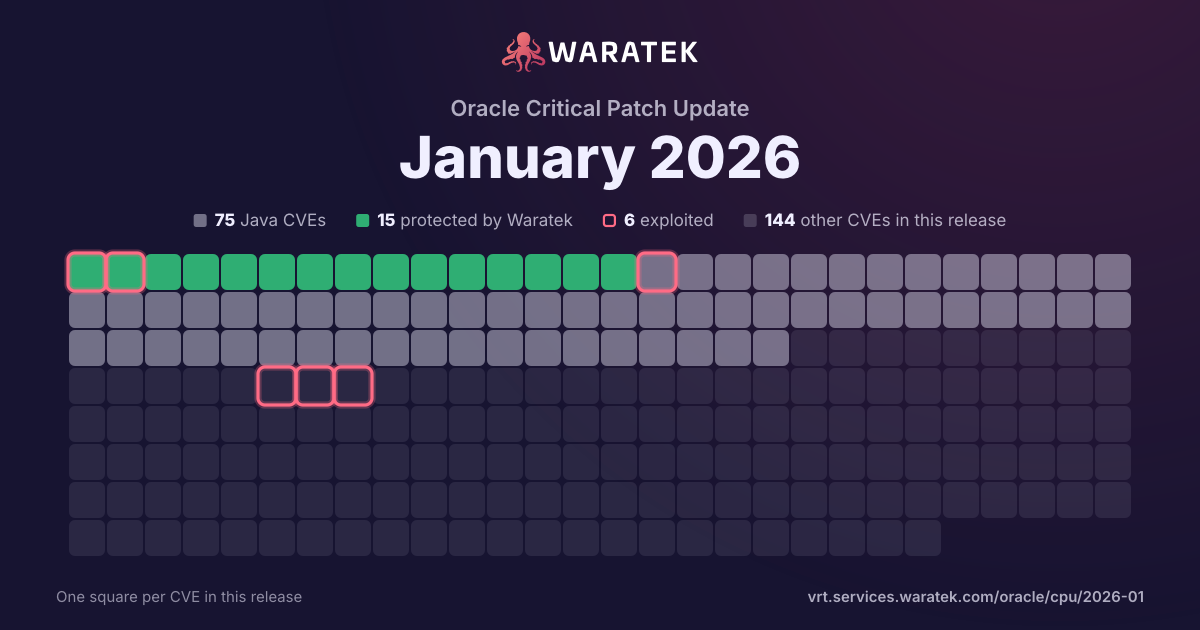
By status
15Protected by Waratek2Mitigation candidate58No exploit published14Outside Waratek scope130Not applicable
6Exploited, marked by the ring
No exploit published. For 26 of them, Oracle's security advisory is the source of public detail.
Protected by Waratek. Waratek RASP can block exploitation of these on systems that have not applied the patch yet.
Overview 55 matches · 0 in Waratek scope · 0 protected · 0 exploited · 0 CISA KEV · 0 public PoC · 0 EPSS ≥ 0.5
55matches
0in Waratek scope0.0%
0protected0.0%
0exploited0.0%
0CISA KEV0.0%
0public PoC0.0%
0EPSS ≥ 0.50.0%
Protected by Waratek
0
0.0%
Rule in development
0
0.0%
Mitigation candidate
0
0.0%
No exploit published
0
0.0%
Outside Waratek scope
0
0.0%
Not applicable
55
100.0%
Withdrawn CVE
0
0.0%
blocked by ARMR today
0
0.0%
partly blocked
0
0.0%
not blocked
55
100.0%
not established
0
0.0%
unrecorded
0
0.0%
Exploited
0
0.0%
Working exploit published
0
0.0%
Proof of concept only
7
12.7%
Forecast only
0
0.0%
No public exploit
48
87.3%
split by
peak 19 / quarter
Q1 221
Not applicable1
Medium1
not blocked1
No public exploit1
Q2 220
Q3 220
Q4 220
Q1 230
Q2 230
Q3 230
Q4 233
Not applicable3
Medium3
not blocked3
No public exploit3
Q1 241
Not applicable1
Medium1
not blocked1
No public exploit1
Q2 240
Q3 241
Not applicable1
Medium1
not blocked1
No public exploit1
Q4 241
Not applicable1
Medium1
not blocked1
No public exploit1
Q1 253
Not applicable3
Medium3
not blocked3
Proof of concept only1
No public exploit2
Q2 253
Not applicable3
Medium3
not blocked3
Proof of concept only1
No public exploit2
Q3 2516
Not applicable16
Medium16
not blocked16
Proof of concept only4
No public exploit12
Q4 257
Not applicable7
Medium7
not blocked7
Proof of concept only1
No public exploit6
Q1 2619
Not applicable19
Medium19
not blocked19
No public exploit19
Q1 22Q3 22Q1 23Q3 23Q1 24Q3 24Q1 25Q3 25Q1 26
| CVE | Severity | Published▾ | Status | Exploitation | Description |
|---|---|---|---|---|---|
| CVE-2026-21985 | Medium | 2026-01-20 | Not applicable | No public exploit | Vulnerability in the Oracle VM VirtualBox product of Oracle Virtualization (component: Core). Supported versions that are affected are 7.1.14 and 7.2.4. Easily exploitable vulnerability allows high privileged attacker with logon to the infrastructure where Oracle VM VirtualBox executes to compromise Oracle VM VirtualBox. While the vulnerability is in Oracle VM VirtualBox, attacks may significantly impact additional products (scope change). Successful attacks of this vulnerability can result in unauthorized access to critical data or complete access to all Oracle VM VirtualBox accessible data. CVSS 3.1 Base Score 6.0 (Confidentiality impacts). CVSS Vector: (CVSS:3.1/AV:L/AC:L/PR:H/UI:N/S:C/C:H/I:N/A:N). |
| CVE-2026-21981 | Medium | 2026-01-20 | Not applicable | No public exploit | Vulnerability in the Oracle VM VirtualBox product of Oracle Virtualization (component: Core). Supported versions that are affected are 7.1.14 and 7.2.4. Easily exploitable vulnerability allows high privileged attacker with logon to the infrastructure where Oracle VM VirtualBox executes to compromise Oracle VM VirtualBox. While the vulnerability is in Oracle VM VirtualBox, attacks may significantly impact additional products (scope change). Successful attacks of this vulnerability can result in unauthorized read access to a subset of Oracle VM VirtualBox accessible data and unauthorized ability to cause a partial denial of service (partial DOS) of Oracle VM VirtualBox. CVSS 3.1 Base Score 4.6 (Confidentiality and Availability impacts). CVSS Vector: (CVSS:3.1/AV:L/AC:L/PR:H/UI:N/S:C/C:L/I:N/A:L). |
| CVE-2026-21975 | Medium | 2026-01-20 | Not applicable | No public exploit | Vulnerability in the Java VM component of Oracle Database Server. Supported versions that are affected are 19.3-19.29 and 21.3-21.20. Easily exploitable vulnerability allows high privileged attacker having Authenticated User privilege with network access via Oracle Net to compromise Java VM. Successful attacks require human interaction from a person other than the attacker. Successful attacks of this vulnerability can result in unauthorized ability to cause a hang or frequently repeatable crash (complete DOS) of Java VM. CVSS 3.1 Base Score 4.5 (Availability impacts). CVSS Vector: (CVSS:3.1/AV:N/AC:L/PR:H/UI:R/S:U/C:N/I:N/A:H). |
| CVE-2026-21968 | Medium | 2026-01-20 | Not applicable | No public exploit | Vulnerability in the MySQL Server product of Oracle MySQL (component: Server: Optimizer). Supported versions that are affected are 8.0.0-8.0.44, 8.4.0-8.4.7 and 9.0.0-9.5.0. Easily exploitable vulnerability allows low privileged attacker with network access via multiple protocols to compromise MySQL Server. Successful attacks of this vulnerability can result in unauthorized ability to cause a hang or frequently repeatable crash (complete DOS) of MySQL Server. CVSS 3.1 Base Score 6.5 (Availability impacts). CVSS Vector: (CVSS:3.1/AV:N/AC:L/PR:L/UI:N/S:U/C:N/I:N/A:H). |
| CVE-2026-21964 | Medium | 2026-01-20 | Not applicable | No public exploit | Vulnerability in the MySQL Server product of Oracle MySQL (component: Server: Thread Pooling). Supported versions that are affected are 8.0.0-8.0.44, 8.4.0-8.4.7 and 9.0.0-9.5.0. Easily exploitable vulnerability allows high privileged attacker with network access via multiple protocols to compromise MySQL Server. Successful attacks of this vulnerability can result in unauthorized ability to cause a hang or frequently repeatable crash (complete DOS) of MySQL Server. CVSS 3.1 Base Score 4.9 (Availability impacts). CVSS Vector: (CVSS:3.1/AV:N/AC:L/PR:H/UI:N/S:U/C:N/I:N/A:H). |
| CVE-2026-21963 | Medium | 2026-01-20 | Not applicable | No public exploit | Vulnerability in the Oracle VM VirtualBox product of Oracle Virtualization (component: Core). Supported versions that are affected are 7.1.14 and 7.2.4. Easily exploitable vulnerability allows high privileged attacker with logon to the infrastructure where Oracle VM VirtualBox executes to compromise Oracle VM VirtualBox. While the vulnerability is in Oracle VM VirtualBox, attacks may significantly impact additional products (scope change). Successful attacks of this vulnerability can result in unauthorized access to critical data or complete access to all Oracle VM VirtualBox accessible data. CVSS 3.1 Base Score 6.0 (Confidentiality impacts). CVSS Vector: (CVSS:3.1/AV:L/AC:L/PR:H/UI:N/S:C/C:H/I:N/A:N). |
| CVE-2026-21952 | Medium | 2026-01-20 | Not applicable | No public exploit | Vulnerability in the MySQL Server product of Oracle MySQL (component: Server: Parser). Supported versions that are affected are 9.0.0-9.5.0. Easily exploitable vulnerability allows high privileged attacker with network access via multiple protocols to compromise MySQL Server. Successful attacks of this vulnerability can result in unauthorized ability to cause a hang or frequently repeatable crash (complete DOS) of MySQL Server. CVSS 3.1 Base Score 4.9 (Availability impacts). CVSS Vector: (CVSS:3.1/AV:N/AC:L/PR:H/UI:N/S:U/C:N/I:N/A:H). |
| CVE-2026-21950 | Medium | 2026-01-20 | Not applicable | No public exploit | Vulnerability in the MySQL Server product of Oracle MySQL (component: Server: Optimizer). Supported versions that are affected are 9.0.0-9.5.0. Easily exploitable vulnerability allows low privileged attacker with network access via multiple protocols to compromise MySQL Server. Successful attacks of this vulnerability can result in unauthorized ability to cause a hang or frequently repeatable crash (complete DOS) of MySQL Server. CVSS 3.1 Base Score 6.5 (Availability impacts). CVSS Vector: (CVSS:3.1/AV:N/AC:L/PR:L/UI:N/S:U/C:N/I:N/A:H). |
| CVE-2026-21949 | Medium | 2026-01-20 | Not applicable | No public exploit | Vulnerability in the MySQL Server product of Oracle MySQL (component: Server: Optimizer). Supported versions that are affected are 9.0.0-9.5.0. Easily exploitable vulnerability allows low privileged attacker with network access via multiple protocols to compromise MySQL Server. Successful attacks of this vulnerability can result in unauthorized ability to cause a hang or frequently repeatable crash (complete DOS) of MySQL Server. CVSS 3.1 Base Score 6.5 (Availability impacts). CVSS Vector: (CVSS:3.1/AV:N/AC:L/PR:L/UI:N/S:U/C:N/I:N/A:H). |
| CVE-2026-21948 | Medium | 2026-01-20 | Not applicable | No public exploit | Vulnerability in the MySQL Server product of Oracle MySQL (component: Server: Optimizer). Supported versions that are affected are 8.0.0-8.0.44, 8.4.0-8.4.7 and 9.0.0-9.5.0. Easily exploitable vulnerability allows high privileged attacker with network access via multiple protocols to compromise MySQL Server. Successful attacks of this vulnerability can result in unauthorized ability to cause a hang or frequently repeatable crash (complete DOS) of MySQL Server. CVSS 3.1 Base Score 4.9 (Availability impacts). CVSS Vector: (CVSS:3.1/AV:N/AC:L/PR:H/UI:N/S:U/C:N/I:N/A:H). |
| CVE-2026-21942 | Medium | 2026-01-20 | Not applicable | No public exploit | Vulnerability in the Oracle Solaris product of Oracle Systems (component: Filesystems). Supported versions that are affected are 10 and 11. Easily exploitable vulnerability allows low privileged attacker with logon to the infrastructure where Oracle Solaris executes to compromise Oracle Solaris. Successful attacks require human interaction from a person other than the attacker. Successful attacks of this vulnerability can result in unauthorized ability to cause a hang or frequently repeatable crash (complete DOS) of Oracle Solaris. CVSS 3.1 Base Score 5.0 (Availability impacts). CVSS Vector: (CVSS:3.1/AV:L/AC:L/PR:L/UI:R/S:U/C:N/I:N/A:H). |
| CVE-2026-21941 | Medium | 2026-01-20 | Not applicable | No public exploit | Vulnerability in the MySQL Server product of Oracle MySQL (component: Server: Optimizer). Supported versions that are affected are 8.0.0-8.0.44, 8.4.0-8.4.7 and 9.0.0-9.5.0. Easily exploitable vulnerability allows high privileged attacker with network access via multiple protocols to compromise MySQL Server. Successful attacks of this vulnerability can result in unauthorized ability to cause a hang or frequently repeatable crash (complete DOS) of MySQL Server. CVSS 3.1 Base Score 4.9 (Availability impacts). CVSS Vector: (CVSS:3.1/AV:N/AC:L/PR:H/UI:N/S:U/C:N/I:N/A:H). |
| CVE-2026-21937 | Medium | 2026-01-20 | Not applicable | No public exploit | Vulnerability in the MySQL Server product of Oracle MySQL (component: Server: DDL). Supported versions that are affected are 8.0.0-8.0.44, 8.4.0-8.4.7 and 9.0.0-9.5.0. Easily exploitable vulnerability allows high privileged attacker with network access via multiple protocols to compromise MySQL Server. Successful attacks of this vulnerability can result in unauthorized ability to cause a hang or frequently repeatable crash (complete DOS) of MySQL Server. CVSS 3.1 Base Score 4.9 (Availability impacts). CVSS Vector: (CVSS:3.1/AV:N/AC:L/PR:H/UI:N/S:U/C:N/I:N/A:H). |
| CVE-2026-21936 | Medium | 2026-01-20 | Not applicable | No public exploit | Vulnerability in the MySQL Server product of Oracle MySQL (component: InnoDB). Supported versions that are affected are 8.0.0-8.0.44, 8.4.0-8.4.7 and 9.0.0-9.5.0. Easily exploitable vulnerability allows high privileged attacker with network access via multiple protocols to compromise MySQL Server. Successful attacks of this vulnerability can result in unauthorized ability to cause a hang or frequently repeatable crash (complete DOS) of MySQL Server. CVSS 3.1 Base Score 4.9 (Availability impacts). CVSS Vector: (CVSS:3.1/AV:N/AC:L/PR:H/UI:N/S:U/C:N/I:N/A:H). |
| CVE-2026-21935 | Medium | 2026-01-20 | Not applicable | No public exploit | Vulnerability in the Oracle Solaris product of Oracle Systems (component: Driver). The supported version that is affected is 11. Easily exploitable vulnerability allows high privileged attacker with logon to the infrastructure where Oracle Solaris executes to compromise Oracle Solaris. Successful attacks require human interaction from a person other than the attacker. Successful attacks of this vulnerability can result in unauthorized creation, deletion or modification access to critical data or all Oracle Solaris accessible data as well as unauthorized access to critical data or complete access to all Oracle Solaris accessible data. CVSS 3.1 Base Score 5.8 (Confidentiality and Integrity impacts). CVSS Vector: (CVSS:3.1/AV:L/AC:L/PR:H/UI:R/S:U/C:H/I:H/A:N). |
| CVE-2026-21931 | Medium | 2026-01-20 | Not applicable | No public exploit | Vulnerability in the Oracle APEX Sample Applications product of Oracle APEX (component: Brookstrut Sample App). Supported versions that are affected are 23.2.0, 23.2.1, 24.1.0, 24.2.0 and 24.2.1. Easily exploitable vulnerability allows low privileged attacker with network access via HTTP to compromise Oracle APEX Sample Applications. Successful attacks require human interaction from a person other than the attacker and while the vulnerability is in Oracle APEX Sample Applications, attacks may significantly impact additional products (scope change). Successful attacks of this vulnerability can result in unauthorized update, insert or delete access to some of Oracle APEX Sample Applications accessible data as well as unauthorized read access to a subset of Oracle APEX Sample Applications accessible data. CVSS 3.1 Base Score 5.4 (Confidentiality and Integrity impacts). CVSS Vector: (CVSS:3.1/AV:N/AC:L/PR:L/UI:R/S:C/C:L/I:L/A:N). |
| CVE-2026-21929 | Medium | 2026-01-20 | Not applicable | No public exploit | Vulnerability in the MySQL Server product of Oracle MySQL (component: Server: Parser). Supported versions that are affected are 9.0.0-9.5.0. Difficult to exploit vulnerability allows low privileged attacker with network access via multiple protocols to compromise MySQL Server. Successful attacks of this vulnerability can result in unauthorized ability to cause a hang or frequently repeatable crash (complete DOS) of MySQL Server. CVSS 3.1 Base Score 5.3 (Availability impacts). CVSS Vector: (CVSS:3.1/AV:N/AC:H/PR:L/UI:N/S:U/C:N/I:N/A:H). |
| CVE-2026-21928 | Medium | 2026-01-20 | Not applicable | No public exploit | Vulnerability in the Oracle Solaris product of Oracle Systems (component: Kernel). The supported version that is affected is 11. Easily exploitable vulnerability allows unauthenticated attacker with network access via TCP to compromise Oracle Solaris. Successful attacks of this vulnerability can result in unauthorized read access to a subset of Oracle Solaris accessible data. CVSS 3.1 Base Score 5.3 (Confidentiality impacts). CVSS Vector: (CVSS:3.1/AV:N/AC:L/PR:N/UI:N/S:U/C:L/I:N/A:N). |
| CVE-2026-21927 | Medium | 2026-01-20 | Not applicable | No public exploit | Vulnerability in the Oracle Solaris product of Oracle Systems (component: Driver). The supported version that is affected is 11. Easily exploitable vulnerability allows high privileged attacker with logon to the infrastructure where Oracle Solaris executes to compromise Oracle Solaris. Successful attacks require human interaction from a person other than the attacker. Successful attacks of this vulnerability can result in unauthorized creation, deletion or modification access to critical data or all Oracle Solaris accessible data as well as unauthorized access to critical data or complete access to all Oracle Solaris accessible data. CVSS 3.1 Base Score 5.8 (Confidentiality and Integrity impacts). CVSS Vector: (CVSS:3.1/AV:L/AC:L/PR:H/UI:R/S:U/C:H/I:H/A:N). |
| CVE-2025-66200 | Medium | 2025-12-05 | Not applicable | No public exploit | mod_userdir+suexec bypass via AllowOverride FileInfo vulnerability in Apache HTTP Server. Users with access to use the RequestHeader directive in htaccess can cause some CGI scripts to run under an unexpected userid. This issue affects Apache HTTP Server: from 2.4.7 through 2.4.65. Users are recommended to upgrade to version 2.4.66, which fixes the issue. |
| CVE-2025-65082 | Medium | 2025-12-05 | Not applicable | No public exploit | Improper Neutralization of Escape, Meta, or Control Sequences vulnerability in Apache HTTP Server through environment variables set via the Apache configuration unexpectedly superseding variables calculated by the server for CGI programs. This issue affects Apache HTTP Server from 2.4.0 through 2.4.65. Users are recommended to upgrade to version 2.4.66 which fixes the issue. |
| CVE-2025-13836 | Medium | 2025-12-01 | Not applicable | No public exploit | When reading an HTTP response from a server, if no read amount is specified, the default behavior will be to use Content-Length. This allows a malicious server to cause the client to read large amounts of data into memory, potentially causing OOM or other DoS. |
| CVE-2025-64506 | Medium | 2025-11-25 | Not applicable | No public exploit | LIBPNG is a reference library for use in applications that read, create, and manipulate PNG (Portable Network Graphics) raster image files. From version 1.6.0 to before 1.6.51, a heap buffer over-read vulnerability exists in libpng's png_write_image_8bit function when processing 8-bit images through the simplified write API with convert_to_8bit enabled. The vulnerability affects 8-bit grayscale+alpha, RGB/RGBA, and images with incomplete row data. A conditional guard incorrectly allows 8-bit input to enter code expecting 16-bit input, causing reads up to 2 bytes beyond allocated buffer boundaries. This issue has been patched in version 1.6.51. |
| CVE-2025-64505 | Medium | 2025-11-25 | Not applicable | No public exploit | LIBPNG is a reference library for use in applications that read, create, and manipulate PNG (Portable Network Graphics) raster image files. Prior to version 1.6.51, a heap buffer over-read vulnerability exists in libpng's png_do_quantize function when processing PNG files with malformed palette indices. The vulnerability occurs when palette_lookup array bounds are not validated against externally-supplied image data, allowing an attacker to craft a PNG file with out-of-range palette indices that trigger out-of-bounds memory access. This issue has been patched in version 1.6.51. |
| CVE-2025-64718 | Medium | 2025-11-13 | Not applicable | No public exploit | js-yaml is a JavaScript YAML parser and dumper. In js-yaml before 4.1.1 and 3.14.2, it's possible for an attacker to modify the prototype of the result of a parsed yaml document via prototype pollution (`__proto__`). All users who parse untrusted yaml documents may be impacted. The problem is patched in js-yaml 4.1.1 and 3.14.2. Users can protect against this kind of attack on the server by using `node --disable-proto=delete` or `deno` (in Deno, pollution protection is on by default). |
| CVE-2025-8291 | Medium | 2025-10-07 | Not applicable | Proof of concept only | The 'zipfile' module would not check the validity of the ZIP64 End of Central Directory (EOCD) Locator record offset value would not be used to locate the ZIP64 EOCD record, instead the ZIP64 EOCD record would be assumed to be the previous record in the ZIP archive. This could be abused to create ZIP archives that are handled differently by the 'zipfile' module compared to other ZIP implementations. Remediation maintains this behavior, but checks that the offset specified in the ZIP64 EOCD Locator record matches the expected value. |
| CVE-2025-9232 | Medium | 2025-09-30 | Not applicable | No public exploit | Issue summary: An application using the OpenSSL HTTP client API functions may trigger an out-of-bounds read if the 'no_proxy' environment variable is set and the host portion of the authority component of the HTTP URL is an IPv6 address. Impact summary: An out-of-bounds read can trigger a crash which leads to Denial of Service for an application. The OpenSSL HTTP client API functions can be used directly by applications but they are also used by the OCSP client functions and CMP (Certificate Management Protocol) client implementation in OpenSSL. However the URLs used by these implementations are unlikely to be controlled by an attacker. In this vulnerable code the out of bounds read can only trigger a crash. Furthermore the vulnerability requires an attacker-controlled URL to be passed from an application to the OpenSSL function and the user has to have a 'no_proxy' environment variable set. For the aforementioned reasons the issue was assessed as Low severity. The vulnerable code was introduced in the following patch releases: 3.0.16, 3.1.8, 3.2.4, 3.3.3, 3.4.0 and 3.5.0. The FIPS modules in 3.5, 3.4, 3.3, 3.2, 3.1 and 3.0 are not affected by this issue, as the HTTP client implementation is outside the OpenSSL FIPS module boundary. |
| CVE-2025-9231 | Medium | 2025-09-30 | Not applicable | No public exploit | Issue summary: A timing side-channel which could potentially allow remote recovery of the private key exists in the SM2 algorithm implementation on 64 bit ARM platforms. Impact summary: A timing side-channel in SM2 signature computations on 64 bit ARM platforms could allow recovering the private key by an attacker.. While remote key recovery over a network was not attempted by the reporter, timing measurements revealed a timing signal which may allow such an attack. OpenSSL does not directly support certificates with SM2 keys in TLS, and so this CVE is not relevant in most TLS contexts. However, given that it is possible to add support for such certificates via a custom provider, coupled with the fact that in such a custom provider context the private key may be recoverable via remote timing measurements, we consider this to be a Moderate severity issue. The FIPS modules in 3.5, 3.4, 3.3, 3.2, 3.1 and 3.0 are not affected by this issue, as SM2 is not an approved algorithm. |
| CVE-2025-8869 | Medium | 2025-09-24 | Not applicable | No public exploit | When extracting a tar archive pip may not check symbolic links point into the extraction directory if the tarfile module doesn't implement PEP 706. Note that upgrading pip to a "fixed" version for this vulnerability doesn't fix all known vulnerabilities that are remediated by using a Python version that implements PEP 706. Note that this is a vulnerability in pip's fallback implementation of tar extraction for Python versions that don't implement PEP 706 and therefore are not secure to all vulnerabilities in the Python 'tarfile' module. If you're using a Python version that implements PEP 706 then pip doesn't use the "vulnerable" fallback code. Mitigations include upgrading to a version of pip that includes the fix, upgrading to a Python version that implements PEP 706 (Python >=3.9.17, >=3.10.12, >=3.11.4, or >=3.12), applying the linked patch, or inspecting source distributions (sdists) before installation as is already a best-practice. |
| CVE-2025-43356 | Medium | 2025-09-15 | Not applicable | No public exploit | The issue was addressed with improved handling of caches. This issue is fixed in Safari 26, iOS 18.7 and iPadOS 18.7, iOS 26 and iPadOS 26, macOS Tahoe 26, tvOS 26, visionOS 26, watchOS 26. A website may be able to access sensor information without user consent. |
| CVE-2025-43272 | Medium | 2025-09-15 | Not applicable | No public exploit | The issue was addressed with improved memory handling. This issue is fixed in Safari 26, iOS 26 and iPadOS 26, macOS Tahoe 26, visionOS 26, watchOS 26. Processing maliciously crafted web content may lead to an unexpected Safari crash. |
| CVE-2025-10148 | Medium | 2025-09-12 | Not applicable | No public exploit | curl's WebSocket code did not update the 32-bit mask pattern for each new outgoing frame as the specification says. Instead it used a fixed mask that persisted and was used throughout the entire connection. A predictable mask pattern allows for a malicious server to induce traffic between the two communicating parties that could be interpreted by an involved proxy (configured or transparent) as genuine, real, HTTP traffic with content and thereby poison its cache. That cached poisoned content could then be served to all users of that proxy. |
| CVE-2025-4877 | Medium | 2025-08-20 | Not applicable | No public exploit | There's a vulnerability in the libssh package where when a libssh consumer passes in an unexpectedly large input buffer to ssh_get_fingerprint_hash() function. In such cases the bin_to_base64() function can experience an integer overflow leading to a memory under allocation, when that happens it's possible that the program perform out of bounds write leading to a heap corruption. This issue affects only 32-bits builds of libssh. |
| CVE-2025-47183 | Medium | 2025-08-07 | Not applicable | Proof of concept only | In GStreamer through 1.26.1, the isomp4 plugin's qtdemux_parse_tree function may read past the end of a heap buffer while parsing an MP4 file, leading to information disclosure. |
| CVE-2025-54571 | Medium | 2025-08-06 | Not applicable | Proof of concept only | ModSecurity is an open source, cross platform web application firewall (WAF) engine for Apache, IIS and Nginx. In versions 2.9.11 and below, an attacker can override the HTTP response’s Content-Type, which could lead to several issues depending on the HTTP scenario. For example, we have demonstrated the potential for XSS and arbitrary script source code disclosure in the latest version of mod_security2. This issue is fixed in version 2.9.12. |
| CVE-2025-54874 | Medium | 2025-08-05 | Not applicable | Proof of concept only | OpenJPEG is an open-source JPEG 2000 codec. In OpenJPEG from 2.5.1 through 2.5.3, a call to opj_jp2_read_header may lead to OOB heap memory write when the data stream p_stream is too short and p_image is not initialized. |
| CVE-2025-8177 | Medium | 2025-07-26 | Not applicable | Proof of concept only | A vulnerability was found in LibTIFF up to 4.7.0. It has been rated as critical. This issue affects the function setrow of the file tools/thumbnail.c. The manipulation leads to buffer overflow. An attack has to be approached locally. The patch is named e8c9d6c616b19438695fd829e58ae4fde5bfbc22. It is recommended to apply a patch to fix this issue. This vulnerability only affects products that are no longer supported by the maintainer. |
| CVE-2025-5449 | Medium | 2025-07-25 | Not applicable | No public exploit | A flaw was found in the SFTP server message decoding logic of libssh. The issue occurs due to an incorrect packet length check that allows an integer overflow when handling large payload sizes on 32-bit systems. This issue leads to failed memory allocation and causes the server process to crash, resulting in a denial of service. |
| CVE-2025-6395 | Medium | 2025-07-10 | Not applicable | No public exploit | A NULL pointer dereference flaw was found in the GnuTLS software in _gnutls_figure_common_ciphersuite(). |
| CVE-2025-32989 | Medium | 2025-07-10 | Not applicable | No public exploit | A heap-buffer-overread vulnerability was found in GnuTLS in how it handles the Certificate Transparency (CT) Signed Certificate Timestamp (SCT) extension during X.509 certificate parsing. This flaw allows a malicious user to create a certificate containing a malformed SCT extension (OID 1.3.6.1.4.1.11129.2.4.2) that contains sensitive data. This issue leads to the exposure of confidential information when GnuTLS verifies certificates from certain websites when the certificate (SCT) is not checked correctly. |
| CVE-2025-5351 | Medium | 2025-07-04 | Not applicable | No public exploit | A flaw was found in the key export functionality of libssh. The issue occurs in the internal function responsible for converting cryptographic keys into serialized formats. During error handling, a memory structure is freed but not cleared, leading to a potential double free issue if an additional failure occurs later in the function. This condition may result in heap corruption or application instability in low-memory scenarios, posing a risk to system reliability where key export operations are performed. |
| CVE-2025-52891 | Medium | 2025-07-02 | Not applicable | No public exploit | ModSecurity is an open source, cross platform web application firewall (WAF) engine for Apache, IIS and Nginx. In versions 2.9.8 to before 2.9.11, an empty XML tag can cause a segmentation fault. If SecParseXmlIntoArgs is set to On or OnlyArgs, and the request type is application/xml, and at least one XML tag is empty (eg <foo></foo>), then a segmentation fault occurs. This issue has been patched in version 2.9.11. A workaround involves setting SecParseXmlIntoArgs to Off. |
| CVE-2025-6069 | Medium | 2025-06-17 | Not applicable | No public exploit | The html.parser.HTMLParser class had worse-case quadratic complexity when processing certain crafted malformed inputs potentially leading to amplified denial-of-service. |
| CVE-2025-4575 | Medium | 2025-05-22 | Not applicable | No public exploit | Issue summary: Use of -addreject option with the openssl x509 application adds a trusted use instead of a rejected use for a certificate. Impact summary: If a user intends to make a trusted certificate rejected for a particular use it will be instead marked as trusted for that use. A copy & paste error during minor refactoring of the code introduced this issue in the OpenSSL 3.5 version. If, for example, a trusted CA certificate should be trusted only for the purpose of authenticating TLS servers but not for CMS signature verification and the CMS signature verification is intended to be marked as rejected with the -addreject option, the resulting CA certificate will be trusted for CMS signature verification purpose instead. Only users which use the trusted certificate format who use the openssl x509 command line application to add rejected uses are affected by this issue. The issues affecting only the command line application are considered to be Low severity. The FIPS modules in 3.5, 3.4, 3.3, 3.2, 3.1 and 3.0 are not affected by this issue. OpenSSL 3.4, 3.3, 3.2, 3.1, 3.0, 1.1.1 and 1.0.2 are also not affected by this issue. |
| CVE-2024-23337 | Medium | 2025-05-21 | Not applicable | Proof of concept only | jq is a command-line JSON processor. In versions up to and including 1.7.1, an integer overflow arises when assigning value using an index of 2147483647, the signed integer limit. This causes a denial of service. Commit de21386681c0df0104a99d9d09db23a9b2a78b1e contains a patch for the issue. |
| CVE-2025-26791 | Medium | 2025-02-14 | Not applicable | Proof of concept only | DOMPurify before 3.2.4 has an incorrect template literal regular expression, sometimes leading to mutation cross-site scripting (mXSS). |
| CVE-2024-12133 | Medium | 2025-02-10 | Not applicable | No public exploit | A flaw in libtasn1 causes inefficient handling of specific certificate data. When processing a large number of elements in a certificate, libtasn1 takes much longer than expected, which can slow down or even crash the system. This flaw allows an attacker to send a specially crafted certificate, causing a denial of service attack. |
| CVE-2025-23084 | Medium | 2025-01-28 | Not applicable | No public exploit | A vulnerability has been identified in Node.js, specifically affecting the handling of drive names in the Windows environment. Certain Node.js functions do not treat drive names as special on Windows. As a result, although Node.js assumes a relative path, it actually refers to the root directory. On Windows, a path that does not start with the file separator is treated as relative to the current directory. This vulnerability affects Windows users of `path.join` API. |
| CVE-2024-46901 | Medium | 2024-12-09 | Not applicable | No public exploit | Insufficient validation of filenames against control characters in Apache Subversion repositories served via mod_dav_svn allows authenticated users with commit access to commit a corrupted revision, leading to disruption for users of the repository. All versions of Subversion up to and including Subversion 1.14.4 are affected if serving repositories via mod_dav_svn. Users are recommended to upgrade to version 1.14.5, which fixes this issue. Repositories served via other access methods are not affected. |
| CVE-2024-43796 | Medium | 2024-09-10 | Not applicable | No public exploit | Express.js minimalist web framework for node. In express < 4.20.0, passing untrusted user input - even after sanitizing it - to response.redirect() may execute untrusted code. This issue is patched in express 4.20.0. |
| CVE-2023-29081 | Medium | 2024-01-26 | Not applicable | No public exploit | A vulnerability has been reported in Suite Setups built with versions prior to InstallShield 2023 R2. This vulnerability may allow locally authenticated users to cause a Denial of Service (DoS) condition when handling move operations on local, temporary folders. |
| CVE-2023-42669 | Medium | 2023-11-06 | Not applicable | No public exploit | A vulnerability was found in Samba's "rpcecho" development server, a non-Windows RPC server used to test Samba's DCE/RPC stack elements. This vulnerability stems from an RPC function that can be blocked indefinitely. The issue arises because the "rpcecho" service operates with only one worker in the main RPC task, allowing calls to the "rpcecho" server to be blocked for a specified time, causing service disruptions. This disruption is triggered by a "sleep()" call in the "dcesrv_echo_TestSleep()" function under specific conditions. Authenticated users or attackers can exploit this vulnerability to make calls to the "rpcecho" server, requesting it to block for a specified duration, effectively disrupting most services and leading to a complete denial of service on the AD DC. The DoS affects all other services as "rpcecho" runs in the main RPC task. |
| CVE-2023-42670 | Medium | 2023-11-03 | Not applicable | No public exploit | A flaw was found in Samba. It is susceptible to a vulnerability where multiple incompatible RPC listeners can be initiated, causing disruptions in the AD DC service. When Samba's RPC server experiences a high load or unresponsiveness, servers intended for non-AD DC purposes (for example, NT4-emulation "classic DCs") can erroneously start and compete for the same unix domain sockets. This issue leads to partial query responses from the AD DC, causing issues such as "The procedure number is out of range" when using tools like Active Directory Users. This flaw allows an attacker to disrupt AD DC services. |
| CVE-2023-4091 | Medium | 2023-11-03 | Not applicable | No public exploit | A vulnerability was discovered in Samba, where the flaw allows SMB clients to truncate files, even with read-only permissions when the Samba VFS module "acl_xattr" is configured with "acl_xattr:ignore system acls = yes". The SMB protocol allows opening files when the client requests read-only access but then implicitly truncates the opened file to 0 bytes if the client specifies a separate OVERWRITE create disposition request. The issue arises in configurations that bypass kernel file system permissions checks, relying solely on Samba's permissions. |
| CVE-2022-23395 | Medium | 2022-03-02 | Not applicable | No public exploit | jQuery Cookie 1.4.1 is affected by prototype pollution, which can lead to DOM cross-site scripting (XSS). |