
Oracle Critical Patch Update January 2026
Released January 2026 · Oracle's advisory ↗ · ← Critical Patch Update, October 2025 · Critical Patch Update, April 2026 →
219 CVEs in this release, one square each
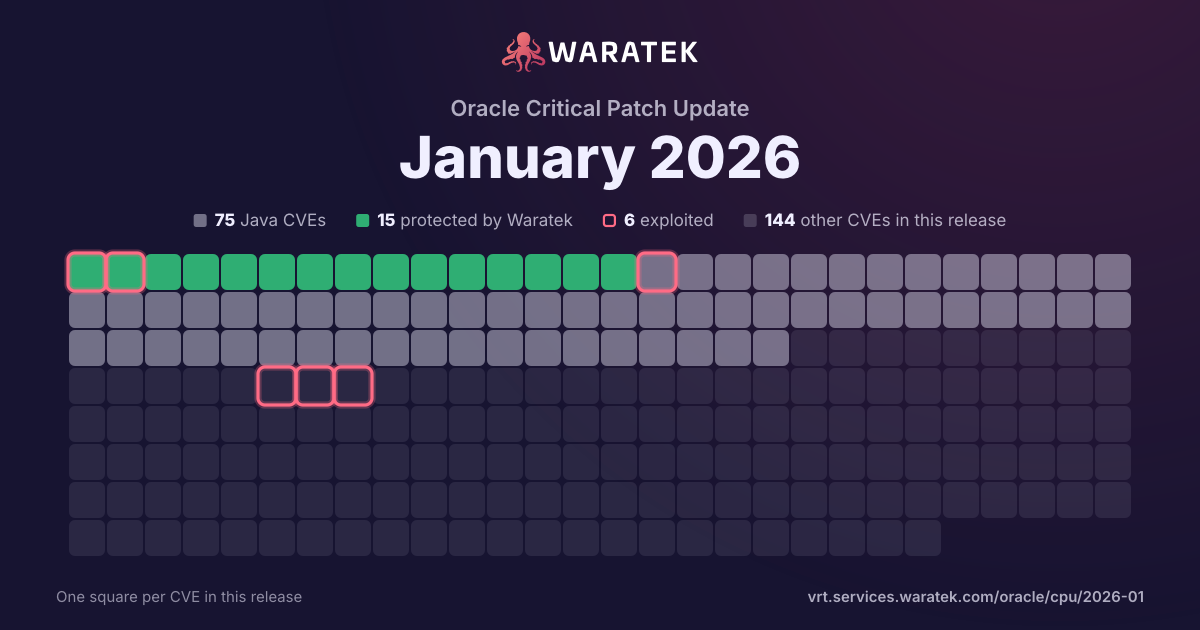
By status
14Protected by Waratek2Mitigation candidate63No exploit published11Outside Waratek scope129Not applicable
6Exploited, marked by the ring
No exploit published. For 26 of them, Oracle's security advisory is the source of public detail.
Protected by Waratek. Waratek RASP can block exploitation of these on systems that have not applied the patch yet.
Overview 6 matches · 1 exploited · 0 CISA KEV · 4 public PoC · 0 EPSS ≥ 0.5
Protected by Waratek
6
100.0%
Rule in development
0
0.0%
Mitigation candidate
0
0.0%
No exploit published
0
0.0%
blocked by ARMR today
6
100.0%
partly blocked
0
0.0%
not blocked
0
0.0%
not established
0
0.0%
unrecorded
0
0.0%
Exploited
1
16.7%
Working exploit published
2
33.3%
Proof of concept only
3
50.0%
Forecast only
0
0.0%
No public exploit
0
0.0%
split by
peak 2 / month
Apr 251
Protected by Waratek1
Critical1
blocked by ARMR today1
Proof of concept only1
May 251
Protected by Waratek1
Medium1
blocked by ARMR today1
Proof of concept only1
Jun 250
Jul 250
Aug 252
Protected by Waratek2
Critical1
Medium1
blocked by ARMR today2
Exploited1
Working exploit published1
Sep 250
Oct 251
Protected by Waratek1
Medium1
blocked by ARMR today1
Proof of concept only1
Nov 250
Dec 251
Protected by Waratek1
Critical1
blocked by ARMR today1
Working exploit published1
Apr 25May 25Jun 25Jul 25Aug 25Sep 25Oct 25Nov 25Dec 25
| CVE | Severity | Published▾ | Status | Exploitation | Description |
|---|---|---|---|---|---|
| CVE-2025-66516 | Critical | 2025-12-04 | Protected by Waratek | Working exploit published | Critical XXE in Apache Tika tika-core (1.13-3.2.1), tika-pdf-module (2.0.0-3.2.1) and tika-parsers (1.13-1.28.5) modules on all platforms allows an attacker to carry out XML External Entity injection via a crafted XFA file inside of a PDF. This CVE covers the same vulnerability as in CVE-2025-54988. However, this CVE expands the scope of affected packages in two ways. First, while the entrypoint for the vulnerability was the tika-parser-pdf-module as reported in CVE-2025-54988, the vulnerability and its fix were in tika-core. Users who upgraded the tika-parser-pdf-module but did not upgrade tika-core to >= 3.2.2 would still be vulnerable. Second, the original report failed to mention that in the 1.x Tika releases, the PDFParser was in the "org.apache.tika:tika-parsers" module. |
| CVE-2025-59419 | Medium | 2025-10-15 | Protected by Waratek | Proof of concept only | Netty is an asynchronous, event-driven network application framework. In versions prior to 4.1.128.Final and 4.2.7.Final, the SMTP codec in Netty contains an SMTP command injection vulnerability due to insufficient input validation for Carriage Return (\r) and Line Feed (\n) characters in user-supplied parameters. The vulnerability exists in io.netty.handler.codec.smtp.DefaultSmtpRequest, where parameters are directly concatenated into the SMTP command string without sanitization. When methods such as SmtpRequests.rcpt(recipient) are called with a malicious string containing CRLF sequences, attackers can inject arbitrary SMTP commands. Because the injected commands are sent from the server's trusted IP address, resulting emails will likely pass SPF and DKIM authentication checks, making them appear legitimate. This allows remote attackers who can control SMTP command parameters (such as email recipients) to forge arbitrary emails from the trusted server, potentially impersonating executives and forging high-stakes corporate communications. This issue has been patched in versions 4.1.129.Final and 4.2.8.Final. No known workarounds exist. |
| CVE-2025-54988 | Critical | 2025-08-20 | Protected by Waratek | Exploited | Critical XXE in Apache Tika (tika-parser-pdf-module) in Apache Tika 1.13 through and including 3.2.1 on all platforms allows an attacker to carry out XML External Entity injection via a crafted XFA file inside of a PDF. An attacker may be able to read sensitive data or trigger malicious requests to internal resources or third-party servers. Note that the tika-parser-pdf-module is used as a dependency in several Tika packages including at least: tika-parsers-standard-modules, tika-parsers-standard-package, tika-app, tika-grpc and tika-server-standard. Users are recommended to upgrade to version 3.2.2, which fixes this issue. |
| CVE-2025-41242 | Medium | 2025-08-18 | Protected by Waratek | Working exploit published | Spring Framework MVC applications can be vulnerable to a “Path Traversal Vulnerability” when deployed on a non-compliant Servlet container. An application can be vulnerable when all the following are true: * the application is deployed as a WAR or with an embedded Servlet container * the Servlet container does not reject suspicious sequences https://jakarta.ee/specifications/servlet/6.1/jakarta-servlet-spec-6.1.html#uri-path-canonicalization * the application serves static resources https://docs.spring.io/spring-framework/reference/web/webmvc/mvc-config/static-resources.html#page-title with Spring resource handling We have verified that applications deployed on Apache Tomcat or Eclipse Jetty are not vulnerable, as long as default security features are not disabled in the configuration. Because we cannot check exploits against all Servlet containers and configuration variants, we strongly recommend upgrading your application. |
| CVE-2025-4949 | Medium | 2025-05-21 | Protected by Waratek | Proof of concept only | In Eclipse JGit versions 7.2.0.202503040940-r and older, the ManifestParser class used by the repo command and the AmazonS3 class used to implement the experimental amazons3 git transport protocol allowing to store git pack files in an Amazon S3 bucket, are vulnerable to XML External Entity (XXE) attacks when parsing XML files. This vulnerability can lead to information disclosure, denial of service, and other security issues. |
| CVE-2025-30065 | Critical | 2025-04-01 | Protected by Waratek | Proof of concept only | Schema parsing in the parquet-avro module of Apache Parquet 1.15.0 and previous versions allows bad actors to execute arbitrary code Users are recommended to upgrade to version 1.15.1, which fixes the issue. |