
Oracle Critical Patch Update January 2026
Released January 2026 · Oracle's advisory ↗ · ← Critical Patch Update, October 2025 · Critical Patch Update, April 2026 →
219 CVEs in this release, one square each
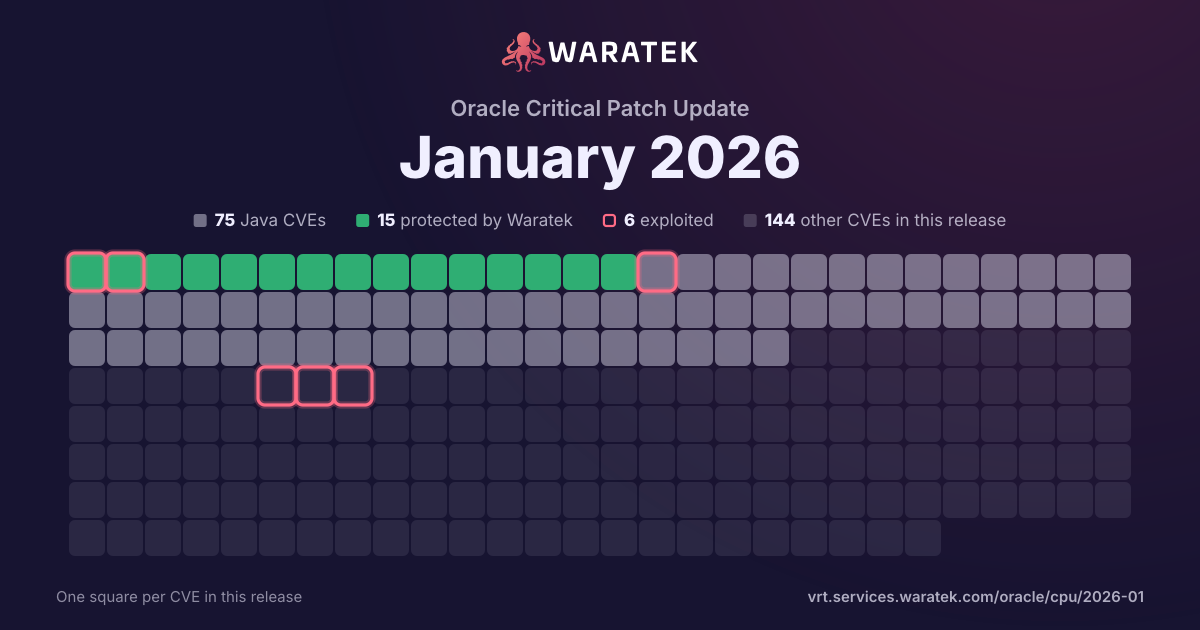
By status
15Protected by Waratek2Mitigation candidate58No exploit published14Outside Waratek scope130Not applicable
6Exploited, marked by the ring
No exploit published. For 26 of them, Oracle's security advisory is the source of public detail.
Protected by Waratek. Waratek RASP can block exploitation of these on systems that have not applied the patch yet.
Overview 10 matches · 0 in Waratek scope · 0 protected · 3 exploited · 2 CISA KEV · 3 EPSS ≥ 0.5
Protected by Waratek
0
0.0%
Rule in development
0
0.0%
Mitigation candidate
0
0.0%
No exploit published
0
0.0%
Outside Waratek scope
0
0.0%
Not applicable
10
100.0%
Withdrawn CVE
0
0.0%
blocked by ARMR today
0
0.0%
partly blocked
0
0.0%
not blocked
10
100.0%
not established
0
0.0%
unrecorded
0
0.0%
Exploited
3
30.0%
Working exploit published
5
50.0%
Proof of concept only
2
20.0%
Forecast only
0
0.0%
No public exploit
0
0.0%
split by
peak 4 / month
Mar 251
Not applicable1
High1
not blocked1
Exploited1
Apr 250
May 250
Jun 250
Jul 253
Not applicable3
High3
not blocked3
Working exploit published2
Proof of concept only1
Aug 250
Sep 250
Oct 254
Not applicable4
Critical1
High3
not blocked4
Exploited1
Working exploit published3
Nov 251
Not applicable1
High1
not blocked1
Proof of concept only1
Dec 250
Jan 261
Not applicable1
Critical1
not blocked1
Exploited1
Mar 25Apr 25May 25Jun 25Jul 25Aug 25Sep 25Oct 25Nov 25Dec 25Jan 26
| CVE | Severity | Published▾ | Status | Exploitation | Description |
|---|---|---|---|---|---|
| CVE-2026-21962 | Critical | 2026-01-20 | Not applicable | Exploited | Vulnerability in the Oracle HTTP Server, Oracle Weblogic Server Proxy Plug-in product of Oracle Fusion Middleware (component: Weblogic Server Proxy Plug-in for Apache HTTP Server, Weblogic Server Proxy Plug-in for IIS). Supported versions that are affected are 12.2.1.4.0, 14.1.1.0.0 and 14.1.2.0.0. Easily exploitable vulnerability allows unauthenticated attacker with network access via HTTP to compromise Oracle HTTP Server, Oracle Weblogic Server Proxy Plug-in. While the vulnerability is in Oracle HTTP Server, Oracle Weblogic Server Proxy Plug-in, attacks may significantly impact additional products (scope change). Successful attacks of this vulnerability can result in unauthorized creation, deletion or modification access to critical data or all Oracle HTTP Server, Oracle Weblogic Server Proxy Plug-in accessible data as well as unauthorized access to critical data or complete access to all Oracle HTTP Server, Oracle Weblogic Server Proxy Plug-in accessible data. Note: Affected version for Weblogic Server Proxy Plug-in for IIS is 12.2.1.4.0 only. CVSS 3.1 Base Score 10.0 (Confidentiality and Integrity impacts). CVSS Vector: (CVSS:3.1/AV:N/AC:L/PR:N/UI:N/S:C/C:H/I:H/A:N). |
| CVE-2025-65018 | High | 2025-11-25 | Not applicable | Proof of concept only | LIBPNG is a reference library for use in applications that read, create, and manipulate PNG (Portable Network Graphics) raster image files. From version 1.6.0 to before 1.6.51, there is a heap buffer overflow vulnerability in the libpng simplified API function png_image_finish_read when processing 16-bit interlaced PNGs with 8-bit output format. Attacker-crafted interlaced PNG files cause heap writes beyond allocated buffer bounds. This issue has been patched in version 1.6.51. |
| CVE-2025-49844 | Critical | 2025-10-03 | Not applicable | Exploited | Redis is an open source, in-memory database that persists on disk. Versions 8.2.1 and below allow an authenticated user to use a specially crafted Lua script to manipulate the garbage collector, trigger a use-after-free and potentially lead to remote code execution. The problem exists in all versions of Redis with Lua scripting. This issue is fixed in version 8.2.2. To workaround this issue without patching the redis-server executable is to prevent users from executing Lua scripts. This can be done using ACL to restrict EVAL and EVALSHA commands. |
| CVE-2025-46819 | High | 2025-10-03 | Not applicable | Working exploit published | Redis is an open source, in-memory database that persists on disk. Versions 8.2.1 and below allow an authenticated user to use a specially crafted LUA script to read out-of-bound data or crash the server and subsequent denial of service. The problem exists in all versions of Redis with Lua scripting. This issue is fixed in version 8.2.2. To workaround this issue without patching the redis-server executable is to prevent users from executing Lua scripts. This can be done using ACL to block a script by restricting both the EVAL and FUNCTION command families. |
| CVE-2025-46818 | High | 2025-10-03 | Not applicable | Working exploit published | Redis is an open source, in-memory database that persists on disk. Versions 8.2.1 and below allow an authenticated user to use a specially crafted Lua script to manipulate different LUA objects and potentially run their own code in the context of another user. The problem exists in all versions of Redis with LUA scripting. This issue is fixed in version 8.2.2. A workaround to mitigate the problem without patching the redis-server executable is to prevent users from executing LUA scripts. This can be done using ACL to block a script by restricting both the EVAL and FUNCTION command families. |
| CVE-2025-46817 | High | 2025-10-03 | Not applicable | Working exploit published | Redis is an open source, in-memory database that persists on disk. Versions 8.2.1 and below allow an authenticated user to use a specially crafted Lua script to cause an integer overflow and potentially lead to remote code execution The problem exists in all versions of Redis with Lua scripting. This issue is fixed in version 8.2.2. |
| CVE-2025-27210 | High | 2025-07-18 | Not applicable | Working exploit published | An incomplete fix has been identified for CVE-2025-23084 in Node.js, specifically affecting Windows device names like CON, PRN, and AUX. This vulnerability affects Windows users of `path.join` API. |
| CVE-2025-6965 | High | 2025-07-15 | Not applicable | Working exploit published | There exists a vulnerability in SQLite versions before 3.50.2 where the number of aggregate terms could exceed the number of columns available. This could lead to a memory corruption issue. We recommend upgrading to version 3.50.2 or above. |
| CVE-2025-53547 | High | 2025-07-08 | Not applicable | Proof of concept only | Helm is a package manager for Charts for Kubernetes. Prior to 3.18.4, a specially crafted Chart.yaml file along with a specially linked Chart.lock file can lead to local code execution when dependencies are updated. Fields in a Chart.yaml file, that are carried over to a Chart.lock file when dependencies are updated and this file is written, can be crafted in a way that can cause execution if that same content were in a file that is executed (e.g., a bash.rc file or shell script). If the Chart.lock file is symlinked to one of these files updating dependencies will write the lock file content to the symlinked file. This can lead to unwanted execution. Helm warns of the symlinked file but did not stop execution due to symlinking. This issue has been resolved in Helm v3.18.4. |
| CVE-2025-27363 | High | 2025-03-11 | Not applicable | Exploited | An out of bounds write exists in FreeType versions 2.13.0 and below (newer versions of FreeType are not vulnerable) when attempting to parse font subglyph structures related to TrueType GX and variable font files. The vulnerable code assigns a signed short value to an unsigned long and then adds a static value causing it to wrap around and allocate too small of a heap buffer. The code then writes up to 6 signed long integers out of bounds relative to this buffer. This may result in arbitrary code execution. This vulnerability may have been exploited in the wild. |