
Oracle Critical Patch Update January 2026
Released January 2026 · Oracle's advisory ↗ · ← Critical Patch Update, October 2025 · Critical Patch Update, April 2026 →
219 CVEs in this release, one square each
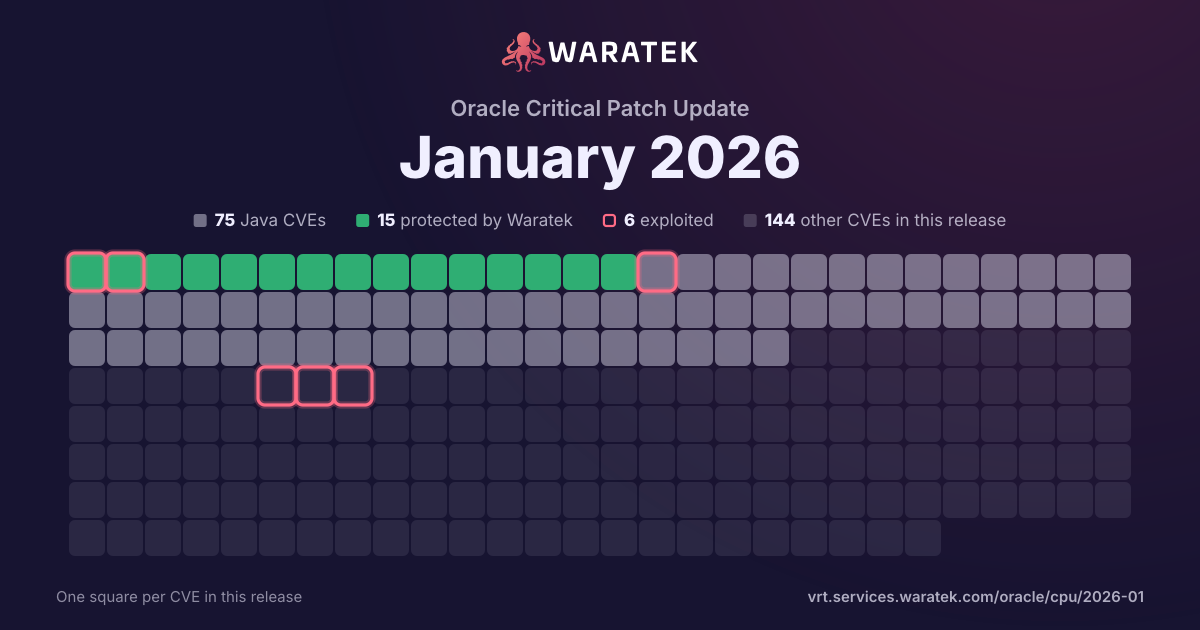
By status
15Protected by Waratek2Mitigation candidate58No exploit published14Outside Waratek scope130Not applicable
6Exploited, marked by the ring
No exploit published. For 26 of them, Oracle's security advisory is the source of public detail.
Protected by Waratek. Waratek RASP can block exploitation of these on systems that have not applied the patch yet.
Overview 130 matches · 0 in Waratek scope · 0 protected · 3 exploited · 2 CISA KEV · 10 public PoC · 3 EPSS ≥ 0.5
130matches
0in Waratek scope0.0%
0protected0.0%
3exploited2.3%
2CISA KEV1.5%
10public PoC7.7%
3EPSS ≥ 0.52.3%
Protected by Waratek
0
0.0%
Rule in development
0
0.0%
Mitigation candidate
0
0.0%
No exploit published
0
0.0%
Outside Waratek scope
0
0.0%
Not applicable
130
100.0%
Withdrawn CVE
0
0.0%
blocked by ARMR today
0
0.0%
partly blocked
0
0.0%
not blocked
130
100.0%
not established
0
0.0%
unrecorded
0
0.0%
split by
peak 42 / quarter
Q1 221
Not applicable1
Medium1
not blocked1
No public exploit1
Q2 220
Q3 220
Q4 220
Q1 233
Not applicable3
High3
not blocked3
No public exploit3
Q2 230
Q3 230
Q4 234
Not applicable4
High1
Medium3
not blocked4
No public exploit4
Q1 242
Not applicable2
Critical1
Medium1
not blocked2
No public exploit2
Q2 240
Q3 241
Not applicable1
Medium1
not blocked1
No public exploit1
Q4 242
Not applicable2
High1
Medium1
not blocked2
No public exploit2
Q1 255
Not applicable5
High2
Medium3
not blocked5
Exploited1
Proof of concept only2
No public exploit2
Q2 2514
Not applicable14
Critical2
High9
Medium3
not blocked14
Proof of concept only4
No public exploit10
Q3 2542
Not applicable42
Critical3
High18
Medium16
Low5
not blocked42
Working exploit published2
Proof of concept only10
No public exploit30
Q4 2521
Not applicable21
Critical1
High11
Medium7
Low2
not blocked21
Exploited1
Working exploit published3
Proof of concept only3
No public exploit14
Q1 2635
Not applicable35
Critical1
High12
Medium19
Low3
not blocked35
Exploited1
No public exploit34
Q1 22Q3 22Q1 23Q3 23Q1 24Q3 24Q1 25Q3 25Q1 26
| CVE | Severity | Published▾ | Status | Exploitation | Description |
|---|---|---|---|---|---|
| CVE-2025-49796 | Critical | 2025-06-16 | Not applicable | No public exploit | A vulnerability was found in libxml2. Processing certain sch:name elements from the input XML file can trigger a memory corruption issue. This flaw allows an attacker to craft a malicious XML input file that can lead libxml to crash, resulting in a denial of service or other possible undefined behavior due to sensitive data being corrupted in memory. |
| CVE-2025-49795 | High | 2025-06-16 | Not applicable | No public exploit | A NULL pointer dereference vulnerability was found in libxml2 when processing XPath XML expressions. This flaw allows an attacker to craft a malicious XML input to libxml2, leading to a denial of service. |
| CVE-2025-49794 | Critical | 2025-06-16 | Not applicable | No public exploit | A use-after-free vulnerability was found in libxml2. This issue occurs when parsing XPath elements under certain circumstances when the XML schematron has the <sch:name path="..."/> schema elements. This flaw allows a malicious actor to craft a malicious XML document used as input for libxml, resulting in the program's crash using libxml or other possible undefined behaviors. |
| CVE-2025-48866 | High | 2025-06-02 | Not applicable | Proof of concept only | ModSecurity is an open source, cross platform web application firewall (WAF) engine for Apache, IIS and Nginx. Versions prior to 2.9.10 contain a denial of service vulnerability similar to GHSA-859r-vvv8-rm8r/CVE-2025-47947. The `sanitiseArg` (and `sanitizeArg` - this is the same action but an alias) is vulnerable to adding an excessive number of arguments, thereby leading to denial of service. Version 2.9.10 fixes the issue. As a workaround, avoid using rules that contain the `sanitiseArg` (or `sanitizeArg`) action. |
| CVE-2025-4575 | Medium | 2025-05-22 | Not applicable | No public exploit | Issue summary: Use of -addreject option with the openssl x509 application adds a trusted use instead of a rejected use for a certificate. Impact summary: If a user intends to make a trusted certificate rejected for a particular use it will be instead marked as trusted for that use. A copy & paste error during minor refactoring of the code introduced this issue in the OpenSSL 3.5 version. If, for example, a trusted CA certificate should be trusted only for the purpose of authenticating TLS servers but not for CMS signature verification and the CMS signature verification is intended to be marked as rejected with the -addreject option, the resulting CA certificate will be trusted for CMS signature verification purpose instead. Only users which use the trusted certificate format who use the openssl x509 command line application to add rejected uses are affected by this issue. The issues affecting only the command line application are considered to be Low severity. The FIPS modules in 3.5, 3.4, 3.3, 3.2, 3.1 and 3.0 are not affected by this issue. OpenSSL 3.4, 3.3, 3.2, 3.1, 3.0, 1.1.1 and 1.0.2 are also not affected by this issue. |
| CVE-2025-48060 | High | 2025-05-21 | Not applicable | Proof of concept only | jq is a command-line JSON processor. In versions up to and including 1.7.1, a heap-buffer-overflow is present in function `jv_string_vfmt` in the jq_fuzz_execute harness from oss-fuzz. This crash happens on file jv.c, line 1456 `void* p = malloc(sz);`. As of time of publication, no patched versions are available. |
| CVE-2025-47947 | High | 2025-05-21 | Not applicable | Proof of concept only | ModSecurity is an open source, cross platform web application firewall (WAF) engine for Apache, IIS and Nginx. Versions up to and including 2.9.8 are vulnerable to denial of service in one special case (in stable released versions): when the payload's content type is `application/json`, and there is at least one rule which does a `sanitiseMatchedBytes` action. A patch is available at pull request 3389 and expected to be part of version 2.9.9. No known workarounds are available. |
| CVE-2024-23337 | Medium | 2025-05-21 | Not applicable | Proof of concept only | jq is a command-line JSON processor. In versions up to and including 1.7.1, an integer overflow arises when assigning value using an index of 2147483647, the signed integer limit. This causes a denial of service. Commit de21386681c0df0104a99d9d09db23a9b2a78b1e contains a patch for the issue. |
| CVE-2025-46727 | High | 2025-05-07 | Not applicable | No public exploit | Rack is a modular Ruby web server interface. Prior to versions 2.2.14, 3.0.16, and 3.1.14, `Rack::QueryParser` parses query strings and `application/x-www-form-urlencoded` bodies into Ruby data structures without imposing any limit on the number of parameters, allowing attackers to send requests with extremely large numbers of parameters. The vulnerability arises because `Rack::QueryParser` iterates over each `&`-separated key-value pair and adds it to a Hash without enforcing an upper bound on the total number of parameters. This allows an attacker to send a single request containing hundreds of thousands (or more) of parameters, which consumes excessive memory and CPU during parsing. An attacker can trigger denial of service by sending specifically crafted HTTP requests, which can cause memory exhaustion or pin CPU resources, stalling or crashing the Rack server. This results in full service disruption until the affected worker is restarted. Versions 2.2.14, 3.0.16, and 3.1.14 fix the issue. Some other mitigations are available. One may use middleware to enforce a maximum query string size or parameter count, or employ a reverse proxy (such as Nginx) to limit request sizes and reject oversized query strings or bodies. Limiting request body sizes and query string lengths at the web server or CDN level is an effective mitigation. |
| CVE-2025-43967 | High | 2025-04-21 | Not applicable | No public exploit | libheif before 1.19.6 has a NULL pointer dereference in ImageItem_Grid::get_decoder in image-items/grid.cc because a grid image can reference a nonexistent image item. |
| CVE-2025-43966 | High | 2025-04-21 | Not applicable | No public exploit | libheif before 1.19.6 has a NULL pointer dereference in ImageItem_iden in image-items/iden.cc. |
| CVE-2024-56406 | High | 2025-04-13 | Not applicable | No public exploit | A heap buffer overflow vulnerability was discovered in Perl. Release branches 5.34, 5.36, 5.38 and 5.40 are affected, including development versions from 5.33.1 through 5.41.10. When there are non-ASCII bytes in the left-hand-side of the `tr` operator, `S_do_trans_invmap` can overflow the destination pointer `d`. $ perl -e '$_ = "\x{FF}" x 1000000; tr/\xFF/\x{100}/;' Segmentation fault (core dumped) It is believed that this vulnerability can enable Denial of Service and possibly Code Execution attacks on platforms that lack sufficient defenses. |
| CVE-2025-27363 | High | 2025-03-11 | Not applicable | Exploited | An out of bounds write exists in FreeType versions 2.13.0 and below (newer versions of FreeType are not vulnerable) when attempting to parse font subglyph structures related to TrueType GX and variable font files. The vulnerable code assigns a signed short value to an unsigned long and then adds a static value causing it to wrap around and allocate too small of a heap buffer. The code then writes up to 6 signed long integers out of bounds relative to this buffer. This may result in arbitrary code execution. This vulnerability may have been exploited in the wild. |
| CVE-2025-26791 | Medium | 2025-02-14 | Not applicable | Proof of concept only | DOMPurify before 3.2.4 has an incorrect template literal regular expression, sometimes leading to mutation cross-site scripting (mXSS). |
| CVE-2024-12133 | Medium | 2025-02-10 | Not applicable | No public exploit | A flaw in libtasn1 causes inefficient handling of specific certificate data. When processing a large number of elements in a certificate, libtasn1 takes much longer than expected, which can slow down or even crash the system. This flaw allows an attacker to send a specially crafted certificate, causing a denial of service attack. |
| CVE-2024-57699 | High | 2025-02-05 | Not applicable | Proof of concept only | A security issue was found in Netplex Json-smart 2.5.0 through 2.5.1. When loading a specially crafted JSON input, containing a large number of ’{’, a stack exhaustion can be trigger, which could allow an attacker to cause a Denial of Service (DoS). This issue exists because of an incomplete fix for CVE-2023-1370. |
| CVE-2025-23084 | Medium | 2025-01-28 | Not applicable | No public exploit | A vulnerability has been identified in Node.js, specifically affecting the handling of drive names in the Windows environment. Certain Node.js functions do not treat drive names as special on Windows. As a result, although Node.js assumes a relative path, it actually refers to the root directory. On Windows, a path that does not start with the file separator is treated as relative to the current directory. This vulnerability affects Windows users of `path.join` API. |
| CVE-2024-46901 | Medium | 2024-12-09 | Not applicable | No public exploit | Insufficient validation of filenames against control characters in Apache Subversion repositories served via mod_dav_svn allows authenticated users with commit access to commit a corrupted revision, leading to disruption for users of the repository. All versions of Subversion up to and including Subversion 1.14.4 are affected if serving repositories via mod_dav_svn. Users are recommended to upgrade to version 1.14.5, which fixes this issue. Repositories served via other access methods are not affected. |
| CVE-2024-45720 | High | 2024-10-09 | Not applicable | No public exploit | On Windows platforms, a "best fit" character encoding conversion of command line arguments to Subversion's executables (e.g., svn.exe, etc.) may lead to unexpected command line argument interpretation, including argument injection and execution of other programs, if a specially crafted command line argument string is processed. All versions of Subversion up to and including Subversion 1.14.3 are affected on Windows platforms only. Users are recommended to upgrade to version Subversion 1.14.4, which fixes this issue. Subversion is not affected on UNIX-like platforms. |
| CVE-2024-43796 | Medium | 2024-09-10 | Not applicable | No public exploit | Express.js minimalist web framework for node. In express < 4.20.0, passing untrusted user input - even after sanitizing it - to response.redirect() may execute untrusted code. This issue is patched in express 4.20.0. |
| CVE-2024-23807 | Critical | 2024-02-29 | Not applicable | No public exploit | The Apache Xerces C++ XML parser on versions 3.0.0 before 3.2.5 contains a use-after-free error triggered during the scanning of external DTDs. Users are recommended to upgrade to version 3.2.5 which fixes the issue, or mitigate the issue by disabling DTD processing. This can be accomplished via the DOM using a standard parser feature, or via SAX using the XERCES_DISABLE_DTD environment variable. This issue has been disclosed before as CVE-2018-1311, but unfortunately that advisory incorrectly stated the issue would be fixed in version 3.2.3 or 3.2.4. |
| CVE-2023-29081 | Medium | 2024-01-26 | Not applicable | No public exploit | A vulnerability has been reported in Suite Setups built with versions prior to InstallShield 2023 R2. This vulnerability may allow locally authenticated users to cause a Denial of Service (DoS) condition when handling move operations on local, temporary folders. |
| CVE-2023-4154 | High | 2023-11-07 | Not applicable | No public exploit | A design flaw was found in Samba's DirSync control implementation, which exposes passwords and secrets in Active Directory to privileged users and Read-Only Domain Controllers (RODCs). This flaw allows RODCs and users possessing the GET_CHANGES right to access all attributes, including sensitive secrets and passwords. Even in a default setup, RODC DC accounts, which should only replicate some passwords, can gain access to all domain secrets, including the vital krbtgt, effectively eliminating the RODC / DC distinction. Furthermore, the vulnerability fails to account for error conditions (fail open), like out-of-memory situations, potentially granting access to secret attributes, even under low-privileged attacker influence. |
| CVE-2023-42669 | Medium | 2023-11-06 | Not applicable | No public exploit | A vulnerability was found in Samba's "rpcecho" development server, a non-Windows RPC server used to test Samba's DCE/RPC stack elements. This vulnerability stems from an RPC function that can be blocked indefinitely. The issue arises because the "rpcecho" service operates with only one worker in the main RPC task, allowing calls to the "rpcecho" server to be blocked for a specified time, causing service disruptions. This disruption is triggered by a "sleep()" call in the "dcesrv_echo_TestSleep()" function under specific conditions. Authenticated users or attackers can exploit this vulnerability to make calls to the "rpcecho" server, requesting it to block for a specified duration, effectively disrupting most services and leading to a complete denial of service on the AD DC. The DoS affects all other services as "rpcecho" runs in the main RPC task. |
| CVE-2023-42670 | Medium | 2023-11-03 | Not applicable | No public exploit | A flaw was found in Samba. It is susceptible to a vulnerability where multiple incompatible RPC listeners can be initiated, causing disruptions in the AD DC service. When Samba's RPC server experiences a high load or unresponsiveness, servers intended for non-AD DC purposes (for example, NT4-emulation "classic DCs") can erroneously start and compete for the same unix domain sockets. This issue leads to partial query responses from the AD DC, causing issues such as "The procedure number is out of range" when using tools like Active Directory Users. This flaw allows an attacker to disrupt AD DC services. |
| CVE-2023-4091 | Medium | 2023-11-03 | Not applicable | No public exploit | A vulnerability was discovered in Samba, where the flaw allows SMB clients to truncate files, even with read-only permissions when the Samba VFS module "acl_xattr" is configured with "acl_xattr:ignore system acls = yes". The SMB protocol allows opening files when the client requests read-only access but then implicitly truncates the opened file to 0 bytes if the client specifies a separate OVERWRITE create disposition request. The issue arises in configurations that bypass kernel file system permissions checks, relying solely on Samba's permissions. |
| CVE-2023-1393 | High | 2023-03-30 | Not applicable | No public exploit | A flaw was found in X.Org Server Overlay Window. A Use-After-Free may lead to local privilege escalation. If a client explicitly destroys the compositor overlay window (aka COW), the Xserver would leave a dangling pointer to that window in the CompScreen structure, which will trigger a use-after-free later. |
| CVE-2022-41342 | High | 2023-02-06 | Not applicable | No public exploit | Improper buffer restrictions in the Intel(R) C++ Compiler Classic before version 2021.7.1 for some Intel(R) oneAPI Toolkits before version 2022.3.1 may allow a privileged user to potentially enable escalation of privilege via local access. |
| CVE-2022-40196 | High | 2023-02-06 | Not applicable | No public exploit | Improper access control in the Intel(R) oneAPI DPC++/C++ Compiler before version 2022.2.1 and Intel C++ Compiler Classic before version 2021.7.1 for some Intel(R) oneAPI Toolkits before version 2022.3.1 may allow an authenticated user to potentially enable escalation of privilege via local access. |
| CVE-2022-23395 | Medium | 2022-03-02 | Not applicable | No public exploit | jQuery Cookie 1.4.1 is affected by prototype pollution, which can lead to DOM cross-site scripting (XSS). |