
Oracle Critical Patch Update January 2026
Released January 2026 · Oracle's advisory ↗ · ← Critical Patch Update, October 2025 · Critical Patch Update, April 2026 →
219 CVEs in this release, one square each
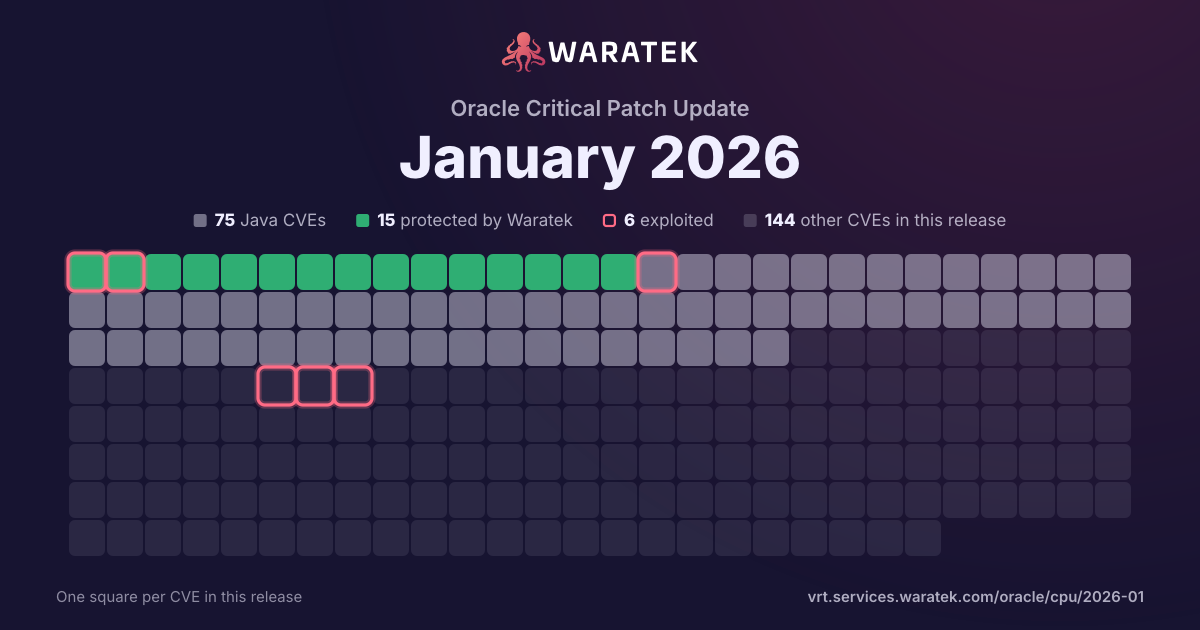
By status
14Protected by Waratek2Mitigation candidate63No exploit published11Outside Waratek scope129Not applicable
6Exploited, marked by the ring
No exploit published. For 26 of them, Oracle's security advisory is the source of public detail.
Protected by Waratek. Waratek RASP can block exploitation of these on systems that have not applied the patch yet.
Overview 5 matches · 2 in Waratek scope · 1 protected · 0 exploited · 0 CISA KEV · 1 public PoC · 0 EPSS ≥ 0.5
5matches
2in Waratek scope40.0%
1protected20.0%
0exploited0.0%
0CISA KEV0.0%
1public PoC20.0%
0EPSS ≥ 0.50.0%
Protected by Waratek
1
20.0%
Rule in development
0
0.0%
Mitigation candidate
0
0.0%
No exploit published
1
20.0%
Outside Waratek scope
0
0.0%
Not applicable
3
60.0%
Withdrawn CVE
0
0.0%
blocked by ARMR today
1
20.0%
partly blocked
0
0.0%
not blocked
4
80.0%
not established
0
0.0%
unrecorded
0
0.0%
Exploited
0
0.0%
Working exploit published
0
0.0%
Proof of concept only
5
100.0%
Forecast only
0
0.0%
No public exploit
0
0.0%
| CVE | Severity | Published▾ | Status | Exploitation | Description |
|---|---|---|---|---|---|
| CVE-2025-67735 | Medium | 2025-12-16 | No exploit published | Proof of concept only | Netty is an asynchronous, event-driven network application framework. In versions prior to 4.1.129.Final and 4.2.8.Final, the `io.netty.handler.codec.http.HttpRequestEncoder` has a CRLF injection with the request URI when constructing a request. This leads to request smuggling when `HttpRequestEncoder` is used without proper sanitization of the URI. Any application / framework using `HttpRequestEncoder` can be subject to be abused to perform request smuggling using CRLF injection. Versions 4.1.129.Final and 4.2.8.Final fix the issue. |
| CVE-2025-65018 | High | 2025-11-25 | Not applicable | Proof of concept only | LIBPNG is a reference library for use in applications that read, create, and manipulate PNG (Portable Network Graphics) raster image files. From version 1.6.0 to before 1.6.51, there is a heap buffer overflow vulnerability in the libpng simplified API function png_image_finish_read when processing 16-bit interlaced PNGs with 8-bit output format. Attacker-crafted interlaced PNG files cause heap writes beyond allocated buffer bounds. This issue has been patched in version 1.6.51. |
| CVE-2025-64720 | High | 2025-11-25 | Not applicable | Proof of concept only | LIBPNG is a reference library for use in applications that read, create, and manipulate PNG (Portable Network Graphics) raster image files. From version 1.6.0 to before 1.6.51, an out-of-bounds read vulnerability exists in png_image_read_composite when processing palette images with PNG_FLAG_OPTIMIZE_ALPHA enabled. The palette compositing code in png_init_read_transformations incorrectly applies background compositing during premultiplication, violating the invariant component ≤ alpha × 257 required by the simplified PNG API. This issue has been patched in version 1.6.51. |
| CVE-2025-59419 | Medium | 2025-10-15 | Protected by Waratek | Proof of concept only | Netty is an asynchronous, event-driven network application framework. In versions prior to 4.1.128.Final and 4.2.7.Final, the SMTP codec in Netty contains an SMTP command injection vulnerability due to insufficient input validation for Carriage Return (\r) and Line Feed (\n) characters in user-supplied parameters. The vulnerability exists in io.netty.handler.codec.smtp.DefaultSmtpRequest, where parameters are directly concatenated into the SMTP command string without sanitization. When methods such as SmtpRequests.rcpt(recipient) are called with a malicious string containing CRLF sequences, attackers can inject arbitrary SMTP commands. Because the injected commands are sent from the server's trusted IP address, resulting emails will likely pass SPF and DKIM authentication checks, making them appear legitimate. This allows remote attackers who can control SMTP command parameters (such as email recipients) to forge arbitrary emails from the trusted server, potentially impersonating executives and forging high-stakes corporate communications. This issue has been patched in versions 4.1.129.Final and 4.2.8.Final. No known workarounds exist. |
| CVE-2025-8291 | Medium | 2025-10-07 | Not applicable | Proof of concept only | The 'zipfile' module would not check the validity of the ZIP64 End of Central Directory (EOCD) Locator record offset value would not be used to locate the ZIP64 EOCD record, instead the ZIP64 EOCD record would be assumed to be the previous record in the ZIP archive. This could be abused to create ZIP archives that are handled differently by the 'zipfile' module compared to other ZIP implementations. Remediation maintains this behavior, but checks that the offset specified in the ZIP64 EOCD Locator record matches the expected value. |