
Oracle Critical Patch Update January 2026
Released January 2026 · Oracle's advisory ↗ · ← Critical Patch Update, October 2025 · Critical Patch Update, April 2026 →
219 CVEs in this release, one square each
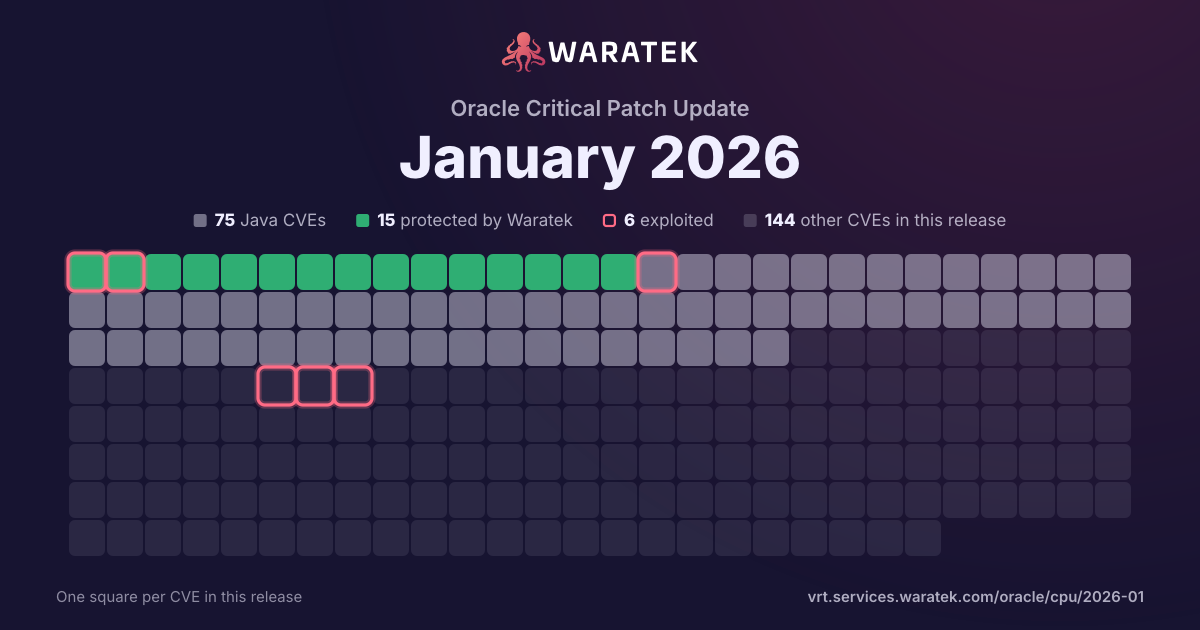
By status
14Protected by Waratek1Rule in development1Mitigation candidate63No exploit published11Outside Waratek scope129Not applicable
6Exploited, marked by the ring
No exploit published. For 26 of them, Oracle's security advisory is the source of public detail.
Protected by Waratek. Waratek RASP can block exploitation of these on systems that have not applied the patch yet.
Overview 6 matches · 0 protected · 0 exploited · 0 CISA KEV · 0 public PoC · 0 EPSS ≥ 0.5
6matches
0protected0.0%
0exploited0.0%
0CISA KEV0.0%
0public PoC0.0%
0EPSS ≥ 0.50.0%
Protected by Waratek
0
0.0%
Rule in development
0
0.0%
Mitigation candidate
0
0.0%
No exploit published
6
100.0%
blocked by ARMR today
0
0.0%
partly blocked
0
0.0%
not blocked
6
100.0%
not established
0
0.0%
unrecorded
0
0.0%
Exploited
0
0.0%
Working exploit published
0
0.0%
Proof of concept only
1
16.7%
Forecast only
0
0.0%
No public exploit
5
83.3%
split by
peak 4 / month
Jul 25Aug 25Sep 25Oct 25Nov 25Dec 25
| CVE | Severity | Published▾ | Status | Exploitation | Description |
|---|---|---|---|---|---|
| CVE-2025-68161 | Medium | 2025-12-18 | No exploit published | No public exploit | The Socket Appender in Apache Log4j Core versions 2.0-beta9 through 2.25.2 does not perform TLS hostname verification of the peer certificate, even when the verifyHostName https://logging.apache.org/log4j/2.x/manual/appenders/network.html#SslConfiguration-attr-verifyHostName configuration attribute or the log4j2.sslVerifyHostName https://logging.apache.org/log4j/2.x/manual/systemproperties.html#log4j2.sslVerifyHostName system property is set to true. This issue may allow a man-in-the-middle attacker to intercept or redirect log traffic under the following conditions: * The attacker is able to intercept or redirect network traffic between the client and the log receiver. * The attacker can present a server certificate issued by a certification authority trusted by the Socket Appender’s configured trust store (or by the default Java trust store if no custom trust store is configured). Users are advised to upgrade to Apache Log4j Core version 2.25.3, which addresses this issue. As an alternative mitigation, the Socket Appender may be configured to use a private or restricted trust root to limit the set of trusted certificates. |
| CVE-2025-8916 | Medium | 2025-08-13 | No exploit published | No public exploit | Allocation of Resources Without Limits or Throttling vulnerability in Legion of the Bouncy Castle Inc. BC Java bcpkix on All (API modules), Legion of the Bouncy Castle Inc. BC Java bcprov on All (API modules), Legion of the Bouncy Castle Inc. BCPKIX FIPS bcpkix-fips on All (API modules) allows Excessive Allocation. This vulnerability is associated with program files https://github.Com/bcgit/bc-java/blob/main/pkix/src/main/java/org/bouncycastle/pkix/jcajce/PKIXCertPathReviewer.Java, https://github.Com/bcgit/bc-java/blob/main/prov/src/main/java/org/bouncycastle/x509/PKIXCertPathReviewer.Java. This issue affects BC Java: from 1.44 through 1.78; BC Java: from 1.44 through 1.78; BCPKIX FIPS: from 1.0.0 through 1.0.7, from 2.0.0 through 2.0.7. |
| CVE-2025-7962 | Medium | 2025-07-21 | No exploit published | No public exploit | In Jakarta Mail versions prior to 2.0.2 it is possible to perform an SMTP Injection by utilizing the \r and \n UTF-8 characters to separate different messages. |
| CVE-2025-48795 | Medium | 2025-07-15 | No exploit published | No public exploit | Apache CXF stores large stream based messages as temporary files on the local filesystem. A bug was introduced which means that the entire temporary file is read into memory and then logged. An attacker might be able to exploit this to cause a denial of service attack by causing an out of memory exception. In addition, it is possible to configure CXF to encrypt temporary files to prevent sensitive credentials from being cached unencrypted on the local filesystem, however this bug means that the cached files are written out to logs unencrypted. Users are recommended to upgrade to versions 3.5.11, 3.6.6, 4.0.7 or 4.1.1, which fixes this issue. |
| CVE-2025-53864 | Medium | 2025-07-11 | No exploit published | Proof of concept only | Connect2id Nimbus JOSE + JWT 10.0.x before 10.0.2 and 9.37.x before 9.37.4 allows a remote attacker to cause a denial of service via a deeply nested JSON object supplied in a JWT claim set, because of uncontrolled recursion. NOTE: this is independent of the Gson 2.11.0 issue because the Connect2id product could have checked the JSON object nesting depth, regardless of what limits (if any) were imposed by Gson. |
| CVE-2025-48924 | Medium | 2025-07-11 | No exploit published | No public exploit | Uncontrolled Recursion vulnerability in Apache Commons Lang. This issue affects Apache Commons Lang: Starting with commons-lang:commons-lang 2.0 to 2.6, and, from org.apache.commons:commons-lang3 3.0 before 3.18.0. The methods ClassUtils.getClass(...) can throw StackOverflowError on very long inputs. Because an Error is usually not handled by applications and libraries, a StackOverflowError could cause an application to stop. Users are recommended to upgrade to version 3.18.0, which fixes the issue. |