
Oracle Critical Patch Update January 2026
Released January 2026 · Oracle's advisory ↗ · ← Critical Patch Update, October 2025 · Critical Patch Update, April 2026 →
219 CVEs in this release, one square each
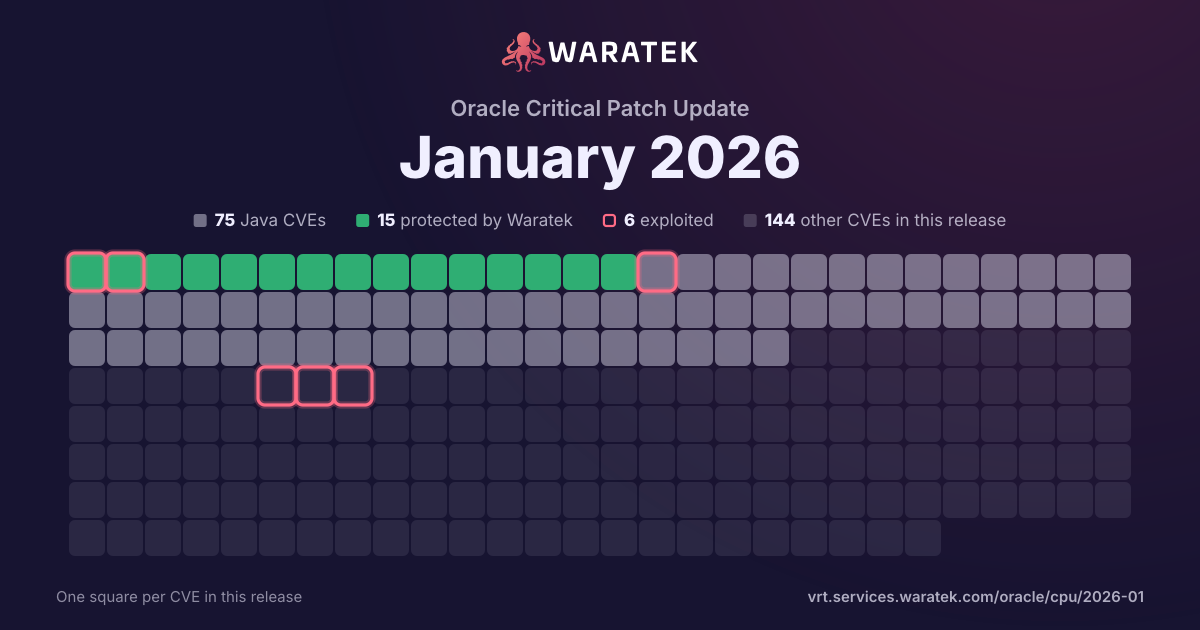
By status
14Protected by Waratek1Rule in development1Mitigation candidate63No exploit published11Outside Waratek scope129Not applicable
6Exploited, marked by the ring
No exploit published. For 26 of them, Oracle's security advisory is the source of public detail.
Protected by Waratek. Waratek RASP can block exploitation of these on systems that have not applied the patch yet.
Overview 5 matches · 0 protected · 0 exploited · 0 CISA KEV · 0 public PoC · 0 EPSS ≥ 0.5
5matches
0protected0.0%
0exploited0.0%
0CISA KEV0.0%
0public PoC0.0%
0EPSS ≥ 0.50.0%
Protected by Waratek
0
0.0%
Rule in development
0
0.0%
Mitigation candidate
0
0.0%
No exploit published
5
100.0%
blocked by ARMR today
0
0.0%
partly blocked
0
0.0%
not blocked
5
100.0%
not established
0
0.0%
unrecorded
0
0.0%
Exploited
0
0.0%
Working exploit published
0
0.0%
Proof of concept only
0
0.0%
Forecast only
0
0.0%
No public exploit
5
100.0%
split by
peak 2 / month
Sep 25Oct 25Nov 25Dec 25Jan 26
| CVE | Severity | Published▾ | Status | Exploitation | Description |
|---|---|---|---|---|---|
| CVE-2026-21973 | High | 2026-01-20 | No exploit published | No public exploit | Vulnerability in the Oracle FLEXCUBE Investor Servicing product of Oracle Financial Services Applications (component: Security Management System). Supported versions that are affected are 14.5.0.15.0, 14.7.0.8.0 and 14.8.0.1.0. Easily exploitable vulnerability allows low privileged attacker with network access via HTTP to compromise Oracle FLEXCUBE Investor Servicing. Successful attacks of this vulnerability can result in unauthorized creation, deletion or modification access to critical data or all Oracle FLEXCUBE Investor Servicing accessible data as well as unauthorized access to critical data or complete access to all Oracle FLEXCUBE Investor Servicing accessible data. CVSS 3.1 Base Score 8.1 (Confidentiality and Integrity impacts). CVSS Vector: (CVSS:3.1/AV:N/AC:L/PR:L/UI:N/S:U/C:H/I:H/A:N). |
| CVE-2025-66566 | High | 2025-12-05 | No exploit published | No public exploit | yawkat LZ4 Java provides LZ4 compression for Java. Insufficient clearing of the output buffer in Java-based decompressor implementations in lz4-java 1.10.0 and earlier allows remote attackers to read previous buffer contents via crafted compressed input. In applications where the output buffer is reused without being cleared, this may lead to disclosure of sensitive data. JNI-based implementations are not affected. This vulnerability is fixed in 1.10.1. |
| CVE-2025-12183 | High | 2025-11-28 | No exploit published | No public exploit | Out-of-bounds memory operations in org.lz4:lz4-java 1.8.0 and earlier allow remote attackers to cause denial of service and read adjacent memory via untrusted compressed input. |
| CVE-2025-41249 | High | 2025-09-16 | No exploit published | No public exploit | The Spring Framework annotation detection mechanism may not correctly resolve annotations on methods within type hierarchies with a parameterized super type with unbounded generics. This can be an issue if such annotations are used for authorization decisions. Your application may be affected by this if you are using Spring Security's @EnableMethodSecurity feature. You are not affected by this if you are not using @EnableMethodSecurity or if you do not use security annotations on methods in generic superclasses or generic interfaces. This CVE is published in conjunction with CVE-2025-41248 https://spring.io/security/cve-2025-41248 . |
| CVE-2025-41248 | High | 2025-09-16 | No exploit published | No public exploit | The Spring Security annotation detection mechanism may not correctly resolve annotations on methods within type hierarchies with a parameterized super type with unbounded generics. This can be an issue when using @PreAuthorize and other method security annotations, resulting in an authorization bypass. Your application may be affected by this if you are using Spring Security's @EnableMethodSecurity feature. You are not affected by this if you are not using @EnableMethodSecurity or if you do not use security annotations on methods in generic superclasses or generic interfaces. This CVE is published in conjunction with CVE-2025-41249 https://spring.io/security/cve-2025-41249 . |