
Oracle Critical Patch Update January 2026
Released January 2026 · Oracle's advisory ↗ · ← Critical Patch Update, October 2025 · Critical Patch Update, April 2026 →
219 CVEs in this release, one square each
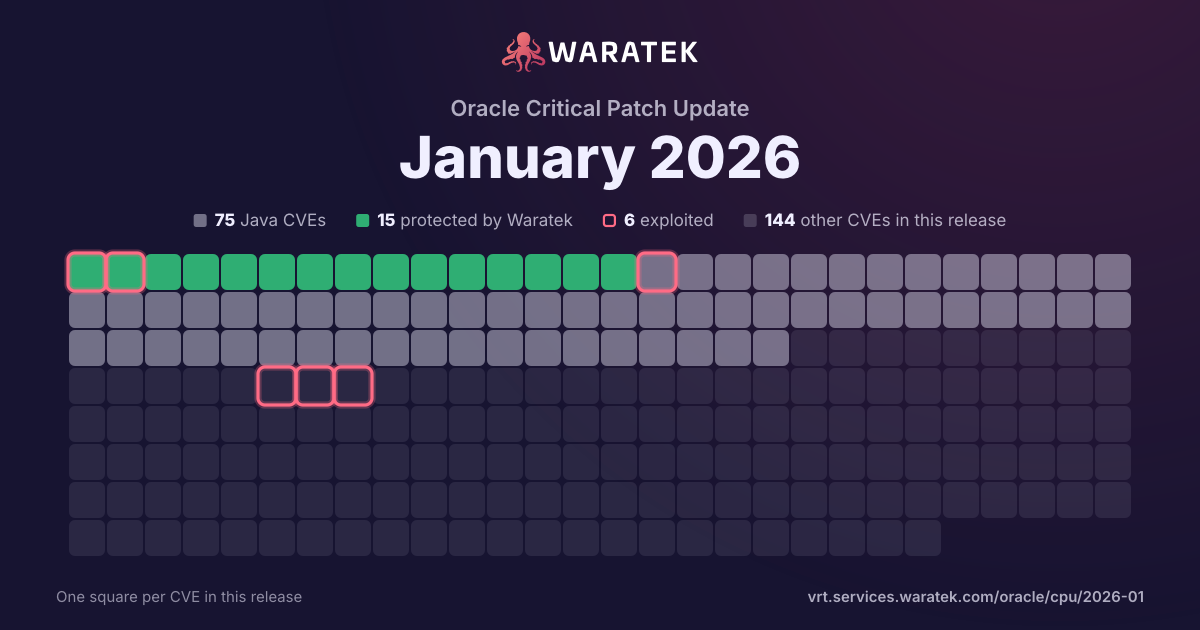
By status
15Protected by Waratek2Mitigation candidate58No exploit published14Outside Waratek scope130Not applicable
6Exploited, marked by the ring
No exploit published. For 26 of them, Oracle's security advisory is the source of public detail.
Protected by Waratek. Waratek RASP can block exploitation of these on systems that have not applied the patch yet.
Overview 18 matches · 10 in Waratek scope · 8 protected · 3 exploited · 1 CISA KEV · 5 public PoC · 3 EPSS ≥ 0.5
18matches
10in Waratek scope55.6%
8protected44.4%
3exploited16.7%
1CISA KEV5.6%
5public PoC27.8%
3EPSS ≥ 0.516.7%
Protected by Waratek
8
44.4%
Rule in development
0
0.0%
Mitigation candidate
0
0.0%
No exploit published
2
11.1%
Outside Waratek scope
0
0.0%
Not applicable
8
44.4%
Withdrawn CVE
0
0.0%
blocked by ARMR today
8
44.4%
partly blocked
0
0.0%
not blocked
10
55.6%
not established
0
0.0%
unrecorded
0
0.0%
split by
peak 4 / quarter
Q2 201
Protected by Waratek1
Critical1
blocked by ARMR today1
No public exploit1
Q3 200
Q4 200
Q1 211
Protected by Waratek1
Critical1
blocked by ARMR today1
No public exploit1
Q2 210
Q3 210
Q4 211
Protected by Waratek1
Critical1
blocked by ARMR today1
No public exploit1
Q1 220
Q2 220
Q3 220
Q4 221
Protected by Waratek1
Critical1
blocked by ARMR today1
Proof of concept only1
Q1 230
Q2 230
Q3 230
Q4 230
Q1 241
Not applicable1
Critical1
not blocked1
No public exploit1
Q2 240
Q3 240
Q4 241
Protected by Waratek1
Critical1
blocked by ARMR today1
No public exploit1
Q1 250
Q2 253
Protected by Waratek1
Not applicable2
Critical3
blocked by ARMR today1
not blocked2
Proof of concept only1
No public exploit2
Q3 254
Protected by Waratek1
Not applicable3
Critical4
blocked by ARMR today1
not blocked3
Exploited1
Proof of concept only1
No public exploit2
Q4 253
Protected by Waratek1
No exploit published1
Not applicable1
Critical3
blocked by ARMR today1
not blocked2
Exploited1
Working exploit published1
No public exploit1
Q1 262
No exploit published1
Not applicable1
Critical2
not blocked2
Exploited1
No public exploit1
Q3 20Q1 21Q3 21Q1 22Q3 22Q1 23Q3 23Q1 24Q3 24Q1 25Q3 25Q1 26
| CVE | Severity | Published▾ | Status | Exploitation | Description |
|---|---|---|---|---|---|
| CVE-2026-21969 | Critical | 2026-01-20 | No exploit published | No public exploit | Vulnerability in the Oracle Agile Product Lifecycle Management for Process product of Oracle Supply Chain (component: Supplier Portal). The supported version that is affected is 6.2.4. Easily exploitable vulnerability allows unauthenticated attacker with network access via HTTP to compromise Oracle Agile Product Lifecycle Management for Process. Successful attacks of this vulnerability can result in takeover of Oracle Agile Product Lifecycle Management for Process. CVSS 3.1 Base Score 9.8 (Confidentiality, Integrity and Availability impacts). CVSS Vector: (CVSS:3.1/AV:N/AC:L/PR:N/UI:N/S:U/C:H/I:H/A:H). |
| CVE-2026-21962 | Critical | 2026-01-20 | Not applicable | Exploited | Vulnerability in the Oracle HTTP Server, Oracle Weblogic Server Proxy Plug-in product of Oracle Fusion Middleware (component: Weblogic Server Proxy Plug-in for Apache HTTP Server, Weblogic Server Proxy Plug-in for IIS). Supported versions that are affected are 12.2.1.4.0, 14.1.1.0.0 and 14.1.2.0.0. Easily exploitable vulnerability allows unauthenticated attacker with network access via HTTP to compromise Oracle HTTP Server, Oracle Weblogic Server Proxy Plug-in. While the vulnerability is in Oracle HTTP Server, Oracle Weblogic Server Proxy Plug-in, attacks may significantly impact additional products (scope change). Successful attacks of this vulnerability can result in unauthorized creation, deletion or modification access to critical data or all Oracle HTTP Server, Oracle Weblogic Server Proxy Plug-in accessible data as well as unauthorized access to critical data or complete access to all Oracle HTTP Server, Oracle Weblogic Server Proxy Plug-in accessible data. Note: Affected version for Weblogic Server Proxy Plug-in for IIS is 12.2.1.4.0 only. CVSS 3.1 Base Score 10.0 (Confidentiality and Integrity impacts). CVSS Vector: (CVSS:3.1/AV:N/AC:L/PR:N/UI:N/S:C/C:H/I:H/A:N). |
| CVE-2025-66516 | Critical | 2025-12-04 | Protected by Waratek | Working exploit published | Critical XXE in Apache Tika tika-core (1.13-3.2.1), tika-pdf-module (2.0.0-3.2.1) and tika-parsers (1.13-1.28.5) modules on all platforms allows an attacker to carry out XML External Entity injection via a crafted XFA file inside of a PDF. This CVE covers the same vulnerability as in CVE-2025-54988. However, this CVE expands the scope of affected packages in two ways. First, while the entrypoint for the vulnerability was the tika-parser-pdf-module as reported in CVE-2025-54988, the vulnerability and its fix were in tika-core. Users who upgraded the tika-parser-pdf-module but did not upgrade tika-core to >= 3.2.2 would still be vulnerable. Second, the original report failed to mention that in the 1.x Tika releases, the PDFParser was in the "org.apache.tika:tika-parsers" module. |
| CVE-2025-12383 | Critical | 2025-11-18 | No exploit published | No public exploit | In Eclipse Jersey versions 2.45, 3.0.16, 3.1.9 a race condition can cause ignoring of critical SSL configurations - such as mutual authentication, custom key/trust stores, and other security settings. This issue may result in SSLHandshakeException under normal circumstances, but under certain conditions, it could lead to unauthorized trust in insecure servers (see PoC) |
| CVE-2025-49844 | Critical | 2025-10-03 | Not applicable | Exploited | Redis is an open source, in-memory database that persists on disk. Versions 8.2.1 and below allow an authenticated user to use a specially crafted Lua script to manipulate the garbage collector, trigger a use-after-free and potentially lead to remote code execution. The problem exists in all versions of Redis with Lua scripting. This issue is fixed in version 8.2.2. To workaround this issue without patching the redis-server executable is to prevent users from executing Lua scripts. This can be done using ACL to restrict EVAL and EVALSHA commands. |
| CVE-2025-9230 | Critical | 2025-09-30 | Not applicable | No public exploit | Issue summary: An application trying to decrypt CMS messages encrypted using password based encryption can trigger an out-of-bounds read and write. Impact summary: This out-of-bounds read may trigger a crash which leads to Denial of Service for an application. The out-of-bounds write can cause a memory corruption which can have various consequences including a Denial of Service or Execution of attacker-supplied code. Although the consequences of a successful exploit of this vulnerability could be severe, the probability that the attacker would be able to perform it is low. Besides, password based (PWRI) encryption support in CMS messages is very rarely used. For that reason the issue was assessed as Moderate severity according to our Security Policy. The FIPS modules in 3.5, 3.4, 3.3, 3.2, 3.1 and 3.0 are not affected by this issue, as the CMS implementation is outside the OpenSSL FIPS module boundary. |
| CVE-2025-43342 | Critical | 2025-09-15 | Not applicable | No public exploit | A correctness issue was addressed with improved checks. This issue is fixed in Safari 26, iOS 18.7 and iPadOS 18.7, iOS 26 and iPadOS 26, macOS Tahoe 26, tvOS 26, visionOS 26, watchOS 26. Processing maliciously crafted web content may lead to an unexpected process crash. |
| CVE-2025-54988 | Critical | 2025-08-20 | Protected by Waratek | Exploited | Critical XXE in Apache Tika (tika-parser-pdf-module) in Apache Tika 1.13 through and including 3.2.1 on all platforms allows an attacker to carry out XML External Entity injection via a crafted XFA file inside of a PDF. An attacker may be able to read sensitive data or trigger malicious requests to internal resources or third-party servers. Note that the tika-parser-pdf-module is used as a dependency in several Tika packages including at least: tika-parsers-standard-modules, tika-parsers-standard-package, tika-app, tika-grpc and tika-server-standard. Users are recommended to upgrade to version 3.2.2, which fixes this issue. |
| CVE-2025-23048 | Critical | 2025-07-10 | Not applicable | Proof of concept only | In some mod_ssl configurations on Apache HTTP Server 2.4.35 through to 2.4.63, an access control bypass by trusted clients is possible using TLS 1.3 session resumption. Configurations are affected when mod_ssl is configured for multiple virtual hosts, with each restricted to a different set of trusted client certificates (for example with a different SSLCACertificateFile/Path setting). In such a case, a client trusted to access one virtual host may be able to access another virtual host, if SSLStrictSNIVHostCheck is not enabled in either virtual host. |
| CVE-2025-49796 | Critical | 2025-06-16 | Not applicable | No public exploit | A vulnerability was found in libxml2. Processing certain sch:name elements from the input XML file can trigger a memory corruption issue. This flaw allows an attacker to craft a malicious XML input file that can lead libxml to crash, resulting in a denial of service or other possible undefined behavior due to sensitive data being corrupted in memory. |
| CVE-2025-49794 | Critical | 2025-06-16 | Not applicable | No public exploit | A use-after-free vulnerability was found in libxml2. This issue occurs when parsing XPath elements under certain circumstances when the XML schematron has the <sch:name path="..."/> schema elements. This flaw allows a malicious actor to craft a malicious XML document used as input for libxml, resulting in the program's crash using libxml or other possible undefined behaviors. |
| CVE-2025-30065 | Critical | 2025-04-01 | Protected by Waratek | Proof of concept only | Schema parsing in the parquet-avro module of Apache Parquet 1.15.0 and previous versions allows bad actors to execute arbitrary code Users are recommended to upgrade to version 1.15.1, which fixes the issue. |
| CVE-2024-52046 | Critical | 2024-12-25 | Protected by Waratek | No public exploit | The ObjectSerializationDecoder in Apache MINA uses Java’s native deserialization protocol to process incoming serialized data but lacks the necessary security checks and defenses. This vulnerability allows attackers to exploit the deserialization process by sending specially crafted malicious serialized data, potentially leading to remote code execution (RCE) attacks. This issue affects MINA core versions 2.0.X, 2.1.X and 2.2.X, and will be fixed by the releases 2.0.27, 2.1.10 and 2.2.4. It's also important to note that an application using MINA core library will only be affected if the IoBuffer#getObject() method is called, and this specific method is potentially called when adding a ProtocolCodecFilter instance using the ObjectSerializationCodecFactory class in the filter chain. If your application is specifically using those classes, you have to upgrade to the latest version of MINA core library. Upgrading will not be enough: you also need to explicitly allow the classes the decoder will accept in the ObjectSerializationDecoder instance, using one of the three new methods: /** * Accept class names where the supplied ClassNameMatcher matches for * deserialization, unless they are otherwise rejected. * * @param classNameMatcher the matcher to use */ public void accept(ClassNameMatcher classNameMatcher) /** * Accept class names that match the supplied pattern for * deserialization, unless they are otherwise rejected. * * @param pattern standard Java regexp */ public void accept(Pattern pattern) /** * Accept the wildcard specified classes for deserialization, * unless they are otherwise rejected. * * @param patterns Wildcard file name patterns as defined by * {@link org.apache.commons.io.FilenameUtils#wildcardMatch(String, String) FilenameUtils.wildcardMatch} */ public void accept(String... patterns) By default, the decoder will reject *all* classes that will be present in the incoming data. Note: The FtpServer, SSHd and Vysper sub-project are not affected by this issue. |
| CVE-2024-23807 | Critical | 2024-02-29 | Not applicable | No public exploit | The Apache Xerces C++ XML parser on versions 3.0.0 before 3.2.5 contains a use-after-free error triggered during the scanning of external DTDs. Users are recommended to upgrade to version 3.2.5 which fixes the issue, or mitigate the issue by disabling DTD processing. This can be accomplished via the DOM using a standard parser feature, or via SAX using the XERCES_DISABLE_DTD environment variable. This issue has been disclosed before as CVE-2018-1311, but unfortunately that advisory incorrectly stated the issue would be fixed in version 3.2.3 or 3.2.4. |
| CVE-2022-45047 | Critical | 2022-11-16 | Protected by Waratek | Proof of concept only | Class org.apache.sshd.server.keyprovider.SimpleGeneratorHostKeyProvider in Apache MINA SSHD <= 2.9.1 uses Java deserialization to load a serialized java.security.PrivateKey. The class is one of several implementations that an implementor using Apache MINA SSHD can choose for loading the host keys of an SSH server. |
| CVE-2021-43113 | Critical | 2021-12-15 | Protected by Waratek | No public exploit | iTextPDF in iText 7 and up to (excluding 4.4.13.3) 7.1.17 allows command injection via a CompareTool filename that is mishandled on the gs (aka Ghostscript) command line in GhostscriptHelper.java. |
| CVE-2021-23926 | Critical | 2021-01-14 | Protected by Waratek | No public exploit | The XML parsers used by XMLBeans up to version 2.6.0 did not set the properties needed to protect the user from malicious XML input. Vulnerabilities include possibilities for XML Entity Expansion attacks. Affects XMLBeans up to and including v2.6.0. |
| CVE-2020-10683 | Critical | 2020-05-01 | Protected by Waratek | No public exploit | dom4j before 2.0.3 and 2.1.x before 2.1.3 allows external DTDs and External Entities by default, which might enable XXE attacks. However, there is popular external documentation from OWASP showing how to enable the safe, non-default behavior in any application that uses dom4j. |