
Oracle Critical Patch Update January 2026
Released January 2026 · Oracle's advisory ↗ · ← Critical Patch Update, October 2025 · Critical Patch Update, April 2026 →
219 CVEs in this release, one square each
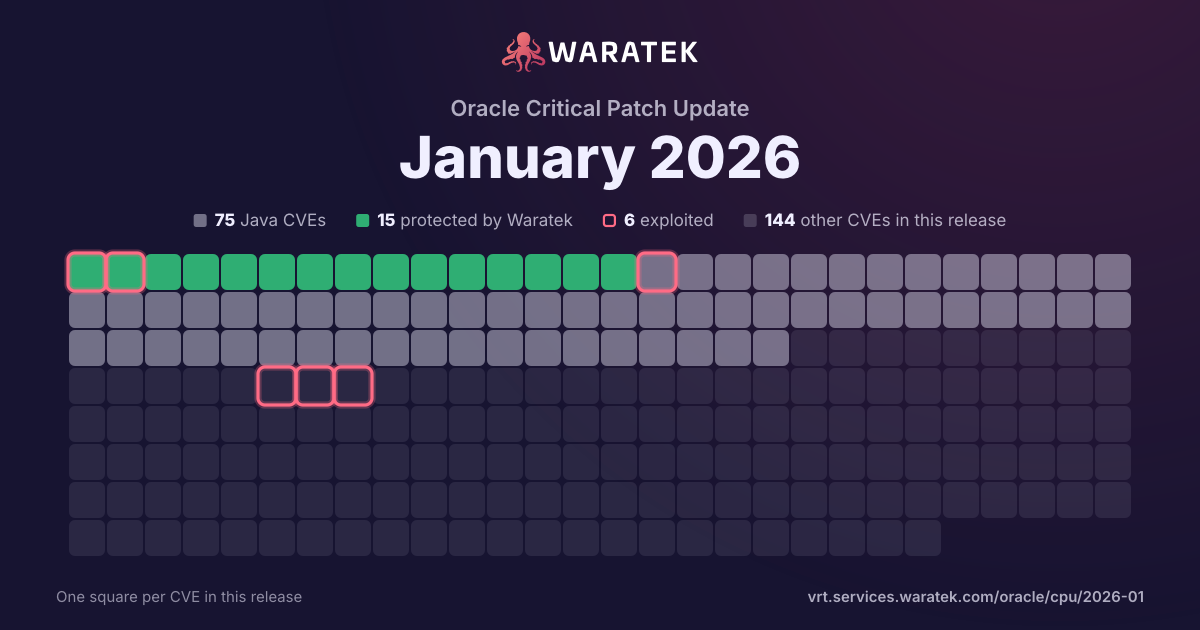
By status
15Protected by Waratek2Mitigation candidate58No exploit published14Outside Waratek scope130Not applicable
6Exploited, marked by the ring
No exploit published. For 26 of them, Oracle's security advisory is the source of public detail.
Protected by Waratek. Waratek RASP can block exploitation of these on systems that have not applied the patch yet.
Overview 3 matches · 2 protected · 1 exploited · 0 CISA KEV · 1 EPSS ≥ 0.5
Protected by Waratek
2
66.7%
Rule in development
0
0.0%
Mitigation candidate
1
33.3%
No exploit published
0
0.0%
blocked by ARMR today
2
66.7%
partly blocked
0
0.0%
not blocked
1
33.3%
not established
0
0.0%
unrecorded
0
0.0%
Exploited
1
33.3%
Working exploit published
2
66.7%
Proof of concept only
0
0.0%
Forecast only
0
0.0%
No public exploit
0
0.0%
split by
peak 1 / quarter
Q4 211
Protected by Waratek1
Medium1
blocked by ARMR today1
Exploited1
Q1 220
Q2 220
Q3 220
Q4 220
Q1 230
Q2 230
Q3 230
Q4 230
Q1 240
Q2 240
Q3 240
Q4 240
Q1 250
Q2 251
Mitigation candidate1
Medium1
not blocked1
Working exploit published1
Q3 251
Protected by Waratek1
Medium1
blocked by ARMR today1
Working exploit published1
Q1 22Q3 22Q1 23Q3 23Q1 24Q3 24Q1 25Q3 25
| CVE | Severity | Published▾ | Status | Exploitation | Description |
|---|---|---|---|---|---|
| CVE-2025-41242 | Medium | 2025-08-18 | Protected by Waratek | Working exploit published | Spring Framework MVC applications can be vulnerable to a “Path Traversal Vulnerability” when deployed on a non-compliant Servlet container. An application can be vulnerable when all the following are true: * the application is deployed as a WAR or with an embedded Servlet container * the Servlet container does not reject suspicious sequences https://jakarta.ee/specifications/servlet/6.1/jakarta-servlet-spec-6.1.html#uri-path-canonicalization * the application serves static resources https://docs.spring.io/spring-framework/reference/web/webmvc/mvc-config/static-resources.html#page-title with Spring resource handling We have verified that applications deployed on Apache Tomcat or Eclipse Jetty are not vulnerable, as long as default security features are not disabled in the configuration. Because we cannot check exploits against all Servlet containers and configuration variants, we strongly recommend upgrading your application. |
| CVE-2025-27533 | Medium | 2025-05-07 | Mitigation candidate | Working exploit published | Memory Allocation with Excessive Size Value vulnerability in Apache ActiveMQ. During unmarshalling of OpenWire commands the size value of buffers was not properly validated which could lead to excessive memory allocation and be exploited to cause a denial of service (DoS) by depleting process memory, thereby affecting applications and services that rely on the availability of the ActiveMQ broker when not using mutual TLS connections. This issue affects Apache ActiveMQ: from 6.0.0 before 6.1.6, from 5.18.0 before 5.18.7, from 5.17.0 before 5.17.7, before 5.16.8. ActiveMQ 5.19.0 is not affected. Users are recommended to upgrade to version 6.1.6+, 5.19.0+, 5.18.7+, 5.17.7, or 5.16.8 or which fixes the issue. Existing users may implement mutual TLS to mitigate the risk on affected brokers. |
| CVE-2021-45105 | Medium | 2021-12-18 | Protected by Waratek | Exploited | Apache Log4j2 versions 2.0-alpha1 through 2.16.0 (excluding 2.12.3 and 2.3.1) did not protect from uncontrolled recursion from self-referential lookups. This allows an attacker with control over Thread Context Map data to cause a denial of service when a crafted string is interpreted. This issue was fixed in Log4j 2.17.0, 2.12.3, and 2.3.1. |