
Oracle Critical Patch Update January 2026
Released January 2026 · Oracle's advisory ↗ · ← Critical Patch Update, October 2025 · Critical Patch Update, April 2026 →
219 CVEs in this release, one square each
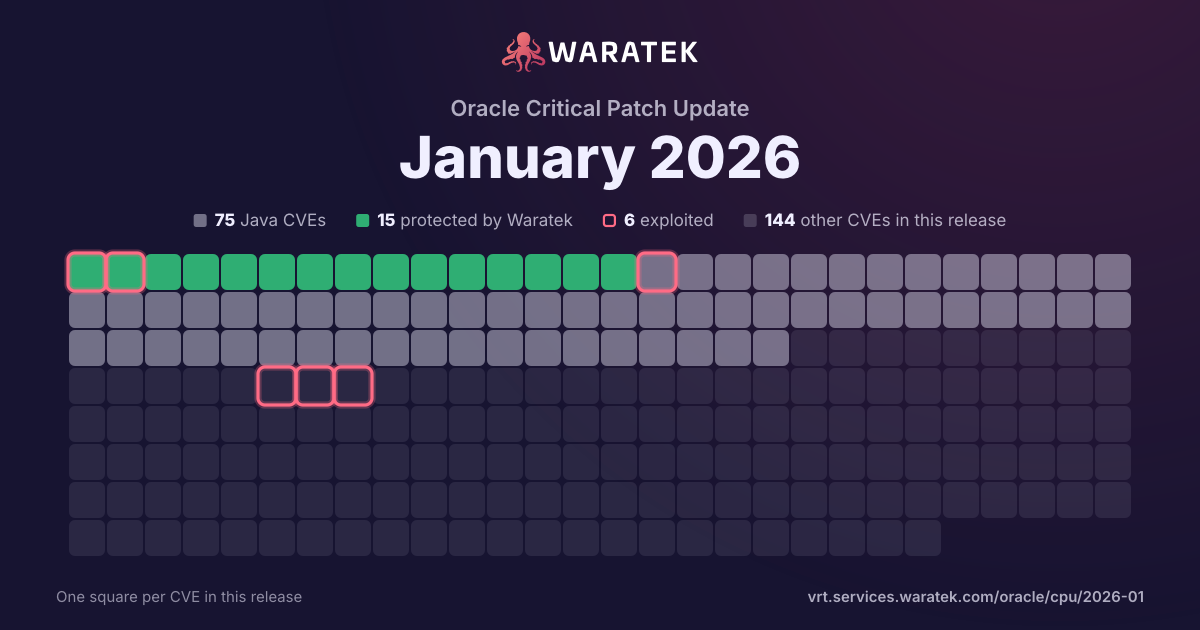
By status
15Protected by Waratek2Mitigation candidate58No exploit published14Outside Waratek scope130Not applicable
6Exploited, marked by the ring
No exploit published. For 26 of them, Oracle's security advisory is the source of public detail.
Protected by Waratek. Waratek RASP can block exploitation of these on systems that have not applied the patch yet.
Overview 8 matches · 3 in Waratek scope · 2 protected · 0 exploited · 0 CISA KEV · 2 EPSS ≥ 0.5
Protected by Waratek
2
25.0%
Rule in development
0
0.0%
Mitigation candidate
1
12.5%
No exploit published
0
0.0%
Outside Waratek scope
0
0.0%
Not applicable
5
62.5%
Withdrawn CVE
0
0.0%
blocked by ARMR today
2
25.0%
partly blocked
0
0.0%
not blocked
6
75.0%
not established
0
0.0%
unrecorded
0
0.0%
Exploited
0
0.0%
Working exploit published
8
100.0%
Proof of concept only
0
0.0%
Forecast only
0
0.0%
No public exploit
0
0.0%
split by
peak 3 / month
May 251
Mitigation candidate1
Medium1
not blocked1
Working exploit published1
Jun 250
Jul 252
Not applicable2
High2
not blocked2
Working exploit published2
Aug 251
Protected by Waratek1
Medium1
blocked by ARMR today1
Working exploit published1
Sep 250
Oct 253
Not applicable3
High3
not blocked3
Working exploit published3
Nov 250
Dec 251
Protected by Waratek1
Critical1
blocked by ARMR today1
Working exploit published1
May 25Jun 25Jul 25Aug 25Sep 25Oct 25Nov 25Dec 25
| CVE | Severity | Published▾ | Status | Exploitation | Description |
|---|---|---|---|---|---|
| CVE-2025-66516 | Critical | 2025-12-04 | Protected by Waratek | Working exploit published | Critical XXE in Apache Tika tika-core (1.13-3.2.1), tika-pdf-module (2.0.0-3.2.1) and tika-parsers (1.13-1.28.5) modules on all platforms allows an attacker to carry out XML External Entity injection via a crafted XFA file inside of a PDF. This CVE covers the same vulnerability as in CVE-2025-54988. However, this CVE expands the scope of affected packages in two ways. First, while the entrypoint for the vulnerability was the tika-parser-pdf-module as reported in CVE-2025-54988, the vulnerability and its fix were in tika-core. Users who upgraded the tika-parser-pdf-module but did not upgrade tika-core to >= 3.2.2 would still be vulnerable. Second, the original report failed to mention that in the 1.x Tika releases, the PDFParser was in the "org.apache.tika:tika-parsers" module. |
| CVE-2025-46819 | High | 2025-10-03 | Not applicable | Working exploit published | Redis is an open source, in-memory database that persists on disk. Versions 8.2.1 and below allow an authenticated user to use a specially crafted LUA script to read out-of-bound data or crash the server and subsequent denial of service. The problem exists in all versions of Redis with Lua scripting. This issue is fixed in version 8.2.2. To workaround this issue without patching the redis-server executable is to prevent users from executing Lua scripts. This can be done using ACL to block a script by restricting both the EVAL and FUNCTION command families. |
| CVE-2025-46818 | High | 2025-10-03 | Not applicable | Working exploit published | Redis is an open source, in-memory database that persists on disk. Versions 8.2.1 and below allow an authenticated user to use a specially crafted Lua script to manipulate different LUA objects and potentially run their own code in the context of another user. The problem exists in all versions of Redis with LUA scripting. This issue is fixed in version 8.2.2. A workaround to mitigate the problem without patching the redis-server executable is to prevent users from executing LUA scripts. This can be done using ACL to block a script by restricting both the EVAL and FUNCTION command families. |
| CVE-2025-46817 | High | 2025-10-03 | Not applicable | Working exploit published | Redis is an open source, in-memory database that persists on disk. Versions 8.2.1 and below allow an authenticated user to use a specially crafted Lua script to cause an integer overflow and potentially lead to remote code execution The problem exists in all versions of Redis with Lua scripting. This issue is fixed in version 8.2.2. |
| CVE-2025-41242 | Medium | 2025-08-18 | Protected by Waratek | Working exploit published | Spring Framework MVC applications can be vulnerable to a “Path Traversal Vulnerability” when deployed on a non-compliant Servlet container. An application can be vulnerable when all the following are true: * the application is deployed as a WAR or with an embedded Servlet container * the Servlet container does not reject suspicious sequences https://jakarta.ee/specifications/servlet/6.1/jakarta-servlet-spec-6.1.html#uri-path-canonicalization * the application serves static resources https://docs.spring.io/spring-framework/reference/web/webmvc/mvc-config/static-resources.html#page-title with Spring resource handling We have verified that applications deployed on Apache Tomcat or Eclipse Jetty are not vulnerable, as long as default security features are not disabled in the configuration. Because we cannot check exploits against all Servlet containers and configuration variants, we strongly recommend upgrading your application. |
| CVE-2025-27210 | High | 2025-07-18 | Not applicable | Working exploit published | An incomplete fix has been identified for CVE-2025-23084 in Node.js, specifically affecting Windows device names like CON, PRN, and AUX. This vulnerability affects Windows users of `path.join` API. |
| CVE-2025-6965 | High | 2025-07-15 | Not applicable | Working exploit published | There exists a vulnerability in SQLite versions before 3.50.2 where the number of aggregate terms could exceed the number of columns available. This could lead to a memory corruption issue. We recommend upgrading to version 3.50.2 or above. |
| CVE-2025-27533 | Medium | 2025-05-07 | Mitigation candidate | Working exploit published | Memory Allocation with Excessive Size Value vulnerability in Apache ActiveMQ. During unmarshalling of OpenWire commands the size value of buffers was not properly validated which could lead to excessive memory allocation and be exploited to cause a denial of service (DoS) by depleting process memory, thereby affecting applications and services that rely on the availability of the ActiveMQ broker when not using mutual TLS connections. This issue affects Apache ActiveMQ: from 6.0.0 before 6.1.6, from 5.18.0 before 5.18.7, from 5.17.0 before 5.17.7, before 5.16.8. ActiveMQ 5.19.0 is not affected. Users are recommended to upgrade to version 6.1.6+, 5.19.0+, 5.18.7+, 5.17.7, or 5.16.8 or which fixes the issue. Existing users may implement mutual TLS to mitigate the risk on affected brokers. |