
Oracle Critical Patch Update January 2026
Released January 2026 · Oracle's advisory ↗ · ← Critical Patch Update, October 2025 · Critical Patch Update, April 2026 →
219 CVEs in this release, one square each
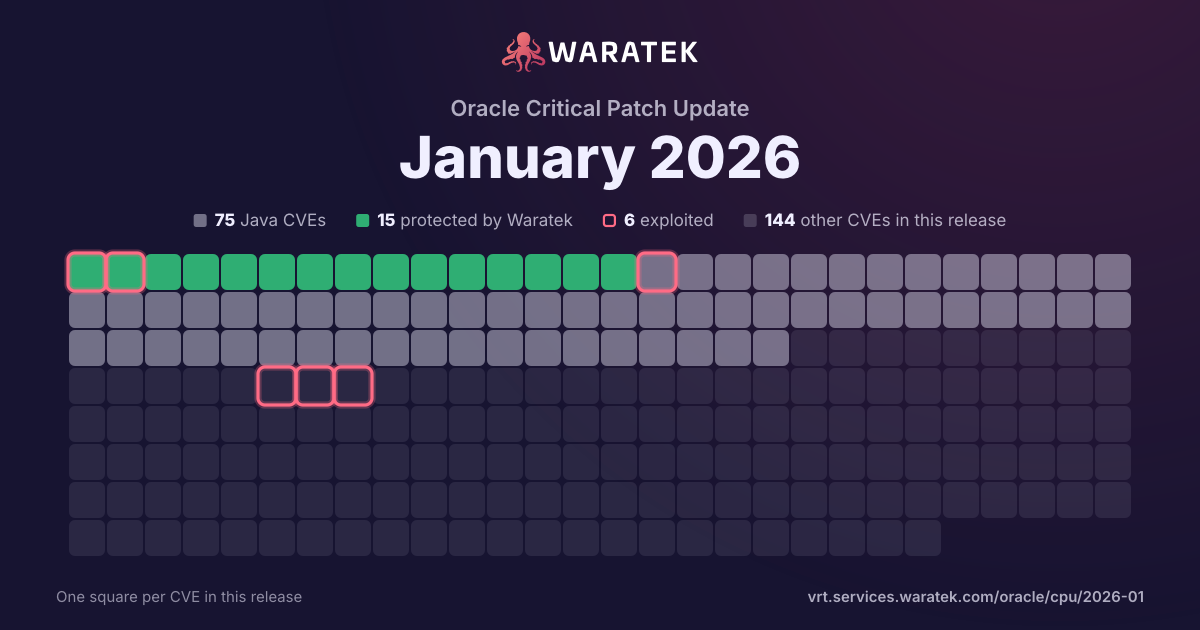
By status
15Protected by Waratek2Mitigation candidate58No exploit published14Outside Waratek scope130Not applicable
6Exploited, marked by the ring
No exploit published. For 26 of them, Oracle's security advisory is the source of public detail.
Protected by Waratek. Waratek RASP can block exploitation of these on systems that have not applied the patch yet.
Overview 7 matches · 1 exploited · 0 CISA KEV · 4 public PoC · 2 EPSS ≥ 0.5
Protected by Waratek
7
100.0%
Rule in development
0
0.0%
Mitigation candidate
0
0.0%
No exploit published
0
0.0%
blocked by ARMR today
7
100.0%
partly blocked
0
0.0%
not blocked
0
0.0%
not established
0
0.0%
unrecorded
0
0.0%
split by
peak 1 / quarter
Q2 201
Protected by Waratek1
Critical1
blocked by ARMR today1
No public exploit1
Q3 200
Q4 200
Q1 210
Q2 210
Q3 210
Q4 211
Protected by Waratek1
Medium1
blocked by ARMR today1
Exploited1
Q1 220
Q2 220
Q3 220
Q4 221
Protected by Waratek1
Critical1
blocked by ARMR today1
Proof of concept only1
Q1 230
Q2 230
Q3 230
Q4 230
Q1 240
Q2 240
Q3 240
Q4 241
Protected by Waratek1
Critical1
blocked by ARMR today1
No public exploit1
Q1 250
Q2 251
Protected by Waratek1
Critical1
blocked by ARMR today1
Proof of concept only1
Q3 251
Protected by Waratek1
Medium1
blocked by ARMR today1
Working exploit published1
Q4 251
Protected by Waratek1
Critical1
blocked by ARMR today1
Working exploit published1
Q2 20Q4 20Q2 21Q4 21Q2 22Q4 22Q2 23Q4 23Q2 24Q4 24Q2 25Q4 25
| CVE | Severity | Published▾ | Status | Exploitation | Description |
|---|---|---|---|---|---|
| CVE-2025-66516 | Critical | 2025-12-04 | Protected by Waratek | Working exploit published | Critical XXE in Apache Tika tika-core (1.13-3.2.1), tika-pdf-module (2.0.0-3.2.1) and tika-parsers (1.13-1.28.5) modules on all platforms allows an attacker to carry out XML External Entity injection via a crafted XFA file inside of a PDF. This CVE covers the same vulnerability as in CVE-2025-54988. However, this CVE expands the scope of affected packages in two ways. First, while the entrypoint for the vulnerability was the tika-parser-pdf-module as reported in CVE-2025-54988, the vulnerability and its fix were in tika-core. Users who upgraded the tika-parser-pdf-module but did not upgrade tika-core to >= 3.2.2 would still be vulnerable. Second, the original report failed to mention that in the 1.x Tika releases, the PDFParser was in the "org.apache.tika:tika-parsers" module. |
| CVE-2025-41242 | Medium | 2025-08-18 | Protected by Waratek | Working exploit published | Spring Framework MVC applications can be vulnerable to a “Path Traversal Vulnerability” when deployed on a non-compliant Servlet container. An application can be vulnerable when all the following are true: * the application is deployed as a WAR or with an embedded Servlet container * the Servlet container does not reject suspicious sequences https://jakarta.ee/specifications/servlet/6.1/jakarta-servlet-spec-6.1.html#uri-path-canonicalization * the application serves static resources https://docs.spring.io/spring-framework/reference/web/webmvc/mvc-config/static-resources.html#page-title with Spring resource handling We have verified that applications deployed on Apache Tomcat or Eclipse Jetty are not vulnerable, as long as default security features are not disabled in the configuration. Because we cannot check exploits against all Servlet containers and configuration variants, we strongly recommend upgrading your application. |
| CVE-2025-30065 | Critical | 2025-04-01 | Protected by Waratek | Proof of concept only | Schema parsing in the parquet-avro module of Apache Parquet 1.15.0 and previous versions allows bad actors to execute arbitrary code Users are recommended to upgrade to version 1.15.1, which fixes the issue. |
| CVE-2024-52046 | Critical | 2024-12-25 | Protected by Waratek | No public exploit | The ObjectSerializationDecoder in Apache MINA uses Java’s native deserialization protocol to process incoming serialized data but lacks the necessary security checks and defenses. This vulnerability allows attackers to exploit the deserialization process by sending specially crafted malicious serialized data, potentially leading to remote code execution (RCE) attacks. This issue affects MINA core versions 2.0.X, 2.1.X and 2.2.X, and will be fixed by the releases 2.0.27, 2.1.10 and 2.2.4. It's also important to note that an application using MINA core library will only be affected if the IoBuffer#getObject() method is called, and this specific method is potentially called when adding a ProtocolCodecFilter instance using the ObjectSerializationCodecFactory class in the filter chain. If your application is specifically using those classes, you have to upgrade to the latest version of MINA core library. Upgrading will not be enough: you also need to explicitly allow the classes the decoder will accept in the ObjectSerializationDecoder instance, using one of the three new methods: /** * Accept class names where the supplied ClassNameMatcher matches for * deserialization, unless they are otherwise rejected. * * @param classNameMatcher the matcher to use */ public void accept(ClassNameMatcher classNameMatcher) /** * Accept class names that match the supplied pattern for * deserialization, unless they are otherwise rejected. * * @param pattern standard Java regexp */ public void accept(Pattern pattern) /** * Accept the wildcard specified classes for deserialization, * unless they are otherwise rejected. * * @param patterns Wildcard file name patterns as defined by * {@link org.apache.commons.io.FilenameUtils#wildcardMatch(String, String) FilenameUtils.wildcardMatch} */ public void accept(String... patterns) By default, the decoder will reject *all* classes that will be present in the incoming data. Note: The FtpServer, SSHd and Vysper sub-project are not affected by this issue. |
| CVE-2022-45047 | Critical | 2022-11-16 | Protected by Waratek | Proof of concept only | Class org.apache.sshd.server.keyprovider.SimpleGeneratorHostKeyProvider in Apache MINA SSHD <= 2.9.1 uses Java deserialization to load a serialized java.security.PrivateKey. The class is one of several implementations that an implementor using Apache MINA SSHD can choose for loading the host keys of an SSH server. |
| CVE-2021-45105 | Medium | 2021-12-18 | Protected by Waratek | Exploited | Apache Log4j2 versions 2.0-alpha1 through 2.16.0 (excluding 2.12.3 and 2.3.1) did not protect from uncontrolled recursion from self-referential lookups. This allows an attacker with control over Thread Context Map data to cause a denial of service when a crafted string is interpreted. This issue was fixed in Log4j 2.17.0, 2.12.3, and 2.3.1. |
| CVE-2020-10683 | Critical | 2020-05-01 | Protected by Waratek | No public exploit | dom4j before 2.0.3 and 2.1.x before 2.1.3 allows external DTDs and External Entities by default, which might enable XXE attacks. However, there is popular external documentation from OWASP showing how to enable the safe, non-default behavior in any application that uses dom4j. |