
Oracle Critical Patch Update October 2025
Released October 2025 · Oracle's advisory ↗ · ← Critical Patch Update, July 2025 · Critical Patch Update, January 2026 →
234 CVEs in this release, one square each
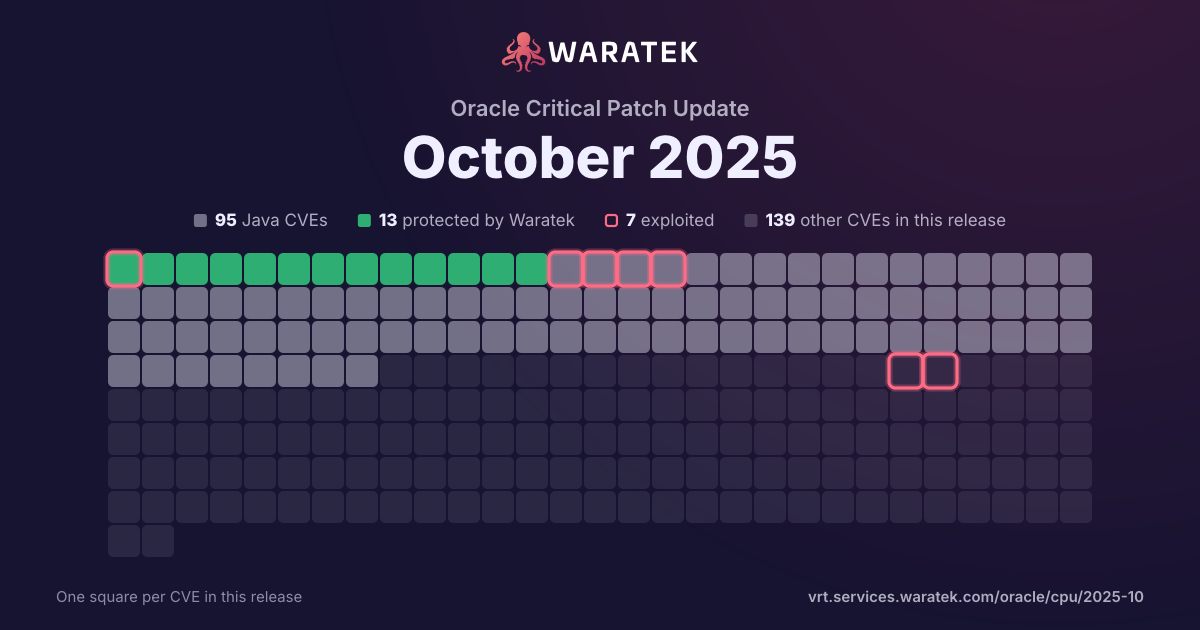
By status
13Protected by Waratek5Mitigation candidate77No exploit published15Outside Waratek scope124Not applicable
7Exploited, marked by the ring
No exploit published. For 36 of them, Oracle's security advisory is the source of public detail.
Protected by Waratek. Waratek RASP can block exploitation of these on systems that have not applied the patch yet.
Overview 124 matches · 0 in Waratek scope · 0 protected · 2 exploited · 2 CISA KEV · 7 public PoC · 2 EPSS ≥ 0.5
124matches
0in Waratek scope0.0%
0protected0.0%
2exploited1.6%
2CISA KEV1.6%
7public PoC5.6%
2EPSS ≥ 0.51.6%
Protected by Waratek
0
0.0%
Rule in development
0
0.0%
Mitigation candidate
0
0.0%
No exploit published
0
0.0%
Outside Waratek scope
0
0.0%
Not applicable
124
100.0%
Withdrawn CVE
0
0.0%
blocked by ARMR today
0
0.0%
partly blocked
0
0.0%
not blocked
124
100.0%
not established
0
0.0%
unrecorded
0
0.0%
split by
peak 37 / quarter
Q2 211
Not applicable1
Medium1
not blocked1
Proof of concept only1
Q3 210
Q4 210
Q1 220
Q2 220
Q3 220
Q4 220
Q1 230
Q2 235
Not applicable5
Medium5
not blocked5
Proof of concept only1
No public exploit4
Q3 230
Q4 231
Not applicable1
Critical1
not blocked1
No public exploit1
Q1 241
Not applicable1
Critical1
not blocked1
No public exploit1
Q2 245
Not applicable5
Critical1
High2
Medium2
not blocked5
Forecast only1
No public exploit4
Q3 244
Not applicable4
High1
Medium3
not blocked4
Proof of concept only1
No public exploit3
Q4 242
Not applicable2
High1
Medium1
not blocked2
No public exploit2
Q1 2510
Not applicable10
High6
Medium3
Low1
not blocked10
Exploited1
Proof of concept only1
No public exploit8
Q2 2525
Not applicable25
Critical3
High10
Medium11
Low1
not blocked25
Proof of concept only8
No public exploit17
Q3 2537
Not applicable37
High19
Medium15
Low3
not blocked37
Exploited1
Working exploit published2
Proof of concept only4
No public exploit30
Q4 2533
Not applicable33
High7
Medium22
Low4
not blocked33
No public exploit33
Q2 21Q4 21Q2 22Q4 22Q2 23Q4 23Q2 24Q4 24Q2 25Q4 25
| CVE | Severity | Published▾ | Status | Exploitation | Description |
|---|---|---|---|---|---|
| CVE-2025-62641 | High | 2025-10-21 | Not applicable | No public exploit | Vulnerability in the Oracle VM VirtualBox product of Oracle Virtualization (component: Core). Supported versions that are affected are 7.1.12 and 7.2.2. Easily exploitable vulnerability allows high privileged attacker with logon to the infrastructure where Oracle VM VirtualBox executes to compromise Oracle VM VirtualBox. While the vulnerability is in Oracle VM VirtualBox, attacks may significantly impact additional products (scope change). Successful attacks of this vulnerability can result in takeover of Oracle VM VirtualBox. CVSS 3.1 Base Score 8.2 (Confidentiality, Integrity and Availability impacts). CVSS Vector: (CVSS:3.1/AV:L/AC:L/PR:H/UI:N/S:C/C:H/I:H/A:H). |
| CVE-2025-62592 | Medium | 2025-10-21 | Not applicable | No public exploit | Vulnerability in the Oracle VM VirtualBox product of Oracle Virtualization (component: Core). Supported versions that are affected are 7.1.12 and 7.2.2. Easily exploitable vulnerability allows high privileged attacker with logon to the infrastructure where Oracle VM VirtualBox executes to compromise Oracle VM VirtualBox. While the vulnerability is in Oracle VM VirtualBox, attacks may significantly impact additional products (scope change). Successful attacks of this vulnerability can result in unauthorized access to critical data or complete access to all Oracle VM VirtualBox accessible data. CVSS 3.1 Base Score 6.0 (Confidentiality impacts). CVSS Vector: (CVSS:3.1/AV:L/AC:L/PR:H/UI:N/S:C/C:H/I:N/A:N). |
| CVE-2025-62591 | Medium | 2025-10-21 | Not applicable | No public exploit | Vulnerability in the Oracle VM VirtualBox product of Oracle Virtualization (component: Core). Supported versions that are affected are 7.1.12 and 7.2.2. Easily exploitable vulnerability allows high privileged attacker with logon to the infrastructure where Oracle VM VirtualBox executes to compromise Oracle VM VirtualBox. While the vulnerability is in Oracle VM VirtualBox, attacks may significantly impact additional products (scope change). Successful attacks of this vulnerability can result in unauthorized access to critical data or complete access to all Oracle VM VirtualBox accessible data. CVSS 3.1 Base Score 6.0 (Confidentiality impacts). CVSS Vector: (CVSS:3.1/AV:L/AC:L/PR:H/UI:N/S:C/C:H/I:N/A:N). |
| CVE-2025-62590 | High | 2025-10-21 | Not applicable | No public exploit | Vulnerability in the Oracle VM VirtualBox product of Oracle Virtualization (component: Core). Supported versions that are affected are 7.1.12 and 7.2.2. Easily exploitable vulnerability allows high privileged attacker with logon to the infrastructure where Oracle VM VirtualBox executes to compromise Oracle VM VirtualBox. While the vulnerability is in Oracle VM VirtualBox, attacks may significantly impact additional products (scope change). Successful attacks of this vulnerability can result in takeover of Oracle VM VirtualBox. CVSS 3.1 Base Score 8.2 (Confidentiality, Integrity and Availability impacts). CVSS Vector: (CVSS:3.1/AV:L/AC:L/PR:H/UI:N/S:C/C:H/I:H/A:H). |
| CVE-2025-62589 | High | 2025-10-21 | Not applicable | No public exploit | Vulnerability in the Oracle VM VirtualBox product of Oracle Virtualization (component: Core). Supported versions that are affected are 7.1.12 and 7.2.2. Easily exploitable vulnerability allows high privileged attacker with logon to the infrastructure where Oracle VM VirtualBox executes to compromise Oracle VM VirtualBox. While the vulnerability is in Oracle VM VirtualBox, attacks may significantly impact additional products (scope change). Successful attacks of this vulnerability can result in takeover of Oracle VM VirtualBox. CVSS 3.1 Base Score 8.2 (Confidentiality, Integrity and Availability impacts). CVSS Vector: (CVSS:3.1/AV:L/AC:L/PR:H/UI:N/S:C/C:H/I:H/A:H). |
| CVE-2025-62588 | High | 2025-10-21 | Not applicable | No public exploit | Vulnerability in the Oracle VM VirtualBox product of Oracle Virtualization (component: Core). Supported versions that are affected are 7.1.12 and 7.2.2. Easily exploitable vulnerability allows high privileged attacker with logon to the infrastructure where Oracle VM VirtualBox executes to compromise Oracle VM VirtualBox. While the vulnerability is in Oracle VM VirtualBox, attacks may significantly impact additional products (scope change). Successful attacks of this vulnerability can result in takeover of Oracle VM VirtualBox. CVSS 3.1 Base Score 8.2 (Confidentiality, Integrity and Availability impacts). CVSS Vector: (CVSS:3.1/AV:L/AC:L/PR:H/UI:N/S:C/C:H/I:H/A:H). |
| CVE-2025-62587 | High | 2025-10-21 | Not applicable | No public exploit | Vulnerability in the Oracle VM VirtualBox product of Oracle Virtualization (component: Core). Supported versions that are affected are 7.1.12 and 7.2.2. Easily exploitable vulnerability allows high privileged attacker with logon to the infrastructure where Oracle VM VirtualBox executes to compromise Oracle VM VirtualBox. While the vulnerability is in Oracle VM VirtualBox, attacks may significantly impact additional products (scope change). Successful attacks of this vulnerability can result in takeover of Oracle VM VirtualBox. CVSS 3.1 Base Score 8.2 (Confidentiality, Integrity and Availability impacts). CVSS Vector: (CVSS:3.1/AV:L/AC:L/PR:H/UI:N/S:C/C:H/I:H/A:H). |
| CVE-2025-62480 | Low | 2025-10-21 | Not applicable | No public exploit | Vulnerability in the Oracle ZFS Storage Appliance Kit product of Oracle Systems (component: Naming Subsystem). The supported version that is affected is 8.8. Easily exploitable vulnerability allows high privileged attacker with network access via HTTP to compromise Oracle ZFS Storage Appliance Kit. Successful attacks of this vulnerability can result in unauthorized ability to cause a partial denial of service (partial DOS) of Oracle ZFS Storage Appliance Kit. CVSS 3.1 Base Score 2.7 (Availability impacts). CVSS Vector: (CVSS:3.1/AV:N/AC:L/PR:H/UI:N/S:U/C:N/I:N/A:L). |
| CVE-2025-62479 | Low | 2025-10-21 | Not applicable | No public exploit | Vulnerability in the Oracle ZFS Storage Appliance Kit product of Oracle Systems (component: Block Storage). The supported version that is affected is 8.8. Easily exploitable vulnerability allows high privileged attacker with network access via HTTP to compromise Oracle ZFS Storage Appliance Kit. Successful attacks of this vulnerability can result in unauthorized ability to cause a partial denial of service (partial DOS) of Oracle ZFS Storage Appliance Kit. CVSS 3.1 Base Score 2.7 (Availability impacts). CVSS Vector: (CVSS:3.1/AV:N/AC:L/PR:H/UI:N/S:U/C:N/I:N/A:L). |
| CVE-2025-62478 | Medium | 2025-10-21 | Not applicable | No public exploit | Vulnerability in the Oracle ZFS Storage Appliance Kit product of Oracle Systems (component: Object Store). The supported version that is affected is 8.8. Easily exploitable vulnerability allows high privileged attacker with network access via HTTP to compromise Oracle ZFS Storage Appliance Kit. Successful attacks of this vulnerability can result in unauthorized ability to cause a hang or frequently repeatable crash (complete DOS) of Oracle ZFS Storage Appliance Kit. CVSS 3.1 Base Score 4.9 (Availability impacts). CVSS Vector: (CVSS:3.1/AV:N/AC:L/PR:H/UI:N/S:U/C:N/I:N/A:H). |
| CVE-2025-62477 | Medium | 2025-10-21 | Not applicable | No public exploit | Vulnerability in the Oracle ZFS Storage Appliance Kit product of Oracle Systems (component: Remote Replication). The supported version that is affected is 8.8. Easily exploitable vulnerability allows high privileged attacker with network access via HTTP to compromise Oracle ZFS Storage Appliance Kit. Successful attacks of this vulnerability can result in unauthorized ability to cause a hang or frequently repeatable crash (complete DOS) of Oracle ZFS Storage Appliance Kit. CVSS 3.1 Base Score 4.9 (Availability impacts). CVSS Vector: (CVSS:3.1/AV:N/AC:L/PR:H/UI:N/S:U/C:N/I:N/A:H). |
| CVE-2025-62476 | Medium | 2025-10-21 | Not applicable | No public exploit | Vulnerability in the Oracle ZFS Storage Appliance Kit product of Oracle Systems (component: Remote Replication). The supported version that is affected is 8.8. Easily exploitable vulnerability allows high privileged attacker with network access via HTTP to compromise Oracle ZFS Storage Appliance Kit. Successful attacks of this vulnerability can result in unauthorized ability to cause a hang or frequently repeatable crash (complete DOS) of Oracle ZFS Storage Appliance Kit. CVSS 3.1 Base Score 4.9 (Availability impacts). CVSS Vector: (CVSS:3.1/AV:N/AC:L/PR:H/UI:N/S:U/C:N/I:N/A:H). |
| CVE-2025-62475 | Medium | 2025-10-21 | Not applicable | No public exploit | Vulnerability in the Oracle ZFS Storage Appliance Kit product of Oracle Systems (component: Core). The supported version that is affected is 8.8. Easily exploitable vulnerability allows high privileged attacker with network access via HTTP to compromise Oracle ZFS Storage Appliance Kit. Successful attacks of this vulnerability can result in unauthorized ability to cause a hang or frequently repeatable crash (complete DOS) of Oracle ZFS Storage Appliance Kit. CVSS 3.1 Base Score 4.9 (Availability impacts). CVSS Vector: (CVSS:3.1/AV:N/AC:L/PR:H/UI:N/S:U/C:N/I:N/A:H). |
| CVE-2025-62290 | High | 2025-10-21 | Not applicable | No public exploit | Vulnerability in the Oracle ZFS Storage Appliance Kit product of Oracle Systems (component: Block Storage). The supported version that is affected is 8.8. Easily exploitable vulnerability allows high privileged attacker with network access via HTTP to compromise Oracle ZFS Storage Appliance Kit. Successful attacks of this vulnerability can result in takeover of Oracle ZFS Storage Appliance Kit. CVSS 3.1 Base Score 7.2 (Confidentiality, Integrity and Availability impacts). CVSS Vector: (CVSS:3.1/AV:N/AC:L/PR:H/UI:N/S:U/C:H/I:H/A:H). |
| CVE-2025-62289 | Medium | 2025-10-21 | Not applicable | No public exploit | Vulnerability in the Oracle ZFS Storage Appliance Kit product of Oracle Systems (component: Filesystems). The supported version that is affected is 8.8. Easily exploitable vulnerability allows high privileged attacker with network access via HTTP to compromise Oracle ZFS Storage Appliance Kit. Successful attacks of this vulnerability can result in unauthorized ability to cause a hang or frequently repeatable crash (complete DOS) of Oracle ZFS Storage Appliance Kit. CVSS 3.1 Base Score 4.9 (Availability impacts). CVSS Vector: (CVSS:3.1/AV:N/AC:L/PR:H/UI:N/S:U/C:N/I:N/A:H). |
| CVE-2025-61881 | Medium | 2025-10-21 | Not applicable | No public exploit | Vulnerability in the Java VM component of Oracle Database Server. Supported versions that are affected are 19.3-19.28, 21.3-21.19 and 23.4-23.9. Difficult to exploit vulnerability allows unauthenticated attacker with network access via Oracle Net to compromise Java VM. Successful attacks of this vulnerability can result in unauthorized creation, deletion or modification access to critical data or all Java VM accessible data. CVSS 3.1 Base Score 5.9 (Integrity impacts). CVSS Vector: (CVSS:3.1/AV:N/AC:H/PR:N/UI:N/S:U/C:N/I:H/A:N). |
| CVE-2025-61760 | High | 2025-10-21 | Not applicable | No public exploit | Vulnerability in the Oracle VM VirtualBox product of Oracle Virtualization (component: Core). Supported versions that are affected are 7.1.12 and 7.2.2. Difficult to exploit vulnerability allows low privileged attacker with logon to the infrastructure where Oracle VM VirtualBox executes to compromise Oracle VM VirtualBox. Successful attacks require human interaction from a person other than the attacker and while the vulnerability is in Oracle VM VirtualBox, attacks may significantly impact additional products (scope change). Successful attacks of this vulnerability can result in takeover of Oracle VM VirtualBox. CVSS 3.1 Base Score 7.5 (Confidentiality, Integrity and Availability impacts). CVSS Vector: (CVSS:3.1/AV:L/AC:H/PR:L/UI:R/S:C/C:H/I:H/A:H). |
| CVE-2025-61759 | Medium | 2025-10-21 | Not applicable | No public exploit | Vulnerability in the Oracle VM VirtualBox product of Oracle Virtualization (component: Core). Supported versions that are affected are 7.1.12 and 7.2.2. Easily exploitable vulnerability allows low privileged attacker with logon to the infrastructure where Oracle VM VirtualBox executes to compromise Oracle VM VirtualBox. While the vulnerability is in Oracle VM VirtualBox, attacks may significantly impact additional products (scope change). Successful attacks of this vulnerability can result in unauthorized access to critical data or complete access to all Oracle VM VirtualBox accessible data. CVSS 3.1 Base Score 6.5 (Confidentiality impacts). CVSS Vector: (CVSS:3.1/AV:L/AC:L/PR:L/UI:N/S:C/C:H/I:N/A:N). |
| CVE-2025-61749 | Low | 2025-10-21 | Not applicable | No public exploit | Vulnerability in the Unified Audit component of Oracle Database Server. Supported versions that are affected are 23.4-23.9. Easily exploitable vulnerability allows high privileged attacker having DBA privilege with network access via Oracle Net to compromise Unified Audit. Successful attacks of this vulnerability can result in unauthorized update, insert or delete access to some of Unified Audit accessible data. CVSS 3.1 Base Score 2.7 (Integrity impacts). CVSS Vector: (CVSS:3.1/AV:N/AC:L/PR:H/UI:N/S:U/C:N/I:L/A:N). |
| CVE-2025-53070 | Medium | 2025-10-21 | Not applicable | No public exploit | Vulnerability in the Oracle Solaris product of Oracle Systems (component: Filesystem). The supported version that is affected is 11. Easily exploitable vulnerability allows high privileged attacker with logon to the infrastructure where Oracle Solaris executes to compromise Oracle Solaris. Successful attacks require human interaction from a person other than the attacker and while the vulnerability is in Oracle Solaris, attacks may significantly impact additional products (scope change). Successful attacks of this vulnerability can result in unauthorized ability to cause a hang or frequently repeatable crash (complete DOS) of Oracle Solaris. CVSS 3.1 Base Score 5.5 (Availability impacts). CVSS Vector: (CVSS:3.1/AV:L/AC:L/PR:H/UI:R/S:C/C:N/I:N/A:H). |
| CVE-2025-53069 | Medium | 2025-10-21 | Not applicable | No public exploit | Vulnerability in the MySQL Server product of Oracle MySQL (component: Server: Components Services). Supported versions that are affected are 8.0.0-8.0.43, 8.4.0-8.4.6 and 9.0.0-9.4.0. Easily exploitable vulnerability allows high privileged attacker with network access via multiple protocols to compromise MySQL Server. Successful attacks of this vulnerability can result in unauthorized ability to cause a hang or frequently repeatable crash (complete DOS) of MySQL Server. CVSS 3.1 Base Score 4.9 (Availability impacts). CVSS Vector: (CVSS:3.1/AV:N/AC:L/PR:H/UI:N/S:U/C:N/I:N/A:H). |
| CVE-2025-53068 | Medium | 2025-10-21 | Not applicable | No public exploit | Vulnerability in the Oracle Solaris product of Oracle Systems (component: Kernel). The supported version that is affected is 11. Easily exploitable vulnerability allows low privileged attacker with logon to the infrastructure where Oracle Solaris executes to compromise Oracle Solaris. While the vulnerability is in Oracle Solaris, attacks may significantly impact additional products (scope change). Successful attacks of this vulnerability can result in unauthorized ability to cause a hang or frequently repeatable crash (complete DOS) of Oracle Solaris. CVSS 3.1 Base Score 6.5 (Availability impacts). CVSS Vector: (CVSS:3.1/AV:L/AC:L/PR:L/UI:N/S:C/C:N/I:N/A:H). |
| CVE-2025-53067 | Medium | 2025-10-21 | Not applicable | No public exploit | Vulnerability in the MySQL Server product of Oracle MySQL (component: Server: Optimizer). Supported versions that are affected are 9.0.0-9.4.0. Easily exploitable vulnerability allows high privileged attacker with network access via multiple protocols to compromise MySQL Server. Successful attacks of this vulnerability can result in unauthorized ability to cause a hang or frequently repeatable crash (complete DOS) of MySQL Server. CVSS 3.1 Base Score 4.9 (Availability impacts). CVSS Vector: (CVSS:3.1/AV:N/AC:L/PR:H/UI:N/S:U/C:N/I:N/A:H). |
| CVE-2025-53062 | Medium | 2025-10-21 | Not applicable | No public exploit | Vulnerability in the MySQL Server product of Oracle MySQL (component: InnoDB). Supported versions that are affected are 8.0.0-8.0.43, 8.4.0-8.4.6 and 9.0.0-9.4.0. Easily exploitable vulnerability allows high privileged attacker with network access via multiple protocols to compromise MySQL Server. Successful attacks of this vulnerability can result in unauthorized ability to cause a hang or frequently repeatable crash (complete DOS) of MySQL Server. CVSS 3.1 Base Score 4.9 (Availability impacts). CVSS Vector: (CVSS:3.1/AV:N/AC:L/PR:H/UI:N/S:U/C:N/I:N/A:H). |
| CVE-2025-53054 | Medium | 2025-10-21 | Not applicable | No public exploit | Vulnerability in the MySQL Server product of Oracle MySQL (component: InnoDB). Supported versions that are affected are 8.0.0-8.0.43, 8.4.0-8.4.6 and 9.0.0-9.4.0. Easily exploitable vulnerability allows high privileged attacker with network access via multiple protocols to compromise MySQL Server. Successful attacks of this vulnerability can result in unauthorized ability to cause a hang or frequently repeatable crash (complete DOS) of MySQL Server as well as unauthorized update, insert or delete access to some of MySQL Server accessible data. CVSS 3.1 Base Score 5.5 (Integrity and Availability impacts). CVSS Vector: (CVSS:3.1/AV:N/AC:L/PR:H/UI:N/S:U/C:N/I:L/A:H). |
| CVE-2025-53053 | Medium | 2025-10-21 | Not applicable | No public exploit | Vulnerability in the MySQL Server product of Oracle MySQL (component: Server: DML). Supported versions that are affected are 8.0.0-8.0.43, 8.4.0-8.4.6 and 9.0.0-9.4.0. Easily exploitable vulnerability allows high privileged attacker with network access via multiple protocols to compromise MySQL Server. Successful attacks of this vulnerability can result in unauthorized ability to cause a hang or frequently repeatable crash (complete DOS) of MySQL Server as well as unauthorized update, insert or delete access to some of MySQL Server accessible data. CVSS 3.1 Base Score 5.5 (Integrity and Availability impacts). CVSS Vector: (CVSS:3.1/AV:N/AC:L/PR:H/UI:N/S:U/C:N/I:L/A:H). |
| CVE-2025-53051 | Low | 2025-10-21 | Not applicable | No public exploit | Vulnerability in the RDBMS Functional Index component of Oracle Database Server. Supported versions that are affected are 23.4-23.9. Easily exploitable vulnerability allows high privileged attacker having SYSDBA privilege with network access via Oracle Net to compromise RDBMS Functional Index. Successful attacks of this vulnerability can result in unauthorized read access to a subset of RDBMS Functional Index accessible data. CVSS 3.1 Base Score 2.7 (Confidentiality impacts). CVSS Vector: (CVSS:3.1/AV:N/AC:L/PR:H/UI:N/S:U/C:L/I:N/A:N). |
| CVE-2025-53047 | Medium | 2025-10-21 | Not applicable | No public exploit | Vulnerability in the Portable Clusterware component of Oracle Database Server. Supported versions that are affected are 19.3-19.28, 21.3-21.19 and 23.4-23.9. Easily exploitable vulnerability allows unauthenticated attacker with network access via Bonjour to compromise Portable Clusterware. While the vulnerability is in Portable Clusterware, attacks may significantly impact additional products (scope change). Successful attacks of this vulnerability can result in unauthorized read access to a subset of Portable Clusterware accessible data. CVSS 3.1 Base Score 5.8 (Confidentiality impacts). CVSS Vector: (CVSS:3.1/AV:N/AC:L/PR:N/UI:N/S:C/C:L/I:N/A:N). |
| CVE-2025-53046 | Medium | 2025-10-21 | Not applicable | No public exploit | Vulnerability in the Oracle ZFS Storage Appliance Kit product of Oracle Systems (component: Analytics). The supported version that is affected is 8.8. Easily exploitable vulnerability allows high privileged attacker with network access via HTTP to compromise Oracle ZFS Storage Appliance Kit. Successful attacks of this vulnerability can result in unauthorized ability to cause a hang or frequently repeatable crash (complete DOS) of Oracle ZFS Storage Appliance Kit. CVSS 3.1 Base Score 4.9 (Availability impacts). CVSS Vector: (CVSS:3.1/AV:N/AC:L/PR:H/UI:N/S:U/C:N/I:N/A:H). |
| CVE-2025-53045 | Medium | 2025-10-21 | Not applicable | No public exploit | Vulnerability in the MySQL Server product of Oracle MySQL (component: InnoDB). Supported versions that are affected are 8.0.0-8.0.43, 8.4.0-8.4.6 and 9.0.0-9.4.0. Easily exploitable vulnerability allows high privileged attacker with network access via multiple protocols to compromise MySQL Server. Successful attacks of this vulnerability can result in unauthorized ability to cause a hang or frequently repeatable crash (complete DOS) of MySQL Server. CVSS 3.1 Base Score 4.9 (Availability impacts). CVSS Vector: (CVSS:3.1/AV:N/AC:L/PR:H/UI:N/S:U/C:N/I:N/A:H). |
| CVE-2025-53044 | Medium | 2025-10-21 | Not applicable | No public exploit | Vulnerability in the MySQL Server product of Oracle MySQL (component: InnoDB). Supported versions that are affected are 8.0.0-8.0.43, 8.4.0-8.4.6 and 9.0.0-9.4.0. Easily exploitable vulnerability allows high privileged attacker with network access via multiple protocols to compromise MySQL Server. Successful attacks of this vulnerability can result in unauthorized ability to cause a hang or frequently repeatable crash (complete DOS) of MySQL Server. CVSS 3.1 Base Score 4.9 (Availability impacts). CVSS Vector: (CVSS:3.1/AV:N/AC:L/PR:H/UI:N/S:U/C:N/I:N/A:H). |
| CVE-2025-53042 | Medium | 2025-10-21 | Not applicable | No public exploit | Vulnerability in the MySQL Server product of Oracle MySQL (component: Server: Optimizer). Supported versions that are affected are 8.0.0-8.0.43, 8.4.0-8.4.6 and 9.0.0-9.4.0. Easily exploitable vulnerability allows high privileged attacker with network access via multiple protocols to compromise MySQL Server. Successful attacks of this vulnerability can result in unauthorized ability to cause a hang or frequently repeatable crash (complete DOS) of MySQL Server. CVSS 3.1 Base Score 4.9 (Availability impacts). CVSS Vector: (CVSS:3.1/AV:N/AC:L/PR:H/UI:N/S:U/C:N/I:N/A:H). |
| CVE-2025-53040 | Medium | 2025-10-21 | Not applicable | No public exploit | Vulnerability in the MySQL Server product of Oracle MySQL (component: Server: Optimizer). Supported versions that are affected are 8.0.0-8.0.43, 8.4.0-8.4.6 and 9.0.0-9.4.0. Easily exploitable vulnerability allows high privileged attacker with network access via multiple protocols to compromise MySQL Server. Successful attacks of this vulnerability can result in unauthorized ability to cause a hang or frequently repeatable crash (complete DOS) of MySQL Server. CVSS 3.1 Base Score 4.9 (Availability impacts). CVSS Vector: (CVSS:3.1/AV:N/AC:L/PR:H/UI:N/S:U/C:N/I:N/A:H). |
| CVE-2024-48014 | High | 2025-09-25 | Not applicable | No public exploit | Dell BSAFE Micro Edition Suite, versions prior to 5.0.2.3 contain an Out-of-bounds Write vulnerability. An unauthenticated attacker with remote access could potentially exploit this vulnerability, leading to denial of service. |
| CVE-2025-59375 | High | 2025-09-15 | Not applicable | No public exploit | libexpat in Expat before 2.7.2 allows attackers to trigger large dynamic memory allocations via a small document that is submitted for parsing. |
| CVE-2025-9086 | High | 2025-09-12 | Not applicable | No public exploit | 1. A cookie is set using the `secure` keyword for `https://target` 2. curl is redirected to or otherwise made to speak with `http://target` (same hostname, but using clear text HTTP) using the same cookie set 3. The same cookie name is set - but with only a slash as path (`path="/"`). Since this site is not secure, the cookie *should* be ignored. 4. A bug in the path comparison logic makes curl read outside a heap buffer boundary The bug either causes a crash or it potentially makes the comparison come to the wrong conclusion and lets the clear-text site override the contents of the secure cookie, contrary to expectations and depending on the memory contents immediately following the single-byte allocation that holds the path. The presumed and correct behavior would be to plainly ignore the second set of the cookie since it was already set as secure on a secure host so overriding it on an insecure host should not be okay. |
| CVE-2025-10148 | Medium | 2025-09-12 | Not applicable | No public exploit | curl's WebSocket code did not update the 32-bit mask pattern for each new outgoing frame as the specification says. Instead it used a fixed mask that persisted and was used throughout the entire connection. A predictable mask pattern allows for a malicious server to induce traffic between the two communicating parties that could be interpreted by an involved proxy (configured or transparent) as genuine, real, HTTP traffic with content and thereby poison its cache. That cached poisoned content could then be served to all users of that proxy. |
| CVE-2025-57803 | High | 2025-08-26 | Not applicable | No public exploit | ImageMagick is free and open-source software used for editing and manipulating digital images. Prior to versions 6.9.13-28 and 7.1.2-2 for ImageMagick's 32-bit build, a 32-bit integer overflow in the BMP encoder’s scanline-stride computation collapses bytes_per_line (stride) to a tiny value while the per-row writer still emits 3 × width bytes for 24-bpp images. The row base pointer advances using the (overflowed) stride, so the first row immediately writes past its slot and into adjacent heap memory with attacker-controlled bytes. This is a classic, powerful primitive for heap corruption in common auto-convert pipelines. This issue has been patched in versions 6.9.13-28 and 7.1.2-2. |
| CVE-2025-55298 | High | 2025-08-26 | Not applicable | Proof of concept only | ImageMagick is free and open-source software used for editing and manipulating digital images. Prior to ImageMagick versions 6.9.13-28 and 7.1.2-2, a format string bug vulnerability exists in InterpretImageFilename function where user input is directly passed to FormatLocaleString without proper sanitization. An attacker can overwrite arbitrary memory regions, enabling a wide range of attacks from heap overflow to remote code execution. This issue has been patched in versions 6.9.13-28 and 7.1.2-2. |
| CVE-2025-55212 | High | 2025-08-26 | Not applicable | Proof of concept only | ImageMagick is free and open-source software used for editing and manipulating digital images. Prior to versions 6.9.13-28 and 7.1.2-2, passing a geometry string containing only a colon (":") to montage -geometry leads GetGeometry() to set width/height to 0. Later, ThumbnailImage() divides by these zero dimensions, triggering a crash (SIGFPE/abort), resulting in a denial of service. This issue has been patched in versions 6.9.13-28 and 7.1.2-2. |
| CVE-2025-4877 | Medium | 2025-08-20 | Not applicable | No public exploit | There's a vulnerability in the libssh package where when a libssh consumer passes in an unexpectedly large input buffer to ssh_get_fingerprint_hash() function. In such cases the bin_to_base64() function can experience an integer overflow leading to a memory under allocation, when that happens it's possible that the program perform out of bounds write leading to a heap corruption. This issue affects only 32-bits builds of libssh. |
| CVE-2025-43265 | Medium | 2025-07-30 | Not applicable | No public exploit | An out-of-bounds read was addressed with improved input validation. This issue is fixed in Safari 18.6, iOS 18.6 and iPadOS 18.6, macOS Sequoia 15.6, tvOS 18.6, visionOS 2.6, watchOS 11.6. Processing maliciously crafted web content may disclose internal states of the app. |
| CVE-2025-43240 | Medium | 2025-07-30 | Not applicable | No public exploit | A logic issue was addressed with improved checks. This issue is fixed in Safari 18.6, macOS Sequoia 15.6. A download's origin may be incorrectly associated. |
| CVE-2025-43228 | Medium | 2025-07-30 | Not applicable | No public exploit | The issue was addressed with improved UI. This issue is fixed in Safari 18.6, iOS 18.6 and iPadOS 18.6. Visiting a malicious website may lead to address bar spoofing. |
| CVE-2025-43227 | High | 2025-07-30 | Not applicable | No public exploit | This issue was addressed through improved state management. This issue is fixed in Safari 18.6, iOS 18.6 and iPadOS 18.6, macOS Sequoia 15.6, tvOS 18.6, visionOS 2.6, watchOS 11.6. Processing maliciously crafted web content may disclose sensitive user information. |
| CVE-2025-43216 | Medium | 2025-07-30 | Not applicable | No public exploit | A use-after-free issue was addressed with improved memory management. This issue is fixed in Safari 18.6, iOS 18.6 and iPadOS 18.6, iPadOS 17.7.9, macOS Sequoia 15.6, tvOS 18.6, visionOS 2.6, watchOS 11.6. Processing maliciously crafted web content may lead to an unexpected Safari crash. |
| CVE-2025-43212 | Medium | 2025-07-30 | Not applicable | No public exploit | The issue was addressed with improved memory handling. This issue is fixed in Safari 18.6, iOS 18.6 and iPadOS 18.6, macOS Sequoia 15.6, tvOS 18.6, visionOS 2.6, watchOS 11.6. Processing maliciously crafted web content may lead to an unexpected Safari crash. |
| CVE-2025-43211 | Medium | 2025-07-30 | Not applicable | No public exploit | The issue was addressed with improved memory handling. This issue is fixed in Safari 18.6, iOS 18.6 and iPadOS 18.6, iPadOS 17.7.9, macOS Sequoia 15.6, tvOS 18.6, visionOS 2.6, watchOS 11.6. Processing web content may lead to a denial-of-service. |
| CVE-2025-31278 | High | 2025-07-30 | Not applicable | No public exploit | The issue was addressed with improved memory handling. This issue is fixed in Safari 18.6, iOS 18.6 and iPadOS 18.6, iPadOS 17.7.9, macOS Sequoia 15.6, tvOS 18.6, visionOS 2.6, watchOS 11.6. Processing maliciously crafted web content may lead to memory corruption. |
| CVE-2025-31273 | High | 2025-07-30 | Not applicable | No public exploit | The issue was addressed with improved memory handling. This issue is fixed in Safari 18.6, iOS 18.6 and iPadOS 18.6, macOS Sequoia 15.6, tvOS 18.6, visionOS 2.6, watchOS 11.6. Processing maliciously crafted web content may lead to memory corruption. |
| CVE-2025-5449 | Medium | 2025-07-25 | Not applicable | No public exploit | A flaw was found in the SFTP server message decoding logic of libssh. The issue occurs due to an incorrect packet length check that allows an integer overflow when handling large payload sizes on 32-bit systems. This issue leads to failed memory allocation and causes the server process to crash, resulting in a denial of service. |
| CVE-2025-8058 | Medium | 2025-07-23 | Not applicable | No public exploit | The regcomp function in the GNU C library version from 2.4 to 2.41 is subject to a double free if some previous allocation fails. It can be accomplished either by a malloc failure or by using an interposed malloc that injects random malloc failures. The double free can allow buffer manipulation depending of how the regex is constructed. This issue affects all architectures and ABIs supported by the GNU C library. |
| CVE-2025-54090 | Medium | 2025-07-23 | Not applicable | No public exploit | A bug in Apache HTTP Server 2.4.64 results in all "RewriteCond expr ..." tests evaluating as "true". Users are recommended to upgrade to version 2.4.65, which fixes the issue. |
| CVE-2025-4878 | Low | 2025-07-22 | Not applicable | No public exploit | A vulnerability was found in libssh, where an uninitialized variable exists under certain conditions in the privatekey_from_file() function. This flaw can be triggered if the file specified by the filename doesn't exist and may lead to possible signing failures or heap corruption. |
| CVE-2025-27210 | High | 2025-07-18 | Not applicable | Working exploit published | An incomplete fix has been identified for CVE-2025-23084 in Node.js, specifically affecting Windows device names like CON, PRN, and AUX. This vulnerability affects Windows users of `path.join` API. |
| CVE-2025-27209 | High | 2025-07-18 | Not applicable | No public exploit | The V8 release used in Node.js v24.0.0 has changed how string hashes are computed using rapidhash. This implementation re-introduces the HashDoS vulnerability as an attacker who can control the strings to be hashed can generate many hash collisions - an attacker can generate collisions even without knowing the hash-seed. * This vulnerability affects Node.js v24.x users. |
| CVE-2025-7339 | Low | 2025-07-17 | Not applicable | Proof of concept only | on-headers is a node.js middleware for listening to when a response writes headers. A bug in on-headers versions `<1.1.0` may result in response headers being inadvertently modified when an array is passed to `response.writeHead()`. Users should upgrade to version 1.1.0 to receive a patch. Uses are strongly encouraged to upgrade to `1.1.0`, but this issue can be worked around by passing an object to `response.writeHead()` rather than an array. |
| CVE-2025-53816 | Medium | 2025-07-17 | Not applicable | No public exploit | 7-Zip is a file archiver with a high compression ratio. Zeroes written outside heap buffer in RAR5 handler may lead to memory corruption and denial of service in versions of 7-Zip prior to 25.0.0. Version 25.0.0 contains a fix for the issue. |
| CVE-2025-6965 | High | 2025-07-15 | Not applicable | Working exploit published | There exists a vulnerability in SQLite versions before 3.50.2 where the number of aggregate terms could exceed the number of columns available. This could lead to a memory corruption issue. We recommend upgrading to version 3.50.2 or above. |
| CVE-2025-6558 | High | 2025-07-15 | Not applicable | Exploited | Insufficient validation of untrusted input in ANGLE and GPU in Google Chrome prior to 138.0.7204.157 allowed a remote attacker to potentially perform a sandbox escape via a crafted HTML page. (Chromium security severity: High) |
| CVE-2025-53643 | Low | 2025-07-14 | Not applicable | No public exploit | AIOHTTP is an asynchronous HTTP client/server framework for asyncio and Python. Prior to version 3.12.14, the Python parser is vulnerable to a request smuggling vulnerability due to not parsing trailer sections of an HTTP request. If a pure Python version of aiohttp is installed (i.e. without the usual C extensions) or AIOHTTP_NO_EXTENSIONS is enabled, then an attacker may be able to execute a request smuggling attack to bypass certain firewalls or proxy protections. Version 3.12.14 contains a patch for this issue. |
| CVE-2025-6395 | Medium | 2025-07-10 | Not applicable | No public exploit | A NULL pointer dereference flaw was found in the GnuTLS software in _gnutls_figure_common_ciphersuite(). |
| CVE-2025-32990 | High | 2025-07-10 | Not applicable | No public exploit | A heap-buffer-overflow (off-by-one) flaw was found in the GnuTLS software in the template parsing logic within the certtool utility. When it reads certain settings from a template file, it allows an attacker to cause an out-of-bounds (OOB) NULL pointer write, resulting in memory corruption and a denial-of-service (DoS) that could potentially crash the system. |
| CVE-2025-32989 | Medium | 2025-07-10 | Not applicable | No public exploit | A heap-buffer-overread vulnerability was found in GnuTLS in how it handles the Certificate Transparency (CT) Signed Certificate Timestamp (SCT) extension during X.509 certificate parsing. This flaw allows a malicious user to create a certificate containing a malformed SCT extension (OID 1.3.6.1.4.1.11129.2.4.2) that contains sensitive data. This issue leads to the exposure of confidential information when GnuTLS verifies certificates from certain websites when the certificate (SCT) is not checked correctly. |
| CVE-2025-32988 | High | 2025-07-10 | Not applicable | No public exploit | A flaw was found in GnuTLS. A double-free vulnerability exists in GnuTLS due to incorrect ownership handling in the export logic of Subject Alternative Name (SAN) entries containing an otherName. If the type-id OID is invalid or malformed, GnuTLS will call asn1_delete_structure() on an ASN.1 node it does not own, leading to a double-free condition when the parent function or caller later attempts to free the same structure. This vulnerability can be triggered using only public GnuTLS APIs and may result in denial of service or memory corruption, depending on allocator behavior. |
| CVE-2025-53547 | High | 2025-07-08 | Not applicable | Proof of concept only | Helm is a package manager for Charts for Kubernetes. Prior to 3.18.4, a specially crafted Chart.yaml file along with a specially linked Chart.lock file can lead to local code execution when dependencies are updated. Fields in a Chart.yaml file, that are carried over to a Chart.lock file when dependencies are updated and this file is written, can be crafted in a way that can cause execution if that same content were in a file that is executed (e.g., a bash.rc file or shell script). If the Chart.lock file is symlinked to one of these files updating dependencies will write the lock file content to the symlinked file. This can lead to unwanted execution. Helm warns of the symlinked file but did not stop execution due to symlinking. This issue has been resolved in Helm v3.18.4. |
| CVE-2025-5987 | High | 2025-07-07 | Not applicable | No public exploit | A flaw was found in libssh when using the ChaCha20 cipher with the OpenSSL library. If an attacker manages to exhaust the heap space, this error is not detected and may lead to libssh using a partially initialized cipher context. This occurs because the OpenSSL error code returned aliases with the SSH_OK code, resulting in libssh not properly detecting the error returned by the OpenSSL library. This issue can lead to undefined behavior, including compromised data confidentiality and integrity or crashes. |
| CVE-2025-5372 | High | 2025-07-04 | Not applicable | No public exploit | A flaw was found in libssh versions built with OpenSSL versions older than 3.0, specifically in the ssh_kdf() function responsible for key derivation. Due to inconsistent interpretation of return values where OpenSSL uses 0 to indicate failure and libssh uses 0 for success—the function may mistakenly return a success status even when key derivation fails. This results in uninitialized cryptographic key buffers being used in subsequent communication, potentially compromising SSH sessions' confidentiality, integrity, and availability. |
| CVE-2025-5351 | Medium | 2025-07-04 | Not applicable | No public exploit | A flaw was found in the key export functionality of libssh. The issue occurs in the internal function responsible for converting cryptographic keys into serialized formats. During error handling, a memory structure is freed but not cleared, leading to a potential double free issue if an additional failure occurs later in the function. This condition may result in heap corruption or application instability in low-memory scenarios, posing a risk to system reliability where key export operations are performed. |
| CVE-2024-35164 | High | 2025-07-02 | Not applicable | No public exploit | The terminal emulator of Apache Guacamole 1.5.5 and older does not properly validate console codes received from servers via text-based protocols like SSH. If a malicious user has access to a text-based connection, a specially-crafted sequence of console codes could allow arbitrary code to be executed with the privileges of the running guacd process. Users are recommended to upgrade to version 1.6.0, which fixes this issue. |
| CVE-2025-5878 | Medium | 2025-06-29 | Not applicable | Proof of concept only | A vulnerability was found in ESAPI esapi-java-legacy and classified as problematic. This issue affects the interface Encoder.encodeForSQL of the SQL Injection Defense. An attack leads to an improper neutralization of special elements. The attack may be initiated remotely and an exploit has been disclosed to the public. The project was contacted early about this issue and handled it with an exceptional level of professionalism. Upgrading to version 2.7.0.0 is able to address this issue. Commit ID f75ac2c2647a81d2cfbdc9c899f8719c240ed512 is disabling the feature by default and any attempt to use it will trigger a warning. And commit ID e2322914304d9b1c52523ff24be495b7832f6a56 is updating the misleading Java class documentation to warn about the risks. |
| CVE-2025-5318 | High | 2025-06-24 | Not applicable | No public exploit | A flaw was found in the libssh library in versions less than 0.11.2. An out-of-bounds read can be triggered in the sftp_handle function due to an incorrect comparison check that permits the function to access memory beyond the valid handle list and to return an invalid pointer, which is used in further processing. This vulnerability allows an authenticated remote attacker to potentially read unintended memory regions, exposing sensitive information or affect service behavior. |
| CVE-2025-50182 | Medium | 2025-06-19 | Not applicable | No public exploit | urllib3 is a user-friendly HTTP client library for Python. Starting in version 2.2.0 and prior to 2.5.0, urllib3 does not control redirects in browsers and Node.js. urllib3 supports being used in a Pyodide runtime utilizing the JavaScript Fetch API or falling back on XMLHttpRequest. This means Python libraries can be used to make HTTP requests from a browser or Node.js. Additionally, urllib3 provides a mechanism to control redirects, but the retries and redirect parameters are ignored with Pyodide; the runtime itself determines redirect behavior. This issue has been patched in version 2.5.0. |
| CVE-2025-50181 | Medium | 2025-06-19 | Not applicable | No public exploit | urllib3 is a user-friendly HTTP client library for Python. Prior to 2.5.0, it is possible to disable redirects for all requests by instantiating a PoolManager and specifying retries in a way that disable redirects. By default, requests and botocore users are not affected. An application attempting to mitigate SSRF or open redirect vulnerabilities by disabling redirects at the PoolManager level will remain vulnerable. This issue has been patched in version 2.5.0. |
| CVE-2025-49796 | Critical | 2025-06-16 | Not applicable | No public exploit | A vulnerability was found in libxml2. Processing certain sch:name elements from the input XML file can trigger a memory corruption issue. This flaw allows an attacker to craft a malicious XML input file that can lead libxml to crash, resulting in a denial of service or other possible undefined behavior due to sensitive data being corrupted in memory. |
| CVE-2025-49795 | High | 2025-06-16 | Not applicable | No public exploit | A NULL pointer dereference vulnerability was found in libxml2 when processing XPath XML expressions. This flaw allows an attacker to craft a malicious XML input to libxml2, leading to a denial of service. |
| CVE-2025-49794 | Critical | 2025-06-16 | Not applicable | No public exploit | A use-after-free vulnerability was found in libxml2. This issue occurs when parsing XPath elements under certain circumstances when the XML schematron has the <sch:name path="..."/> schema elements. This flaw allows a malicious actor to craft a malicious XML document used as input for libxml, resulting in the program's crash using libxml or other possible undefined behaviors. |
| CVE-2025-27587 | Medium | 2025-06-16 | Not applicable | No public exploit | OpenSSL 3.0.0 through 3.3.2 on the PowerPC architecture is vulnerable to a Minerva attack, exploitable by measuring the time of signing of random messages using the EVP_DigestSign API, and then using the private key to extract the K value (nonce) from the signatures. Next, based on the bit size of the extracted nonce, one can compare the signing time of full-sized nonces to signatures that used smaller nonces, via statistical tests. There is a side-channel in the P-364 curve that allows private key extraction (also, there is a dependency between the bit size of K and the size of the side channel). NOTE: This CVE is disputed because the OpenSSL security policy explicitly notes that any side channels which require same physical system to be detected are outside of the threat model for the software. The timing signal is so small that it is infeasible to be detected without having the attacking process running on the same physical system. |
| CVE-2025-5889 | Low | 2025-06-09 | Not applicable | Proof of concept only | A vulnerability was found in juliangruber brace-expansion up to 1.1.11/2.0.1/3.0.0/4.0.0. It has been rated as problematic. Affected by this issue is the function expand of the file index.js. The manipulation leads to inefficient regular expression complexity. The attack may be launched remotely. The complexity of an attack is rather high. The exploitation is known to be difficult. The exploit has been disclosed to the public and may be used. Upgrading to version 1.1.12, 2.0.2, 3.0.1 and 4.0.1 is able to address this issue. The name of the patch is a5b98a4f30d7813266b221435e1eaaf25a1b0ac5. It is recommended to upgrade the affected component. |
| CVE-2025-5399 | High | 2025-06-07 | Not applicable | Proof of concept only | Due to a mistake in libcurl's WebSocket code, a malicious server can send a particularly crafted packet which makes libcurl get trapped in an endless busy-loop. There is no other way for the application to escape or exit this loop other than killing the thread/process. This might be used to DoS libcurl-using application. |
| CVE-2025-4517 | Critical | 2025-06-03 | Not applicable | Proof of concept only | Allows arbitrary filesystem writes outside the extraction directory during extraction with filter="data". You are affected by this vulnerability if using the tarfile module to extract untrusted tar archives using TarFile.extractall() or TarFile.extract() using the filter= parameter with a value of "data" or "tar". See the tarfile extraction filters documentation https://docs.python.org/3/library/tarfile.html#tarfile-extraction-filter for more information. Note that for Python 3.14 or later the default value of filter= changed from "no filtering" to `"data", so if you are relying on this new default behavior then your usage is also affected. Note that none of these vulnerabilities significantly affect the installation of source distributions which are tar archives as source distributions already allow arbitrary code execution during the build process. However when evaluating source distributions it's important to avoid installing source distributions with suspicious links. |
| CVE-2025-4435 | High | 2025-06-03 | Not applicable | No public exploit | When using a TarFile.errorlevel = 0 and extracting with a filter the documented behavior is that any filtered members would be skipped and not extracted. However the actual behavior of TarFile.errorlevel = 0 in affected versions is that the member would still be extracted and not skipped. |
| CVE-2025-4330 | High | 2025-06-03 | Not applicable | No public exploit | Allows the extraction filter to be ignored, allowing symlink targets to point outside the destination directory, and the modification of some file metadata. You are affected by this vulnerability if using the tarfile module to extract untrusted tar archives using TarFile.extractall() or TarFile.extract() using the filter= parameter with a value of "data" or "tar". See the tarfile extraction filters documentation https://docs.python.org/3/library/tarfile.html#tarfile-extraction-filter for more information. Note that for Python 3.14 or later the default value of filter= changed from "no filtering" to `"data", so if you are relying on this new default behavior then your usage is also affected. Note that none of these vulnerabilities significantly affect the installation of source distributions which are tar archives as source distributions already allow arbitrary code execution during the build process. However when evaluating source distributions it's important to avoid installing source distributions with suspicious links. |
| CVE-2025-4138 | High | 2025-06-03 | Not applicable | Proof of concept only | Allows the extraction filter to be ignored, allowing symlink targets to point outside the destination directory, and the modification of some file metadata. You are affected by this vulnerability if using the tarfile module to extract untrusted tar archives using TarFile.extractall() or TarFile.extract() using the filter= parameter with a value of "data" or "tar". See the tarfile extraction filters documentation https://docs.python.org/3/library/tarfile.html#tarfile-extraction-filter for more information. Note that for Python 3.14 or later the default value of filter= changed from "no filtering" to `"data", so if you are relying on this new default behavior then your usage is also affected. Note that none of these vulnerabilities significantly affect the installation of source distributions which are tar archives as source distributions already allow arbitrary code execution during the build process. However when evaluating source distributions it's important to avoid installing source distributions with suspicious links. |
| CVE-2024-12718 | Medium | 2025-06-03 | Not applicable | Proof of concept only | Allows modifying some file metadata (e.g. last modified) with filter="data" or file permissions (chmod) with filter="tar" of files outside the extraction directory. You are affected by this vulnerability if using the tarfile module to extract untrusted tar archives using TarFile.extractall() or TarFile.extract() using the filter= parameter with a value of "data" or "tar". See the tarfile extraction filters documentation https://docs.python.org/3/library/tarfile.html#tarfile-extraction-filter for more information. Only Python versions 3.12 or later are affected by these vulnerabilities, earlier versions don't include the extraction filter feature. Note that for Python 3.14 or later the default value of filter= changed from "no filtering" to `"data", so if you are relying on this new default behavior then your usage is also affected. Note that none of these vulnerabilities significantly affect the installation of source distributions which are tar archives as source distributions already allow arbitrary code execution during the build process. However when evaluating source distributions it's important to avoid installing source distributions with suspicious links. |
| CVE-2025-4575 | Medium | 2025-05-22 | Not applicable | No public exploit | Issue summary: Use of -addreject option with the openssl x509 application adds a trusted use instead of a rejected use for a certificate. Impact summary: If a user intends to make a trusted certificate rejected for a particular use it will be instead marked as trusted for that use. A copy & paste error during minor refactoring of the code introduced this issue in the OpenSSL 3.5 version. If, for example, a trusted CA certificate should be trusted only for the purpose of authenticating TLS servers but not for CMS signature verification and the CMS signature verification is intended to be marked as rejected with the -addreject option, the resulting CA certificate will be trusted for CMS signature verification purpose instead. Only users which use the trusted certificate format who use the openssl x509 command line application to add rejected uses are affected by this issue. The issues affecting only the command line application are considered to be Low severity. The FIPS modules in 3.5, 3.4, 3.3, 3.2, 3.1 and 3.0 are not affected by this issue. OpenSSL 3.4, 3.3, 3.2, 3.1, 3.0, 1.1.1 and 1.0.2 are also not affected by this issue. |
| CVE-2025-24189 | High | 2025-05-19 | Not applicable | No public exploit | The issue was addressed with improved checks. This issue is fixed in Safari 18.3, iOS 18.3 and iPadOS 18.3, macOS Sequoia 15.3, tvOS 18.3, visionOS 2.3, watchOS 11.3. Processing maliciously crafted web content may lead to memory corruption. |
| CVE-2025-4802 | High | 2025-05-16 | Not applicable | No public exploit | Untrusted LD_LIBRARY_PATH environment variable vulnerability in the GNU C Library version 2.27 to 2.38 allows attacker controlled loading of dynamically shared library in statically compiled setuid binaries that call dlopen (including internal dlopen calls after setlocale or calls to NSS functions such as getaddrinfo). |
| CVE-2025-31257 | Medium | 2025-05-12 | Not applicable | No public exploit | This issue was addressed with improved memory handling. This issue is fixed in Safari 18.5, iOS 18.5 and iPadOS 18.5, macOS Sequoia 15.5, tvOS 18.5, visionOS 2.5, watchOS 11.5. Processing maliciously crafted web content may lead to an unexpected Safari crash. |
| CVE-2025-4373 | Medium | 2025-05-06 | Not applicable | No public exploit | A flaw was found in GLib, which is vulnerable to an integer overflow in the g_string_insert_unichar() function. When the position at which to insert the character is large, the position will overflow, leading to a buffer underwrite. |
| CVE-2025-32415 | High | 2025-04-17 | Not applicable | Proof of concept only | In libxml2 before 2.13.8 and 2.14.x before 2.14.2, xmlSchemaIDCFillNodeTables in xmlschemas.c has a heap-based buffer under-read. To exploit this, a crafted XML document must be validated against an XML schema with certain identity constraints, or a crafted XML schema must be used. |
| CVE-2025-3576 | Medium | 2025-04-15 | Not applicable | No public exploit | A vulnerability in the MIT Kerberos implementation allows GSSAPI-protected messages using RC4-HMAC-MD5 to be spoofed due to weaknesses in the MD5 checksum design. If RC4 is preferred over stronger encryption types, an attacker could exploit MD5 collisions to forge message integrity codes. This may lead to unauthorized message tampering. |
| CVE-2025-3573 | Medium | 2025-04-15 | Not applicable | No public exploit | Versions of the package jquery-validation before 1.20.0 are vulnerable to Cross-site Scripting (XSS) in the showLabel() function, which may take input from a user-controlled placeholder value. This value will populate a message via $.validator.messages in a user localizable dictionary. |
| CVE-2025-32728 | Medium | 2025-04-10 | Not applicable | No public exploit | In sshd in OpenSSH before 10.0, the DisableForwarding directive does not adhere to the documentation stating that it disables X11 and agent forwarding. |
| CVE-2025-32414 | High | 2025-04-08 | Not applicable | Proof of concept only | In libxml2 before 2.13.8 and 2.14.x before 2.14.2, out-of-bounds memory access can occur in the Python API (Python bindings) because of an incorrect return value. This occurs in xmlPythonFileRead and xmlPythonFileReadRaw because of a difference between bytes and characters. |
| CVE-2025-27363 | High | 2025-03-11 | Not applicable | Exploited | An out of bounds write exists in FreeType versions 2.13.0 and below (newer versions of FreeType are not vulnerable) when attempting to parse font subglyph structures related to TrueType GX and variable font files. The vulnerable code assigns a signed short value to an unsigned long and then adds a static value causing it to wrap around and allocate too small of a heap buffer. The code then writes up to 6 signed long integers out of bounds relative to this buffer. This may result in arbitrary code execution. This vulnerability may have been exploited in the wild. |
| CVE-2025-25724 | High | 2025-03-02 | Not applicable | No public exploit | list_item_verbose in tar/util.c in libarchive through 3.7.7 does not check an strftime return value, which can lead to a denial of service or unspecified other impact via a crafted TAR archive that is read with a verbose value of 2. For example, the 100-byte buffer may not be sufficient for a custom locale. |
| CVE-2025-1795 | Low | 2025-02-28 | Not applicable | No public exploit | During an address list folding when a separating comma ends up on a folded line and that line is to be unicode-encoded then the separator itself is also unicode-encoded. Expected behavior is that the separating comma remains a plan comma. This can result in the address header being misinterpreted by some mail servers. |
| CVE-2024-50609 | High | 2025-02-18 | Not applicable | No public exploit | An issue was discovered in Fluent Bit 3.1.9. When the OpenTelemetry input plugin is running and listening on an IP address and port, one can send a packet with Content-Length: 0 and it crashes the server. Improper handling of the case when Content-Length is 0 allows a user (with access to the endpoint) to perform a remote Denial of service attack. The crash happens because of a NULL pointer dereference when 0 (from the Content-Length) is passed to the function cfl_sds_len, which in turn tries to cast a NULL pointer into struct cfl_sds. This is related to process_payload_traces_proto_ng() at opentelemetry_prot.c. |
| CVE-2024-50608 | High | 2025-02-18 | Not applicable | No public exploit | An issue was discovered in Fluent Bit 3.1.9. When the Prometheus Remote Write input plugin is running and listening on an IP address and port, one can send a packet with Content-Length: 0 and it crashes the server. Improper handling of the case when Content-Length is 0 allows a user (with access to the endpoint) to perform a remote Denial of service attack. The crash happens because of a NULL pointer dereference when 0 (from the Content-Length) is passed to the function cfl_sds_len, which in turn tries to cast a NULL pointer into struct cfl_sds. This is related to process_payload_metrics_ng() at prom_rw_prot.c. |