
Oracle Critical Patch Update October 2025
Released October 2025 · Oracle's advisory ↗ · ← Critical Patch Update, July 2025 · Critical Patch Update, January 2026 →
234 CVEs in this release, one square each
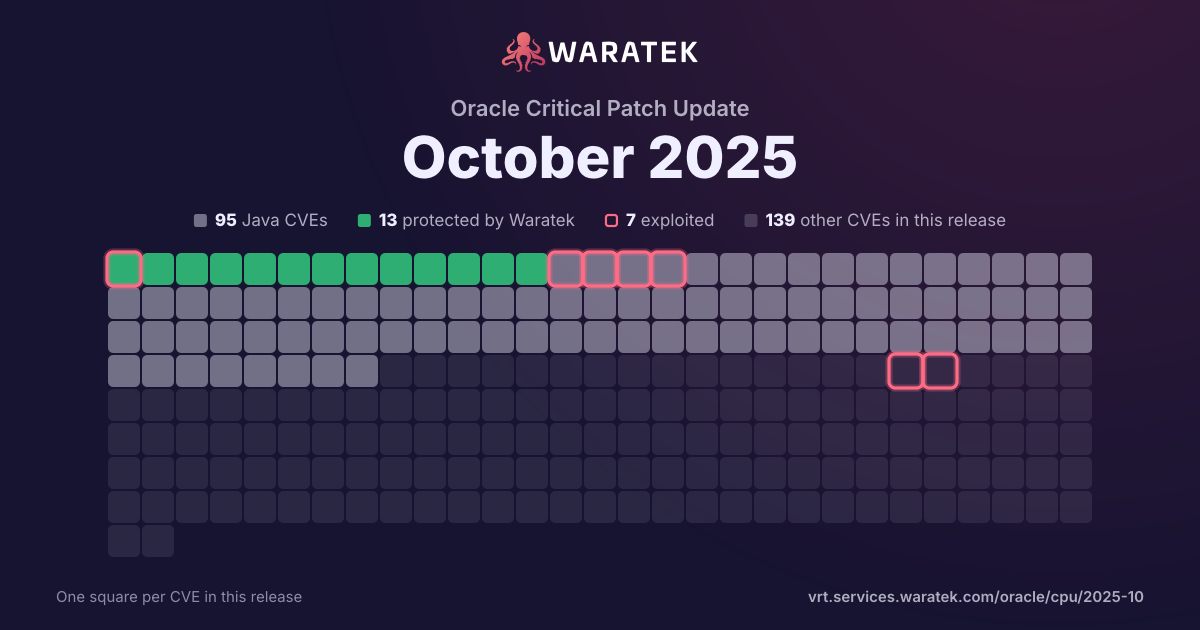
By status
13Protected by Waratek5Mitigation candidate77No exploit published15Outside Waratek scope124Not applicable
7Exploited, marked by the ring
No exploit published. For 36 of them, Oracle's security advisory is the source of public detail.
Protected by Waratek. Waratek RASP can block exploitation of these on systems that have not applied the patch yet.
Overview 6 matches · 0 in Waratek scope · 0 protected · 0 exploited · 0 CISA KEV · 1 public PoC · 0 EPSS ≥ 0.5
6matches
0in Waratek scope0.0%
0protected0.0%
0exploited0.0%
0CISA KEV0.0%
1public PoC16.7%
0EPSS ≥ 0.50.0%
Protected by Waratek
0
0.0%
Rule in development
0
0.0%
Mitigation candidate
0
0.0%
No exploit published
0
0.0%
Outside Waratek scope
0
0.0%
Not applicable
6
100.0%
Withdrawn CVE
0
0.0%
blocked by ARMR today
0
0.0%
partly blocked
0
0.0%
not blocked
6
100.0%
not established
0
0.0%
unrecorded
0
0.0%
Exploited
0
0.0%
Working exploit published
0
0.0%
Proof of concept only
1
16.7%
Forecast only
0
0.0%
No public exploit
5
83.3%
split by
peak 3 / quarter
Q4 231
Not applicable1
Critical1
not blocked1
No public exploit1
Q1 241
Not applicable1
Critical1
not blocked1
No public exploit1
Q2 241
Not applicable1
Critical1
not blocked1
No public exploit1
Q3 240
Q4 240
Q1 250
Q2 253
Not applicable3
Critical3
not blocked3
Proof of concept only1
No public exploit2
Q4 23Q1 24Q2 24Q3 24Q4 24Q1 25Q2 25
| CVE | Severity | Published▾ | Status | Exploitation | Description |
|---|---|---|---|---|---|
| CVE-2025-49796 | Critical | 2025-06-16 | Not applicable | No public exploit | A vulnerability was found in libxml2. Processing certain sch:name elements from the input XML file can trigger a memory corruption issue. This flaw allows an attacker to craft a malicious XML input file that can lead libxml to crash, resulting in a denial of service or other possible undefined behavior due to sensitive data being corrupted in memory. |
| CVE-2025-49794 | Critical | 2025-06-16 | Not applicable | No public exploit | A use-after-free vulnerability was found in libxml2. This issue occurs when parsing XPath elements under certain circumstances when the XML schematron has the <sch:name path="..."/> schema elements. This flaw allows a malicious actor to craft a malicious XML document used as input for libxml, resulting in the program's crash using libxml or other possible undefined behaviors. |
| CVE-2025-4517 | Critical | 2025-06-03 | Not applicable | Proof of concept only | Allows arbitrary filesystem writes outside the extraction directory during extraction with filter="data". You are affected by this vulnerability if using the tarfile module to extract untrusted tar archives using TarFile.extractall() or TarFile.extract() using the filter= parameter with a value of "data" or "tar". See the tarfile extraction filters documentation https://docs.python.org/3/library/tarfile.html#tarfile-extraction-filter for more information. Note that for Python 3.14 or later the default value of filter= changed from "no filtering" to `"data", so if you are relying on this new default behavior then your usage is also affected. Note that none of these vulnerabilities significantly affect the installation of source distributions which are tar archives as source distributions already allow arbitrary code execution during the build process. However when evaluating source distributions it's important to avoid installing source distributions with suspicious links. |
| CVE-2024-37371 | Critical | 2024-06-28 | Not applicable | No public exploit | In MIT Kerberos 5 (aka krb5) before 1.21.3, an attacker can cause invalid memory reads during GSS message token handling by sending message tokens with invalid length fields. |
| CVE-2024-23807 | Critical | 2024-02-29 | Not applicable | No public exploit | The Apache Xerces C++ XML parser on versions 3.0.0 before 3.2.5 contains a use-after-free error triggered during the scanning of external DTDs. Users are recommended to upgrade to version 3.2.5 which fixes the issue, or mitigate the issue by disabling DTD processing. This can be accomplished via the DOM using a standard parser feature, or via SAX using the XERCES_DISABLE_DTD environment variable. This issue has been disclosed before as CVE-2018-1311, but unfortunately that advisory incorrectly stated the issue would be fixed in version 3.2.3 or 3.2.4. |
| CVE-2023-45853 | Critical | 2023-10-14 | Not applicable | No public exploit | MiniZip in zlib through 1.3 has an integer overflow and resultant heap-based buffer overflow in zipOpenNewFileInZip4_64 via a long filename, comment, or extra field. NOTE: MiniZip is not a supported part of the zlib product. NOTE: pyminizip through 0.2.6 is also vulnerable because it bundles an affected zlib version, and exposes the applicable MiniZip code through its compress API. |