
Oracle Critical Patch Update October 2025
Released October 2025 · Oracle's advisory ↗ · ← Critical Patch Update, July 2025 · Critical Patch Update, January 2026 →
234 CVEs in this release, one square each
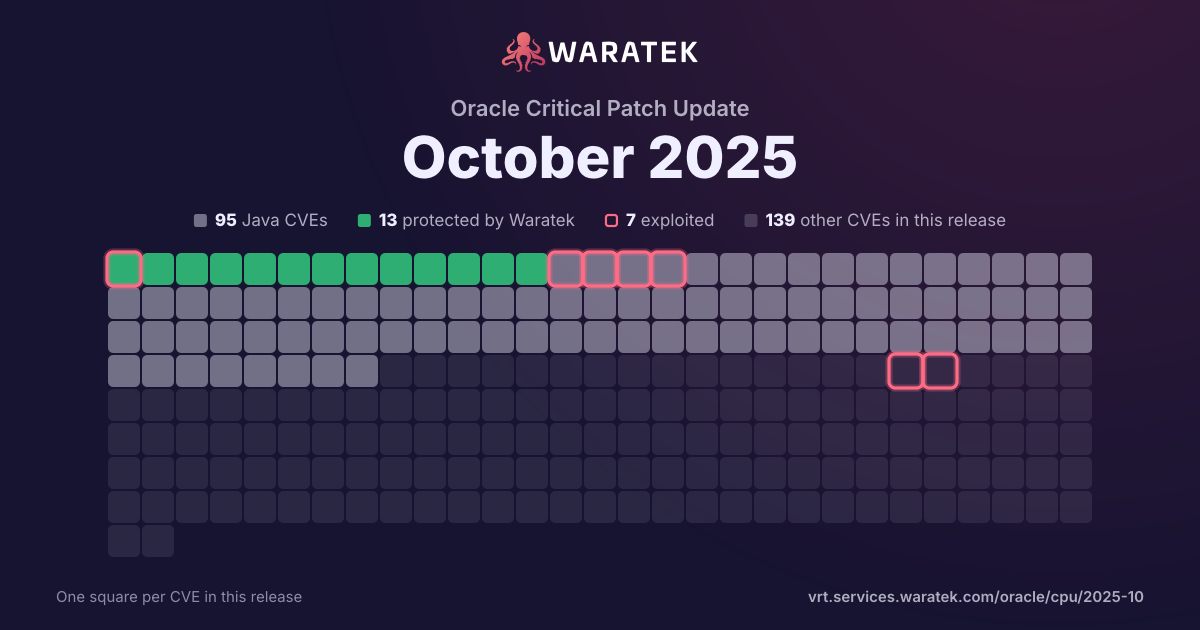
By status
11Protected by Waratek6Mitigation candidate87No exploit published4Outside Waratek scope126Not applicable
7Exploited, marked by the ring
No exploit published. For 37 of them, Oracle's security advisory is the source of public detail.
Protected by Waratek. Waratek RASP can block exploitation of these on systems that have not applied the patch yet.
Overview 4 matches · 0 protected · 0 exploited · 0 CISA KEV · 0 public PoC · 0 EPSS ≥ 0.5
4matches
0protected0.0%
0exploited0.0%
0CISA KEV0.0%
0public PoC0.0%
0EPSS ≥ 0.50.0%
Protected by Waratek
0
0.0%
Rule in development
0
0.0%
Mitigation candidate
0
0.0%
No exploit published
4
100.0%
blocked by ARMR today
0
0.0%
partly blocked
0
0.0%
not blocked
4
100.0%
not established
0
0.0%
unrecorded
0
0.0%
Exploited
0
0.0%
Working exploit published
0
0.0%
Proof of concept only
0
0.0%
Forecast only
0
0.0%
No public exploit
4
100.0%
| CVE | Severity | Published▾ | Status | Exploitation | Description |
|---|---|---|---|---|---|
| CVE-2024-12798 | Medium | 2024-12-19 | No exploit published | No public exploit | ACE vulnerability in JaninoEventEvaluator by QOS.CH logback-core upto including version 0.1 to 1.3.14 and 1.4.0 to 1.5.12 in Java applications allows attacker to execute arbitrary code by compromising an existing logback configuration file or by injecting an environment variable before program execution. Malicious logback configuration files can allow the attacker to execute arbitrary code using the JaninoEventEvaluator extension. A successful attack requires the user to have write access to a configuration file. Alternatively, the attacker could inject a malicious environment variable pointing to a malicious configuration file. In both cases, the attack requires existing privilege. |
| CVE-2024-51504 | Critical | 2024-11-07 | No exploit published | No public exploit | When using IPAuthenticationProvider in ZooKeeper Admin Server there is a possibility of Authentication Bypass by Spoofing -- this only impacts IP based authentication implemented in ZooKeeper Admin Server. Default configuration of client's IP address detection in IPAuthenticationProvider, which uses HTTP request headers, is weak and allows an attacker to bypass authentication via spoofing client's IP address in request headers. Default configuration honors X-Forwarded-For HTTP header to read client's IP address. X-Forwarded-For request header is mainly used by proxy servers to identify the client and can be easily spoofed by an attacker pretending that the request comes from a different IP address. Admin Server commands, such as snapshot and restore arbitrarily can be executed on successful exploitation which could potentially lead to information leakage or service availability issues. Users are recommended to upgrade to version 3.9.3, which fixes this issue. |
| CVE-2024-38820 | Medium | 2024-10-18 | No exploit published | No public exploit | The fix for CVE-2022-22968 made disallowedFields patterns in DataBinder case insensitive. However, String.toLowerCase() has some Locale dependent exceptions that could potentially result in fields not protected as expected. |
| CVE-2024-47554 | Medium | 2024-10-03 | No exploit published | No public exploit | Uncontrolled Resource Consumption vulnerability in Apache Commons IO. The org.apache.commons.io.input.XmlStreamReader class may excessively consume CPU resources when processing maliciously crafted input. This issue affects Apache Commons IO: from 2.0 before 2.14.0. Users are recommended to upgrade to version 2.14.0 or later, which fixes the issue. |