
Oracle Critical Patch Update October 2025
Released October 2025 · Oracle's advisory ↗ · ← Critical Patch Update, July 2025 · Critical Patch Update, January 2026 →
234 CVEs in this release, one square each
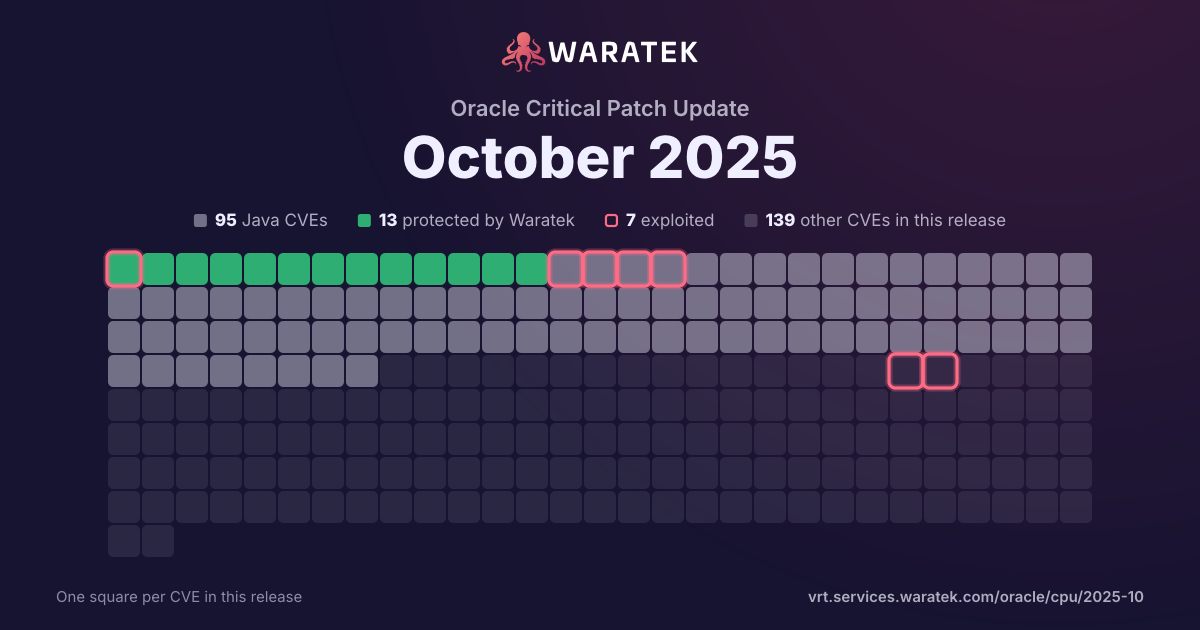
By status
11Protected by Waratek6Mitigation candidate87No exploit published4Outside Waratek scope126Not applicable
7Exploited, marked by the ring
No exploit published. For 37 of them, Oracle's security advisory is the source of public detail.
Protected by Waratek. Waratek RASP can block exploitation of these on systems that have not applied the patch yet.
Overview 7 matches · 2 in Waratek scope · 0 protected · 0 exploited · 0 CISA KEV · 1 public PoC · 0 EPSS ≥ 0.5
7matches
2in Waratek scope28.6%
0protected0.0%
0exploited0.0%
0CISA KEV0.0%
1public PoC14.3%
0EPSS ≥ 0.50.0%
Protected by Waratek
0
0.0%
Rule in development
0
0.0%
Mitigation candidate
0
0.0%
No exploit published
2
28.6%
Outside Waratek scope
1
14.3%
Not applicable
4
57.1%
Withdrawn CVE
0
0.0%
blocked by ARMR today
0
0.0%
partly blocked
0
0.0%
not blocked
7
100.0%
not established
0
0.0%
unrecorded
0
0.0%
Exploited
0
0.0%
Working exploit published
0
0.0%
Proof of concept only
7
100.0%
Forecast only
0
0.0%
No public exploit
0
0.0%
split by
peak 4 / month
Jul 25Aug 25Sep 25
| CVE | Severity | Published▾ | Status | Exploitation | Description |
|---|---|---|---|---|---|
| CVE-2025-58057 | Medium | 2025-09-04 | No exploit published | Proof of concept only | Netty is an asynchronous event-driven network application framework for rapid development of maintainable high performance protocol servers & clients. In netty-codec-compression versions 4.1.124.Final and below, and netty-codec versions 4.2.4.Final and below, when supplied with specially crafted input, BrotliDecoder and certain other decompression decoders will allocate a large number of reachable byte buffers, which can lead to denial of service. BrotliDecoder.decompress has no limit in how often it calls pull, decompressing data 64K bytes at a time. The buffers are saved in the output list, and remain reachable until OOM is hit. This is fixed in versions 4.1.125.Final of netty-codec and 4.2.5.Final of netty-codec-compression. |
| CVE-2025-55298 | High | 2025-08-26 | Not applicable | Proof of concept only | ImageMagick is free and open-source software used for editing and manipulating digital images. Prior to ImageMagick versions 6.9.13-28 and 7.1.2-2, a format string bug vulnerability exists in InterpretImageFilename function where user input is directly passed to FormatLocaleString without proper sanitization. An attacker can overwrite arbitrary memory regions, enabling a wide range of attacks from heap overflow to remote code execution. This issue has been patched in versions 6.9.13-28 and 7.1.2-2. |
| CVE-2025-55212 | High | 2025-08-26 | Not applicable | Proof of concept only | ImageMagick is free and open-source software used for editing and manipulating digital images. Prior to versions 6.9.13-28 and 7.1.2-2, passing a geometry string containing only a colon (":") to montage -geometry leads GetGeometry() to set width/height to 0. Later, ThumbnailImage() divides by these zero dimensions, triggering a crash (SIGFPE/abort), resulting in a denial of service. This issue has been patched in versions 6.9.13-28 and 7.1.2-2. |
| CVE-2025-7339 | Low | 2025-07-17 | Not applicable | Proof of concept only | on-headers is a node.js middleware for listening to when a response writes headers. A bug in on-headers versions `<1.1.0` may result in response headers being inadvertently modified when an array is passed to `response.writeHead()`. Users should upgrade to version 1.1.0 to receive a patch. Uses are strongly encouraged to upgrade to `1.1.0`, but this issue can be worked around by passing an object to `response.writeHead()` rather than an array. |
| CVE-2025-53864 | Medium | 2025-07-11 | No exploit published | Proof of concept only | Connect2id Nimbus JOSE + JWT 10.0.x before 10.0.2 and 9.37.x before 9.37.4 allows a remote attacker to cause a denial of service via a deeply nested JSON object supplied in a JWT claim set, because of uncontrolled recursion. NOTE: this is independent of the Gson 2.11.0 issue because the Connect2id product could have checked the JSON object nesting depth, regardless of what limits (if any) were imposed by Gson. |
| CVE-2025-7425 | High | 2025-07-10 | Outside Waratek scope | Proof of concept only | A flaw was found in libxslt where the attribute type, atype, flags are modified in a way that corrupts internal memory management. When XSLT functions, such as the key() process, result in tree fragments, this corruption prevents the proper cleanup of ID attributes. As a result, the system may access freed memory, causing crashes or enabling attackers to trigger heap corruption. |
| CVE-2025-53547 | High | 2025-07-08 | Not applicable | Proof of concept only | Helm is a package manager for Charts for Kubernetes. Prior to 3.18.4, a specially crafted Chart.yaml file along with a specially linked Chart.lock file can lead to local code execution when dependencies are updated. Fields in a Chart.yaml file, that are carried over to a Chart.lock file when dependencies are updated and this file is written, can be crafted in a way that can cause execution if that same content were in a file that is executed (e.g., a bash.rc file or shell script). If the Chart.lock file is symlinked to one of these files updating dependencies will write the lock file content to the symlinked file. This can lead to unwanted execution. Helm warns of the symlinked file but did not stop execution due to symlinking. This issue has been resolved in Helm v3.18.4. |