
Oracle Critical Patch Update October 2025
Released October 2025 · Oracle's advisory ↗ · ← Critical Patch Update, July 2025 · Critical Patch Update, January 2026 →
234 CVEs in this release, one square each
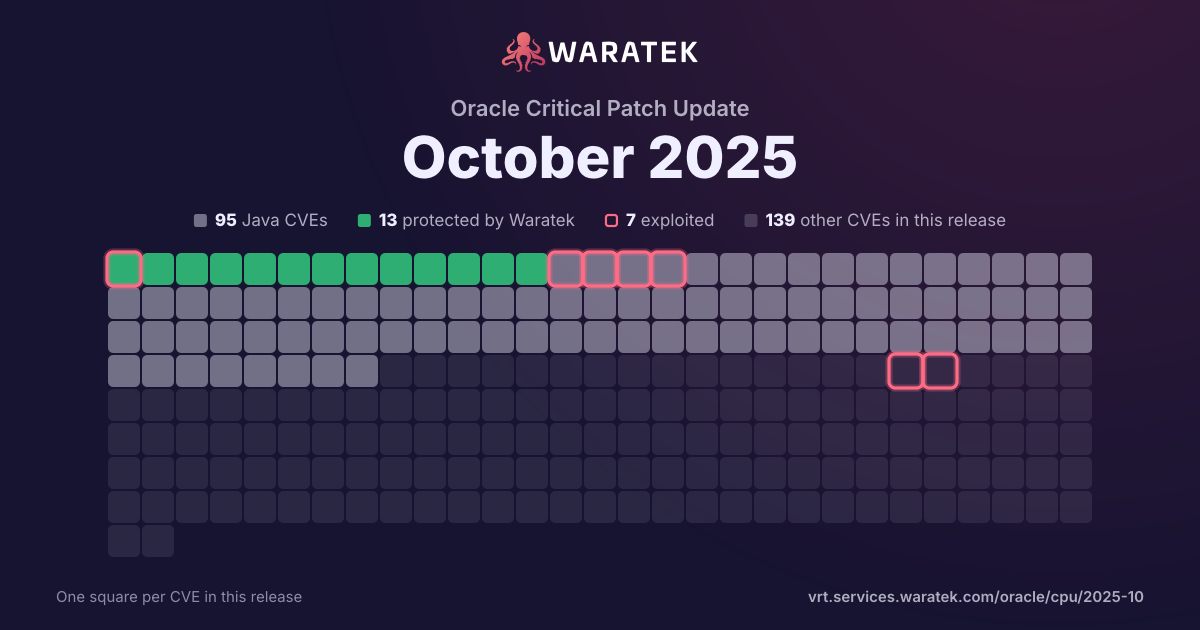
By status
13Protected by Waratek5Mitigation candidate86No exploit published4Outside Waratek scope126Not applicable
7Exploited, marked by the ring
No exploit published. For 39 of them, Oracle's security advisory is the source of public detail.
Protected by Waratek. Waratek RASP can block exploitation of these on systems that have not applied the patch yet.
Overview 3 matches · 0 in Waratek scope · 0 protected · 0 exploited · 0 CISA KEV · 0 EPSS ≥ 0.5
3matches
0in Waratek scope0.0%
0protected0.0%
0exploited0.0%
0CISA KEV0.0%
0EPSS ≥ 0.50.0%
Protected by Waratek
0
0.0%
Rule in development
0
0.0%
Mitigation candidate
0
0.0%
No exploit published
0
0.0%
Outside Waratek scope
0
0.0%
Not applicable
3
100.0%
Withdrawn CVE
0
0.0%
blocked by ARMR today
0
0.0%
partly blocked
0
0.0%
not blocked
3
100.0%
not established
0
0.0%
unrecorded
0
0.0%
Exploited
0
0.0%
Working exploit published
0
0.0%
Proof of concept only
3
100.0%
Forecast only
0
0.0%
No public exploit
0
0.0%
split by
peak 2 / month
Jun 25Jul 25
| CVE | Severity | Published▾ | Status | Exploitation | Description |
|---|---|---|---|---|---|
| CVE-2025-53547 | High | 2025-07-08 | Not applicable | Proof of concept only | Helm is a package manager for Charts for Kubernetes. Prior to 3.18.4, a specially crafted Chart.yaml file along with a specially linked Chart.lock file can lead to local code execution when dependencies are updated. Fields in a Chart.yaml file, that are carried over to a Chart.lock file when dependencies are updated and this file is written, can be crafted in a way that can cause execution if that same content were in a file that is executed (e.g., a bash.rc file or shell script). If the Chart.lock file is symlinked to one of these files updating dependencies will write the lock file content to the symlinked file. This can lead to unwanted execution. Helm warns of the symlinked file but did not stop execution due to symlinking. This issue has been resolved in Helm v3.18.4. |
| CVE-2025-4517 | Critical | 2025-06-03 | Not applicable | Proof of concept only | Allows arbitrary filesystem writes outside the extraction directory during extraction with filter="data". You are affected by this vulnerability if using the tarfile module to extract untrusted tar archives using TarFile.extractall() or TarFile.extract() using the filter= parameter with a value of "data" or "tar". See the tarfile extraction filters documentation https://docs.python.org/3/library/tarfile.html#tarfile-extraction-filter for more information. Note that for Python 3.14 or later the default value of filter= changed from "no filtering" to `"data", so if you are relying on this new default behavior then your usage is also affected. Note that none of these vulnerabilities significantly affect the installation of source distributions which are tar archives as source distributions already allow arbitrary code execution during the build process. However when evaluating source distributions it's important to avoid installing source distributions with suspicious links. |
| CVE-2025-4138 | High | 2025-06-03 | Not applicable | Proof of concept only | Allows the extraction filter to be ignored, allowing symlink targets to point outside the destination directory, and the modification of some file metadata. You are affected by this vulnerability if using the tarfile module to extract untrusted tar archives using TarFile.extractall() or TarFile.extract() using the filter= parameter with a value of "data" or "tar". See the tarfile extraction filters documentation https://docs.python.org/3/library/tarfile.html#tarfile-extraction-filter for more information. Note that for Python 3.14 or later the default value of filter= changed from "no filtering" to `"data", so if you are relying on this new default behavior then your usage is also affected. Note that none of these vulnerabilities significantly affect the installation of source distributions which are tar archives as source distributions already allow arbitrary code execution during the build process. However when evaluating source distributions it's important to avoid installing source distributions with suspicious links. |