
Oracle Critical Patch Update October 2025
Released October 2025 · Oracle's advisory ↗ · ← Critical Patch Update, July 2025 · Critical Patch Update, January 2026 →
234 CVEs in this release, one square each
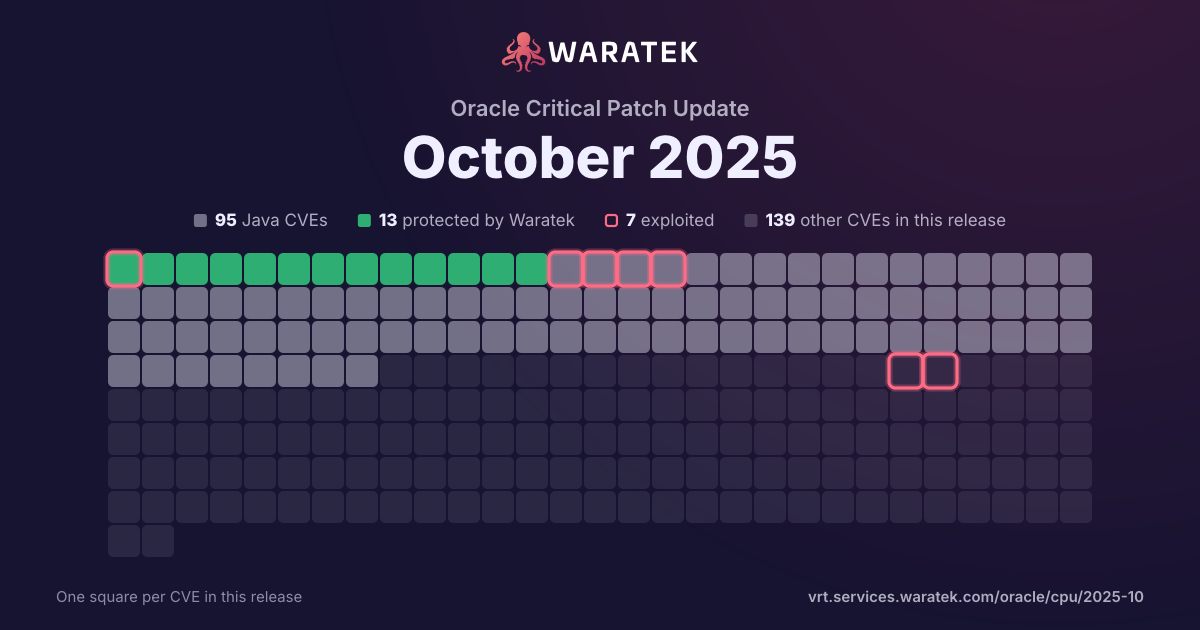
By status
13Protected by Waratek5Mitigation candidate77No exploit published15Outside Waratek scope124Not applicable
7Exploited, marked by the ring
No exploit published. For 36 of them, Oracle's security advisory is the source of public detail.
Protected by Waratek. Waratek RASP can block exploitation of these on systems that have not applied the patch yet.
Overview 7 matches · 3 protected · 3 exploited · 1 CISA KEV · 1 public PoC · 1 EPSS ≥ 0.5
Protected by Waratek
3
42.9%
Rule in development
0
0.0%
Mitigation candidate
2
28.6%
No exploit published
2
28.6%
blocked by ARMR today
3
42.9%
partly blocked
0
0.0%
not blocked
2
28.6%
not established
2
28.6%
unrecorded
0
0.0%
Exploited
3
42.9%
Working exploit published
0
0.0%
Proof of concept only
0
0.0%
Forecast only
0
0.0%
No public exploit
4
57.1%
split by
peak 4 / month
Nov 241
No exploit published1
Critical1
not blocked1
No public exploit1
Dec 241
Protected by Waratek1
Critical1
blocked by ARMR today1
No public exploit1
Jan 250
Feb 251
Protected by Waratek1
Critical1
blocked by ARMR today1
No public exploit1
Mar 250
Apr 250
May 250
Jun 250
Jul 250
Aug 250
Sep 250
Oct 254
Protected by Waratek1
Mitigation candidate2
No exploit published1
Critical4
blocked by ARMR today1
not blocked1
not established2
Exploited3
No public exploit1
Nov 24Dec 24Jan 25Feb 25Mar 25Apr 25May 25Jun 25Jul 25Aug 25Sep 25Oct 25
| CVE | Severity | Published▾ | Status | Exploitation | Description |
|---|---|---|---|---|---|
| CVE-2025-62481 | Critical | 2025-10-21 | Mitigation candidate | Exploited | Vulnerability in the Oracle Marketing product of Oracle E-Business Suite (component: Marketing Administration). Supported versions that are affected are 12.2.3-12.2.14. Easily exploitable vulnerability allows unauthenticated attacker with network access via HTTP to compromise Oracle Marketing. Successful attacks of this vulnerability can result in takeover of Oracle Marketing. CVSS 3.1 Base Score 9.8 (Confidentiality, Integrity and Availability impacts). CVSS Vector: (CVSS:3.1/AV:N/AC:L/PR:N/UI:N/S:U/C:H/I:H/A:H). |
| CVE-2025-61757 | Critical | 2025-10-21 | Protected by Waratek | Exploited | Vulnerability in the Identity Manager product of Oracle Fusion Middleware (component: REST WebServices). Supported versions that are affected are 12.2.1.4.0 and 14.1.2.1.0. Easily exploitable vulnerability allows unauthenticated attacker with network access via HTTP to compromise Identity Manager. Successful attacks of this vulnerability can result in takeover of Identity Manager. CVSS 3.1 Base Score 9.8 (Confidentiality, Integrity and Availability impacts). CVSS Vector: (CVSS:3.1/AV:N/AC:L/PR:N/UI:N/S:U/C:H/I:H/A:H). |
| CVE-2025-53072 | Critical | 2025-10-21 | Mitigation candidate | Exploited | Vulnerability in the Oracle Marketing product of Oracle E-Business Suite (component: Marketing Administration). Supported versions that are affected are 12.2.3-12.2.14. Easily exploitable vulnerability allows unauthenticated attacker with network access via HTTP to compromise Oracle Marketing. Successful attacks of this vulnerability can result in takeover of Oracle Marketing. CVSS 3.1 Base Score 9.8 (Confidentiality, Integrity and Availability impacts). CVSS Vector: (CVSS:3.1/AV:N/AC:L/PR:N/UI:N/S:U/C:H/I:H/A:H). |
| CVE-2025-53037 | Critical | 2025-10-21 | No exploit published | No public exploit | Vulnerability in the Oracle Financial Services Analytical Applications Infrastructure product of Oracle Financial Services Applications (component: Platform). Supported versions that are affected are 8.0.7.9, 8.0.8.7 and 8.1.2.5. Easily exploitable vulnerability allows unauthenticated attacker with network access via HTTP to compromise Oracle Financial Services Analytical Applications Infrastructure. Successful attacks of this vulnerability can result in takeover of Oracle Financial Services Analytical Applications Infrastructure. CVSS 3.1 Base Score 9.8 (Confidentiality, Integrity and Availability impacts). CVSS Vector: (CVSS:3.1/AV:N/AC:L/PR:N/UI:N/S:U/C:H/I:H/A:H). |
| CVE-2024-52577 | Critical | 2025-02-14 | Protected by Waratek | No public exploit | In Apache Ignite versions from 2.6.0 and before 2.17.0, configured Class Serialization Filters are ignored for some Ignite endpoints. The vulnerability could be exploited if an attacker manually crafts an Ignite message containing a vulnerable object whose class is present in the Ignite server classpath and sends it to Ignite server endpoints. Deserialization of such a message by the Ignite server may result in the execution of arbitrary code on the Apache Ignite server side. |
| CVE-2024-52046 | Critical | 2024-12-25 | Protected by Waratek | No public exploit | The ObjectSerializationDecoder in Apache MINA uses Java’s native deserialization protocol to process incoming serialized data but lacks the necessary security checks and defenses. This vulnerability allows attackers to exploit the deserialization process by sending specially crafted malicious serialized data, potentially leading to remote code execution (RCE) attacks. This issue affects MINA core versions 2.0.X, 2.1.X and 2.2.X, and will be fixed by the releases 2.0.27, 2.1.10 and 2.2.4. It's also important to note that an application using MINA core library will only be affected if the IoBuffer#getObject() method is called, and this specific method is potentially called when adding a ProtocolCodecFilter instance using the ObjectSerializationCodecFactory class in the filter chain. If your application is specifically using those classes, you have to upgrade to the latest version of MINA core library. Upgrading will not be enough: you also need to explicitly allow the classes the decoder will accept in the ObjectSerializationDecoder instance, using one of the three new methods: /** * Accept class names where the supplied ClassNameMatcher matches for * deserialization, unless they are otherwise rejected. * * @param classNameMatcher the matcher to use */ public void accept(ClassNameMatcher classNameMatcher) /** * Accept class names that match the supplied pattern for * deserialization, unless they are otherwise rejected. * * @param pattern standard Java regexp */ public void accept(Pattern pattern) /** * Accept the wildcard specified classes for deserialization, * unless they are otherwise rejected. * * @param patterns Wildcard file name patterns as defined by * {@link org.apache.commons.io.FilenameUtils#wildcardMatch(String, String) FilenameUtils.wildcardMatch} */ public void accept(String... patterns) By default, the decoder will reject *all* classes that will be present in the incoming data. Note: The FtpServer, SSHd and Vysper sub-project are not affected by this issue. |
| CVE-2024-51504 | Critical | 2024-11-07 | No exploit published | No public exploit | When using IPAuthenticationProvider in ZooKeeper Admin Server there is a possibility of Authentication Bypass by Spoofing -- this only impacts IP based authentication implemented in ZooKeeper Admin Server. Default configuration of client's IP address detection in IPAuthenticationProvider, which uses HTTP request headers, is weak and allows an attacker to bypass authentication via spoofing client's IP address in request headers. Default configuration honors X-Forwarded-For HTTP header to read client's IP address. X-Forwarded-For request header is mainly used by proxy servers to identify the client and can be easily spoofed by an attacker pretending that the request comes from a different IP address. Admin Server commands, such as snapshot and restore arbitrarily can be executed on successful exploitation which could potentially lead to information leakage or service availability issues. Users are recommended to upgrade to version 3.9.3, which fixes this issue. |