
Oracle Critical Patch Update July 2025
Released July 2025 · Oracle's advisory ↗ · ← Critical Patch Update, April 2025 · Critical Patch Update, October 2025 →
196 CVEs in this release, one square each
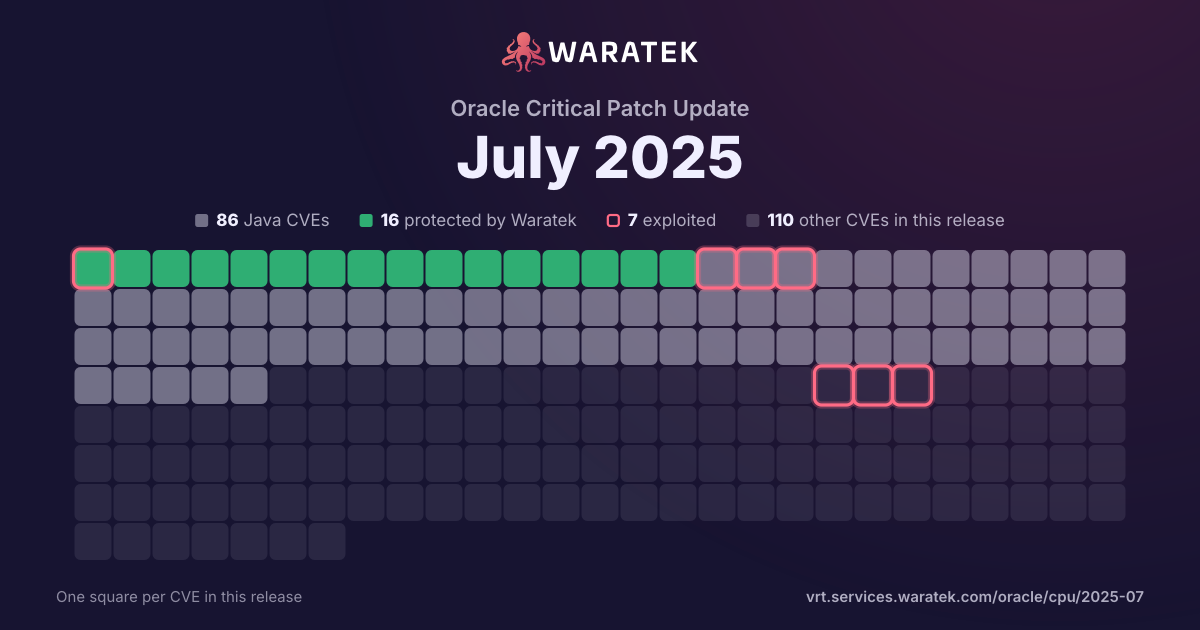
By status
16Protected by Waratek4Mitigation candidate66No exploit published14Outside Waratek scope96Not applicable
7Exploited, marked by the ring
No exploit published. For 31 of them, Oracle's security advisory is the source of public detail.
Protected by Waratek. Waratek RASP can block exploitation of these on systems that have not applied the patch yet.
Overview 54 matches · 0 in Waratek scope · 0 protected · 0 exploited · 0 CISA KEV · 0 public PoC · 1 EPSS ≥ 0.5
54matches
0in Waratek scope0.0%
0protected0.0%
0exploited0.0%
0CISA KEV0.0%
0public PoC0.0%
1EPSS ≥ 0.51.9%
Protected by Waratek
0
0.0%
Rule in development
0
0.0%
Mitigation candidate
0
0.0%
No exploit published
0
0.0%
Outside Waratek scope
0
0.0%
Not applicable
54
100.0%
Withdrawn CVE
0
0.0%
blocked by ARMR today
0
0.0%
partly blocked
0
0.0%
not blocked
54
100.0%
not established
0
0.0%
unrecorded
0
0.0%
Exploited
0
0.0%
Working exploit published
0
0.0%
Proof of concept only
4
7.4%
Forecast only
1
1.9%
No public exploit
49
90.7%
split by
peak 30 / month
Feb 241
Not applicable1
Medium1
not blocked1
No public exploit1
Mar 240
Apr 241
Not applicable1
Medium1
not blocked1
Forecast only1
May 242
Not applicable2
Medium2
not blocked2
No public exploit2
Jun 242
Not applicable2
Medium2
not blocked2
No public exploit2
Jul 242
Not applicable2
Medium2
not blocked2
No public exploit2
Aug 243
Not applicable3
Medium3
not blocked3
No public exploit3
Sep 241
Not applicable1
Medium1
not blocked1
No public exploit1
Oct 242
Not applicable2
Medium2
not blocked2
No public exploit2
Nov 240
Dec 242
Not applicable2
Medium2
not blocked2
No public exploit2
Jan 252
Not applicable2
Medium2
not blocked2
Proof of concept only1
No public exploit1
Feb 253
Not applicable3
Medium3
not blocked3
Proof of concept only1
No public exploit2
Mar 251
Not applicable1
Medium1
not blocked1
No public exploit1
Apr 251
Not applicable1
Medium1
not blocked1
Proof of concept only1
May 251
Not applicable1
Medium1
not blocked1
Proof of concept only1
Jun 250
Jul 2530
Not applicable30
Medium30
not blocked30
No public exploit30
Mar 24May 24Jul 24Sep 24Nov 24Jan 25Mar 25May 25Jul 25
| CVE | Severity | Published▾ | Status | Exploitation | Description |
|---|---|---|---|---|---|
| CVE-2025-53032 | Medium | 2025-07-15 | Not applicable | No public exploit | Vulnerability in the MySQL Server product of Oracle MySQL (component: Server: Optimizer). Supported versions that are affected are 9.0.0-9.1.0. Easily exploitable vulnerability allows high privileged attacker with network access via multiple protocols to compromise MySQL Server. Successful attacks of this vulnerability can result in unauthorized ability to cause a hang or frequently repeatable crash (complete DOS) of MySQL Server. CVSS 3.1 Base Score 4.9 (Availability impacts). CVSS Vector: (CVSS:3.1/AV:N/AC:L/PR:H/UI:N/S:U/C:N/I:N/A:H). |
| CVE-2025-53030 | Medium | 2025-07-15 | Not applicable | No public exploit | Vulnerability in the Oracle VM VirtualBox product of Oracle Virtualization (component: Core). The supported version that is affected is 7.1.10. Easily exploitable vulnerability allows high privileged attacker with logon to the infrastructure where Oracle VM VirtualBox executes to compromise Oracle VM VirtualBox. While the vulnerability is in Oracle VM VirtualBox, attacks may significantly impact additional products (scope change). Successful attacks of this vulnerability can result in unauthorized access to critical data or complete access to all Oracle VM VirtualBox accessible data. CVSS 3.1 Base Score 6.0 (Confidentiality impacts). CVSS Vector: (CVSS:3.1/AV:L/AC:L/PR:H/UI:N/S:C/C:H/I:N/A:N). |
| CVE-2025-53026 | Medium | 2025-07-15 | Not applicable | No public exploit | Vulnerability in the Oracle VM VirtualBox product of Oracle Virtualization (component: Core). The supported version that is affected is 7.1.10. Easily exploitable vulnerability allows high privileged attacker with logon to the infrastructure where Oracle VM VirtualBox executes to compromise Oracle VM VirtualBox. While the vulnerability is in Oracle VM VirtualBox, attacks may significantly impact additional products (scope change). Successful attacks of this vulnerability can result in unauthorized access to critical data or complete access to all Oracle VM VirtualBox accessible data. CVSS 3.1 Base Score 6.0 (Confidentiality impacts). CVSS Vector: (CVSS:3.1/AV:L/AC:L/PR:H/UI:N/S:C/C:H/I:N/A:N). |
| CVE-2025-53025 | Medium | 2025-07-15 | Not applicable | No public exploit | Vulnerability in the Oracle VM VirtualBox product of Oracle Virtualization (component: Core). The supported version that is affected is 7.1.10. Easily exploitable vulnerability allows high privileged attacker with logon to the infrastructure where Oracle VM VirtualBox executes to compromise Oracle VM VirtualBox. While the vulnerability is in Oracle VM VirtualBox, attacks may significantly impact additional products (scope change). Successful attacks of this vulnerability can result in unauthorized access to critical data or complete access to all Oracle VM VirtualBox accessible data. CVSS 3.1 Base Score 6.0 (Confidentiality impacts). CVSS Vector: (CVSS:3.1/AV:L/AC:L/PR:H/UI:N/S:C/C:H/I:N/A:N). |
| CVE-2025-53023 | Medium | 2025-07-15 | Not applicable | No public exploit | Vulnerability in the MySQL Server product of Oracle MySQL (component: Server: Replication). Supported versions that are affected are 8.0.0-8.0.42. Easily exploitable vulnerability allows high privileged attacker with network access via multiple protocols to compromise MySQL Server. Successful attacks of this vulnerability can result in unauthorized ability to cause a hang or frequently repeatable crash (complete DOS) of MySQL Server. CVSS 3.1 Base Score 4.9 (Availability impacts). CVSS Vector: (CVSS:3.1/AV:N/AC:L/PR:H/UI:N/S:U/C:N/I:N/A:H). |
| CVE-2025-50103 | Medium | 2025-07-15 | Not applicable | No public exploit | Vulnerability in the MySQL Server product of Oracle MySQL (component: Server: Security: LDAP Auth). Supported versions that are affected are 9.0.0-9.3.0. Difficult to exploit vulnerability allows high privileged attacker with network access via multiple protocols to compromise MySQL Server. Successful attacks of this vulnerability can result in unauthorized ability to cause a hang or frequently repeatable crash (complete DOS) of MySQL Server. CVSS 3.1 Base Score 4.4 (Availability impacts). CVSS Vector: (CVSS:3.1/AV:N/AC:H/PR:H/UI:N/S:U/C:N/I:N/A:H). |
| CVE-2025-50102 | Medium | 2025-07-15 | Not applicable | No public exploit | Vulnerability in the MySQL Server product of Oracle MySQL (component: Server: Optimizer). Supported versions that are affected are 8.0.0-8.0.42, 8.4.0-8.4.5 and 9.0.0-9.3.0. Easily exploitable vulnerability allows high privileged attacker with network access via multiple protocols to compromise MySQL Server. Successful attacks of this vulnerability can result in unauthorized ability to cause a hang or frequently repeatable crash (complete DOS) of MySQL Server. CVSS 3.1 Base Score 4.9 (Availability impacts). CVSS Vector: (CVSS:3.1/AV:N/AC:L/PR:H/UI:N/S:U/C:N/I:N/A:H). |
| CVE-2025-50101 | Medium | 2025-07-15 | Not applicable | No public exploit | Vulnerability in the MySQL Server product of Oracle MySQL (component: Server: Optimizer). Supported versions that are affected are 8.0.0-8.0.42, 8.4.0-8.4.5 and 9.0.0-9.3.0. Easily exploitable vulnerability allows high privileged attacker with network access via multiple protocols to compromise MySQL Server. Successful attacks of this vulnerability can result in unauthorized ability to cause a hang or frequently repeatable crash (complete DOS) of MySQL Server. CVSS 3.1 Base Score 4.9 (Availability impacts). CVSS Vector: (CVSS:3.1/AV:N/AC:L/PR:H/UI:N/S:U/C:N/I:N/A:H). |
| CVE-2025-50099 | Medium | 2025-07-15 | Not applicable | No public exploit | Vulnerability in the MySQL Server product of Oracle MySQL (component: InnoDB). Supported versions that are affected are 8.0.0-8.0.42, 8.4.0-8.4.5 and 9.0.0-9.3.0. Easily exploitable vulnerability allows high privileged attacker with network access via multiple protocols to compromise MySQL Server. Successful attacks of this vulnerability can result in unauthorized ability to cause a hang or frequently repeatable crash (complete DOS) of MySQL Server. CVSS 3.1 Base Score 4.9 (Availability impacts). CVSS Vector: (CVSS:3.1/AV:N/AC:L/PR:H/UI:N/S:U/C:N/I:N/A:H). |
| CVE-2025-50097 | Medium | 2025-07-15 | Not applicable | No public exploit | Vulnerability in the MySQL Server product of Oracle MySQL (component: Server: Security: Encryption). Supported versions that are affected are 8.0.0-8.0.42, 8.4.0-8.4.5 and 9.0.0-9.3.0. Easily exploitable vulnerability allows high privileged attacker with network access via multiple protocols to compromise MySQL Server. Successful attacks of this vulnerability can result in unauthorized ability to cause a hang or frequently repeatable crash (complete DOS) of MySQL Server. CVSS 3.1 Base Score 4.9 (Availability impacts). CVSS Vector: (CVSS:3.1/AV:N/AC:L/PR:H/UI:N/S:U/C:N/I:N/A:H). |
| CVE-2025-50096 | Medium | 2025-07-15 | Not applicable | No public exploit | Vulnerability in the MySQL Server product of Oracle MySQL (component: InnoDB). Supported versions that are affected are 8.0.0-8.0.42, 8.4.0-8.4.5 and 9.0.0-9.3.0. Easily exploitable vulnerability allows high privileged attacker with logon to the infrastructure where MySQL Server executes to compromise MySQL Server. Successful attacks of this vulnerability can result in unauthorized ability to cause a hang or frequently repeatable crash (complete DOS) of MySQL Server. CVSS 3.1 Base Score 4.4 (Availability impacts). CVSS Vector: (CVSS:3.1/AV:L/AC:L/PR:H/UI:N/S:U/C:N/I:N/A:H). |
| CVE-2025-50095 | Medium | 2025-07-15 | Not applicable | No public exploit | Vulnerability in the MySQL Server product of Oracle MySQL (component: Server: Optimizer). Supported versions that are affected are 9.0.0-9.3.0. Easily exploitable vulnerability allows high privileged attacker with network access via multiple protocols to compromise MySQL Server. Successful attacks of this vulnerability can result in unauthorized ability to cause a hang or frequently repeatable crash (complete DOS) of MySQL Server. CVSS 3.1 Base Score 4.9 (Availability impacts). CVSS Vector: (CVSS:3.1/AV:N/AC:L/PR:H/UI:N/S:U/C:N/I:N/A:H). |
| CVE-2025-50094 | Medium | 2025-07-15 | Not applicable | No public exploit | Vulnerability in the MySQL Server product of Oracle MySQL (component: Server: DDL). Supported versions that are affected are 8.0.42, 8.4.5 and 9.3.0. Easily exploitable vulnerability allows high privileged attacker with network access via multiple protocols to compromise MySQL Server. Successful attacks of this vulnerability can result in unauthorized ability to cause a hang or frequently repeatable crash (complete DOS) of MySQL Server. CVSS 3.1 Base Score 4.9 (Availability impacts). CVSS Vector: (CVSS:3.1/AV:N/AC:L/PR:H/UI:N/S:U/C:N/I:N/A:H). |
| CVE-2025-50093 | Medium | 2025-07-15 | Not applicable | No public exploit | Vulnerability in the MySQL Server product of Oracle MySQL (component: Server: DDL). Supported versions that are affected are 8.0.0-8.0.42, 8.4.0-8.4.5 and 9.0.0-9.3.0. Easily exploitable vulnerability allows high privileged attacker with network access via multiple protocols to compromise MySQL Server. Successful attacks of this vulnerability can result in unauthorized ability to cause a hang or frequently repeatable crash (complete DOS) of MySQL Server. CVSS 3.1 Base Score 4.9 (Availability impacts). CVSS Vector: (CVSS:3.1/AV:N/AC:L/PR:H/UI:N/S:U/C:N/I:N/A:H). |
| CVE-2025-50092 | Medium | 2025-07-15 | Not applicable | No public exploit | Vulnerability in the MySQL Server product of Oracle MySQL (component: InnoDB). Supported versions that are affected are 8.0.0-8.0.42, 8.4.0-8.4.5 and 9.0.0-9.3.0. Easily exploitable vulnerability allows high privileged attacker with network access via multiple protocols to compromise MySQL Server. Successful attacks of this vulnerability can result in unauthorized ability to cause a hang or frequently repeatable crash (complete DOS) of MySQL Server. CVSS 3.1 Base Score 4.9 (Availability impacts). CVSS Vector: (CVSS:3.1/AV:N/AC:L/PR:H/UI:N/S:U/C:N/I:N/A:H). |
| CVE-2025-50091 | Medium | 2025-07-15 | Not applicable | No public exploit | Vulnerability in the MySQL Server product of Oracle MySQL (component: Server: Optimizer). Supported versions that are affected are 8.0.0-8.0.42, 8.4.0-8.4.5 and 9.0.0-9.3.0. Easily exploitable vulnerability allows high privileged attacker with network access via multiple protocols to compromise MySQL Server. Successful attacks of this vulnerability can result in unauthorized ability to cause a hang or frequently repeatable crash (complete DOS) of MySQL Server. CVSS 3.1 Base Score 4.9 (Availability impacts). CVSS Vector: (CVSS:3.1/AV:N/AC:L/PR:H/UI:N/S:U/C:N/I:N/A:H). |
| CVE-2025-50089 | Medium | 2025-07-15 | Not applicable | No public exploit | Vulnerability in the MySQL Server product of Oracle MySQL (component: Server: Optimizer). Supported versions that are affected are 9.0.0-9.1.0. Easily exploitable vulnerability allows high privileged attacker with network access via multiple protocols to compromise MySQL Server. Successful attacks of this vulnerability can result in unauthorized ability to cause a hang or frequently repeatable crash (complete DOS) of MySQL Server. CVSS 3.1 Base Score 4.9 (Availability impacts). CVSS Vector: (CVSS:3.1/AV:N/AC:L/PR:H/UI:N/S:U/C:N/I:N/A:H). |
| CVE-2025-50088 | Medium | 2025-07-15 | Not applicable | No public exploit | Vulnerability in the MySQL Server product of Oracle MySQL (component: InnoDB). Supported versions that are affected are 8.0.0-8.0.41, 8.4.0-8.4.4 and 9.0.0-9.2.0. Easily exploitable vulnerability allows high privileged attacker with network access via multiple protocols to compromise MySQL Server. Successful attacks of this vulnerability can result in unauthorized ability to cause a hang or frequently repeatable crash (complete DOS) of MySQL Server. CVSS 3.1 Base Score 4.9 (Availability impacts). CVSS Vector: (CVSS:3.1/AV:N/AC:L/PR:H/UI:N/S:U/C:N/I:N/A:H). |
| CVE-2025-50087 | Medium | 2025-07-15 | Not applicable | No public exploit | Vulnerability in the MySQL Server product of Oracle MySQL (component: Server: Optimizer). Supported versions that are affected are 8.0.0-8.0.42, 8.4.0-8.4.5 and 9.0.0-9.3.0. Easily exploitable vulnerability allows high privileged attacker with network access via multiple protocols to compromise MySQL Server. Successful attacks of this vulnerability can result in unauthorized creation, deletion or modification access to critical data or all MySQL Server accessible data. CVSS 3.1 Base Score 4.9 (Integrity impacts). CVSS Vector: (CVSS:3.1/AV:N/AC:L/PR:H/UI:N/S:U/C:N/I:H/A:N). |
| CVE-2025-50086 | Medium | 2025-07-15 | Not applicable | No public exploit | Vulnerability in the MySQL Server product of Oracle MySQL (component: Server: Components Services). Supported versions that are affected are 8.0.0-8.0.42, 8.4.0-8.4.5 and 9.0.0-9.3.0. Easily exploitable vulnerability allows high privileged attacker with network access via multiple protocols to compromise MySQL Server. Successful attacks of this vulnerability can result in unauthorized ability to cause a hang or frequently repeatable crash (complete DOS) of MySQL Server. CVSS 3.1 Base Score 4.9 (Availability impacts). CVSS Vector: (CVSS:3.1/AV:N/AC:L/PR:H/UI:N/S:U/C:N/I:N/A:H). |
| CVE-2025-50085 | Medium | 2025-07-15 | Not applicable | No public exploit | Vulnerability in the MySQL Server product of Oracle MySQL (component: InnoDB). Supported versions that are affected are 8.0.0-8.0.42, 8.4.0-8.4.5 and 9.0.0-9.3.0. Easily exploitable vulnerability allows high privileged attacker with network access via multiple protocols to compromise MySQL Server. Successful attacks of this vulnerability can result in unauthorized ability to cause a hang or frequently repeatable crash (complete DOS) of MySQL Server as well as unauthorized update, insert or delete access to some of MySQL Server accessible data. CVSS 3.1 Base Score 5.5 (Integrity and Availability impacts). CVSS Vector: (CVSS:3.1/AV:N/AC:L/PR:H/UI:N/S:U/C:N/I:L/A:H). |
| CVE-2025-50084 | Medium | 2025-07-15 | Not applicable | No public exploit | Vulnerability in the MySQL Server product of Oracle MySQL (component: Server: Optimizer). Supported versions that are affected are 8.0.0-8.0.42, 8.4.0-8.4.5 and 9.0.0-9.3.0. Easily exploitable vulnerability allows high privileged attacker with network access via multiple protocols to compromise MySQL Server. Successful attacks of this vulnerability can result in unauthorized ability to cause a hang or frequently repeatable crash (complete DOS) of MySQL Server. CVSS 3.1 Base Score 4.9 (Availability impacts). CVSS Vector: (CVSS:3.1/AV:N/AC:L/PR:H/UI:N/S:U/C:N/I:N/A:H). |
| CVE-2025-50083 | Medium | 2025-07-15 | Not applicable | No public exploit | Vulnerability in the MySQL Server product of Oracle MySQL (component: Server: Optimizer). Supported versions that are affected are 8.0.0-8.0.42, 8.4.0-8.4.5 and 9.0.0-9.3.0. Easily exploitable vulnerability allows low privileged attacker with network access via multiple protocols to compromise MySQL Server. Successful attacks of this vulnerability can result in unauthorized ability to cause a hang or frequently repeatable crash (complete DOS) of MySQL Server. CVSS 3.1 Base Score 6.5 (Availability impacts). CVSS Vector: (CVSS:3.1/AV:N/AC:L/PR:L/UI:N/S:U/C:N/I:N/A:H). |
| CVE-2025-50082 | Medium | 2025-07-15 | Not applicable | No public exploit | Vulnerability in the MySQL Server product of Oracle MySQL (component: Server: Optimizer). Supported versions that are affected are 8.0.0-8.0.42, 8.4.0-8.4.5 and 9.0.0-9.3.0. Easily exploitable vulnerability allows low privileged attacker with network access via multiple protocols to compromise MySQL Server. Successful attacks of this vulnerability can result in unauthorized ability to cause a hang or frequently repeatable crash (complete DOS) of MySQL Server. CVSS 3.1 Base Score 6.5 (Availability impacts). CVSS Vector: (CVSS:3.1/AV:N/AC:L/PR:L/UI:N/S:U/C:N/I:N/A:H). |
| CVE-2025-50080 | Medium | 2025-07-15 | Not applicable | No public exploit | Vulnerability in the MySQL Server product of Oracle MySQL (component: Server: Stored Procedure). Supported versions that are affected are 8.0.0-8.0.42, 8.4.0-8.4.5 and 9.0.0-9.3.0. Easily exploitable vulnerability allows high privileged attacker with network access via multiple protocols to compromise MySQL Server. Successful attacks of this vulnerability can result in unauthorized ability to cause a hang or frequently repeatable crash (complete DOS) of MySQL Server. CVSS 3.1 Base Score 4.9 (Availability impacts). CVSS Vector: (CVSS:3.1/AV:N/AC:L/PR:H/UI:N/S:U/C:N/I:N/A:H). |
| CVE-2025-50079 | Medium | 2025-07-15 | Not applicable | No public exploit | Vulnerability in the MySQL Server product of Oracle MySQL (component: Server: Optimizer). Supported versions that are affected are 8.0.0-8.0.42, 8.4.0-8.4.5 and 9.0.0-9.3.0. Easily exploitable vulnerability allows high privileged attacker with network access via multiple protocols to compromise MySQL Server. Successful attacks of this vulnerability can result in unauthorized ability to cause a hang or frequently repeatable crash (complete DOS) of MySQL Server. CVSS 3.1 Base Score 4.9 (Availability impacts). CVSS Vector: (CVSS:3.1/AV:N/AC:L/PR:H/UI:N/S:U/C:N/I:N/A:H). |
| CVE-2025-50078 | Medium | 2025-07-15 | Not applicable | No public exploit | Vulnerability in the MySQL Server product of Oracle MySQL (component: Server: DML). Supported versions that are affected are 8.0.0-8.0.42, 8.4.0-8.4.5 and 9.0.0-9.3.0. Easily exploitable vulnerability allows low privileged attacker with network access via multiple protocols to compromise MySQL Server. Successful attacks of this vulnerability can result in unauthorized ability to cause a hang or frequently repeatable crash (complete DOS) of MySQL Server. CVSS 3.1 Base Score 6.5 (Availability impacts). CVSS Vector: (CVSS:3.1/AV:N/AC:L/PR:L/UI:N/S:U/C:N/I:N/A:H). |
| CVE-2025-50077 | Medium | 2025-07-15 | Not applicable | No public exploit | Vulnerability in the MySQL Server product of Oracle MySQL (component: InnoDB). Supported versions that are affected are 8.0.0-8.0.42, 8.4.0-8.4.5 and 9.0.0-9.3.0. Easily exploitable vulnerability allows high privileged attacker with network access via multiple protocols to compromise MySQL Server. Successful attacks of this vulnerability can result in unauthorized ability to cause a hang or frequently repeatable crash (complete DOS) of MySQL Server. CVSS 3.1 Base Score 4.9 (Availability impacts). CVSS Vector: (CVSS:3.1/AV:N/AC:L/PR:H/UI:N/S:U/C:N/I:N/A:H). |
| CVE-2025-50076 | Medium | 2025-07-15 | Not applicable | No public exploit | Vulnerability in the MySQL Server product of Oracle MySQL (component: Server: DML). Supported versions that are affected are 8.0.0-8.0.25. Easily exploitable vulnerability allows low privileged attacker with network access via multiple protocols to compromise MySQL Server. Successful attacks of this vulnerability can result in unauthorized ability to cause a hang or frequently repeatable crash (complete DOS) of MySQL Server. CVSS 3.1 Base Score 6.5 (Availability impacts). CVSS Vector: (CVSS:3.1/AV:N/AC:L/PR:L/UI:N/S:U/C:N/I:N/A:H). |
| CVE-2025-50068 | Medium | 2025-07-15 | Not applicable | No public exploit | Vulnerability in the MySQL Cluster product of Oracle MySQL (component: Cluster: General). Supported versions that are affected are 8.0.0-8.0.42, 8.4.0-8.4.5 and 9.0.0-9.3.0. Easily exploitable vulnerability allows high privileged attacker with logon to the infrastructure where MySQL Cluster executes to compromise MySQL Cluster. Successful attacks of this vulnerability can result in takeover of MySQL Cluster. CVSS 3.1 Base Score 6.7 (Confidentiality, Integrity and Availability impacts). CVSS Vector: (CVSS:3.1/AV:L/AC:L/PR:H/UI:N/S:U/C:H/I:H/A:H). |
| CVE-2025-4598 | Medium | 2025-05-30 | Not applicable | Proof of concept only | A vulnerability was found in systemd-coredump. This flaw allows an attacker to force a SUID process to crash and replace it with a non-SUID binary to access the original's privileged process coredump, allowing the attacker to read sensitive data, such as /etc/shadow content, loaded by the original process. A SUID binary or process has a special type of permission, which allows the process to run with the file owner's permissions, regardless of the user executing the binary. This allows the process to access more restricted data than unprivileged users or processes would be able to. An attacker can leverage this flaw by forcing a SUID process to crash and force the Linux kernel to recycle the process PID before systemd-coredump can analyze the /proc/pid/auxv file. If the attacker wins the race condition, they gain access to the original's SUID process coredump file. They can read sensitive content loaded into memory by the original binary, affecting data confidentiality. |
| CVE-2025-29482 | Medium | 2025-04-07 | Not applicable | Proof of concept only | Buffer Overflow vulnerability in libheif 1.19.7 allows a local attacker to execute arbitrary code via the SAO (Sample Adaptive Offset) processing of libde265. |
| CVE-2025-27516 | Medium | 2025-03-05 | Not applicable | No public exploit | Jinja is an extensible templating engine. Prior to 3.1.6, an oversight in how the Jinja sandboxed environment interacts with the |attr filter allows an attacker that controls the content of a template to execute arbitrary Python code. To exploit the vulnerability, an attacker needs to control the content of a template. Whether that is the case depends on the type of application using Jinja. This vulnerability impacts users of applications which execute untrusted templates. Jinja's sandbox does catch calls to str.format and ensures they don't escape the sandbox. However, it's possible to use the |attr filter to get a reference to a string's plain format method, bypassing the sandbox. After the fix, the |attr filter no longer bypasses the environment's attribute lookup. This vulnerability is fixed in 3.1.6. |
| CVE-2025-26791 | Medium | 2025-02-14 | Not applicable | Proof of concept only | DOMPurify before 3.2.4 has an incorrect template literal regular expression, sometimes leading to mutation cross-site scripting (mXSS). |
| CVE-2024-12133 | Medium | 2025-02-10 | Not applicable | No public exploit | A flaw in libtasn1 causes inefficient handling of specific certificate data. When processing a large number of elements in a certificate, libtasn1 takes much longer than expected, which can slow down or even crash the system. This flaw allows an attacker to send a specially crafted certificate, causing a denial of service attack. |
| CVE-2025-23085 | Medium | 2025-02-07 | Not applicable | No public exploit | A memory leak could occur when a remote peer abruptly closes the socket without sending a GOAWAY notification. Additionally, if an invalid header was detected by nghttp2, causing the connection to be terminated by the peer, the same leak was triggered. This flaw could lead to increased memory consumption and potential denial of service under certain conditions. This vulnerability affects HTTP/2 Server users on Node.js v18.x, v20.x, v22.x and v23.x. |
| CVE-2025-23084 | Medium | 2025-01-28 | Not applicable | No public exploit | A vulnerability has been identified in Node.js, specifically affecting the handling of drive names in the Windows environment. Certain Node.js functions do not treat drive names as special on Windows. As a result, although Node.js assumes a relative path, it actually refers to the root directory. On Windows, a path that does not start with the file separator is treated as relative to the current directory. This vulnerability affects Windows users of `path.join` API. |
| CVE-2025-0395 | Medium | 2025-01-22 | Not applicable | Proof of concept only | When the assert() function in the GNU C Library versions 2.13 to 2.40 fails, it does not allocate enough space for the assertion failure message string and size information, which may lead to a buffer overflow if the message string size aligns to page size. |
| CVE-2024-56326 | Medium | 2024-12-23 | Not applicable | No public exploit | Jinja is an extensible templating engine. Prior to 3.1.5, An oversight in how the Jinja sandboxed environment detects calls to str.format allows an attacker that controls the content of a template to execute arbitrary Python code. To exploit the vulnerability, an attacker needs to control the content of a template. Whether that is the case depends on the type of application using Jinja. This vulnerability impacts users of applications which execute untrusted templates. Jinja's sandbox does catch calls to str.format and ensures they don't escape the sandbox. However, it's possible to store a reference to a malicious string's format method, then pass that to a filter that calls it. No such filters are built-in to Jinja, but could be present through custom filters in an application. After the fix, such indirect calls are also handled by the sandbox. This vulnerability is fixed in 3.1.5. |
| CVE-2024-56201 | Medium | 2024-12-23 | Not applicable | No public exploit | Jinja is an extensible templating engine. In versions on the 3.x branch prior to 3.1.5, a bug in the Jinja compiler allows an attacker that controls both the content and filename of a template to execute arbitrary Python code, regardless of if Jinja's sandbox is used. To exploit the vulnerability, an attacker needs to control both the filename and the contents of a template. Whether that is the case depends on the type of application using Jinja. This vulnerability impacts users of applications which execute untrusted templates where the template author can also choose the template filename. This vulnerability is fixed in 3.1.5. |
| CVE-2024-49767 | Medium | 2024-10-25 | Not applicable | No public exploit | Werkzeug is a Web Server Gateway Interface web application library. Applications using `werkzeug.formparser.MultiPartParser` corresponding to a version of Werkzeug prior to 3.0.6 to parse `multipart/form-data` requests (e.g. all flask applications) are vulnerable to a relatively simple but effective resource exhaustion (denial of service) attack. A specifically crafted form submission request can cause the parser to allocate and block 3 to 8 times the upload size in main memory. There is no upper limit; a single upload at 1 Gbit/s can exhaust 32 GB of RAM in less than 60 seconds. Werkzeug version 3.0.6 fixes this issue. |
| CVE-2024-9287 | Medium | 2024-10-22 | Not applicable | No public exploit | A vulnerability has been found in the CPython `venv` module and CLI where path names provided when creating a virtual environment were not quoted properly, allowing the creator to inject commands into virtual environment "activation" scripts (ie "source venv/bin/activate"). This means that attacker-controlled virtual environments are able to run commands when the virtual environment is activated. Virtual environments which are not created by an attacker or which aren't activated before being used (ie "./venv/bin/python") are not affected. |
| CVE-2024-43796 | Medium | 2024-09-10 | Not applicable | No public exploit | Express.js minimalist web framework for node. In express < 4.20.0, passing untrusted user input - even after sanitizing it - to response.redirect() may execute untrusted code. This issue is patched in express 4.20.0. |
| CVE-2024-8006 | Medium | 2024-08-31 | Not applicable | No public exploit | Remote packet capture support is disabled by default in libpcap. When a user builds libpcap with remote packet capture support enabled, one of the functions that become available is pcap_findalldevs_ex(). One of the function arguments can be a filesystem path, which normally means a directory with input data files. When the specified path cannot be used as a directory, the function receives NULL from opendir(), but does not check the return value and passes the NULL value to readdir(), which causes a NULL pointer derefence. |
| CVE-2023-7256 | Medium | 2024-08-31 | Not applicable | No public exploit | In affected libpcap versions during the setup of a remote packet capture the internal function sock_initaddress() calls getaddrinfo() and possibly freeaddrinfo(), but does not clearly indicate to the caller function whether freeaddrinfo() still remains to be called after the function returns. This makes it possible in some scenarios that both the function and its caller call freeaddrinfo() for the same allocated memory block. A similar problem was reported in Apple libpcap, to which Apple assigned CVE-2023-40400. |
| CVE-2023-49582 | Medium | 2024-08-26 | Not applicable | No public exploit | Lax permissions set by the Apache Portable Runtime library on Unix platforms would allow local users read access to named shared memory segments, potentially revealing sensitive application data. This issue does not affect non-Unix platforms, or builds with APR_USE_SHMEM_SHMGET=1 (apr.h) Users are recommended to upgrade to APR version 1.7.5, which fixes this issue. |
| CVE-2024-7264 | Medium | 2024-07-31 | Not applicable | No public exploit | libcurl's ASN1 parser code has the `GTime2str()` function, used for parsing an ASN.1 Generalized Time field. If given an syntactically incorrect field, the parser might end up using -1 for the length of the *time fraction*, leading to a `strlen()` getting performed on a pointer to a heap buffer area that is not (purposely) null terminated. This flaw most likely leads to a crash, but can also lead to heap contents getting returned to the application when [CURLINFO_CERTINFO](https://curl.se/libcurl/c/CURLINFO_CERTINFO.html) is used. |
| CVE-2024-39884 | Medium | 2024-07-04 | Not applicable | No public exploit | A regression in the core of Apache HTTP Server 2.4.60 ignores some use of the legacy content-type based configuration of handlers. "AddType" and similar configuration, under some circumstances where files are requested indirectly, result in source code disclosure of local content. For example, PHP scripts may be served instead of interpreted. Users are recommended to upgrade to version 2.4.61, which fixes this issue. |
| CVE-2024-38357 | Medium | 2024-06-19 | Not applicable | No public exploit | TinyMCE is an open source rich text editor. A cross-site scripting (XSS) vulnerability was discovered in TinyMCE’s content parsing code. This allowed specially crafted noscript elements containing malicious code to be executed when that content was loaded into the editor. This vulnerability has been patched in TinyMCE 7.2.0, TinyMCE 6.8.4 and TinyMCE 5.11.0 LTS by ensuring that content within noscript elements are properly parsed. Users are advised to upgrade. There are no known workarounds for this vulnerability. |
| CVE-2024-38356 | Medium | 2024-06-19 | Not applicable | No public exploit | TinyMCE is an open source rich text editor. A cross-site scripting (XSS) vulnerability was discovered in TinyMCE’s content extraction code. When using the `noneditable_regexp` option, specially crafted HTML attributes containing malicious code were able to be executed when content was extracted from the editor. This vulnerability has been patched in TinyMCE 7.2.0, TinyMCE 6.8.4 and TinyMCE 5.11.0 LTS by ensuring that, when using the `noneditable_regexp` option, any content within an attribute is properly verified to match the configured regular expression before being added. Users are advised to upgrade. There are no known workarounds for this vulnerability. |
| CVE-2024-35195 | Medium | 2024-05-20 | Not applicable | No public exploit | Requests is a HTTP library. Prior to 2.32.0, when making requests through a Requests `Session`, if the first request is made with `verify=False` to disable cert verification, all subsequent requests to the same host will continue to ignore cert verification regardless of changes to the value of `verify`. This behavior will continue for the lifecycle of the connection in the connection pool. This vulnerability is fixed in 2.32.0. |
| CVE-2024-34064 | Medium | 2024-05-06 | Not applicable | No public exploit | Jinja is an extensible templating engine. The `xmlattr` filter in affected versions of Jinja accepts keys containing non-attribute characters. XML/HTML attributes cannot contain spaces, `/`, `>`, or `=`, as each would then be interpreted as starting a separate attribute. If an application accepts keys (as opposed to only values) as user input, and renders these in pages that other users see as well, an attacker could use this to inject other attributes and perform XSS. The fix for CVE-2024-22195 only addressed spaces but not other characters. Accepting keys as user input is now explicitly considered an unintended use case of the `xmlattr` filter, and code that does so without otherwise validating the input should be flagged as insecure, regardless of Jinja version. Accepting _values_ as user input continues to be safe. This vulnerability is fixed in 3.1.4. |
| CVE-2024-28182 | Medium | 2024-04-04 | Not applicable | Forecast only | nghttp2 is an implementation of the Hypertext Transfer Protocol version 2 in C. The nghttp2 library prior to version 1.61.0 keeps reading the unbounded number of HTTP/2 CONTINUATION frames even after a stream is reset to keep HPACK context in sync. This causes excessive CPU usage to decode HPACK stream. nghttp2 v1.61.0 mitigates this vulnerability by limiting the number of CONTINUATION frames it accepts per stream. There is no workaround for this vulnerability. |
| CVE-2024-26143 | Medium | 2024-02-27 | Not applicable | No public exploit | Rails is a web-application framework. There is a possible XSS vulnerability when using the translation helpers in Action Controller. Applications using translation methods like translate, or t on a controller, with a key ending in "_html", a :default key which contains untrusted user input, and the resulting string is used in a view, may be susceptible to an XSS vulnerability. The vulnerability is fixed in 7.1.3.1 and 7.0.8.1. |