
Oracle Critical Patch Update July 2025
Released July 2025 · Oracle's advisory ↗ · ← Critical Patch Update, April 2025 · Critical Patch Update, October 2025 →
196 CVEs in this release, one square each
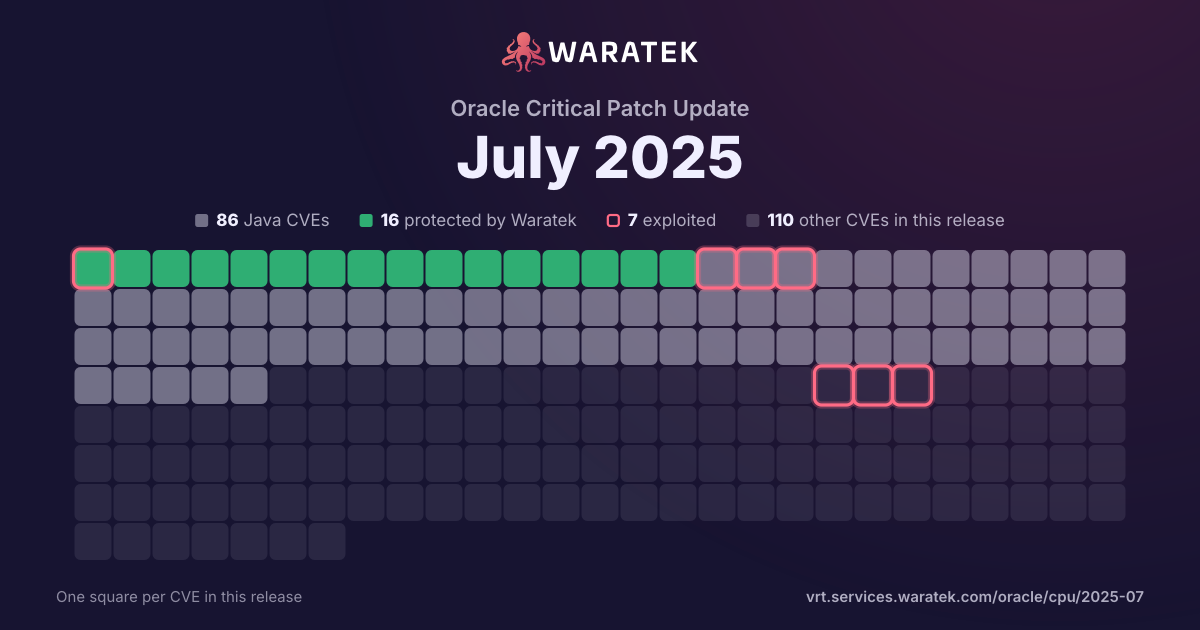
By status
16Protected by Waratek4Mitigation candidate66No exploit published14Outside Waratek scope96Not applicable
7Exploited, marked by the ring
No exploit published. For 31 of them, Oracle's security advisory is the source of public detail.
Protected by Waratek. Waratek RASP can block exploitation of these on systems that have not applied the patch yet.
Overview 31 matches · 0 in Waratek scope · 0 protected · 2 exploited · 2 CISA KEV · 2 public PoC · 1 EPSS ≥ 0.5
31matches
0in Waratek scope0.0%
0protected0.0%
2exploited6.5%
2CISA KEV6.5%
2public PoC6.5%
1EPSS ≥ 0.53.2%
Protected by Waratek
0
0.0%
Rule in development
0
0.0%
Mitigation candidate
0
0.0%
No exploit published
0
0.0%
Outside Waratek scope
0
0.0%
Not applicable
31
100.0%
Withdrawn CVE
0
0.0%
blocked by ARMR today
0
0.0%
partly blocked
0
0.0%
not blocked
31
100.0%
not established
0
0.0%
unrecorded
0
0.0%
split by
peak 10 / quarter
Q4 231
Not applicable1
High1
not blocked1
Exploited1
Q1 240
Q2 243
Not applicable3
High3
not blocked3
No public exploit3
Q3 243
Not applicable3
High3
not blocked3
Working exploit published1
Proof of concept only1
No public exploit1
Q4 243
Not applicable3
High3
not blocked3
No public exploit3
Q1 2510
Not applicable10
High10
not blocked10
Exploited1
Proof of concept only4
No public exploit5
Q2 256
Not applicable6
High6
not blocked6
Proof of concept only3
No public exploit3
Q3 255
Not applicable5
High5
not blocked5
No public exploit5
Q4 23Q1 24Q2 24Q3 24Q4 24Q1 25Q2 25Q3 25
| CVE | Severity | Published▾ | Status | Exploitation | Description |
|---|---|---|---|---|---|
| CVE-2025-53028 | High | 2025-07-15 | Not applicable | No public exploit | Vulnerability in the Oracle VM VirtualBox product of Oracle Virtualization (component: Core). The supported version that is affected is 7.1.10. Easily exploitable vulnerability allows high privileged attacker with logon to the infrastructure where Oracle VM VirtualBox executes to compromise Oracle VM VirtualBox. While the vulnerability is in Oracle VM VirtualBox, attacks may significantly impact additional products (scope change). Successful attacks of this vulnerability can result in takeover of Oracle VM VirtualBox. CVSS 3.1 Base Score 8.2 (Confidentiality, Integrity and Availability impacts). CVSS Vector: (CVSS:3.1/AV:L/AC:L/PR:H/UI:N/S:C/C:H/I:H/A:H). |
| CVE-2025-53027 | High | 2025-07-15 | Not applicable | No public exploit | Vulnerability in the Oracle VM VirtualBox product of Oracle Virtualization (component: Core). The supported version that is affected is 7.1.10. Easily exploitable vulnerability allows high privileged attacker with logon to the infrastructure where Oracle VM VirtualBox executes to compromise Oracle VM VirtualBox. While the vulnerability is in Oracle VM VirtualBox, attacks may significantly impact additional products (scope change). Successful attacks of this vulnerability can result in takeover of Oracle VM VirtualBox. CVSS 3.1 Base Score 8.2 (Confidentiality, Integrity and Availability impacts). CVSS Vector: (CVSS:3.1/AV:L/AC:L/PR:H/UI:N/S:C/C:H/I:H/A:H). |
| CVE-2025-53024 | High | 2025-07-15 | Not applicable | No public exploit | Vulnerability in the Oracle VM VirtualBox product of Oracle Virtualization (component: Core). The supported version that is affected is 7.1.10. Easily exploitable vulnerability allows high privileged attacker with logon to the infrastructure where Oracle VM VirtualBox executes to compromise Oracle VM VirtualBox. While the vulnerability is in Oracle VM VirtualBox, attacks may significantly impact additional products (scope change). Successful attacks of this vulnerability can result in takeover of Oracle VM VirtualBox. CVSS 3.1 Base Score 8.2 (Confidentiality, Integrity and Availability impacts). CVSS Vector: (CVSS:3.1/AV:L/AC:L/PR:H/UI:N/S:C/C:H/I:H/A:H). |
| CVE-2025-50069 | High | 2025-07-15 | Not applicable | No public exploit | Vulnerability in the Java VM component of Oracle Database Server. Supported versions that are affected are 19.3-19.27 and 21.3-21.18. Easily exploitable vulnerability allows low privileged attacker having Create Session, Create Procedure privilege with network access via Oracle Net to compromise Java VM. While the vulnerability is in Java VM, attacks may significantly impact additional products (scope change). Successful attacks of this vulnerability can result in unauthorized access to critical data or complete access to all Java VM accessible data. CVSS 3.1 Base Score 7.7 (Confidentiality impacts). CVSS Vector: (CVSS:3.1/AV:N/AC:L/PR:L/UI:N/S:C/C:H/I:N/A:N). |
| CVE-2025-30751 | High | 2025-07-15 | Not applicable | No public exploit | Vulnerability in the Oracle Database component of Oracle Database Server. Supported versions that are affected are 19.27 and 23.4-23.8. Easily exploitable vulnerability allows low privileged attacker having Create Session, Create Procedure privilege with network access via Oracle Net to compromise Oracle Database. Successful attacks of this vulnerability can result in takeover of Oracle Database. CVSS 3.1 Base Score 8.8 (Confidentiality, Integrity and Availability impacts). CVSS Vector: (CVSS:3.1/AV:N/AC:L/PR:L/UI:N/S:U/C:H/I:H/A:H). |
| CVE-2025-5399 | High | 2025-06-07 | Not applicable | Proof of concept only | Due to a mistake in libcurl's WebSocket code, a malicious server can send a particularly crafted packet which makes libcurl get trapped in an endless busy-loop. There is no other way for the application to escape or exit this loop other than killing the thread/process. This might be used to DoS libcurl-using application. |
| CVE-2025-23166 | High | 2025-05-19 | Not applicable | No public exploit | The C++ method SignTraits::DeriveBits() may incorrectly call ThrowException() based on user-supplied inputs when executing in a background thread, crashing the Node.js process. Such cryptographic operations are commonly applied to untrusted inputs. Thus, this mechanism potentially allows an adversary to remotely crash a Node.js runtime. |
| CVE-2025-4802 | High | 2025-05-16 | Not applicable | No public exploit | Untrusted LD_LIBRARY_PATH environment variable vulnerability in the GNU C Library version 2.27 to 2.38 allows attacker controlled loading of dynamically shared library in statically compiled setuid binaries that call dlopen (including internal dlopen calls after setlocale or calls to NSS functions such as getaddrinfo). |
| CVE-2025-32415 | High | 2025-04-17 | Not applicable | Proof of concept only | In libxml2 before 2.13.8 and 2.14.x before 2.14.2, xmlSchemaIDCFillNodeTables in xmlschemas.c has a heap-based buffer under-read. To exploit this, a crafted XML document must be validated against an XML schema with certain identity constraints, or a crafted XML schema must be used. |
| CVE-2024-56406 | High | 2025-04-13 | Not applicable | No public exploit | A heap buffer overflow vulnerability was discovered in Perl. Release branches 5.34, 5.36, 5.38 and 5.40 are affected, including development versions from 5.33.1 through 5.41.10. When there are non-ASCII bytes in the left-hand-side of the `tr` operator, `S_do_trans_invmap` can overflow the destination pointer `d`. $ perl -e '$_ = "\x{FF}" x 1000000; tr/\xFF/\x{100}/;' Segmentation fault (core dumped) It is believed that this vulnerability can enable Denial of Service and possibly Code Execution attacks on platforms that lack sufficient defenses. |
| CVE-2025-32414 | High | 2025-04-08 | Not applicable | Proof of concept only | In libxml2 before 2.13.8 and 2.14.x before 2.14.2, out-of-bounds memory access can occur in the Python API (Python bindings) because of an incorrect return value. This occurs in xmlPythonFileRead and xmlPythonFileReadRaw because of a difference between bytes and characters. |
| CVE-2025-24855 | High | 2025-03-14 | Not applicable | No public exploit | numbers.c in libxslt before 1.1.43 has a use-after-free because, in nested XPath evaluations, an XPath context node can be modified but never restored. This is related to xsltNumberFormatGetValue, xsltEvalXPathPredicate, xsltEvalXPathStringNs, and xsltComputeSortResultInternal. |
| CVE-2024-8176 | High | 2025-03-14 | Not applicable | Proof of concept only | A stack overflow vulnerability exists in the libexpat library due to the way it handles recursive entity expansion in XML documents. When parsing an XML document with deeply nested entity references, libexpat can be forced to recurse indefinitely, exhausting the stack space and causing a crash. This issue could lead to denial of service (DoS) or, in some cases, exploitable memory corruption, depending on the environment and library usage. |
| CVE-2024-55549 | High | 2025-03-14 | Not applicable | Proof of concept only | xsltGetInheritedNsList in libxslt before 1.1.43 has a use-after-free issue related to exclusion of result prefixes. |
| CVE-2025-27363 | High | 2025-03-11 | Not applicable | Exploited | An out of bounds write exists in FreeType versions 2.13.0 and below (newer versions of FreeType are not vulnerable) when attempting to parse font subglyph structures related to TrueType GX and variable font files. The vulnerable code assigns a signed short value to an unsigned long and then adds a static value causing it to wrap around and allocate too small of a heap buffer. The code then writes up to 6 signed long integers out of bounds relative to this buffer. This may result in arbitrary code execution. This vulnerability may have been exploited in the wild. |
| CVE-2025-0624 | High | 2025-02-19 | Not applicable | No public exploit | A flaw was found in grub2. During the network boot process, when trying to search for the configuration file, grub copies data from a user controlled environment variable into an internal buffer using the grub_strcpy() function. During this step, it fails to consider the environment variable length when allocating the internal buffer, resulting in an out-of-bounds write. If correctly exploited, this issue may result in remote code execution through the same network segment grub is searching for the boot information, which can be used to by-pass secure boot protections. |
| CVE-2025-27113 | High | 2025-02-18 | Not applicable | No public exploit | libxml2 before 2.12.10 and 2.13.x before 2.13.6 has a NULL pointer dereference in xmlPatMatch in pattern.c. |
| CVE-2024-12797 | High | 2025-02-11 | Not applicable | No public exploit | Issue summary: Clients using RFC7250 Raw Public Keys (RPKs) to authenticate a server may fail to notice that the server was not authenticated, because handshakes don't abort as expected when the SSL_VERIFY_PEER verification mode is set. Impact summary: TLS and DTLS connections using raw public keys may be vulnerable to man-in-middle attacks when server authentication failure is not detected by clients. RPKs are disabled by default in both TLS clients and TLS servers. The issue only arises when TLS clients explicitly enable RPK use by the server, and the server, likewise, enables sending of an RPK instead of an X.509 certificate chain. The affected clients are those that then rely on the handshake to fail when the server's RPK fails to match one of the expected public keys, by setting the verification mode to SSL_VERIFY_PEER. Clients that enable server-side raw public keys can still find out that raw public key verification failed by calling SSL_get_verify_result(), and those that do, and take appropriate action, are not affected. This issue was introduced in the initial implementation of RPK support in OpenSSL 3.2. The FIPS modules in 3.4, 3.3, 3.2, 3.1 and 3.0 are not affected by this issue. |
| CVE-2025-0725 | High | 2025-02-05 | Not applicable | Proof of concept only | When libcurl is asked to perform automatic gzip decompression of content-encoded HTTP responses with the `CURLOPT_ACCEPT_ENCODING` option, **using zlib 1.2.0.3 or older**, an attacker-controlled integer overflow would make libcurl perform a buffer overflow. |
| CVE-2024-57699 | High | 2025-02-05 | Not applicable | Proof of concept only | A security issue was found in Netplex Json-smart 2.5.0 through 2.5.1. When loading a specially crafted JSON input, containing a large number of ’{’, a stack exhaustion can be trigger, which could allow an attacker to cause a Denial of Service (DoS). This issue exists because of an incomplete fix for CVE-2023-1370. |
| CVE-2025-23083 | High | 2025-01-22 | Not applicable | No public exploit | With the aid of the diagnostics_channel utility, an event can be hooked into whenever a worker thread is created. This is not limited only to workers but also exposes internal workers, where an instance of them can be fetched, and its constructor can be grabbed and reinstated for malicious usage. This vulnerability affects Permission Model users (--permission) on Node.js v20, v22, and v23. |
| CVE-2024-47606 | High | 2024-12-12 | Not applicable | No public exploit | GStreamer is a library for constructing graphs of media-handling components. An integer underflow has been detected in the function qtdemux_parse_theora_extension within qtdemux.c. The vulnerability occurs due to an underflow of the gint size variable, which causes size to hold a large unintended value when cast to an unsigned integer. This 32-bit negative value is then cast to a 64-bit unsigned integer (0xfffffffffffffffa) in a subsequent call to gst_buffer_new_and_alloc. The function gst_buffer_new_allocate then attempts to allocate memory, eventually calling _sysmem_new_block. The function _sysmem_new_block adds alignment and header size to the (unsigned) size, causing the overflow of the 'slice_size' variable. As a result, only 0x89 bytes are allocated, despite the large input size. When the following memcpy call occurs in gst_buffer_fill, the data from the input file will overwrite the content of the GstMapInfo info structure. Finally, during the call to gst_memory_unmap, the overwritten memory may cause a function pointer hijack, as the mem->allocator->mem_unmap_full function is called with a corrupted pointer. This function pointer overwrite could allow an attacker to alter the execution flow of the program, leading to arbitrary code execution. This vulnerability is fixed in 1.24.10. |
| CVE-2024-46956 | High | 2024-11-10 | Not applicable | No public exploit | An issue was discovered in psi/zfile.c in Artifex Ghostscript before 10.04.0. Out-of-bounds data access in filenameforall can lead to arbitrary code execution. |
| CVE-2024-47072 | High | 2024-11-08 | Not applicable | No public exploit | XStream is a simple library to serialize objects to XML and back again. This vulnerability may allow a remote attacker to terminate the application with a stack overflow error resulting in a denial of service only by manipulating the processed input stream when XStream is configured to use the BinaryStreamDriver. XStream 1.4.21 has been patched to detect the manipulation in the binary input stream causing the the stack overflow and raises an InputManipulationException instead. Users are advised to upgrade. Users unable to upgrade may catch the StackOverflowError in the client code calling XStream if XStream is configured to use the BinaryStreamDriver. |
| CVE-2024-7592 | High | 2024-08-19 | Not applicable | Proof of concept only | There is a LOW severity vulnerability affecting CPython, specifically the 'http.cookies' standard library module. When parsing cookies that contained backslashes for quoted characters in the cookie value, the parser would use an algorithm with quadratic complexity, resulting in excess CPU resources being used while parsing the value. |
| CVE-2024-38477 | High | 2024-07-01 | Not applicable | No public exploit | null pointer dereference in mod_proxy in Apache HTTP Server 2.4.59 and earlier allows an attacker to crash the server via a malicious request. Users are recommended to upgrade to version 2.4.60, which fixes this issue. |
| CVE-2024-38472 | High | 2024-07-01 | Not applicable | Working exploit published | SSRF in Apache HTTP Server on Windows allows to potentially leak NTLM hashes to a malicious server via SSRF and malicious requests or content Users are recommended to upgrade to version 2.4.60 which fixes this issue. Note: Existing configurations that access UNC paths will have to configure new directive "UNCList" to allow access during request processing. |
| CVE-2023-27349 | High | 2024-05-03 | Not applicable | No public exploit | BlueZ Audio Profile AVRCP Improper Validation of Array Index Remote Code Execution Vulnerability. This vulnerability allows network-adjacent attackers to execute arbitrary code via Bluetooth on affected installations of BlueZ. User interaction is required to exploit this vulnerability in that the target must connect to a malicious device. The specific flaw exists within the handling of the AVRCP protocol. The issue results from the lack of proper validation of user-supplied data, which can result in a write past the end of an allocated buffer. An attacker can leverage this vulnerability to execute code in the context of root. Was ZDI-CAN-19908. |
| CVE-2024-31744 | High | 2024-04-19 | Not applicable | No public exploit | In Jasper 4.2.2, the jpc_streamlist_remove function in src/libjasper/jpc/jpc_dec.c:2407 has an assertion failure vulnerability, allowing attackers to cause a denial of service attack through a specific image file. |
| CVE-2024-1135 | High | 2024-04-16 | Not applicable | No public exploit | Gunicorn fails to properly validate Transfer-Encoding headers, leading to HTTP Request Smuggling (HRS) vulnerabilities. By crafting requests with conflicting Transfer-Encoding headers, attackers can bypass security restrictions and access restricted endpoints. This issue is due to Gunicorn's handling of Transfer-Encoding headers, where it incorrectly processes requests with multiple, conflicting Transfer-Encoding headers, treating them as chunked regardless of the final encoding specified. This vulnerability allows for a range of attacks including cache poisoning, session manipulation, and data exposure. |
| CVE-2023-42917 | High | 2023-11-30 | Not applicable | Exploited | A memory corruption vulnerability was addressed with improved locking. This issue is fixed in iOS 17.1.2 and iPadOS 17.1.2, macOS Sonoma 14.1.2, Safari 17.1.2. Processing web content may lead to arbitrary code execution. Apple is aware of a report that this issue may have been exploited against versions of iOS before iOS 16.7.1. |