
Oracle Critical Patch Update July 2025
Released July 2025 · Oracle's advisory ↗ · ← Critical Patch Update, April 2025 · Critical Patch Update, October 2025 →
196 CVEs in this release, one square each
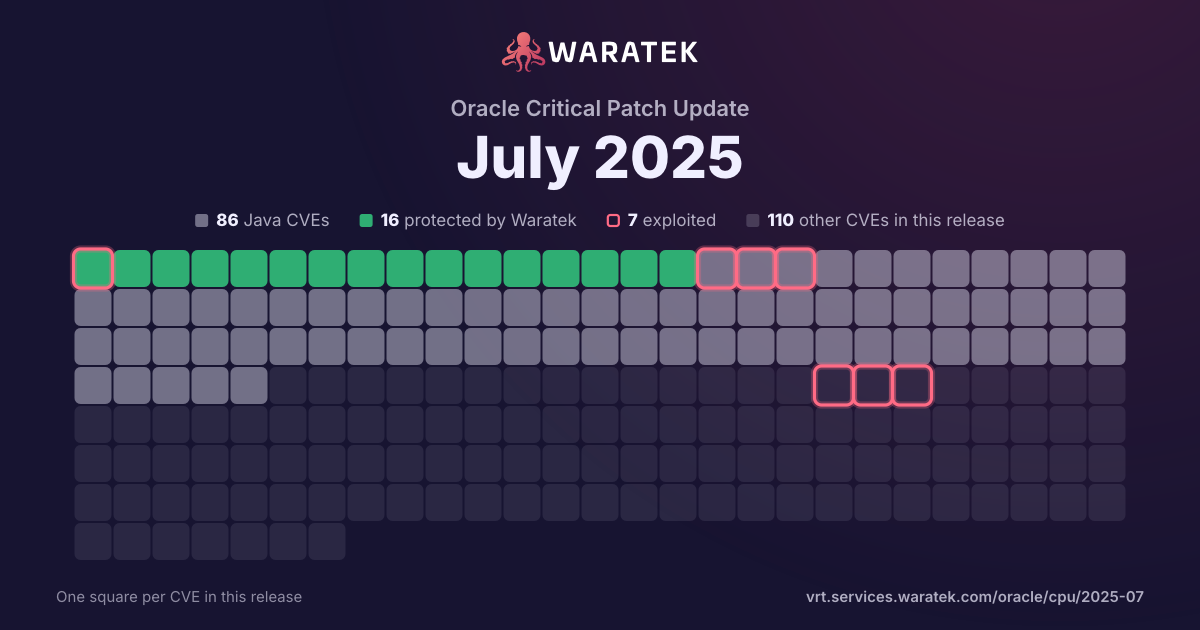
By status
16Protected by Waratek4Mitigation candidate66No exploit published14Outside Waratek scope96Not applicable
7Exploited, marked by the ring
No exploit published. For 31 of them, Oracle's security advisory is the source of public detail.
Protected by Waratek. Waratek RASP can block exploitation of these on systems that have not applied the patch yet.
Overview 11 matches · 0 exploited · 0 CISA KEV · 0 public PoC · 0 EPSS ≥ 0.5
11matches
0exploited0.0%
0CISA KEV0.0%
0public PoC0.0%
0EPSS ≥ 0.50.0%
Protected by Waratek
11
100.0%
Rule in development
0
0.0%
Mitigation candidate
0
0.0%
No exploit published
0
0.0%
blocked by ARMR today
11
100.0%
partly blocked
0
0.0%
not blocked
0
0.0%
not established
0
0.0%
unrecorded
0
0.0%
Exploited
0
0.0%
Working exploit published
0
0.0%
Proof of concept only
0
0.0%
Forecast only
0
0.0%
No public exploit
11
100.0%
split by
peak 3 / quarter
Q2 211
Protected by Waratek1
High1
blocked by ARMR today1
No public exploit1
Q3 210
Q4 211
Protected by Waratek1
Critical1
blocked by ARMR today1
No public exploit1
Q1 220
Q2 220
Q3 220
Q4 220
Q1 230
Q2 230
Q3 230
Q4 230
Q1 240
Q2 240
Q3 240
Q4 243
Protected by Waratek3
Critical2
High1
blocked by ARMR today3
No public exploit3
Q1 252
Protected by Waratek2
High1
Medium1
blocked by ARMR today2
No public exploit2
Q2 252
Protected by Waratek2
High2
blocked by ARMR today2
No public exploit2
Q3 252
Protected by Waratek2
Medium2
blocked by ARMR today2
No public exploit2
Q3 21Q1 22Q3 22Q1 23Q3 23Q1 24Q3 24Q1 25Q3 25
| CVE | Severity | Published▾ | Status | Exploitation | Description |
|---|---|---|---|---|---|
| CVE-2025-30761 | Medium | 2025-07-15 | Protected by Waratek | No public exploit | Vulnerability in the Oracle Java SE, Oracle GraalVM Enterprise Edition product of Oracle Java SE (component: Scripting). Supported versions that are affected are Oracle Java SE: 8u451, 8u451-perf and 11.0.27; Oracle GraalVM Enterprise Edition: 21.3.14. Difficult to exploit vulnerability allows unauthenticated attacker with network access via multiple protocols to compromise Oracle Java SE, Oracle GraalVM Enterprise Edition. Successful attacks of this vulnerability can result in unauthorized creation, deletion or modification access to critical data or all Oracle Java SE, Oracle GraalVM Enterprise Edition accessible data. Note: This vulnerability can be exploited by using APIs in the specified Component, e.g., through a web service which supplies data to the APIs. This vulnerability also applies to Java deployments, typically in clients running sandboxed Java Web Start applications or sandboxed Java applets, that load and run untrusted code (e.g., code that comes from the internet) and rely on the Java sandbox for security. CVSS 3.1 Base Score 5.9 (Integrity impacts). CVSS Vector: (CVSS:3.1/AV:N/AC:H/PR:N/UI:N/S:U/C:N/I:H/A:N). |
| CVE-2025-30754 | Medium | 2025-07-15 | Protected by Waratek | No public exploit | Vulnerability in the Oracle Java SE, Oracle GraalVM for JDK, Oracle GraalVM Enterprise Edition product of Oracle Java SE (component: JSSE). Supported versions that are affected are Oracle Java SE: 8u451, 8u451-perf, 11.0.27, 17.0.15, 21.0.7, 24.0.1; Oracle GraalVM for JDK: 17.0.15, 21.0.7 and 24.0.1; Oracle GraalVM Enterprise Edition: 21.3.14. Difficult to exploit vulnerability allows unauthenticated attacker with network access via TLS to compromise Oracle Java SE, Oracle GraalVM for JDK, Oracle GraalVM Enterprise Edition. Successful attacks of this vulnerability can result in unauthorized update, insert or delete access to some of Oracle Java SE, Oracle GraalVM for JDK, Oracle GraalVM Enterprise Edition accessible data as well as unauthorized read access to a subset of Oracle Java SE, Oracle GraalVM for JDK, Oracle GraalVM Enterprise Edition accessible data. Note: This vulnerability applies to Java deployments, typically in clients running sandboxed Java Web Start applications or sandboxed Java applets, that load and run untrusted code (e.g., code that comes from the internet) and rely on the Java sandbox for security. This vulnerability does not apply to Java deployments, typically in servers, that load and run only trusted code (e.g., code installed by an administrator). CVSS 3.1 Base Score 4.8 (Confidentiality and Integrity impacts). CVSS Vector: (CVSS:3.1/AV:N/AC:H/PR:N/UI:N/S:U/C:L/I:L/A:N). |
| CVE-2025-27819 | High | 2025-06-10 | Protected by Waratek | No public exploit | In CVE-2023-25194, we announced the RCE/Denial of service attack via SASL JAAS JndiLoginModule configuration in Kafka Connect API. But not only Kafka Connect API is vulnerable to this attack, the Apache Kafka brokers also have this vulnerability. To exploit this vulnerability, the attacker needs to be able to connect to the Kafka cluster and have the AlterConfigs permission on the cluster resource. Since Apache Kafka 3.4.0, we have added a system property ("-Dorg.apache.kafka.disallowed.login.modules") to disable the problematic login modules usage in SASL JAAS configuration. Also by default "com.sun.security.auth.module.JndiLoginModule" is disabled in Apache Kafka 3.4.0, and "com.sun.security.auth.module.JndiLoginModule,com.sun.security.auth.module.LdapLoginModule" is disabled by default in in Apache Kafka 3.9.1/4.0.0 |
| CVE-2025-27818 | High | 2025-06-10 | Protected by Waratek | No public exploit | A possible security vulnerability has been identified in Apache Kafka. This requires access to a alterConfig to the cluster resource, or Kafka Connect worker, and the ability to create/modify connectors on it with an arbitrary Kafka client SASL JAAS config and a SASL-based security protocol, which has been possible on Kafka clusters since Apache Kafka 2.0.0 (Kafka Connect 2.3.0). When configuring the broker via config file or AlterConfig command, or connector via the Kafka Kafka Connect REST API, an authenticated operator can set the `sasl.jaas.config` property for any of the connector's Kafka clients to "com.sun.security.auth.module.LdapLoginModule", which can be done via the `producer.override.sasl.jaas.config`, `consumer.override.sasl.jaas.config`, or `admin.override.sasl.jaas.config` properties. This will allow the server to connect to the attacker's LDAP server and deserialize the LDAP response, which the attacker can use to execute java deserialization gadget chains on the Kafka connect server. Attacker can cause unrestricted deserialization of untrusted data (or) RCE vulnerability when there are gadgets in the classpath. Since Apache Kafka 3.0.0, users are allowed to specify these properties in connector configurations for Kafka Connect clusters running with out-of-the-box configurations. Before Apache Kafka 3.0.0, users may not specify these properties unless the Kafka Connect cluster has been reconfigured with a connector client override policy that permits them. Since Apache Kafka 3.9.1/4.0.0, we have added a system property ("-Dorg.apache.kafka.disallowed.login.modules") to disable the problematic login modules usage in SASL JAAS configuration. Also by default "com.sun.security.auth.module.JndiLoginModule,com.sun.security.auth.module.LdapLoginModule" are disabled in Apache Kafka Connect 3.9.1/4.0.0. We advise the Kafka users to validate connector configurations and only allow trusted LDAP configurations. Also examine connector dependencies for vulnerable versions and either upgrade their connectors, upgrading that specific dependency, or removing the connectors as options for remediation. Finally, in addition to leveraging the "org.apache.kafka.disallowed.login.modules" system property, Kafka Connect users can also implement their own connector client config override policy, which can be used to control which Kafka client properties can be overridden directly in a connector config and which cannot. |
| CVE-2025-27553 | High | 2025-03-23 | Protected by Waratek | No public exploit | Relative Path Traversal vulnerability in Apache Commons VFS before 2.10.0. The FileObject API in Commons VFS has a 'resolveFile' method that takes a 'scope' parameter. Specifying 'NameScope.DESCENDENT' promises that "an exception is thrown if the resolved file is not a descendent of the base file". However, when the path contains encoded ".." characters (for example, "%2E%2E/bar.txt"), it might return file objects that are not a descendent of the base file, without throwing an exception. This issue affects Apache Commons VFS: before 2.10.0. Users are recommended to upgrade to version 2.10.0, which fixes the issue. |
| CVE-2024-52012 | Medium | 2025-01-27 | Protected by Waratek | No public exploit | Relative Path Traversal vulnerability in Apache Solr. Solr instances running on Windows are vulnerable to arbitrary filepath write-access, due to a lack of input-sanitation in the "configset upload" API. Commonly known as a "zipslip", maliciously constructed ZIP files can use relative filepaths to write data to unanticipated parts of the filesystem. This issue affects Apache Solr: from 6.6 through 9.7.0. Users are recommended to upgrade to version 9.8.0, which fixes the issue. Users unable to upgrade may also safely prevent the issue by using Solr's "Rule-Based Authentication Plugin" to restrict access to the configset upload API, so that it can only be accessed by a trusted set of administrators/users. |
| CVE-2024-52046 | Critical | 2024-12-25 | Protected by Waratek | No public exploit | The ObjectSerializationDecoder in Apache MINA uses Java’s native deserialization protocol to process incoming serialized data but lacks the necessary security checks and defenses. This vulnerability allows attackers to exploit the deserialization process by sending specially crafted malicious serialized data, potentially leading to remote code execution (RCE) attacks. This issue affects MINA core versions 2.0.X, 2.1.X and 2.2.X, and will be fixed by the releases 2.0.27, 2.1.10 and 2.2.4. It's also important to note that an application using MINA core library will only be affected if the IoBuffer#getObject() method is called, and this specific method is potentially called when adding a ProtocolCodecFilter instance using the ObjectSerializationCodecFactory class in the filter chain. If your application is specifically using those classes, you have to upgrade to the latest version of MINA core library. Upgrading will not be enough: you also need to explicitly allow the classes the decoder will accept in the ObjectSerializationDecoder instance, using one of the three new methods: /** * Accept class names where the supplied ClassNameMatcher matches for * deserialization, unless they are otherwise rejected. * * @param classNameMatcher the matcher to use */ public void accept(ClassNameMatcher classNameMatcher) /** * Accept class names that match the supplied pattern for * deserialization, unless they are otherwise rejected. * * @param pattern standard Java regexp */ public void accept(Pattern pattern) /** * Accept the wildcard specified classes for deserialization, * unless they are otherwise rejected. * * @param patterns Wildcard file name patterns as defined by * {@link org.apache.commons.io.FilenameUtils#wildcardMatch(String, String) FilenameUtils.wildcardMatch} */ public void accept(String... patterns) By default, the decoder will reject *all* classes that will be present in the incoming data. Note: The FtpServer, SSHd and Vysper sub-project are not affected by this issue. |
| CVE-2024-28168 | High | 2024-10-09 | Protected by Waratek | No public exploit | Improper Restriction of XML External Entity Reference ('XXE') vulnerability in Apache XML Graphics FOP. This issue affects Apache XML Graphics FOP: 2.9. Users are recommended to upgrade to version 2.10, which fixes the issue. |
| CVE-2024-47561 | Critical | 2024-10-03 | Protected by Waratek | No public exploit | Schema parsing in the Java SDK of Apache Avro 1.11.3 and previous versions allows bad actors to execute arbitrary code. Users are recommended to upgrade to version 1.11.4 or 1.12.0, which fix this issue. |
| CVE-2021-42575 | Critical | 2021-10-18 | Protected by Waratek | No public exploit | The OWASP Java HTML Sanitizer before 20211018.1 does not properly enforce policies associated with the SELECT, STYLE, and OPTION elements. |
| CVE-2021-33813 | High | 2021-06-16 | Protected by Waratek | No public exploit | An XXE issue in SAXBuilder in JDOM through 2.0.6 allows attackers to cause a denial of service via a crafted HTTP request. |