
Oracle Critical Patch Update July 2025
Released July 2025 · Oracle's advisory ↗ · ← Critical Patch Update, April 2025 · Critical Patch Update, October 2025 →
196 CVEs in this release, one square each
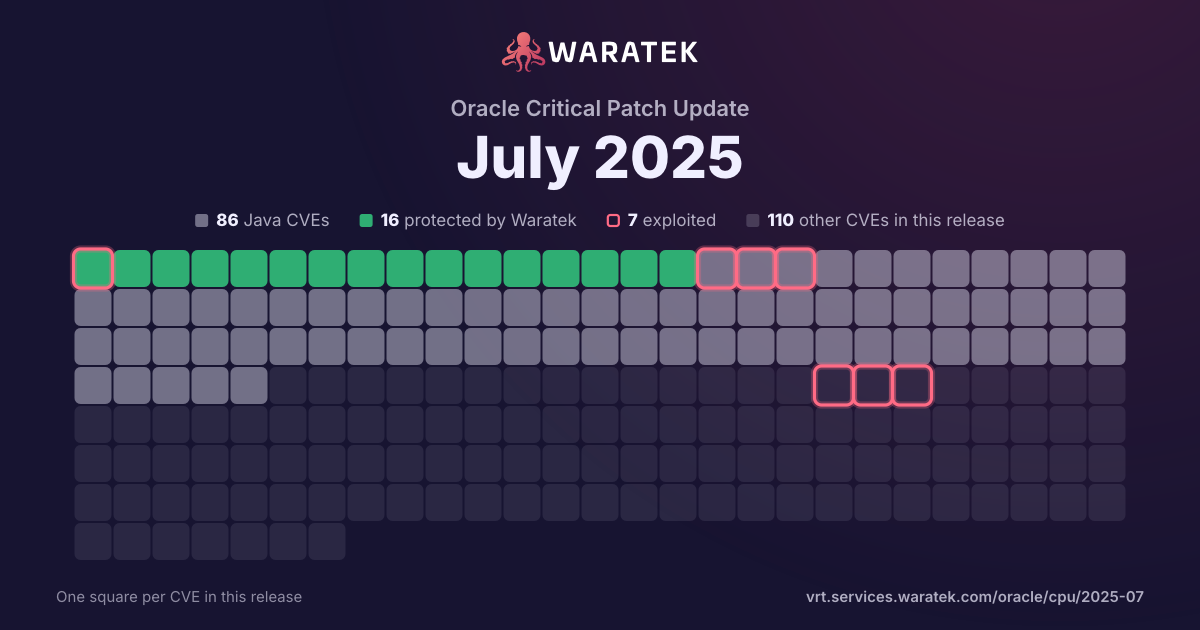
By status
16Protected by Waratek4Mitigation candidate66No exploit published14Outside Waratek scope96Not applicable
7Exploited, marked by the ring
No exploit published. For 31 of them, Oracle's security advisory is the source of public detail.
Protected by Waratek. Waratek RASP can block exploitation of these on systems that have not applied the patch yet.
Overview 77 matches · 0 in Waratek scope · 0 protected · 0 exploited · 0 CISA KEV · 0 public PoC · 0 EPSS ≥ 0.5
77matches
0in Waratek scope0.0%
0protected0.0%
0exploited0.0%
0CISA KEV0.0%
0public PoC0.0%
0EPSS ≥ 0.50.0%
Protected by Waratek
0
0.0%
Rule in development
0
0.0%
Mitigation candidate
0
0.0%
No exploit published
0
0.0%
Outside Waratek scope
0
0.0%
Not applicable
77
100.0%
Withdrawn CVE
0
0.0%
blocked by ARMR today
0
0.0%
partly blocked
0
0.0%
not blocked
77
100.0%
not established
0
0.0%
unrecorded
0
0.0%
Exploited
0
0.0%
Working exploit published
0
0.0%
Proof of concept only
0
0.0%
Forecast only
0
0.0%
No public exploit
77
100.0%
split by
peak 43 / month
Feb 241
Not applicable1
Medium1
not blocked1
No public exploit1
Mar 240
Apr 242
Not applicable2
High2
not blocked2
No public exploit2
May 243
Not applicable3
High1
Medium2
not blocked3
No public exploit3
Jun 242
Not applicable2
Medium2
not blocked2
No public exploit2
Jul 243
Not applicable3
High1
Medium2
not blocked3
No public exploit3
Aug 243
Not applicable3
Medium3
not blocked3
No public exploit3
Sep 241
Not applicable1
Medium1
not blocked1
No public exploit1
Oct 242
Not applicable2
Medium2
not blocked2
No public exploit2
Nov 242
Not applicable2
High2
not blocked2
No public exploit2
Dec 243
Not applicable3
High1
Medium2
not blocked3
No public exploit3
Jan 252
Not applicable2
High1
Medium1
not blocked2
No public exploit2
Feb 255
Not applicable5
High3
Medium2
not blocked5
No public exploit5
Mar 252
Not applicable2
High1
Medium1
not blocked2
No public exploit2
Apr 251
Not applicable1
High1
not blocked1
No public exploit1
May 252
Not applicable2
High2
not blocked2
No public exploit2
Jun 250
Jul 2543
Not applicable43
Critical1
High5
Medium30
Low7
not blocked43
No public exploit43
Mar 24May 24Jul 24Sep 24Nov 24Jan 25Mar 25May 25Jul 25
| CVE | Severity | Published▾ | Status | Exploitation | Description |
|---|---|---|---|---|---|
| CVE-2025-53032 | Medium | 2025-07-15 | Not applicable | No public exploit | Vulnerability in the MySQL Server product of Oracle MySQL (component: Server: Optimizer). Supported versions that are affected are 9.0.0-9.1.0. Easily exploitable vulnerability allows high privileged attacker with network access via multiple protocols to compromise MySQL Server. Successful attacks of this vulnerability can result in unauthorized ability to cause a hang or frequently repeatable crash (complete DOS) of MySQL Server. CVSS 3.1 Base Score 4.9 (Availability impacts). CVSS Vector: (CVSS:3.1/AV:N/AC:L/PR:H/UI:N/S:U/C:N/I:N/A:H). |
| CVE-2025-53030 | Medium | 2025-07-15 | Not applicable | No public exploit | Vulnerability in the Oracle VM VirtualBox product of Oracle Virtualization (component: Core). The supported version that is affected is 7.1.10. Easily exploitable vulnerability allows high privileged attacker with logon to the infrastructure where Oracle VM VirtualBox executes to compromise Oracle VM VirtualBox. While the vulnerability is in Oracle VM VirtualBox, attacks may significantly impact additional products (scope change). Successful attacks of this vulnerability can result in unauthorized access to critical data or complete access to all Oracle VM VirtualBox accessible data. CVSS 3.1 Base Score 6.0 (Confidentiality impacts). CVSS Vector: (CVSS:3.1/AV:L/AC:L/PR:H/UI:N/S:C/C:H/I:N/A:N). |
| CVE-2025-53029 | Low | 2025-07-15 | Not applicable | No public exploit | Vulnerability in the Oracle VM VirtualBox product of Oracle Virtualization (component: Core). The supported version that is affected is 7.1.10. Easily exploitable vulnerability allows high privileged attacker with logon to the infrastructure where Oracle VM VirtualBox executes to compromise Oracle VM VirtualBox. Successful attacks of this vulnerability can result in unauthorized read access to a subset of Oracle VM VirtualBox accessible data. CVSS 3.1 Base Score 2.3 (Confidentiality impacts). CVSS Vector: (CVSS:3.1/AV:L/AC:L/PR:H/UI:N/S:U/C:L/I:N/A:N). |
| CVE-2025-53028 | High | 2025-07-15 | Not applicable | No public exploit | Vulnerability in the Oracle VM VirtualBox product of Oracle Virtualization (component: Core). The supported version that is affected is 7.1.10. Easily exploitable vulnerability allows high privileged attacker with logon to the infrastructure where Oracle VM VirtualBox executes to compromise Oracle VM VirtualBox. While the vulnerability is in Oracle VM VirtualBox, attacks may significantly impact additional products (scope change). Successful attacks of this vulnerability can result in takeover of Oracle VM VirtualBox. CVSS 3.1 Base Score 8.2 (Confidentiality, Integrity and Availability impacts). CVSS Vector: (CVSS:3.1/AV:L/AC:L/PR:H/UI:N/S:C/C:H/I:H/A:H). |
| CVE-2025-53027 | High | 2025-07-15 | Not applicable | No public exploit | Vulnerability in the Oracle VM VirtualBox product of Oracle Virtualization (component: Core). The supported version that is affected is 7.1.10. Easily exploitable vulnerability allows high privileged attacker with logon to the infrastructure where Oracle VM VirtualBox executes to compromise Oracle VM VirtualBox. While the vulnerability is in Oracle VM VirtualBox, attacks may significantly impact additional products (scope change). Successful attacks of this vulnerability can result in takeover of Oracle VM VirtualBox. CVSS 3.1 Base Score 8.2 (Confidentiality, Integrity and Availability impacts). CVSS Vector: (CVSS:3.1/AV:L/AC:L/PR:H/UI:N/S:C/C:H/I:H/A:H). |
| CVE-2025-53026 | Medium | 2025-07-15 | Not applicable | No public exploit | Vulnerability in the Oracle VM VirtualBox product of Oracle Virtualization (component: Core). The supported version that is affected is 7.1.10. Easily exploitable vulnerability allows high privileged attacker with logon to the infrastructure where Oracle VM VirtualBox executes to compromise Oracle VM VirtualBox. While the vulnerability is in Oracle VM VirtualBox, attacks may significantly impact additional products (scope change). Successful attacks of this vulnerability can result in unauthorized access to critical data or complete access to all Oracle VM VirtualBox accessible data. CVSS 3.1 Base Score 6.0 (Confidentiality impacts). CVSS Vector: (CVSS:3.1/AV:L/AC:L/PR:H/UI:N/S:C/C:H/I:N/A:N). |
| CVE-2025-53025 | Medium | 2025-07-15 | Not applicable | No public exploit | Vulnerability in the Oracle VM VirtualBox product of Oracle Virtualization (component: Core). The supported version that is affected is 7.1.10. Easily exploitable vulnerability allows high privileged attacker with logon to the infrastructure where Oracle VM VirtualBox executes to compromise Oracle VM VirtualBox. While the vulnerability is in Oracle VM VirtualBox, attacks may significantly impact additional products (scope change). Successful attacks of this vulnerability can result in unauthorized access to critical data or complete access to all Oracle VM VirtualBox accessible data. CVSS 3.1 Base Score 6.0 (Confidentiality impacts). CVSS Vector: (CVSS:3.1/AV:L/AC:L/PR:H/UI:N/S:C/C:H/I:N/A:N). |
| CVE-2025-53024 | High | 2025-07-15 | Not applicable | No public exploit | Vulnerability in the Oracle VM VirtualBox product of Oracle Virtualization (component: Core). The supported version that is affected is 7.1.10. Easily exploitable vulnerability allows high privileged attacker with logon to the infrastructure where Oracle VM VirtualBox executes to compromise Oracle VM VirtualBox. While the vulnerability is in Oracle VM VirtualBox, attacks may significantly impact additional products (scope change). Successful attacks of this vulnerability can result in takeover of Oracle VM VirtualBox. CVSS 3.1 Base Score 8.2 (Confidentiality, Integrity and Availability impacts). CVSS Vector: (CVSS:3.1/AV:L/AC:L/PR:H/UI:N/S:C/C:H/I:H/A:H). |
| CVE-2025-53023 | Medium | 2025-07-15 | Not applicable | No public exploit | Vulnerability in the MySQL Server product of Oracle MySQL (component: Server: Replication). Supported versions that are affected are 8.0.0-8.0.42. Easily exploitable vulnerability allows high privileged attacker with network access via multiple protocols to compromise MySQL Server. Successful attacks of this vulnerability can result in unauthorized ability to cause a hang or frequently repeatable crash (complete DOS) of MySQL Server. CVSS 3.1 Base Score 4.9 (Availability impacts). CVSS Vector: (CVSS:3.1/AV:N/AC:L/PR:H/UI:N/S:U/C:N/I:N/A:H). |
| CVE-2025-50104 | Low | 2025-07-15 | Not applicable | No public exploit | Vulnerability in the MySQL Server product of Oracle MySQL (component: Server: DDL). Supported versions that are affected are 8.0.0-8.0.42, 8.4.0-8.4.5 and 9.0.0-9.3.0. Easily exploitable vulnerability allows high privileged attacker with network access via multiple protocols to compromise MySQL Server. Successful attacks of this vulnerability can result in unauthorized ability to cause a partial denial of service (partial DOS) of MySQL Server. CVSS 3.1 Base Score 2.7 (Availability impacts). CVSS Vector: (CVSS:3.1/AV:N/AC:L/PR:H/UI:N/S:U/C:N/I:N/A:L). |
| CVE-2025-50103 | Medium | 2025-07-15 | Not applicable | No public exploit | Vulnerability in the MySQL Server product of Oracle MySQL (component: Server: Security: LDAP Auth). Supported versions that are affected are 9.0.0-9.3.0. Difficult to exploit vulnerability allows high privileged attacker with network access via multiple protocols to compromise MySQL Server. Successful attacks of this vulnerability can result in unauthorized ability to cause a hang or frequently repeatable crash (complete DOS) of MySQL Server. CVSS 3.1 Base Score 4.4 (Availability impacts). CVSS Vector: (CVSS:3.1/AV:N/AC:H/PR:H/UI:N/S:U/C:N/I:N/A:H). |
| CVE-2025-50102 | Medium | 2025-07-15 | Not applicable | No public exploit | Vulnerability in the MySQL Server product of Oracle MySQL (component: Server: Optimizer). Supported versions that are affected are 8.0.0-8.0.42, 8.4.0-8.4.5 and 9.0.0-9.3.0. Easily exploitable vulnerability allows high privileged attacker with network access via multiple protocols to compromise MySQL Server. Successful attacks of this vulnerability can result in unauthorized ability to cause a hang or frequently repeatable crash (complete DOS) of MySQL Server. CVSS 3.1 Base Score 4.9 (Availability impacts). CVSS Vector: (CVSS:3.1/AV:N/AC:L/PR:H/UI:N/S:U/C:N/I:N/A:H). |
| CVE-2025-50101 | Medium | 2025-07-15 | Not applicable | No public exploit | Vulnerability in the MySQL Server product of Oracle MySQL (component: Server: Optimizer). Supported versions that are affected are 8.0.0-8.0.42, 8.4.0-8.4.5 and 9.0.0-9.3.0. Easily exploitable vulnerability allows high privileged attacker with network access via multiple protocols to compromise MySQL Server. Successful attacks of this vulnerability can result in unauthorized ability to cause a hang or frequently repeatable crash (complete DOS) of MySQL Server. CVSS 3.1 Base Score 4.9 (Availability impacts). CVSS Vector: (CVSS:3.1/AV:N/AC:L/PR:H/UI:N/S:U/C:N/I:N/A:H). |
| CVE-2025-50100 | Low | 2025-07-15 | Not applicable | No public exploit | Vulnerability in the MySQL Server product of Oracle MySQL (component: Server: Thread Pooling). Supported versions that are affected are 8.0.0-8.0.42, 8.4.0-8.4.5 and 9.0.0-9.3.0. Difficult to exploit vulnerability allows high privileged attacker with network access via multiple protocols to compromise MySQL Server. Successful attacks of this vulnerability can result in unauthorized ability to cause a partial denial of service (partial DOS) of MySQL Server. CVSS 3.1 Base Score 2.2 (Availability impacts). CVSS Vector: (CVSS:3.1/AV:N/AC:H/PR:H/UI:N/S:U/C:N/I:N/A:L). |
| CVE-2025-50099 | Medium | 2025-07-15 | Not applicable | No public exploit | Vulnerability in the MySQL Server product of Oracle MySQL (component: InnoDB). Supported versions that are affected are 8.0.0-8.0.42, 8.4.0-8.4.5 and 9.0.0-9.3.0. Easily exploitable vulnerability allows high privileged attacker with network access via multiple protocols to compromise MySQL Server. Successful attacks of this vulnerability can result in unauthorized ability to cause a hang or frequently repeatable crash (complete DOS) of MySQL Server. CVSS 3.1 Base Score 4.9 (Availability impacts). CVSS Vector: (CVSS:3.1/AV:N/AC:L/PR:H/UI:N/S:U/C:N/I:N/A:H). |
| CVE-2025-50098 | Low | 2025-07-15 | Not applicable | No public exploit | Vulnerability in the MySQL Server product of Oracle MySQL (component: Server: Optimizer). Supported versions that are affected are 8.0.0-8.0.42, 8.4.0-8.4.5 and 9.0.0-9.3.0. Easily exploitable vulnerability allows high privileged attacker with network access via multiple protocols to compromise MySQL Server. Successful attacks of this vulnerability can result in unauthorized ability to cause a partial denial of service (partial DOS) of MySQL Server. CVSS 3.1 Base Score 2.7 (Availability impacts). CVSS Vector: (CVSS:3.1/AV:N/AC:L/PR:H/UI:N/S:U/C:N/I:N/A:L). |
| CVE-2025-50097 | Medium | 2025-07-15 | Not applicable | No public exploit | Vulnerability in the MySQL Server product of Oracle MySQL (component: Server: Security: Encryption). Supported versions that are affected are 8.0.0-8.0.42, 8.4.0-8.4.5 and 9.0.0-9.3.0. Easily exploitable vulnerability allows high privileged attacker with network access via multiple protocols to compromise MySQL Server. Successful attacks of this vulnerability can result in unauthorized ability to cause a hang or frequently repeatable crash (complete DOS) of MySQL Server. CVSS 3.1 Base Score 4.9 (Availability impacts). CVSS Vector: (CVSS:3.1/AV:N/AC:L/PR:H/UI:N/S:U/C:N/I:N/A:H). |
| CVE-2025-50096 | Medium | 2025-07-15 | Not applicable | No public exploit | Vulnerability in the MySQL Server product of Oracle MySQL (component: InnoDB). Supported versions that are affected are 8.0.0-8.0.42, 8.4.0-8.4.5 and 9.0.0-9.3.0. Easily exploitable vulnerability allows high privileged attacker with logon to the infrastructure where MySQL Server executes to compromise MySQL Server. Successful attacks of this vulnerability can result in unauthorized ability to cause a hang or frequently repeatable crash (complete DOS) of MySQL Server. CVSS 3.1 Base Score 4.4 (Availability impacts). CVSS Vector: (CVSS:3.1/AV:L/AC:L/PR:H/UI:N/S:U/C:N/I:N/A:H). |
| CVE-2025-50095 | Medium | 2025-07-15 | Not applicable | No public exploit | Vulnerability in the MySQL Server product of Oracle MySQL (component: Server: Optimizer). Supported versions that are affected are 9.0.0-9.3.0. Easily exploitable vulnerability allows high privileged attacker with network access via multiple protocols to compromise MySQL Server. Successful attacks of this vulnerability can result in unauthorized ability to cause a hang or frequently repeatable crash (complete DOS) of MySQL Server. CVSS 3.1 Base Score 4.9 (Availability impacts). CVSS Vector: (CVSS:3.1/AV:N/AC:L/PR:H/UI:N/S:U/C:N/I:N/A:H). |
| CVE-2025-50094 | Medium | 2025-07-15 | Not applicable | No public exploit | Vulnerability in the MySQL Server product of Oracle MySQL (component: Server: DDL). Supported versions that are affected are 8.0.42, 8.4.5 and 9.3.0. Easily exploitable vulnerability allows high privileged attacker with network access via multiple protocols to compromise MySQL Server. Successful attacks of this vulnerability can result in unauthorized ability to cause a hang or frequently repeatable crash (complete DOS) of MySQL Server. CVSS 3.1 Base Score 4.9 (Availability impacts). CVSS Vector: (CVSS:3.1/AV:N/AC:L/PR:H/UI:N/S:U/C:N/I:N/A:H). |
| CVE-2025-50093 | Medium | 2025-07-15 | Not applicable | No public exploit | Vulnerability in the MySQL Server product of Oracle MySQL (component: Server: DDL). Supported versions that are affected are 8.0.0-8.0.42, 8.4.0-8.4.5 and 9.0.0-9.3.0. Easily exploitable vulnerability allows high privileged attacker with network access via multiple protocols to compromise MySQL Server. Successful attacks of this vulnerability can result in unauthorized ability to cause a hang or frequently repeatable crash (complete DOS) of MySQL Server. CVSS 3.1 Base Score 4.9 (Availability impacts). CVSS Vector: (CVSS:3.1/AV:N/AC:L/PR:H/UI:N/S:U/C:N/I:N/A:H). |
| CVE-2025-50092 | Medium | 2025-07-15 | Not applicable | No public exploit | Vulnerability in the MySQL Server product of Oracle MySQL (component: InnoDB). Supported versions that are affected are 8.0.0-8.0.42, 8.4.0-8.4.5 and 9.0.0-9.3.0. Easily exploitable vulnerability allows high privileged attacker with network access via multiple protocols to compromise MySQL Server. Successful attacks of this vulnerability can result in unauthorized ability to cause a hang or frequently repeatable crash (complete DOS) of MySQL Server. CVSS 3.1 Base Score 4.9 (Availability impacts). CVSS Vector: (CVSS:3.1/AV:N/AC:L/PR:H/UI:N/S:U/C:N/I:N/A:H). |
| CVE-2025-50091 | Medium | 2025-07-15 | Not applicable | No public exploit | Vulnerability in the MySQL Server product of Oracle MySQL (component: Server: Optimizer). Supported versions that are affected are 8.0.0-8.0.42, 8.4.0-8.4.5 and 9.0.0-9.3.0. Easily exploitable vulnerability allows high privileged attacker with network access via multiple protocols to compromise MySQL Server. Successful attacks of this vulnerability can result in unauthorized ability to cause a hang or frequently repeatable crash (complete DOS) of MySQL Server. CVSS 3.1 Base Score 4.9 (Availability impacts). CVSS Vector: (CVSS:3.1/AV:N/AC:L/PR:H/UI:N/S:U/C:N/I:N/A:H). |
| CVE-2025-50089 | Medium | 2025-07-15 | Not applicable | No public exploit | Vulnerability in the MySQL Server product of Oracle MySQL (component: Server: Optimizer). Supported versions that are affected are 9.0.0-9.1.0. Easily exploitable vulnerability allows high privileged attacker with network access via multiple protocols to compromise MySQL Server. Successful attacks of this vulnerability can result in unauthorized ability to cause a hang or frequently repeatable crash (complete DOS) of MySQL Server. CVSS 3.1 Base Score 4.9 (Availability impacts). CVSS Vector: (CVSS:3.1/AV:N/AC:L/PR:H/UI:N/S:U/C:N/I:N/A:H). |
| CVE-2025-50088 | Medium | 2025-07-15 | Not applicable | No public exploit | Vulnerability in the MySQL Server product of Oracle MySQL (component: InnoDB). Supported versions that are affected are 8.0.0-8.0.41, 8.4.0-8.4.4 and 9.0.0-9.2.0. Easily exploitable vulnerability allows high privileged attacker with network access via multiple protocols to compromise MySQL Server. Successful attacks of this vulnerability can result in unauthorized ability to cause a hang or frequently repeatable crash (complete DOS) of MySQL Server. CVSS 3.1 Base Score 4.9 (Availability impacts). CVSS Vector: (CVSS:3.1/AV:N/AC:L/PR:H/UI:N/S:U/C:N/I:N/A:H). |
| CVE-2025-50087 | Medium | 2025-07-15 | Not applicable | No public exploit | Vulnerability in the MySQL Server product of Oracle MySQL (component: Server: Optimizer). Supported versions that are affected are 8.0.0-8.0.42, 8.4.0-8.4.5 and 9.0.0-9.3.0. Easily exploitable vulnerability allows high privileged attacker with network access via multiple protocols to compromise MySQL Server. Successful attacks of this vulnerability can result in unauthorized creation, deletion or modification access to critical data or all MySQL Server accessible data. CVSS 3.1 Base Score 4.9 (Integrity impacts). CVSS Vector: (CVSS:3.1/AV:N/AC:L/PR:H/UI:N/S:U/C:N/I:H/A:N). |
| CVE-2025-50086 | Medium | 2025-07-15 | Not applicable | No public exploit | Vulnerability in the MySQL Server product of Oracle MySQL (component: Server: Components Services). Supported versions that are affected are 8.0.0-8.0.42, 8.4.0-8.4.5 and 9.0.0-9.3.0. Easily exploitable vulnerability allows high privileged attacker with network access via multiple protocols to compromise MySQL Server. Successful attacks of this vulnerability can result in unauthorized ability to cause a hang or frequently repeatable crash (complete DOS) of MySQL Server. CVSS 3.1 Base Score 4.9 (Availability impacts). CVSS Vector: (CVSS:3.1/AV:N/AC:L/PR:H/UI:N/S:U/C:N/I:N/A:H). |
| CVE-2025-50085 | Medium | 2025-07-15 | Not applicable | No public exploit | Vulnerability in the MySQL Server product of Oracle MySQL (component: InnoDB). Supported versions that are affected are 8.0.0-8.0.42, 8.4.0-8.4.5 and 9.0.0-9.3.0. Easily exploitable vulnerability allows high privileged attacker with network access via multiple protocols to compromise MySQL Server. Successful attacks of this vulnerability can result in unauthorized ability to cause a hang or frequently repeatable crash (complete DOS) of MySQL Server as well as unauthorized update, insert or delete access to some of MySQL Server accessible data. CVSS 3.1 Base Score 5.5 (Integrity and Availability impacts). CVSS Vector: (CVSS:3.1/AV:N/AC:L/PR:H/UI:N/S:U/C:N/I:L/A:H). |
| CVE-2025-50084 | Medium | 2025-07-15 | Not applicable | No public exploit | Vulnerability in the MySQL Server product of Oracle MySQL (component: Server: Optimizer). Supported versions that are affected are 8.0.0-8.0.42, 8.4.0-8.4.5 and 9.0.0-9.3.0. Easily exploitable vulnerability allows high privileged attacker with network access via multiple protocols to compromise MySQL Server. Successful attacks of this vulnerability can result in unauthorized ability to cause a hang or frequently repeatable crash (complete DOS) of MySQL Server. CVSS 3.1 Base Score 4.9 (Availability impacts). CVSS Vector: (CVSS:3.1/AV:N/AC:L/PR:H/UI:N/S:U/C:N/I:N/A:H). |
| CVE-2025-50083 | Medium | 2025-07-15 | Not applicable | No public exploit | Vulnerability in the MySQL Server product of Oracle MySQL (component: Server: Optimizer). Supported versions that are affected are 8.0.0-8.0.42, 8.4.0-8.4.5 and 9.0.0-9.3.0. Easily exploitable vulnerability allows low privileged attacker with network access via multiple protocols to compromise MySQL Server. Successful attacks of this vulnerability can result in unauthorized ability to cause a hang or frequently repeatable crash (complete DOS) of MySQL Server. CVSS 3.1 Base Score 6.5 (Availability impacts). CVSS Vector: (CVSS:3.1/AV:N/AC:L/PR:L/UI:N/S:U/C:N/I:N/A:H). |
| CVE-2025-50082 | Medium | 2025-07-15 | Not applicable | No public exploit | Vulnerability in the MySQL Server product of Oracle MySQL (component: Server: Optimizer). Supported versions that are affected are 8.0.0-8.0.42, 8.4.0-8.4.5 and 9.0.0-9.3.0. Easily exploitable vulnerability allows low privileged attacker with network access via multiple protocols to compromise MySQL Server. Successful attacks of this vulnerability can result in unauthorized ability to cause a hang or frequently repeatable crash (complete DOS) of MySQL Server. CVSS 3.1 Base Score 6.5 (Availability impacts). CVSS Vector: (CVSS:3.1/AV:N/AC:L/PR:L/UI:N/S:U/C:N/I:N/A:H). |
| CVE-2025-50081 | Low | 2025-07-15 | Not applicable | No public exploit | Vulnerability in the MySQL Client product of Oracle MySQL (component: Client: mysqldump). Supported versions that are affected are 8.0.0-8.0.42, 8.4.0-8.4.5 and 9.0.0-9.3.0. Difficult to exploit vulnerability allows high privileged attacker with network access via multiple protocols to compromise MySQL Client. Successful attacks require human interaction from a person other than the attacker. Successful attacks of this vulnerability can result in unauthorized update, insert or delete access to some of MySQL Client accessible data as well as unauthorized read access to a subset of MySQL Client accessible data. CVSS 3.1 Base Score 3.1 (Confidentiality and Integrity impacts). CVSS Vector: (CVSS:3.1/AV:N/AC:H/PR:H/UI:R/S:U/C:L/I:L/A:N). |
| CVE-2025-50080 | Medium | 2025-07-15 | Not applicable | No public exploit | Vulnerability in the MySQL Server product of Oracle MySQL (component: Server: Stored Procedure). Supported versions that are affected are 8.0.0-8.0.42, 8.4.0-8.4.5 and 9.0.0-9.3.0. Easily exploitable vulnerability allows high privileged attacker with network access via multiple protocols to compromise MySQL Server. Successful attacks of this vulnerability can result in unauthorized ability to cause a hang or frequently repeatable crash (complete DOS) of MySQL Server. CVSS 3.1 Base Score 4.9 (Availability impacts). CVSS Vector: (CVSS:3.1/AV:N/AC:L/PR:H/UI:N/S:U/C:N/I:N/A:H). |
| CVE-2025-50079 | Medium | 2025-07-15 | Not applicable | No public exploit | Vulnerability in the MySQL Server product of Oracle MySQL (component: Server: Optimizer). Supported versions that are affected are 8.0.0-8.0.42, 8.4.0-8.4.5 and 9.0.0-9.3.0. Easily exploitable vulnerability allows high privileged attacker with network access via multiple protocols to compromise MySQL Server. Successful attacks of this vulnerability can result in unauthorized ability to cause a hang or frequently repeatable crash (complete DOS) of MySQL Server. CVSS 3.1 Base Score 4.9 (Availability impacts). CVSS Vector: (CVSS:3.1/AV:N/AC:L/PR:H/UI:N/S:U/C:N/I:N/A:H). |
| CVE-2025-50078 | Medium | 2025-07-15 | Not applicable | No public exploit | Vulnerability in the MySQL Server product of Oracle MySQL (component: Server: DML). Supported versions that are affected are 8.0.0-8.0.42, 8.4.0-8.4.5 and 9.0.0-9.3.0. Easily exploitable vulnerability allows low privileged attacker with network access via multiple protocols to compromise MySQL Server. Successful attacks of this vulnerability can result in unauthorized ability to cause a hang or frequently repeatable crash (complete DOS) of MySQL Server. CVSS 3.1 Base Score 6.5 (Availability impacts). CVSS Vector: (CVSS:3.1/AV:N/AC:L/PR:L/UI:N/S:U/C:N/I:N/A:H). |
| CVE-2025-50077 | Medium | 2025-07-15 | Not applicable | No public exploit | Vulnerability in the MySQL Server product of Oracle MySQL (component: InnoDB). Supported versions that are affected are 8.0.0-8.0.42, 8.4.0-8.4.5 and 9.0.0-9.3.0. Easily exploitable vulnerability allows high privileged attacker with network access via multiple protocols to compromise MySQL Server. Successful attacks of this vulnerability can result in unauthorized ability to cause a hang or frequently repeatable crash (complete DOS) of MySQL Server. CVSS 3.1 Base Score 4.9 (Availability impacts). CVSS Vector: (CVSS:3.1/AV:N/AC:L/PR:H/UI:N/S:U/C:N/I:N/A:H). |
| CVE-2025-50076 | Medium | 2025-07-15 | Not applicable | No public exploit | Vulnerability in the MySQL Server product of Oracle MySQL (component: Server: DML). Supported versions that are affected are 8.0.0-8.0.25. Easily exploitable vulnerability allows low privileged attacker with network access via multiple protocols to compromise MySQL Server. Successful attacks of this vulnerability can result in unauthorized ability to cause a hang or frequently repeatable crash (complete DOS) of MySQL Server. CVSS 3.1 Base Score 6.5 (Availability impacts). CVSS Vector: (CVSS:3.1/AV:N/AC:L/PR:L/UI:N/S:U/C:N/I:N/A:H). |
| CVE-2025-50069 | High | 2025-07-15 | Not applicable | No public exploit | Vulnerability in the Java VM component of Oracle Database Server. Supported versions that are affected are 19.3-19.27 and 21.3-21.18. Easily exploitable vulnerability allows low privileged attacker having Create Session, Create Procedure privilege with network access via Oracle Net to compromise Java VM. While the vulnerability is in Java VM, attacks may significantly impact additional products (scope change). Successful attacks of this vulnerability can result in unauthorized access to critical data or complete access to all Java VM accessible data. CVSS 3.1 Base Score 7.7 (Confidentiality impacts). CVSS Vector: (CVSS:3.1/AV:N/AC:L/PR:L/UI:N/S:C/C:H/I:N/A:N). |
| CVE-2025-50068 | Medium | 2025-07-15 | Not applicable | No public exploit | Vulnerability in the MySQL Cluster product of Oracle MySQL (component: Cluster: General). Supported versions that are affected are 8.0.0-8.0.42, 8.4.0-8.4.5 and 9.0.0-9.3.0. Easily exploitable vulnerability allows high privileged attacker with logon to the infrastructure where MySQL Cluster executes to compromise MySQL Cluster. Successful attacks of this vulnerability can result in takeover of MySQL Cluster. CVSS 3.1 Base Score 6.7 (Confidentiality, Integrity and Availability impacts). CVSS Vector: (CVSS:3.1/AV:L/AC:L/PR:H/UI:N/S:U/C:H/I:H/A:H). |
| CVE-2025-50067 | Critical | 2025-07-15 | Not applicable | No public exploit | Vulnerability in Oracle Application Express (component: Strategic Planner Starter App). Supported versions that are affected are 24.2.4 and 24.2.5. Easily exploitable vulnerability allows low privileged attacker with network access via HTTP to compromise Oracle Application Express. Successful attacks require human interaction from a person other than the attacker and while the vulnerability is in Oracle Application Express, attacks may significantly impact additional products (scope change). Successful attacks of this vulnerability can result in takeover of Oracle Application Express. CVSS 3.1 Base Score 9.0 (Confidentiality, Integrity and Availability impacts). CVSS Vector: (CVSS:3.1/AV:N/AC:L/PR:L/UI:R/S:C/C:H/I:H/A:H). |
| CVE-2025-50066 | Low | 2025-07-15 | Not applicable | No public exploit | Vulnerability in the Oracle Database Materialized View component of Oracle Database Server. Supported versions that are affected are 19.3-19.27, 21.3-21.18 and 23.4-23.8. Easily exploitable vulnerability allows high privileged attacker having Execute on DBMS_REDEFINITION privilege with network access via Oracle Net to compromise Oracle Database Materialized View. Successful attacks of this vulnerability can result in unauthorized update, insert or delete access to some of Oracle Database Materialized View accessible data. CVSS 3.1 Base Score 2.7 (Integrity impacts). CVSS Vector: (CVSS:3.1/AV:N/AC:L/PR:H/UI:N/S:U/C:N/I:L/A:N). |
| CVE-2025-30751 | High | 2025-07-15 | Not applicable | No public exploit | Vulnerability in the Oracle Database component of Oracle Database Server. Supported versions that are affected are 19.27 and 23.4-23.8. Easily exploitable vulnerability allows low privileged attacker having Create Session, Create Procedure privilege with network access via Oracle Net to compromise Oracle Database. Successful attacks of this vulnerability can result in takeover of Oracle Database. CVSS 3.1 Base Score 8.8 (Confidentiality, Integrity and Availability impacts). CVSS Vector: (CVSS:3.1/AV:N/AC:L/PR:L/UI:N/S:U/C:H/I:H/A:H). |
| CVE-2025-30750 | Low | 2025-07-15 | Not applicable | No public exploit | Vulnerability in the Unified Audit component of Oracle Database Server. Supported versions that are affected are 19.3-19.27, 21.3-21.18 and 23.4-23.8. Easily exploitable vulnerability allows high privileged attacker having Create User privilege with network access via Oracle Net to compromise Unified Audit. Successful attacks require human interaction from a person other than the attacker. Successful attacks of this vulnerability can result in unauthorized update, insert or delete access to some of Unified Audit accessible data. CVSS 3.1 Base Score 2.4 (Integrity impacts). CVSS Vector: (CVSS:3.1/AV:N/AC:L/PR:H/UI:R/S:U/C:N/I:L/A:N). |
| CVE-2025-23166 | High | 2025-05-19 | Not applicable | No public exploit | The C++ method SignTraits::DeriveBits() may incorrectly call ThrowException() based on user-supplied inputs when executing in a background thread, crashing the Node.js process. Such cryptographic operations are commonly applied to untrusted inputs. Thus, this mechanism potentially allows an adversary to remotely crash a Node.js runtime. |
| CVE-2025-4802 | High | 2025-05-16 | Not applicable | No public exploit | Untrusted LD_LIBRARY_PATH environment variable vulnerability in the GNU C Library version 2.27 to 2.38 allows attacker controlled loading of dynamically shared library in statically compiled setuid binaries that call dlopen (including internal dlopen calls after setlocale or calls to NSS functions such as getaddrinfo). |
| CVE-2024-56406 | High | 2025-04-13 | Not applicable | No public exploit | A heap buffer overflow vulnerability was discovered in Perl. Release branches 5.34, 5.36, 5.38 and 5.40 are affected, including development versions from 5.33.1 through 5.41.10. When there are non-ASCII bytes in the left-hand-side of the `tr` operator, `S_do_trans_invmap` can overflow the destination pointer `d`. $ perl -e '$_ = "\x{FF}" x 1000000; tr/\xFF/\x{100}/;' Segmentation fault (core dumped) It is believed that this vulnerability can enable Denial of Service and possibly Code Execution attacks on platforms that lack sufficient defenses. |
| CVE-2025-24855 | High | 2025-03-14 | Not applicable | No public exploit | numbers.c in libxslt before 1.1.43 has a use-after-free because, in nested XPath evaluations, an XPath context node can be modified but never restored. This is related to xsltNumberFormatGetValue, xsltEvalXPathPredicate, xsltEvalXPathStringNs, and xsltComputeSortResultInternal. |
| CVE-2025-27516 | Medium | 2025-03-05 | Not applicable | No public exploit | Jinja is an extensible templating engine. Prior to 3.1.6, an oversight in how the Jinja sandboxed environment interacts with the |attr filter allows an attacker that controls the content of a template to execute arbitrary Python code. To exploit the vulnerability, an attacker needs to control the content of a template. Whether that is the case depends on the type of application using Jinja. This vulnerability impacts users of applications which execute untrusted templates. Jinja's sandbox does catch calls to str.format and ensures they don't escape the sandbox. However, it's possible to use the |attr filter to get a reference to a string's plain format method, bypassing the sandbox. After the fix, the |attr filter no longer bypasses the environment's attribute lookup. This vulnerability is fixed in 3.1.6. |
| CVE-2025-0624 | High | 2025-02-19 | Not applicable | No public exploit | A flaw was found in grub2. During the network boot process, when trying to search for the configuration file, grub copies data from a user controlled environment variable into an internal buffer using the grub_strcpy() function. During this step, it fails to consider the environment variable length when allocating the internal buffer, resulting in an out-of-bounds write. If correctly exploited, this issue may result in remote code execution through the same network segment grub is searching for the boot information, which can be used to by-pass secure boot protections. |
| CVE-2025-27113 | High | 2025-02-18 | Not applicable | No public exploit | libxml2 before 2.12.10 and 2.13.x before 2.13.6 has a NULL pointer dereference in xmlPatMatch in pattern.c. |
| CVE-2024-12797 | High | 2025-02-11 | Not applicable | No public exploit | Issue summary: Clients using RFC7250 Raw Public Keys (RPKs) to authenticate a server may fail to notice that the server was not authenticated, because handshakes don't abort as expected when the SSL_VERIFY_PEER verification mode is set. Impact summary: TLS and DTLS connections using raw public keys may be vulnerable to man-in-middle attacks when server authentication failure is not detected by clients. RPKs are disabled by default in both TLS clients and TLS servers. The issue only arises when TLS clients explicitly enable RPK use by the server, and the server, likewise, enables sending of an RPK instead of an X.509 certificate chain. The affected clients are those that then rely on the handshake to fail when the server's RPK fails to match one of the expected public keys, by setting the verification mode to SSL_VERIFY_PEER. Clients that enable server-side raw public keys can still find out that raw public key verification failed by calling SSL_get_verify_result(), and those that do, and take appropriate action, are not affected. This issue was introduced in the initial implementation of RPK support in OpenSSL 3.2. The FIPS modules in 3.4, 3.3, 3.2, 3.1 and 3.0 are not affected by this issue. |
| CVE-2024-12133 | Medium | 2025-02-10 | Not applicable | No public exploit | A flaw in libtasn1 causes inefficient handling of specific certificate data. When processing a large number of elements in a certificate, libtasn1 takes much longer than expected, which can slow down or even crash the system. This flaw allows an attacker to send a specially crafted certificate, causing a denial of service attack. |
| CVE-2025-23085 | Medium | 2025-02-07 | Not applicable | No public exploit | A memory leak could occur when a remote peer abruptly closes the socket without sending a GOAWAY notification. Additionally, if an invalid header was detected by nghttp2, causing the connection to be terminated by the peer, the same leak was triggered. This flaw could lead to increased memory consumption and potential denial of service under certain conditions. This vulnerability affects HTTP/2 Server users on Node.js v18.x, v20.x, v22.x and v23.x. |
| CVE-2025-23084 | Medium | 2025-01-28 | Not applicable | No public exploit | A vulnerability has been identified in Node.js, specifically affecting the handling of drive names in the Windows environment. Certain Node.js functions do not treat drive names as special on Windows. As a result, although Node.js assumes a relative path, it actually refers to the root directory. On Windows, a path that does not start with the file separator is treated as relative to the current directory. This vulnerability affects Windows users of `path.join` API. |
| CVE-2025-23083 | High | 2025-01-22 | Not applicable | No public exploit | With the aid of the diagnostics_channel utility, an event can be hooked into whenever a worker thread is created. This is not limited only to workers but also exposes internal workers, where an instance of them can be fetched, and its constructor can be grabbed and reinstated for malicious usage. This vulnerability affects Permission Model users (--permission) on Node.js v20, v22, and v23. |
| CVE-2024-56326 | Medium | 2024-12-23 | Not applicable | No public exploit | Jinja is an extensible templating engine. Prior to 3.1.5, An oversight in how the Jinja sandboxed environment detects calls to str.format allows an attacker that controls the content of a template to execute arbitrary Python code. To exploit the vulnerability, an attacker needs to control the content of a template. Whether that is the case depends on the type of application using Jinja. This vulnerability impacts users of applications which execute untrusted templates. Jinja's sandbox does catch calls to str.format and ensures they don't escape the sandbox. However, it's possible to store a reference to a malicious string's format method, then pass that to a filter that calls it. No such filters are built-in to Jinja, but could be present through custom filters in an application. After the fix, such indirect calls are also handled by the sandbox. This vulnerability is fixed in 3.1.5. |
| CVE-2024-56201 | Medium | 2024-12-23 | Not applicable | No public exploit | Jinja is an extensible templating engine. In versions on the 3.x branch prior to 3.1.5, a bug in the Jinja compiler allows an attacker that controls both the content and filename of a template to execute arbitrary Python code, regardless of if Jinja's sandbox is used. To exploit the vulnerability, an attacker needs to control both the filename and the contents of a template. Whether that is the case depends on the type of application using Jinja. This vulnerability impacts users of applications which execute untrusted templates where the template author can also choose the template filename. This vulnerability is fixed in 3.1.5. |
| CVE-2024-47606 | High | 2024-12-12 | Not applicable | No public exploit | GStreamer is a library for constructing graphs of media-handling components. An integer underflow has been detected in the function qtdemux_parse_theora_extension within qtdemux.c. The vulnerability occurs due to an underflow of the gint size variable, which causes size to hold a large unintended value when cast to an unsigned integer. This 32-bit negative value is then cast to a 64-bit unsigned integer (0xfffffffffffffffa) in a subsequent call to gst_buffer_new_and_alloc. The function gst_buffer_new_allocate then attempts to allocate memory, eventually calling _sysmem_new_block. The function _sysmem_new_block adds alignment and header size to the (unsigned) size, causing the overflow of the 'slice_size' variable. As a result, only 0x89 bytes are allocated, despite the large input size. When the following memcpy call occurs in gst_buffer_fill, the data from the input file will overwrite the content of the GstMapInfo info structure. Finally, during the call to gst_memory_unmap, the overwritten memory may cause a function pointer hijack, as the mem->allocator->mem_unmap_full function is called with a corrupted pointer. This function pointer overwrite could allow an attacker to alter the execution flow of the program, leading to arbitrary code execution. This vulnerability is fixed in 1.24.10. |
| CVE-2024-46956 | High | 2024-11-10 | Not applicable | No public exploit | An issue was discovered in psi/zfile.c in Artifex Ghostscript before 10.04.0. Out-of-bounds data access in filenameforall can lead to arbitrary code execution. |
| CVE-2024-47072 | High | 2024-11-08 | Not applicable | No public exploit | XStream is a simple library to serialize objects to XML and back again. This vulnerability may allow a remote attacker to terminate the application with a stack overflow error resulting in a denial of service only by manipulating the processed input stream when XStream is configured to use the BinaryStreamDriver. XStream 1.4.21 has been patched to detect the manipulation in the binary input stream causing the the stack overflow and raises an InputManipulationException instead. Users are advised to upgrade. Users unable to upgrade may catch the StackOverflowError in the client code calling XStream if XStream is configured to use the BinaryStreamDriver. |
| CVE-2024-49767 | Medium | 2024-10-25 | Not applicable | No public exploit | Werkzeug is a Web Server Gateway Interface web application library. Applications using `werkzeug.formparser.MultiPartParser` corresponding to a version of Werkzeug prior to 3.0.6 to parse `multipart/form-data` requests (e.g. all flask applications) are vulnerable to a relatively simple but effective resource exhaustion (denial of service) attack. A specifically crafted form submission request can cause the parser to allocate and block 3 to 8 times the upload size in main memory. There is no upper limit; a single upload at 1 Gbit/s can exhaust 32 GB of RAM in less than 60 seconds. Werkzeug version 3.0.6 fixes this issue. |
| CVE-2024-9287 | Medium | 2024-10-22 | Not applicable | No public exploit | A vulnerability has been found in the CPython `venv` module and CLI where path names provided when creating a virtual environment were not quoted properly, allowing the creator to inject commands into virtual environment "activation" scripts (ie "source venv/bin/activate"). This means that attacker-controlled virtual environments are able to run commands when the virtual environment is activated. Virtual environments which are not created by an attacker or which aren't activated before being used (ie "./venv/bin/python") are not affected. |
| CVE-2024-43796 | Medium | 2024-09-10 | Not applicable | No public exploit | Express.js minimalist web framework for node. In express < 4.20.0, passing untrusted user input - even after sanitizing it - to response.redirect() may execute untrusted code. This issue is patched in express 4.20.0. |
| CVE-2024-8006 | Medium | 2024-08-31 | Not applicable | No public exploit | Remote packet capture support is disabled by default in libpcap. When a user builds libpcap with remote packet capture support enabled, one of the functions that become available is pcap_findalldevs_ex(). One of the function arguments can be a filesystem path, which normally means a directory with input data files. When the specified path cannot be used as a directory, the function receives NULL from opendir(), but does not check the return value and passes the NULL value to readdir(), which causes a NULL pointer derefence. |
| CVE-2023-7256 | Medium | 2024-08-31 | Not applicable | No public exploit | In affected libpcap versions during the setup of a remote packet capture the internal function sock_initaddress() calls getaddrinfo() and possibly freeaddrinfo(), but does not clearly indicate to the caller function whether freeaddrinfo() still remains to be called after the function returns. This makes it possible in some scenarios that both the function and its caller call freeaddrinfo() for the same allocated memory block. A similar problem was reported in Apple libpcap, to which Apple assigned CVE-2023-40400. |
| CVE-2023-49582 | Medium | 2024-08-26 | Not applicable | No public exploit | Lax permissions set by the Apache Portable Runtime library on Unix platforms would allow local users read access to named shared memory segments, potentially revealing sensitive application data. This issue does not affect non-Unix platforms, or builds with APR_USE_SHMEM_SHMGET=1 (apr.h) Users are recommended to upgrade to APR version 1.7.5, which fixes this issue. |
| CVE-2024-7264 | Medium | 2024-07-31 | Not applicable | No public exploit | libcurl's ASN1 parser code has the `GTime2str()` function, used for parsing an ASN.1 Generalized Time field. If given an syntactically incorrect field, the parser might end up using -1 for the length of the *time fraction*, leading to a `strlen()` getting performed on a pointer to a heap buffer area that is not (purposely) null terminated. This flaw most likely leads to a crash, but can also lead to heap contents getting returned to the application when [CURLINFO_CERTINFO](https://curl.se/libcurl/c/CURLINFO_CERTINFO.html) is used. |
| CVE-2024-39884 | Medium | 2024-07-04 | Not applicable | No public exploit | A regression in the core of Apache HTTP Server 2.4.60 ignores some use of the legacy content-type based configuration of handlers. "AddType" and similar configuration, under some circumstances where files are requested indirectly, result in source code disclosure of local content. For example, PHP scripts may be served instead of interpreted. Users are recommended to upgrade to version 2.4.61, which fixes this issue. |
| CVE-2024-38477 | High | 2024-07-01 | Not applicable | No public exploit | null pointer dereference in mod_proxy in Apache HTTP Server 2.4.59 and earlier allows an attacker to crash the server via a malicious request. Users are recommended to upgrade to version 2.4.60, which fixes this issue. |
| CVE-2024-38357 | Medium | 2024-06-19 | Not applicable | No public exploit | TinyMCE is an open source rich text editor. A cross-site scripting (XSS) vulnerability was discovered in TinyMCE’s content parsing code. This allowed specially crafted noscript elements containing malicious code to be executed when that content was loaded into the editor. This vulnerability has been patched in TinyMCE 7.2.0, TinyMCE 6.8.4 and TinyMCE 5.11.0 LTS by ensuring that content within noscript elements are properly parsed. Users are advised to upgrade. There are no known workarounds for this vulnerability. |
| CVE-2024-38356 | Medium | 2024-06-19 | Not applicable | No public exploit | TinyMCE is an open source rich text editor. A cross-site scripting (XSS) vulnerability was discovered in TinyMCE’s content extraction code. When using the `noneditable_regexp` option, specially crafted HTML attributes containing malicious code were able to be executed when content was extracted from the editor. This vulnerability has been patched in TinyMCE 7.2.0, TinyMCE 6.8.4 and TinyMCE 5.11.0 LTS by ensuring that, when using the `noneditable_regexp` option, any content within an attribute is properly verified to match the configured regular expression before being added. Users are advised to upgrade. There are no known workarounds for this vulnerability. |
| CVE-2024-35195 | Medium | 2024-05-20 | Not applicable | No public exploit | Requests is a HTTP library. Prior to 2.32.0, when making requests through a Requests `Session`, if the first request is made with `verify=False` to disable cert verification, all subsequent requests to the same host will continue to ignore cert verification regardless of changes to the value of `verify`. This behavior will continue for the lifecycle of the connection in the connection pool. This vulnerability is fixed in 2.32.0. |
| CVE-2024-34064 | Medium | 2024-05-06 | Not applicable | No public exploit | Jinja is an extensible templating engine. The `xmlattr` filter in affected versions of Jinja accepts keys containing non-attribute characters. XML/HTML attributes cannot contain spaces, `/`, `>`, or `=`, as each would then be interpreted as starting a separate attribute. If an application accepts keys (as opposed to only values) as user input, and renders these in pages that other users see as well, an attacker could use this to inject other attributes and perform XSS. The fix for CVE-2024-22195 only addressed spaces but not other characters. Accepting keys as user input is now explicitly considered an unintended use case of the `xmlattr` filter, and code that does so without otherwise validating the input should be flagged as insecure, regardless of Jinja version. Accepting _values_ as user input continues to be safe. This vulnerability is fixed in 3.1.4. |
| CVE-2023-27349 | High | 2024-05-03 | Not applicable | No public exploit | BlueZ Audio Profile AVRCP Improper Validation of Array Index Remote Code Execution Vulnerability. This vulnerability allows network-adjacent attackers to execute arbitrary code via Bluetooth on affected installations of BlueZ. User interaction is required to exploit this vulnerability in that the target must connect to a malicious device. The specific flaw exists within the handling of the AVRCP protocol. The issue results from the lack of proper validation of user-supplied data, which can result in a write past the end of an allocated buffer. An attacker can leverage this vulnerability to execute code in the context of root. Was ZDI-CAN-19908. |
| CVE-2024-31744 | High | 2024-04-19 | Not applicable | No public exploit | In Jasper 4.2.2, the jpc_streamlist_remove function in src/libjasper/jpc/jpc_dec.c:2407 has an assertion failure vulnerability, allowing attackers to cause a denial of service attack through a specific image file. |
| CVE-2024-1135 | High | 2024-04-16 | Not applicable | No public exploit | Gunicorn fails to properly validate Transfer-Encoding headers, leading to HTTP Request Smuggling (HRS) vulnerabilities. By crafting requests with conflicting Transfer-Encoding headers, attackers can bypass security restrictions and access restricted endpoints. This issue is due to Gunicorn's handling of Transfer-Encoding headers, where it incorrectly processes requests with multiple, conflicting Transfer-Encoding headers, treating them as chunked regardless of the final encoding specified. This vulnerability allows for a range of attacks including cache poisoning, session manipulation, and data exposure. |
| CVE-2024-26143 | Medium | 2024-02-27 | Not applicable | No public exploit | Rails is a web-application framework. There is a possible XSS vulnerability when using the translation helpers in Action Controller. Applications using translation methods like translate, or t on a controller, with a key ending in "_html", a :default key which contains untrusted user input, and the resulting string is used in a view, may be susceptible to an XSS vulnerability. The vulnerability is fixed in 7.1.3.1 and 7.0.8.1. |