
Oracle Critical Patch Update July 2025
Released July 2025 · Oracle's advisory ↗ · ← Critical Patch Update, April 2025 · Critical Patch Update, October 2025 →
196 CVEs in this release, one square each
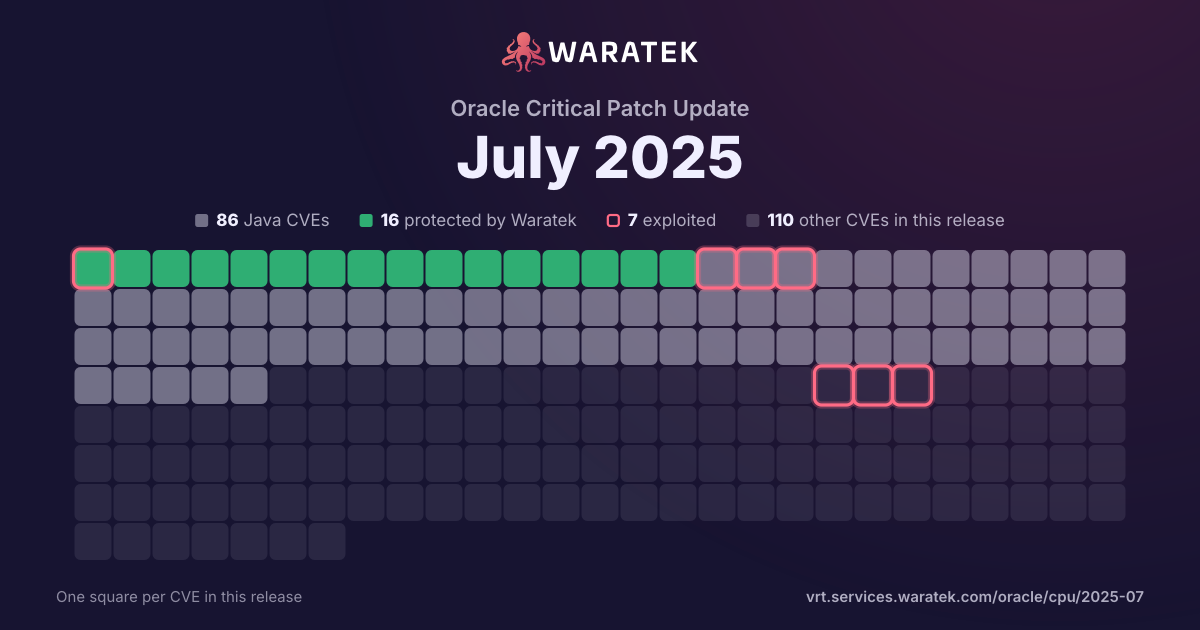
By status
16Protected by Waratek4Mitigation candidate66No exploit published14Outside Waratek scope96Not applicable
7Exploited, marked by the ring
No exploit published. For 31 of them, Oracle's security advisory is the source of public detail.
Protected by Waratek. Waratek RASP can block exploitation of these on systems that have not applied the patch yet.
Overview 11 matches · 0 protected · 0 exploited · 0 CISA KEV · 0 public PoC · 0 EPSS ≥ 0.5
11matches
0protected0.0%
0exploited0.0%
0CISA KEV0.0%
0public PoC0.0%
0EPSS ≥ 0.50.0%
Protected by Waratek
0
0.0%
Rule in development
0
0.0%
Mitigation candidate
0
0.0%
No exploit published
11
100.0%
blocked by ARMR today
0
0.0%
partly blocked
0
0.0%
not blocked
11
100.0%
not established
0
0.0%
unrecorded
0
0.0%
Exploited
0
0.0%
Working exploit published
0
0.0%
Proof of concept only
4
36.4%
Forecast only
0
0.0%
No public exploit
7
63.6%
split by
peak 4 / quarter
Q1 211
No exploit published1
High1
not blocked1
No public exploit1
Q2 210
Q3 210
Q4 210
Q1 220
Q2 220
Q3 220
Q4 220
Q1 231
No exploit published1
High1
not blocked1
Proof of concept only1
Q2 230
Q3 230
Q4 230
Q1 242
No exploit published2
High2
not blocked2
Proof of concept only1
No public exploit1
Q2 241
No exploit published1
High1
not blocked1
No public exploit1
Q3 241
No exploit published1
High1
not blocked1
No public exploit1
Q4 240
Q1 251
No exploit published1
High1
not blocked1
Proof of concept only1
Q2 254
No exploit published4
High4
not blocked4
Proof of concept only1
No public exploit3
Q2 21Q4 21Q2 22Q4 22Q2 23Q4 23Q2 24Q4 24Q2 25
| CVE | Severity | Published▾ | Status | Exploitation | Description |
|---|---|---|---|---|---|
| CVE-2025-49125 | High | 2025-06-16 | No exploit published | No public exploit | Authentication Bypass Using an Alternate Path or Channel vulnerability in Apache Tomcat. When using PreResources or PostResources mounted other than at the root of the web application, it was possible to access those resources via an unexpected path. That path was likely not to be protected by the same security constraints as the expected path, allowing those security constraints to be bypassed. This issue affects Apache Tomcat: from 11.0.0-M1 through 11.0.7, from 10.1.0-M1 through 10.1.41, from 9.0.0.M1 through 9.0.105. The following versions were EOL at the time the CVE was created but are known to be affected: 8.5.0 through 8.5.100. Other, older, EOL versions may also be affected. Users are recommended to upgrade to version 11.0.8, 10.1.42 or 9.0.106, which fix the issue. |
| CVE-2025-49124 | High | 2025-06-16 | No exploit published | No public exploit | Untrusted Search Path vulnerability in Apache Tomcat installer for Windows. During installation, the Tomcat installer for Windows used icacls.exe without specifying a full path. This issue affects Apache Tomcat: from 11.0.0-M1 through 11.0.7, from 10.1.0 through 10.1.41, from 9.0.23 through 9.0.105. The following versions were EOL at the time the CVE was created but are known to be affected: 8.5.0 through 8.5.100 and 7.0.95 through 7.0.109. Other EOL versions may also be affected. Users are recommended to upgrade to version 11.0.8, 10.1.42 or 9.0.106, which fix the issue. |
| CVE-2025-48988 | High | 2025-06-16 | No exploit published | No public exploit | Allocation of Resources Without Limits or Throttling vulnerability in Apache Tomcat. This issue affects Apache Tomcat: from 11.0.0-M1 through 11.0.7, from 10.1.0-M1 through 10.1.41, from 9.0.0.M1 through 9.0.105. The following versions were EOL at the time the CVE was created but are known to be affected: 8.5.0 though 8.5.100. Other, older, EOL versions may also be affected. Users are recommended to upgrade to version 11.0.8, 10.1.42 or 9.0.106, which fix the issue. |
| CVE-2025-48734 | High | 2025-05-28 | No exploit published | Proof of concept only | Improper Access Control vulnerability in Apache Commons. A special BeanIntrospector class was added in version 1.9.2. This can be used to stop attackers from using the declared class property of Java enum objects to get access to the classloader. However this protection was not enabled by default. PropertyUtilsBean (and consequently BeanUtilsBean) now disallows declared class level property access by default. Releases 1.11.0 and 2.0.0-M2 address a potential security issue when accessing enum properties in an uncontrolled way. If an application using Commons BeanUtils passes property paths from an external source directly to the getProperty() method of PropertyUtilsBean, an attacker can access the enum’s class loader via the “declaredClass” property available on all Java “enum” objects. Accessing the enum’s “declaredClass” allows remote attackers to access the ClassLoader and execute arbitrary code. The same issue exists with PropertyUtilsBean.getNestedProperty(). Starting in versions 1.11.0 and 2.0.0-M2 a special BeanIntrospector suppresses the “declaredClass” property. Note that this new BeanIntrospector is enabled by default, but you can disable it to regain the old behavior; see section 2.5 of the user's guide and the unit tests. This issue affects Apache Commons BeanUtils 1.x before 1.11.0, and 2.x before 2.0.0-M2.Users of the artifact commons-beanutils:commons-beanutils 1.x are recommended to upgrade to version 1.11.0, which fixes the issue. Users of the artifact org.apache.commons:commons-beanutils2 2.x are recommended to upgrade to version 2.0.0-M2, which fixes the issue. |
| CVE-2025-24970 | High | 2025-02-10 | No exploit published | Proof of concept only | Netty, an asynchronous, event-driven network application framework, has a vulnerability starting in version 4.1.91.Final and prior to version 4.1.118.Final. When a special crafted packet is received via SslHandler it doesn't correctly handle validation of such a packet in all cases which can lead to a native crash. Version 4.1.118.Final contains a patch. As workaround its possible to either disable the usage of the native SSLEngine or change the code manually. |
| CVE-2024-7254 | High | 2024-09-19 | No exploit published | No public exploit | Any project that parses untrusted Protocol Buffers data containing an arbitrary number of nested groups / series of SGROUP tags can corrupted by exceeding the stack limit i.e. StackOverflow. Parsing nested groups as unknown fields with DiscardUnknownFieldsParser or Java Protobuf Lite parser, or against Protobuf map fields, creates unbounded recursions that can be abused by an attacker. |
| CVE-2024-27309 | High | 2024-04-12 | No exploit published | No public exploit | While an Apache Kafka cluster is being migrated from ZooKeeper mode to KRaft mode, in some cases ACLs will not be correctly enforced. Two preconditions are needed to trigger the bug: 1. The administrator decides to remove an ACL 2. The resource associated with the removed ACL continues to have two or more other ACLs associated with it after the removal. When those two preconditions are met, Kafka will treat the resource as if it had only one ACL associated with it after the removal, rather than the two or more that would be correct. The incorrect condition is cleared by removing all brokers in ZK mode, or by adding a new ACL to the affected resource. Once the migration is completed, there is no metadata loss (the ACLs all remain). The full impact depends on the ACLs in use. If only ALLOW ACLs were configured during the migration, the impact would be limited to availability impact. if DENY ACLs were configured, the impact could include confidentiality and integrity impact depending on the ACLs configured, as the DENY ACLs might be ignored due to this vulnerability during the migration period. |
| CVE-2024-22201 | High | 2024-02-26 | No exploit published | Proof of concept only | Jetty is a Java based web server and servlet engine. An HTTP/2 SSL connection that is established and TCP congested will be leaked when it times out. An attacker can cause many connections to end up in this state, and the server may run out of file descriptors, eventually causing the server to stop accepting new connections from valid clients. The vulnerability is patched in 9.4.54, 10.0.20, 11.0.20, and 12.0.6. |
| CVE-2024-25710 | High | 2024-02-19 | No exploit published | No public exploit | Loop with Unreachable Exit Condition ('Infinite Loop') vulnerability in Apache Commons Compress.This issue affects Apache Commons Compress: from 1.3 through 1.25.0. Users are recommended to upgrade to version 1.26.0 which fixes the issue. |
| CVE-2023-1436 | High | 2023-03-22 | No exploit published | Proof of concept only | An infinite recursion is triggered in Jettison when constructing a JSONArray from a Collection that contains a self-reference in one of its elements. This leads to a StackOverflowError exception being thrown. |
| CVE-2020-13936 | High | 2021-03-10 | No exploit published | No public exploit | An attacker that is able to modify Velocity templates may execute arbitrary Java code or run arbitrary system commands with the same privileges as the account running the Servlet container. This applies to applications that allow untrusted users to upload/modify velocity templates running Apache Velocity Engine versions up to 2.2. |