
Oracle Critical Patch Update July 2025
Released July 2025 · Oracle's advisory ↗ · ← Critical Patch Update, April 2025 · Critical Patch Update, October 2025 →
196 CVEs in this release, one square each
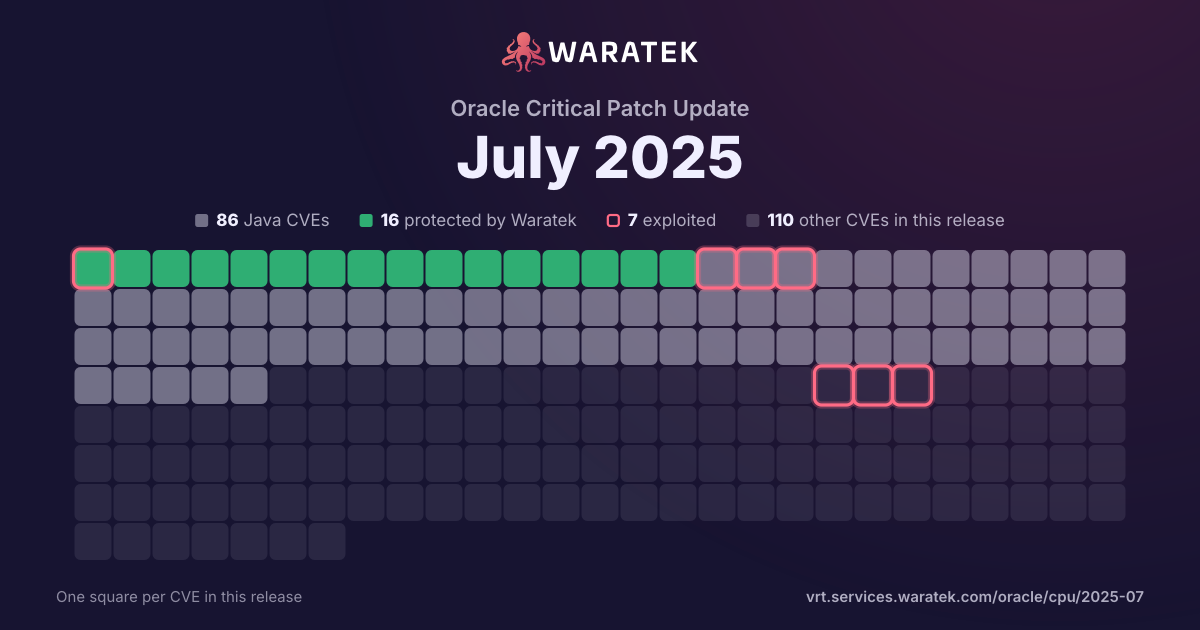
By status
11Protected by Waratek1Rule in development4Mitigation candidate73No exploit published7Outside Waratek scope100Not applicable
7Exploited, marked by the ring
No exploit published. For 26 of them, Oracle's security advisory is the source of public detail.
Protected by Waratek. Waratek RASP can block exploitation of these on systems that have not applied the patch yet.
Overview 9 matches · 2 protected · 0 exploited · 0 CISA KEV · 1 public PoC · 0 EPSS ≥ 0.5
Protected by Waratek
2
22.2%
Rule in development
0
0.0%
Mitigation candidate
0
0.0%
No exploit published
7
77.8%
blocked by ARMR today
2
22.2%
partly blocked
0
0.0%
not blocked
7
77.8%
not established
0
0.0%
unrecorded
0
0.0%
Exploited
0
0.0%
Working exploit published
1
11.1%
Proof of concept only
3
33.3%
Forecast only
0
0.0%
No public exploit
5
55.6%
split by
peak 3 / month
Dec 241
Protected by Waratek1
High1
blocked by ARMR today1
Working exploit published1
Jan 251
No exploit published1
High1
not blocked1
No public exploit1
Feb 252
No exploit published2
High2
not blocked2
Proof of concept only2
Mar 251
Protected by Waratek1
High1
blocked by ARMR today1
No public exploit1
Apr 250
May 251
No exploit published1
High1
not blocked1
Proof of concept only1
Jun 253
No exploit published3
High3
not blocked3
No public exploit3
Dec 24Jan 25Feb 25Mar 25Apr 25May 25Jun 25
| CVE | Severity | Published▾ | Status | Exploitation | Description |
|---|---|---|---|---|---|
| CVE-2025-49125 | High | 2025-06-16 | No exploit published | No public exploit | Authentication Bypass Using an Alternate Path or Channel vulnerability in Apache Tomcat. When using PreResources or PostResources mounted other than at the root of the web application, it was possible to access those resources via an unexpected path. That path was likely not to be protected by the same security constraints as the expected path, allowing those security constraints to be bypassed. This issue affects Apache Tomcat: from 11.0.0-M1 through 11.0.7, from 10.1.0-M1 through 10.1.41, from 9.0.0.M1 through 9.0.105. The following versions were EOL at the time the CVE was created but are known to be affected: 8.5.0 through 8.5.100. Other, older, EOL versions may also be affected. Users are recommended to upgrade to version 11.0.8, 10.1.42 or 9.0.106, which fix the issue. |
| CVE-2025-49124 | High | 2025-06-16 | No exploit published | No public exploit | Untrusted Search Path vulnerability in Apache Tomcat installer for Windows. During installation, the Tomcat installer for Windows used icacls.exe without specifying a full path. This issue affects Apache Tomcat: from 11.0.0-M1 through 11.0.7, from 10.1.0 through 10.1.41, from 9.0.23 through 9.0.105. The following versions were EOL at the time the CVE was created but are known to be affected: 8.5.0 through 8.5.100 and 7.0.95 through 7.0.109. Other EOL versions may also be affected. Users are recommended to upgrade to version 11.0.8, 10.1.42 or 9.0.106, which fix the issue. |
| CVE-2025-48988 | High | 2025-06-16 | No exploit published | No public exploit | Allocation of Resources Without Limits or Throttling vulnerability in Apache Tomcat. This issue affects Apache Tomcat: from 11.0.0-M1 through 11.0.7, from 10.1.0-M1 through 10.1.41, from 9.0.0.M1 through 9.0.105. The following versions were EOL at the time the CVE was created but are known to be affected: 8.5.0 though 8.5.100. Other, older, EOL versions may also be affected. Users are recommended to upgrade to version 11.0.8, 10.1.42 or 9.0.106, which fix the issue. |
| CVE-2025-48734 | High | 2025-05-28 | No exploit published | Proof of concept only | Improper Access Control vulnerability in Apache Commons. A special BeanIntrospector class was added in version 1.9.2. This can be used to stop attackers from using the declared class property of Java enum objects to get access to the classloader. However this protection was not enabled by default. PropertyUtilsBean (and consequently BeanUtilsBean) now disallows declared class level property access by default. Releases 1.11.0 and 2.0.0-M2 address a potential security issue when accessing enum properties in an uncontrolled way. If an application using Commons BeanUtils passes property paths from an external source directly to the getProperty() method of PropertyUtilsBean, an attacker can access the enum’s class loader via the “declaredClass” property available on all Java “enum” objects. Accessing the enum’s “declaredClass” allows remote attackers to access the ClassLoader and execute arbitrary code. The same issue exists with PropertyUtilsBean.getNestedProperty(). Starting in versions 1.11.0 and 2.0.0-M2 a special BeanIntrospector suppresses the “declaredClass” property. Note that this new BeanIntrospector is enabled by default, but you can disable it to regain the old behavior; see section 2.5 of the user's guide and the unit tests. This issue affects Apache Commons BeanUtils 1.x before 1.11.0, and 2.x before 2.0.0-M2.Users of the artifact commons-beanutils:commons-beanutils 1.x are recommended to upgrade to version 1.11.0, which fixes the issue. Users of the artifact org.apache.commons:commons-beanutils2 2.x are recommended to upgrade to version 2.0.0-M2, which fixes the issue. |
| CVE-2025-27553 | High | 2025-03-23 | Protected by Waratek | No public exploit | Relative Path Traversal vulnerability in Apache Commons VFS before 2.10.0. The FileObject API in Commons VFS has a 'resolveFile' method that takes a 'scope' parameter. Specifying 'NameScope.DESCENDENT' promises that "an exception is thrown if the resolved file is not a descendent of the base file". However, when the path contains encoded ".." characters (for example, "%2E%2E/bar.txt"), it might return file objects that are not a descendent of the base file, without throwing an exception. This issue affects Apache Commons VFS: before 2.10.0. Users are recommended to upgrade to version 2.10.0, which fixes the issue. |
| CVE-2025-24970 | High | 2025-02-10 | No exploit published | Proof of concept only | Netty, an asynchronous, event-driven network application framework, has a vulnerability starting in version 4.1.91.Final and prior to version 4.1.118.Final. When a special crafted packet is received via SslHandler it doesn't correctly handle validation of such a packet in all cases which can lead to a native crash. Version 4.1.118.Final contains a patch. As workaround its possible to either disable the usage of the native SSLEngine or change the code manually. |
| CVE-2024-57699 | High | 2025-02-05 | No exploit published | Proof of concept only | A security issue was found in Netplex Json-smart 2.5.0 through 2.5.1. When loading a specially crafted JSON input, containing a large number of ’{’, a stack exhaustion can be trigger, which could allow an attacker to cause a Denial of Service (DoS). This issue exists because of an incomplete fix for CVE-2023-1370. |
| CVE-2025-23184 | High | 2025-01-21 | No exploit published | No public exploit | A potential denial of service vulnerability is present in versions of Apache CXF before 3.5.10, 3.6.5 and 4.0.6. In some edge cases, the CachedOutputStream instances may not be closed and, if backed by temporary files, may fill up the file system (it applies to servers and clients). |
| CVE-2024-38819 | High | 2024-12-19 | Protected by Waratek | Working exploit published | Applications serving static resources through the functional web frameworks WebMvc.fn or WebFlux.fn are vulnerable to path traversal attacks. An attacker can craft malicious HTTP requests and obtain any file on the file system that is also accessible to the process in which the Spring application is running. |