
Oracle Critical Patch Update July 2025
Released July 2025 · Oracle's advisory ↗ · ← Critical Patch Update, April 2025 · Critical Patch Update, October 2025 →
196 CVEs in this release, one square each
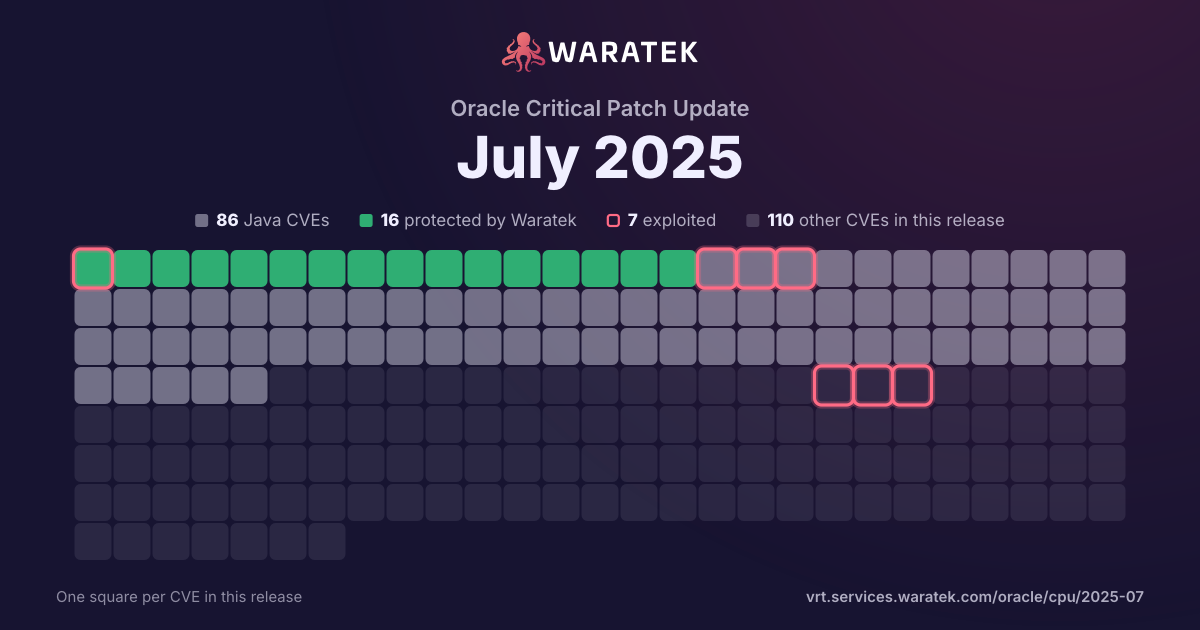
By status
11Protected by Waratek1Rule in development4Mitigation candidate73No exploit published7Outside Waratek scope100Not applicable
7Exploited, marked by the ring
No exploit published. For 26 of them, Oracle's security advisory is the source of public detail.
Protected by Waratek. Waratek RASP can block exploitation of these on systems that have not applied the patch yet.
Overview 19 matches · 4 protected · 0 exploited · 0 CISA KEV · 1 public PoC · 0 EPSS ≥ 0.5
Protected by Waratek
4
21.1%
Rule in development
0
0.0%
Mitigation candidate
0
0.0%
No exploit published
15
78.9%
blocked by ARMR today
4
21.1%
partly blocked
0
0.0%
not blocked
15
78.9%
not established
0
0.0%
unrecorded
0
0.0%
Exploited
0
0.0%
Working exploit published
0
0.0%
Proof of concept only
5
26.3%
Forecast only
0
0.0%
No public exploit
14
73.7%
split by
peak 6 / quarter
Q1 211
No exploit published1
High1
not blocked1
No public exploit1
Q2 211
Protected by Waratek1
High1
blocked by ARMR today1
No public exploit1
Q3 210
Q4 211
No exploit published1
Critical1
not blocked1
No public exploit1
Q1 220
Q2 220
Q3 221
Protected by Waratek1
High1
blocked by ARMR today1
Proof of concept only1
Q4 221
No exploit published1
High1
not blocked1
Proof of concept only1
Q1 231
No exploit published1
High1
not blocked1
Proof of concept only1
Q2 230
Q3 230
Q4 231
No exploit published1
Medium1
not blocked1
No public exploit1
Q1 243
No exploit published3
High2
Medium1
not blocked3
Proof of concept only1
No public exploit2
Q2 241
No exploit published1
Low1
not blocked1
No public exploit1
Q3 242
No exploit published2
High1
Low1
not blocked2
No public exploit2
Q4 246
Protected by Waratek2
No exploit published4
Critical1
High1
Medium4
blocked by ARMR today2
not blocked4
Proof of concept only1
No public exploit5
Q2 21Q4 21Q2 22Q4 22Q2 23Q4 23Q2 24Q4 24
| CVE | Severity | Published▾ | Status | Exploitation | Description |
|---|---|---|---|---|---|
| CVE-2024-38820 | Medium | 2024-10-18 | No exploit published | No public exploit | The fix for CVE-2022-22968 made disallowedFields patterns in DataBinder case insensitive. However, String.toLowerCase() has some Locale dependent exceptions that could potentially result in fields not protected as expected. |
| CVE-2024-8184 | Medium | 2024-10-14 | No exploit published | No public exploit | There exists a security vulnerability in Jetty's ThreadLimitHandler.getRemote() which can be exploited by unauthorized users to cause remote denial-of-service (DoS) attack. By repeatedly sending crafted requests, attackers can trigger OutofMemory errors and exhaust the server's memory. |
| CVE-2024-6763 | Medium | 2024-10-14 | No exploit published | Proof of concept only | Eclipse Jetty is a lightweight, highly scalable, Java-based web server and Servlet engine . It includes a utility class, HttpURI, for URI/URL parsing. The HttpURI class does insufficient validation on the authority segment of a URI. However the behaviour of HttpURI differs from the common browsers in how it handles a URI that would be considered invalid if fully validated against the RRC. Specifically HttpURI and the browser may differ on the value of the host extracted from an invalid URI and thus a combination of Jetty and a vulnerable browser may be vulnerable to a open redirect attack or to a SSRF attack if the URI is used after passing validation checks. |
| CVE-2024-28168 | High | 2024-10-09 | Protected by Waratek | No public exploit | Improper Restriction of XML External Entity Reference ('XXE') vulnerability in Apache XML Graphics FOP. This issue affects Apache XML Graphics FOP: 2.9. Users are recommended to upgrade to version 2.10, which fixes the issue. |
| CVE-2024-47561 | Critical | 2024-10-03 | Protected by Waratek | No public exploit | Schema parsing in the Java SDK of Apache Avro 1.11.3 and previous versions allows bad actors to execute arbitrary code. Users are recommended to upgrade to version 1.11.4 or 1.12.0, which fix this issue. |
| CVE-2024-47554 | Medium | 2024-10-03 | No exploit published | No public exploit | Uncontrolled Resource Consumption vulnerability in Apache Commons IO. The org.apache.commons.io.input.XmlStreamReader class may excessively consume CPU resources when processing maliciously crafted input. This issue affects Apache Commons IO: from 2.0 before 2.14.0. Users are recommended to upgrade to version 2.14.0 or later, which fixes the issue. |
| CVE-2024-7254 | High | 2024-09-19 | No exploit published | No public exploit | Any project that parses untrusted Protocol Buffers data containing an arbitrary number of nested groups / series of SGROUP tags can corrupted by exceeding the stack limit i.e. StackOverflow. Parsing nested groups as unknown fields with DiscardUnknownFieldsParser or Java Protobuf Lite parser, or against Protobuf map fields, creates unbounded recursions that can be abused by an attacker. |
| CVE-2024-21131 | Low | 2024-07-16 | No exploit published | No public exploit | Vulnerability in the Oracle Java SE, Oracle GraalVM for JDK, Oracle GraalVM Enterprise Edition product of Oracle Java SE (component: Hotspot). Supported versions that are affected are Oracle Java SE: 8u411, 8u411-perf, 11.0.23, 17.0.11, 21.0.3, 22.0.1; Oracle GraalVM for JDK: 17.0.11, 21.0.3, 22.0.1; Oracle GraalVM Enterprise Edition: 20.3.14 and 21.3.10. Difficult to exploit vulnerability allows unauthenticated attacker with network access via multiple protocols to compromise Oracle Java SE, Oracle GraalVM for JDK, Oracle GraalVM Enterprise Edition. Successful attacks of this vulnerability can result in unauthorized update, insert or delete access to some of Oracle Java SE, Oracle GraalVM for JDK, Oracle GraalVM Enterprise Edition accessible data. Note: This vulnerability can be exploited by using APIs in the specified Component, e.g., through a web service which supplies data to the APIs. This vulnerability also applies to Java deployments, typically in clients running sandboxed Java Web Start applications or sandboxed Java applets, that load and run untrusted code (e.g., code that comes from the internet) and rely on the Java sandbox for security. CVSS 3.1 Base Score 3.7 (Integrity impacts). CVSS Vector: (CVSS:3.1/AV:N/AC:H/PR:N/UI:N/S:U/C:N/I:L/A:N). |
| CVE-2024-21094 | Low | 2024-04-16 | No exploit published | No public exploit | Vulnerability in the Oracle Java SE, Oracle GraalVM for JDK, Oracle GraalVM Enterprise Edition product of Oracle Java SE (component: Hotspot). Supported versions that are affected are Oracle Java SE: 8u401, 8u401-perf, 11.0.22, 17.0.10, 21.0.2, 22; Oracle GraalVM for JDK: 17.0.10, 21.0.2, 22; Oracle GraalVM Enterprise Edition: 20.3.13 and 21.3.9. Difficult to exploit vulnerability allows unauthenticated attacker with network access via multiple protocols to compromise Oracle Java SE, Oracle GraalVM for JDK, Oracle GraalVM Enterprise Edition. Successful attacks of this vulnerability can result in unauthorized update, insert or delete access to some of Oracle Java SE, Oracle GraalVM for JDK, Oracle GraalVM Enterprise Edition accessible data. Note: This vulnerability can be exploited by using APIs in the specified Component, e.g., through a web service which supplies data to the APIs. This vulnerability also applies to Java deployments, typically in clients running sandboxed Java Web Start applications or sandboxed Java applets, that load and run untrusted code (e.g., code that comes from the internet) and rely on the Java sandbox for security. CVSS 3.1 Base Score 3.7 (Integrity impacts). CVSS Vector: (CVSS:3.1/AV:N/AC:H/PR:N/UI:N/S:U/C:N/I:L/A:N). |
| CVE-2024-22201 | High | 2024-02-26 | No exploit published | Proof of concept only | Jetty is a Java based web server and servlet engine. An HTTP/2 SSL connection that is established and TCP congested will be leaked when it times out. An attacker can cause many connections to end up in this state, and the server may run out of file descriptors, eventually causing the server to stop accepting new connections from valid clients. The vulnerability is patched in 9.4.54, 10.0.20, 11.0.20, and 12.0.6. |
| CVE-2024-26308 | Medium | 2024-02-19 | No exploit published | No public exploit | Allocation of Resources Without Limits or Throttling vulnerability in Apache Commons Compress.This issue affects Apache Commons Compress: from 1.21 before 1.26. Users are recommended to upgrade to version 1.26, which fixes the issue. |
| CVE-2024-25710 | High | 2024-02-19 | No exploit published | No public exploit | Loop with Unreachable Exit Condition ('Infinite Loop') vulnerability in Apache Commons Compress.This issue affects Apache Commons Compress: from 1.3 through 1.25.0. Users are recommended to upgrade to version 1.26.0 which fixes the issue. |
| CVE-2023-44483 | Medium | 2023-10-20 | No exploit published | No public exploit | All versions of Apache Santuario - XML Security for Java prior to 2.2.6, 2.3.4, and 3.0.3, when using the JSR 105 API, are vulnerable to an issue where a private key may be disclosed in log files when generating an XML Signature and logging with debug level is enabled. Users are recommended to upgrade to version 2.2.6, 2.3.4, or 3.0.3, which fixes this issue. |
| CVE-2023-1436 | High | 2023-03-22 | No exploit published | Proof of concept only | An infinite recursion is triggered in Jettison when constructing a JSONArray from a Collection that contains a self-reference in one of its elements. This leads to a StackOverflowError exception being thrown. |
| CVE-2022-45693 | High | 2022-12-13 | No exploit published | Proof of concept only | Jettison before v1.5.2 was discovered to contain a stack overflow via the map parameter. This vulnerability allows attackers to cause a Denial of Service (DoS) via a crafted string. |
| CVE-2022-34169 | High | 2022-07-19 | Protected by Waratek | Proof of concept only | The Apache Xalan Java XSLT library is vulnerable to an integer truncation issue when processing malicious XSLT stylesheets. This can be used to corrupt Java class files generated by the internal XSLTC compiler and execute arbitrary Java bytecode. Users are recommended to update to version 2.7.3 or later. Note: Java runtimes (such as OpenJDK) include repackaged copies of Xalan. |
| CVE-2021-42575 | Critical | 2021-10-18 | No exploit published | No public exploit | The OWASP Java HTML Sanitizer before 20211018.1 does not properly enforce policies associated with the SELECT, STYLE, and OPTION elements. |
| CVE-2021-33813 | High | 2021-06-16 | Protected by Waratek | No public exploit | An XXE issue in SAXBuilder in JDOM through 2.0.6 allows attackers to cause a denial of service via a crafted HTTP request. |
| CVE-2020-13936 | High | 2021-03-10 | No exploit published | No public exploit | An attacker that is able to modify Velocity templates may execute arbitrary Java code or run arbitrary system commands with the same privileges as the account running the Servlet container. This applies to applications that allow untrusted users to upload/modify velocity templates running Apache Velocity Engine versions up to 2.2. |