
Oracle Critical Patch Update July 2024
Released July 2024 · Oracle's advisory ↗ · ← Critical Patch Update, April 2024 · Critical Patch Update, October 2024 →
231 CVEs in this release, one square each
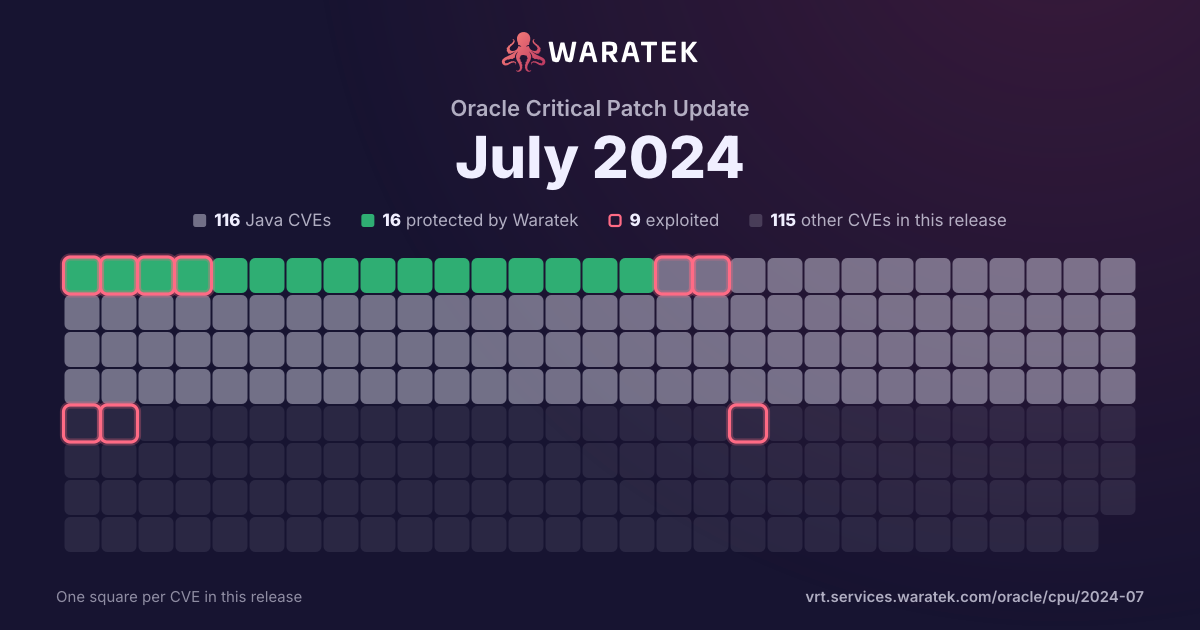
By status
16Protected by Waratek4Mitigation candidate96No exploit published18Outside Waratek scope97Not applicable
9Exploited, marked by the ring
No exploit published. For 35 of them, Oracle's security advisory is the source of public detail.
Protected by Waratek. Waratek RASP can block exploitation of these on systems that have not applied the patch yet.
Overview 57 matches · 0 in Waratek scope · 0 protected · 0 exploited · 0 CISA KEV · 1 public PoC · 1 EPSS ≥ 0.5
57matches
0in Waratek scope0.0%
0protected0.0%
0exploited0.0%
0CISA KEV0.0%
1public PoC1.8%
1EPSS ≥ 0.51.8%
Protected by Waratek
0
0.0%
Rule in development
0
0.0%
Mitigation candidate
0
0.0%
No exploit published
0
0.0%
Outside Waratek scope
0
0.0%
Not applicable
57
100.0%
Withdrawn CVE
0
0.0%
blocked by ARMR today
0
0.0%
partly blocked
0
0.0%
not blocked
57
100.0%
not established
0
0.0%
unrecorded
0
0.0%
Exploited
0
0.0%
Working exploit published
0
0.0%
Proof of concept only
7
12.3%
Forecast only
1
1.8%
No public exploit
49
86.0%
split by
peak 26 / month
Mar 233
Not applicable3
Medium3
not blocked3
Proof of concept only1
No public exploit2
Apr 230
May 230
Jun 230
Jul 233
Not applicable3
Medium3
not blocked3
No public exploit3
Aug 230
Sep 230
Oct 230
Nov 233
Not applicable3
Medium3
not blocked3
Proof of concept only1
No public exploit2
Dec 233
Not applicable3
Medium3
not blocked3
Proof of concept only2
No public exploit1
Jan 245
Not applicable5
Medium5
not blocked5
No public exploit5
Feb 244
Not applicable4
Medium4
not blocked4
Proof of concept only1
No public exploit3
Mar 246
Not applicable6
Medium6
not blocked6
Proof of concept only2
No public exploit4
Apr 241
Not applicable1
Medium1
not blocked1
Forecast only1
May 243
Not applicable3
Medium3
not blocked3
No public exploit3
Jun 240
Jul 2426
Not applicable26
Medium26
not blocked26
No public exploit26
Mar 23May 23Jul 23Sep 23Nov 23Jan 24Mar 24May 24Jul 24
| CVE | Severity | Published▾ | Status | Exploitation | Description |
|---|---|---|---|---|---|
| CVE-2024-21185 | Medium | 2024-07-16 | Not applicable | No public exploit | Vulnerability in the MySQL Server product of Oracle MySQL (component: InnoDB). Supported versions that are affected are 8.0.38, 8.4.1 and 9.0.0. Easily exploitable vulnerability allows high privileged attacker with network access via multiple protocols to compromise MySQL Server. Successful attacks of this vulnerability can result in unauthorized ability to cause a hang or frequently repeatable crash (complete DOS) of MySQL Server. CVSS 3.1 Base Score 4.9 (Availability impacts). CVSS Vector: (CVSS:3.1/AV:N/AC:L/PR:H/UI:N/S:U/C:N/I:N/A:H). |
| CVE-2024-21179 | Medium | 2024-07-16 | Not applicable | No public exploit | Vulnerability in the MySQL Server product of Oracle MySQL (component: InnoDB). Supported versions that are affected are 8.0.37 and prior and 8.4.0 and prior. Easily exploitable vulnerability allows high privileged attacker with network access via multiple protocols to compromise MySQL Server. Successful attacks of this vulnerability can result in unauthorized ability to cause a hang or frequently repeatable crash (complete DOS) of MySQL Server. CVSS 3.1 Base Score 4.9 (Availability impacts). CVSS Vector: (CVSS:3.1/AV:N/AC:L/PR:H/UI:N/S:U/C:N/I:N/A:H). |
| CVE-2024-21177 | Medium | 2024-07-16 | Not applicable | No public exploit | Vulnerability in the MySQL Server product of Oracle MySQL (component: Server: Optimizer). Supported versions that are affected are 8.0.37 and prior and 8.4.0 and prior. Easily exploitable vulnerability allows low privileged attacker with network access via multiple protocols to compromise MySQL Server. Successful attacks of this vulnerability can result in unauthorized ability to cause a hang or frequently repeatable crash (complete DOS) of MySQL Server. CVSS 3.1 Base Score 6.5 (Availability impacts). CVSS Vector: (CVSS:3.1/AV:N/AC:L/PR:L/UI:N/S:U/C:N/I:N/A:H). |
| CVE-2024-21176 | Medium | 2024-07-16 | Not applicable | No public exploit | Vulnerability in the MySQL Server product of Oracle MySQL (component: Server: Thread Pooling). Supported versions that are affected are 8.4.0 and prior. Difficult to exploit vulnerability allows low privileged attacker with network access via multiple protocols to compromise MySQL Server. Successful attacks of this vulnerability can result in unauthorized ability to cause a hang or frequently repeatable crash (complete DOS) of MySQL Server. CVSS 3.1 Base Score 5.3 (Availability impacts). CVSS Vector: (CVSS:3.1/AV:N/AC:H/PR:L/UI:N/S:U/C:N/I:N/A:H). |
| CVE-2024-21173 | Medium | 2024-07-16 | Not applicable | No public exploit | Vulnerability in the MySQL Server product of Oracle MySQL (component: InnoDB). Supported versions that are affected are 8.0.37 and prior and 8.4.0 and prior. Easily exploitable vulnerability allows high privileged attacker with network access via multiple protocols to compromise MySQL Server. Successful attacks of this vulnerability can result in unauthorized ability to cause a hang or frequently repeatable crash (complete DOS) of MySQL Server. CVSS 3.1 Base Score 4.9 (Availability impacts). CVSS Vector: (CVSS:3.1/AV:N/AC:L/PR:H/UI:N/S:U/C:N/I:N/A:H). |
| CVE-2024-21171 | Medium | 2024-07-16 | Not applicable | No public exploit | Vulnerability in the MySQL Server product of Oracle MySQL (component: Server: Optimizer). Supported versions that are affected are 8.0.37 and prior and 8.4.0 and prior. Easily exploitable vulnerability allows low privileged attacker with network access via multiple protocols to compromise MySQL Server. Successful attacks of this vulnerability can result in unauthorized ability to cause a hang or frequently repeatable crash (complete DOS) of MySQL Server. CVSS 3.1 Base Score 6.5 (Availability impacts). CVSS Vector: (CVSS:3.1/AV:N/AC:L/PR:L/UI:N/S:U/C:N/I:N/A:H). |
| CVE-2024-21170 | Medium | 2024-07-16 | Not applicable | No public exploit | Vulnerability in the MySQL Connectors product of Oracle MySQL (component: Connector/Python). Supported versions that are affected are 8.4.0 and prior. Easily exploitable vulnerability allows low privileged attacker with network access via multiple protocols to compromise MySQL Connectors. Successful attacks of this vulnerability can result in unauthorized update, insert or delete access to some of MySQL Connectors accessible data as well as unauthorized read access to a subset of MySQL Connectors accessible data and unauthorized ability to cause a partial denial of service (partial DOS) of MySQL Connectors. CVSS 3.1 Base Score 6.3 (Confidentiality, Integrity and Availability impacts). CVSS Vector: (CVSS:3.1/AV:N/AC:L/PR:L/UI:N/S:U/C:L/I:L/A:L). |
| CVE-2024-21166 | Medium | 2024-07-16 | Not applicable | No public exploit | Vulnerability in the MySQL Server product of Oracle MySQL (component: InnoDB). Supported versions that are affected are 8.0.36 and prior and 8.3.0 and prior. Difficult to exploit vulnerability allows high privileged attacker with network access via multiple protocols to compromise MySQL Server. Successful attacks of this vulnerability can result in unauthorized creation, deletion or modification access to critical data or all MySQL Server accessible data and unauthorized ability to cause a hang or frequently repeatable crash (complete DOS) of MySQL Server. CVSS 3.1 Base Score 5.9 (Integrity and Availability impacts). CVSS Vector: (CVSS:3.1/AV:N/AC:H/PR:H/UI:N/S:U/C:N/I:H/A:H). |
| CVE-2024-21165 | Medium | 2024-07-16 | Not applicable | No public exploit | Vulnerability in the MySQL Server product of Oracle MySQL (component: Server: Pluggable Auth). Supported versions that are affected are 8.0.37 and prior. Easily exploitable vulnerability allows high privileged attacker with network access via multiple protocols to compromise MySQL Server. Successful attacks of this vulnerability can result in unauthorized ability to cause a hang or frequently repeatable crash (complete DOS) of MySQL Server. CVSS 3.1 Base Score 4.9 (Availability impacts). CVSS Vector: (CVSS:3.1/AV:N/AC:L/PR:H/UI:N/S:U/C:N/I:N/A:H). |
| CVE-2024-21163 | Medium | 2024-07-16 | Not applicable | No public exploit | Vulnerability in the MySQL Server product of Oracle MySQL (component: Server: Optimizer). Supported versions that are affected are 8.0.37 and prior and 8.4.0 and prior. Easily exploitable vulnerability allows high privileged attacker with network access via multiple protocols to compromise MySQL Server. Successful attacks of this vulnerability can result in unauthorized ability to cause a hang or frequently repeatable crash (complete DOS) of MySQL Server as well as unauthorized update, insert or delete access to some of MySQL Server accessible data. CVSS 3.1 Base Score 5.5 (Integrity and Availability impacts). CVSS Vector: (CVSS:3.1/AV:N/AC:L/PR:H/UI:N/S:U/C:N/I:L/A:H). |
| CVE-2024-21162 | Medium | 2024-07-16 | Not applicable | No public exploit | Vulnerability in the MySQL Server product of Oracle MySQL (component: Server: Optimizer). Supported versions that are affected are 8.0.37 and prior and 8.4.0 and prior. Easily exploitable vulnerability allows high privileged attacker with network access via multiple protocols to compromise MySQL Server. Successful attacks of this vulnerability can result in unauthorized ability to cause a hang or frequently repeatable crash (complete DOS) of MySQL Server. CVSS 3.1 Base Score 4.9 (Availability impacts). CVSS Vector: (CVSS:3.1/AV:N/AC:L/PR:H/UI:N/S:U/C:N/I:N/A:H). |
| CVE-2024-21161 | Medium | 2024-07-16 | Not applicable | No public exploit | Vulnerability in the Oracle VM VirtualBox product of Oracle Virtualization (component: Core). Supported versions that are affected are Prior to 7.0.20. Easily exploitable vulnerability allows low privileged attacker with logon to the infrastructure where Oracle VM VirtualBox executes to compromise Oracle VM VirtualBox. Successful attacks of this vulnerability can result in unauthorized ability to cause a hang or frequently repeatable crash (complete DOS) of Oracle VM VirtualBox. Note: This vulnerability applies to Linux hosts only. CVSS 3.1 Base Score 5.5 (Availability impacts). CVSS Vector: (CVSS:3.1/AV:L/AC:L/PR:L/UI:N/S:U/C:N/I:N/A:H). |
| CVE-2024-21160 | Medium | 2024-07-16 | Not applicable | No public exploit | Vulnerability in the MySQL Server product of Oracle MySQL (component: InnoDB). Supported versions that are affected are 8.0.36 and prior and 8.3.0 and prior. Easily exploitable vulnerability allows high privileged attacker with network access via multiple protocols to compromise MySQL Server. Successful attacks of this vulnerability can result in unauthorized ability to cause a hang or frequently repeatable crash (complete DOS) of MySQL Server. CVSS 3.1 Base Score 4.9 (Availability impacts). CVSS Vector: (CVSS:3.1/AV:N/AC:L/PR:H/UI:N/S:U/C:N/I:N/A:H). |
| CVE-2024-21159 | Medium | 2024-07-16 | Not applicable | No public exploit | Vulnerability in the MySQL Server product of Oracle MySQL (component: InnoDB). Supported versions that are affected are 8.0.36 and prior and 8.3.0 and prior. Easily exploitable vulnerability allows high privileged attacker with network access via multiple protocols to compromise MySQL Server. Successful attacks of this vulnerability can result in unauthorized ability to cause a hang or frequently repeatable crash (complete DOS) of MySQL Server. CVSS 3.1 Base Score 4.9 (Availability impacts). CVSS Vector: (CVSS:3.1/AV:N/AC:L/PR:H/UI:N/S:U/C:N/I:N/A:H). |
| CVE-2024-21157 | Medium | 2024-07-16 | Not applicable | No public exploit | Vulnerability in the MySQL Server product of Oracle MySQL (component: InnoDB). Supported versions that are affected are 8.0.36 and prior and 8.4.0 and prior. Easily exploitable vulnerability allows high privileged attacker with network access via multiple protocols to compromise MySQL Server. Successful attacks of this vulnerability can result in unauthorized ability to cause a hang or frequently repeatable crash (complete DOS) of MySQL Server. CVSS 3.1 Base Score 4.9 (Availability impacts). CVSS Vector: (CVSS:3.1/AV:N/AC:L/PR:H/UI:N/S:U/C:N/I:N/A:H). |
| CVE-2024-21155 | Medium | 2024-07-16 | Not applicable | No public exploit | Vulnerability in the Oracle ZFS Storage Appliance Kit product of Oracle Systems (component: User Interface). The supported version that is affected is 8.8. Easily exploitable vulnerability allows unauthenticated attacker with network access via HTTP to compromise Oracle ZFS Storage Appliance Kit. Successful attacks require human interaction from a person other than the attacker and while the vulnerability is in Oracle ZFS Storage Appliance Kit, attacks may significantly impact additional products (scope change). Successful attacks of this vulnerability can result in unauthorized read access to a subset of Oracle ZFS Storage Appliance Kit accessible data. CVSS 3.1 Base Score 4.7 (Confidentiality impacts). CVSS Vector: (CVSS:3.1/AV:N/AC:L/PR:N/UI:R/S:C/C:L/I:N/A:N). |
| CVE-2024-21142 | Medium | 2024-07-16 | Not applicable | No public exploit | Vulnerability in the MySQL Server product of Oracle MySQL (component: Server: Security: Privileges). Supported versions that are affected are 8.0.37 and prior and 8.4.0 and prior. Easily exploitable vulnerability allows high privileged attacker with network access via multiple protocols to compromise MySQL Server. Successful attacks of this vulnerability can result in unauthorized ability to cause a hang or frequently repeatable crash (complete DOS) of MySQL Server. CVSS 3.1 Base Score 4.9 (Availability impacts). CVSS Vector: (CVSS:3.1/AV:N/AC:L/PR:H/UI:N/S:U/C:N/I:N/A:H). |
| CVE-2024-21137 | Medium | 2024-07-16 | Not applicable | No public exploit | Vulnerability in the MySQL Server product of Oracle MySQL (component: Server: Optimizer). Supported versions that are affected are 8.0.35 and prior and 8.2.0 and prior. Easily exploitable vulnerability allows high privileged attacker with network access via multiple protocols to compromise MySQL Server. Successful attacks of this vulnerability can result in unauthorized ability to cause a hang or frequently repeatable crash (complete DOS) of MySQL Server. CVSS 3.1 Base Score 4.9 (Availability impacts). CVSS Vector: (CVSS:3.1/AV:N/AC:L/PR:H/UI:N/S:U/C:N/I:N/A:H). |
| CVE-2024-21135 | Medium | 2024-07-16 | Not applicable | No public exploit | Vulnerability in the MySQL Server product of Oracle MySQL (component: Server: Optimizer). Supported versions that are affected are 8.0.36 and prior and 8.3.0 and prior. Easily exploitable vulnerability allows high privileged attacker with network access via multiple protocols to compromise MySQL Server. Successful attacks of this vulnerability can result in unauthorized ability to cause a hang or frequently repeatable crash (complete DOS) of MySQL Server. CVSS 3.1 Base Score 4.9 (Availability impacts). CVSS Vector: (CVSS:3.1/AV:N/AC:L/PR:H/UI:N/S:U/C:N/I:N/A:H). |
| CVE-2024-21134 | Medium | 2024-07-16 | Not applicable | No public exploit | Vulnerability in the MySQL Server product of Oracle MySQL (component: Server: Connection Handling). Supported versions that are affected are 8.0.37 and prior and 8.4.0 and prior. Easily exploitable vulnerability allows low privileged attacker with network access via multiple protocols to compromise MySQL Server. Successful attacks of this vulnerability can result in unauthorized ability to cause a partial denial of service (partial DOS) of MySQL Server. CVSS 3.1 Base Score 4.3 (Availability impacts). CVSS Vector: (CVSS:3.1/AV:N/AC:L/PR:L/UI:N/S:U/C:N/I:N/A:L). |
| CVE-2024-21130 | Medium | 2024-07-16 | Not applicable | No public exploit | Vulnerability in the MySQL Server product of Oracle MySQL (component: Server: Optimizer). Supported versions that are affected are 8.0.37 and prior and 8.4.0 and prior. Easily exploitable vulnerability allows high privileged attacker with network access via multiple protocols to compromise MySQL Server. Successful attacks of this vulnerability can result in unauthorized ability to cause a hang or frequently repeatable crash (complete DOS) of MySQL Server. CVSS 3.1 Base Score 4.9 (Availability impacts). CVSS Vector: (CVSS:3.1/AV:N/AC:L/PR:H/UI:N/S:U/C:N/I:N/A:H). |
| CVE-2024-21129 | Medium | 2024-07-16 | Not applicable | No public exploit | Vulnerability in the MySQL Server product of Oracle MySQL (component: Server: DDL). Supported versions that are affected are 8.0.37 and prior and 8.4.0 and prior. Easily exploitable vulnerability allows high privileged attacker with network access via multiple protocols to compromise MySQL Server. Successful attacks of this vulnerability can result in unauthorized ability to cause a hang or frequently repeatable crash (complete DOS) of MySQL Server. CVSS 3.1 Base Score 4.9 (Availability impacts). CVSS Vector: (CVSS:3.1/AV:N/AC:L/PR:H/UI:N/S:U/C:N/I:N/A:H). |
| CVE-2024-21127 | Medium | 2024-07-16 | Not applicable | No public exploit | Vulnerability in the MySQL Server product of Oracle MySQL (component: Server: DDL). Supported versions that are affected are 8.0.37 and prior and 8.4.0 and prior. Easily exploitable vulnerability allows high privileged attacker with network access via multiple protocols to compromise MySQL Server. Successful attacks of this vulnerability can result in unauthorized ability to cause a hang or frequently repeatable crash (complete DOS) of MySQL Server. CVSS 3.1 Base Score 4.9 (Availability impacts). CVSS Vector: (CVSS:3.1/AV:N/AC:L/PR:H/UI:N/S:U/C:N/I:N/A:H). |
| CVE-2024-21126 | Medium | 2024-07-16 | Not applicable | No public exploit | Vulnerability in the Oracle Database Portable Clusterware component of Oracle Database Server. Supported versions that are affected are 19.3-19.23 and 21.3-21.14. Easily exploitable vulnerability allows unauthenticated attacker with network access via DNS to compromise Oracle Database Portable Clusterware. While the vulnerability is in Oracle Database Portable Clusterware, attacks may significantly impact additional products (scope change). Successful attacks of this vulnerability can result in unauthorized ability to cause a partial denial of service (partial DOS) of Oracle Database Portable Clusterware. CVSS 3.1 Base Score 5.8 (Availability impacts). CVSS Vector: (CVSS:3.1/AV:N/AC:L/PR:N/UI:N/S:C/C:N/I:N/A:L). |
| CVE-2024-21125 | Medium | 2024-07-16 | Not applicable | No public exploit | Vulnerability in the MySQL Server product of Oracle MySQL (component: Server: FTS). Supported versions that are affected are 8.0.37 and prior and 8.4.0 and prior. Easily exploitable vulnerability allows high privileged attacker with network access via multiple protocols to compromise MySQL Server. Successful attacks of this vulnerability can result in unauthorized ability to cause a hang or frequently repeatable crash (complete DOS) of MySQL Server. CVSS 3.1 Base Score 4.9 (Availability impacts). CVSS Vector: (CVSS:3.1/AV:N/AC:L/PR:H/UI:N/S:U/C:N/I:N/A:H). |
| CVE-2024-20996 | Medium | 2024-07-16 | Not applicable | No public exploit | Vulnerability in the MySQL Server product of Oracle MySQL (component: InnoDB). Supported versions that are affected are 8.0.37 and prior and 8.4.0 and prior. Easily exploitable vulnerability allows high privileged attacker with network access via multiple protocols to compromise MySQL Server. Successful attacks of this vulnerability can result in unauthorized ability to cause a hang or frequently repeatable crash (complete DOS) of MySQL Server. CVSS 3.1 Base Score 4.9 (Availability impacts). CVSS Vector: (CVSS:3.1/AV:N/AC:L/PR:H/UI:N/S:U/C:N/I:N/A:H). |
| CVE-2024-4603 | Medium | 2024-05-16 | Not applicable | No public exploit | Issue summary: Checking excessively long DSA keys or parameters may be very slow. Impact summary: Applications that use the functions EVP_PKEY_param_check() or EVP_PKEY_public_check() to check a DSA public key or DSA parameters may experience long delays. Where the key or parameters that are being checked have been obtained from an untrusted source this may lead to a Denial of Service. The functions EVP_PKEY_param_check() or EVP_PKEY_public_check() perform various checks on DSA parameters. Some of those computations take a long time if the modulus (`p` parameter) is too large. Trying to use a very large modulus is slow and OpenSSL will not allow using public keys with a modulus which is over 10,000 bits in length for signature verification. However the key and parameter check functions do not limit the modulus size when performing the checks. An application that calls EVP_PKEY_param_check() or EVP_PKEY_public_check() and supplies a key or parameters obtained from an untrusted source could be vulnerable to a Denial of Service attack. These functions are not called by OpenSSL itself on untrusted DSA keys so only applications that directly call these functions may be vulnerable. Also vulnerable are the OpenSSL pkey and pkeyparam command line applications when using the `-check` option. The OpenSSL SSL/TLS implementation is not affected by this issue. The OpenSSL 3.0 and 3.1 FIPS providers are affected by this issue. |
| CVE-2024-27982 | Medium | 2024-05-07 | Not applicable | No public exploit | The team has identified a critical vulnerability in the http server of the most recent version of Node, where malformed headers can lead to HTTP request smuggling. Specifically, if a space is placed before a content-length header, it is not interpreted correctly, enabling attackers to smuggle in a second request within the body of the first. |
| CVE-2024-34064 | Medium | 2024-05-06 | Not applicable | No public exploit | Jinja is an extensible templating engine. The `xmlattr` filter in affected versions of Jinja accepts keys containing non-attribute characters. XML/HTML attributes cannot contain spaces, `/`, `>`, or `=`, as each would then be interpreted as starting a separate attribute. If an application accepts keys (as opposed to only values) as user input, and renders these in pages that other users see as well, an attacker could use this to inject other attributes and perform XSS. The fix for CVE-2024-22195 only addressed spaces but not other characters. Accepting keys as user input is now explicitly considered an unintended use case of the `xmlattr` filter, and code that does so without otherwise validating the input should be flagged as insecure, regardless of Jinja version. Accepting _values_ as user input continues to be safe. This vulnerability is fixed in 3.1.4. |
| CVE-2024-28182 | Medium | 2024-04-04 | Not applicable | Forecast only | nghttp2 is an implementation of the Hypertext Transfer Protocol version 2 in C. The nghttp2 library prior to version 1.61.0 keeps reading the unbounded number of HTTP/2 CONTINUATION frames even after a stream is reset to keep HPACK context in sync. This causes excessive CPU usage to decode HPACK stream. nghttp2 v1.61.0 mitigates this vulnerability by limiting the number of CONTINUATION frames it accepts per stream. There is no workaround for this vulnerability. |
| CVE-2024-29881 | Medium | 2024-03-26 | Not applicable | No public exploit | TinyMCE is an open source rich text editor. A cross-site scripting (XSS) vulnerability was discovered in TinyMCE’s content loading and content inserting code. A SVG image could be loaded though an `object` or `embed` element and that image could potentially contain a XSS payload. This vulnerability is fixed in 6.8.1 and 7.0.0. |
| CVE-2024-29203 | Medium | 2024-03-26 | Not applicable | No public exploit | TinyMCE is an open source rich text editor. A cross-site scripting (XSS) vulnerability was discovered in TinyMCE’s content insertion code. This allowed `iframe` elements containing malicious code to execute when inserted into the editor. These `iframe` elements are restricted in their permissions by same-origin browser protections, but could still trigger operations such as downloading of malicious assets. This vulnerability is fixed in 6.8.1. |
| CVE-2024-29041 | Medium | 2024-03-25 | Not applicable | No public exploit | Express.js minimalist web framework for node. Versions of Express.js prior to 4.19.0 and all pre-release alpha and beta versions of 5.0 are affected by an open redirect vulnerability using malformed URLs. When a user of Express performs a redirect using a user-provided URL Express performs an encode [using `encodeurl`](https://github.com/pillarjs/encodeurl) on the contents before passing it to the `location` header. This can cause malformed URLs to be evaluated in unexpected ways by common redirect allow list implementations in Express applications, leading to an Open Redirect via bypass of a properly implemented allow list. The main method impacted is `res.location()` but this is also called from within `res.redirect()`. The vulnerability is fixed in 4.19.2 and 5.0.0-beta.3. |
| CVE-2024-22025 | Medium | 2024-03-19 | Not applicable | No public exploit | A vulnerability in Node.js has been identified, allowing for a Denial of Service (DoS) attack through resource exhaustion when using the fetch() function to retrieve content from an untrusted URL. The vulnerability stems from the fact that the fetch() function in Node.js always decodes Brotli, making it possible for an attacker to cause resource exhaustion when fetching content from an untrusted URL. An attacker controlling the URL passed into fetch() can exploit this vulnerability to exhaust memory, potentially leading to process termination, depending on the system configuration. |
| CVE-2024-0450 | Medium | 2024-03-19 | Not applicable | Proof of concept only | An issue was found in the CPython `zipfile` module affecting versions 3.12.1, 3.11.7, 3.10.13, 3.9.18, and 3.8.18 and prior. The zipfile module is vulnerable to “quoted-overlap” zip-bombs which exploit the zip format to create a zip-bomb with a high compression ratio. The fixed versions of CPython makes the zipfile module reject zip archives which overlap entries in the archive. |
| CVE-2024-28849 | Medium | 2024-03-14 | Not applicable | Proof of concept only | follow-redirects is an open source, drop-in replacement for Node's `http` and `https` modules that automatically follows redirects. In affected versions follow-redirects only clears authorization header during cross-domain redirect, but keep the proxy-authentication header which contains credentials too. This vulnerability may lead to credentials leak, but has been addressed in version 1.15.6. Users are advised to upgrade. There are no known workarounds for this vulnerability. |
| CVE-2024-24816 | Medium | 2024-02-07 | Not applicable | No public exploit | CKEditor4 is an open source what-you-see-is-what-you-get HTML editor. A cross-site scripting vulnerability vulnerability has been discovered in versions prior to 4.24.0-lts in samples that use the `preview` feature. All integrators that use these samples in the production code can be affected. The vulnerability allows an attacker to execute JavaScript code by abusing the misconfigured preview feature. It affects all users using the CKEditor 4 at version < 4.24.0-lts with affected samples used in a production environment. A fix is available in version 4.24.0-lts. |
| CVE-2024-24815 | Medium | 2024-02-07 | Not applicable | No public exploit | CKEditor4 is an open source what-you-see-is-what-you-get HTML editor. A cross-site scripting vulnerability has been discovered in the core HTML parsing module in versions of CKEditor4 prior to 4.24.0-lts. It may affect all editor instances that enabled full-page editing mode or enabled CDATA elements in Advanced Content Filtering configuration (defaults to `script` and `style` elements). The vulnerability allows attackers to inject malformed HTML content bypassing Advanced Content Filtering mechanism, which could result in executing JavaScript code. An attacker could abuse faulty CDATA content detection and use it to prepare an intentional attack on the editor. A fix is available in version 4.24.0-lts. |
| CVE-2023-52426 | Medium | 2024-02-04 | Not applicable | No public exploit | libexpat through 2.5.0 allows recursive XML Entity Expansion if XML_DTD is undefined at compile time. |
| CVE-2024-0853 | Medium | 2024-02-03 | Not applicable | Proof of concept only | curl inadvertently kept the SSL session ID for connections in its cache even when the verify status (*OCSP stapling*) test failed. A subsequent transfer to the same hostname could then succeed if the session ID cache was still fresh, which then skipped the verify status check. |
| CVE-2024-0727 | Medium | 2024-01-26 | Not applicable | No public exploit | Issue summary: Processing a maliciously formatted PKCS12 file may lead OpenSSL to crash leading to a potential Denial of Service attack Impact summary: Applications loading files in the PKCS12 format from untrusted sources might terminate abruptly. A file in PKCS12 format can contain certificates and keys and may come from an untrusted source. The PKCS12 specification allows certain fields to be NULL, but OpenSSL does not correctly check for this case. This can lead to a NULL pointer dereference that results in OpenSSL crashing. If an application processes PKCS12 files from an untrusted source using the OpenSSL APIs then that application will be vulnerable to this issue. OpenSSL APIs that are vulnerable to this are: PKCS12_parse(), PKCS12_unpack_p7data(), PKCS12_unpack_p7encdata(), PKCS12_unpack_authsafes() and PKCS12_newpass(). We have also fixed a similar issue in SMIME_write_PKCS7(). However since this function is related to writing data we do not consider it security significant. The FIPS modules in 3.2, 3.1 and 3.0 are not affected by this issue. |
| CVE-2023-29081 | Medium | 2024-01-26 | Not applicable | No public exploit | A vulnerability has been reported in Suite Setups built with versions prior to InstallShield 2023 R2. This vulnerability may allow locally authenticated users to cause a Denial of Service (DoS) condition when handling move operations on local, temporary folders. |
| CVE-2024-0232 | Medium | 2024-01-16 | Not applicable | No public exploit | A heap use-after-free issue has been identified in SQLite in the jsonParseAddNodeArray() function in sqlite3.c. This flaw allows a local attacker to leverage a victim to pass specially crafted malicious input to the application, potentially causing a crash and leading to a denial of service. |
| CVE-2023-6129 | Medium | 2024-01-09 | Not applicable | No public exploit | Issue summary: The POLY1305 MAC (message authentication code) implementation contains a bug that might corrupt the internal state of applications running on PowerPC CPU based platforms if the CPU provides vector instructions. Impact summary: If an attacker can influence whether the POLY1305 MAC algorithm is used, the application state might be corrupted with various application dependent consequences. The POLY1305 MAC (message authentication code) implementation in OpenSSL for PowerPC CPUs restores the contents of vector registers in a different order than they are saved. Thus the contents of some of these vector registers are corrupted when returning to the caller. The vulnerable code is used only on newer PowerPC processors supporting the PowerISA 2.07 instructions. The consequences of this kind of internal application state corruption can be various - from no consequences, if the calling application does not depend on the contents of non-volatile XMM registers at all, to the worst consequences, where the attacker could get complete control of the application process. However unless the compiler uses the vector registers for storing pointers, the most likely consequence, if any, would be an incorrect result of some application dependent calculations or a crash leading to a denial of service. The POLY1305 MAC algorithm is most frequently used as part of the CHACHA20-POLY1305 AEAD (authenticated encryption with associated data) algorithm. The most common usage of this AEAD cipher is with TLS protocol versions 1.2 and 1.3. If this cipher is enabled on the server a malicious client can influence whether this AEAD cipher is used. This implies that TLS server applications using OpenSSL can be potentially impacted. However we are currently not aware of any concrete application that would be affected by this issue therefore we consider this a Low severity security issue. |
| CVE-2023-6004 | Medium | 2024-01-03 | Not applicable | No public exploit | A flaw was found in libssh. By utilizing the ProxyCommand or ProxyJump feature, users can exploit unchecked hostname syntax on the client. This issue may allow an attacker to inject malicious code into the command of the features mentioned through the hostname parameter. |
| CVE-2023-6918 | Medium | 2023-12-19 | Not applicable | No public exploit | A flaw was found in the libssh implements abstract layer for message digest (MD) operations implemented by different supported crypto backends. The return values from these were not properly checked, which could cause low-memory situations failures, NULL dereferences, crashes, or usage of the uninitialized memory as an input for the KDF. In this case, non-matching keys will result in decryption/integrity failures, terminating the connection. |
| CVE-2023-46219 | Medium | 2023-12-12 | Not applicable | Proof of concept only | When saving HSTS data to an excessively long file name, curl could end up removing all contents, making subsequent requests using that file unaware of the HSTS status they should otherwise use. |
| CVE-2023-46218 | Medium | 2023-12-07 | Not applicable | Proof of concept only | This flaw allows a malicious HTTP server to set "super cookies" in curl that are then passed back to more origins than what is otherwise allowed or possible. This allows a site to set cookies that then would get sent to different and unrelated sites and domains. It could do this by exploiting a mixed case flaw in curl's function that verifies a given cookie domain against the Public Suffix List (PSL). For example a cookie could be set with `domain=co.UK` when the URL used a lower case hostname `curl.co.uk`, even though `co.uk` is listed as a PSL domain. |
| CVE-2023-49082 | Medium | 2023-11-29 | Not applicable | Proof of concept only | aiohttp is an asynchronous HTTP client/server framework for asyncio and Python. Improper validation makes it possible for an attacker to modify the HTTP request (e.g. insert a new header) or even create a new HTTP request if the attacker controls the HTTP method. The vulnerability occurs only if the attacker can control the HTTP method (GET, POST etc.) of the request. If the attacker can control the HTTP version of the request it will be able to modify the request (request smuggling). This issue has been patched in version 3.9.0. |
| CVE-2023-5981 | Medium | 2023-11-28 | Not applicable | No public exploit | A vulnerability was found that the response times to malformed ciphertexts in RSA-PSK ClientKeyExchange differ from response times of ciphertexts with correct PKCS#1 v1.5 padding. |
| CVE-2023-5678 | Medium | 2023-11-06 | Not applicable | No public exploit | Issue summary: Generating excessively long X9.42 DH keys or checking excessively long X9.42 DH keys or parameters may be very slow. Impact summary: Applications that use the functions DH_generate_key() to generate an X9.42 DH key may experience long delays. Likewise, applications that use DH_check_pub_key(), DH_check_pub_key_ex() or EVP_PKEY_public_check() to check an X9.42 DH key or X9.42 DH parameters may experience long delays. Where the key or parameters that are being checked have been obtained from an untrusted source this may lead to a Denial of Service. While DH_check() performs all the necessary checks (as of CVE-2023-3817), DH_check_pub_key() doesn't make any of these checks, and is therefore vulnerable for excessively large P and Q parameters. Likewise, while DH_generate_key() performs a check for an excessively large P, it doesn't check for an excessively large Q. An application that calls DH_generate_key() or DH_check_pub_key() and supplies a key or parameters obtained from an untrusted source could be vulnerable to a Denial of Service attack. DH_generate_key() and DH_check_pub_key() are also called by a number of other OpenSSL functions. An application calling any of those other functions may similarly be affected. The other functions affected by this are DH_check_pub_key_ex(), EVP_PKEY_public_check(), and EVP_PKEY_generate(). Also vulnerable are the OpenSSL pkey command line application when using the "-pubcheck" option, as well as the OpenSSL genpkey command line application. The OpenSSL SSL/TLS implementation is not affected by this issue. The OpenSSL 3.0 and 3.1 FIPS providers are not affected by this issue. |
| CVE-2023-3817 | Medium | 2023-07-31 | Not applicable | No public exploit | Issue summary: Checking excessively long DH keys or parameters may be very slow. Impact summary: Applications that use the functions DH_check(), DH_check_ex() or EVP_PKEY_param_check() to check a DH key or DH parameters may experience long delays. Where the key or parameters that are being checked have been obtained from an untrusted source this may lead to a Denial of Service. The function DH_check() performs various checks on DH parameters. After fixing CVE-2023-3446 it was discovered that a large q parameter value can also trigger an overly long computation during some of these checks. A correct q value, if present, cannot be larger than the modulus p parameter, thus it is unnecessary to perform these checks if q is larger than p. An application that calls DH_check() and supplies a key or parameters obtained from an untrusted source could be vulnerable to a Denial of Service attack. The function DH_check() is itself called by a number of other OpenSSL functions. An application calling any of those other functions may similarly be affected. The other functions affected by this are DH_check_ex() and EVP_PKEY_param_check(). Also vulnerable are the OpenSSL dhparam and pkeyparam command line applications when using the "-check" option. The OpenSSL SSL/TLS implementation is not affected by this issue. The OpenSSL 3.0 and 3.1 FIPS providers are not affected by this issue. |
| CVE-2023-3446 | Medium | 2023-07-19 | Not applicable | No public exploit | Issue summary: Checking excessively long DH keys or parameters may be very slow. Impact summary: Applications that use the functions DH_check(), DH_check_ex() or EVP_PKEY_param_check() to check a DH key or DH parameters may experience long delays. Where the key or parameters that are being checked have been obtained from an untrusted source this may lead to a Denial of Service. The function DH_check() performs various checks on DH parameters. One of those checks confirms that the modulus ('p' parameter) is not too large. Trying to use a very large modulus is slow and OpenSSL will not normally use a modulus which is over 10,000 bits in length. However the DH_check() function checks numerous aspects of the key or parameters that have been supplied. Some of those checks use the supplied modulus value even if it has already been found to be too large. An application that calls DH_check() and supplies a key or parameters obtained from an untrusted source could be vulernable to a Denial of Service attack. The function DH_check() is itself called by a number of other OpenSSL functions. An application calling any of those other functions may similarly be affected. The other functions affected by this are DH_check_ex() and EVP_PKEY_param_check(). Also vulnerable are the OpenSSL dhparam and pkeyparam command line applications when using the '-check' option. The OpenSSL SSL/TLS implementation is not affected by this issue. The OpenSSL 3.0 and 3.1 FIPS providers are not affected by this issue. |
| CVE-2023-2975 | Medium | 2023-07-14 | Not applicable | No public exploit | Issue summary: The AES-SIV cipher implementation contains a bug that causes it to ignore empty associated data entries which are unauthenticated as a consequence. Impact summary: Applications that use the AES-SIV algorithm and want to authenticate empty data entries as associated data can be misled by removing, adding or reordering such empty entries as these are ignored by the OpenSSL implementation. We are currently unaware of any such applications. The AES-SIV algorithm allows for authentication of multiple associated data entries along with the encryption. To authenticate empty data the application has to call EVP_EncryptUpdate() (or EVP_CipherUpdate()) with NULL pointer as the output buffer and 0 as the input buffer length. The AES-SIV implementation in OpenSSL just returns success for such a call instead of performing the associated data authentication operation. The empty data thus will not be authenticated. As this issue does not affect non-empty associated data authentication and we expect it to be rare for an application to use empty associated data entries this is qualified as Low severity issue. |
| CVE-2023-28756 | Medium | 2023-03-31 | Not applicable | No public exploit | A ReDoS issue was discovered in the Time component through 0.2.1 in Ruby through 3.2.1. The Time parser mishandles invalid URLs that have specific characters. It causes an increase in execution time for parsing strings to Time objects. The fixed versions are 0.1.1 and 0.2.2. |
| CVE-2023-28755 | Medium | 2023-03-31 | Not applicable | No public exploit | A ReDoS issue was discovered in the URI component through 0.12.0 in Ruby through 3.2.1. The URI parser mishandles invalid URLs that have specific characters. It causes an increase in execution time for parsing strings to URI objects. The fixed versions are 0.12.1, 0.11.1, 0.10.2 and 0.10.0.1. |
| CVE-2023-21036 | Medium | 2023-03-24 | Not applicable | Proof of concept only | In BitmapExport.java, there is a possible failure to truncate images due to a logic error in the code.Product: AndroidVersions: Android kernelAndroid ID: A-264261868References: N/A |