
Oracle Critical Patch Update July 2024
Released July 2024 · Oracle's advisory ↗ · ← Critical Patch Update, April 2024 · Critical Patch Update, October 2024 →
231 CVEs in this release, one square each
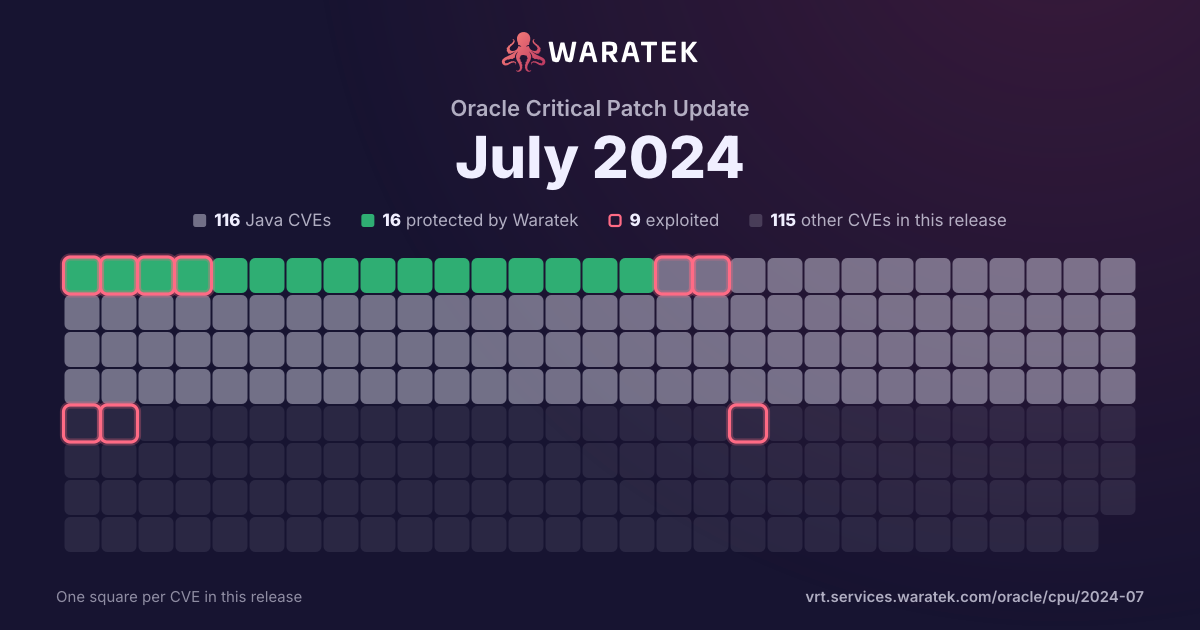
By status
16Protected by Waratek4Mitigation candidate96No exploit published18Outside Waratek scope97Not applicable
9Exploited, marked by the ring
No exploit published. For 35 of them, Oracle's security advisory is the source of public detail.
Protected by Waratek. Waratek RASP can block exploitation of these on systems that have not applied the patch yet.
Overview 28 matches · 0 in Waratek scope · 0 protected · 0 exploited · 0 CISA KEV · 5 public PoC · 3 EPSS ≥ 0.5
28matches
0in Waratek scope0.0%
0protected0.0%
0exploited0.0%
0CISA KEV0.0%
5public PoC17.9%
3EPSS ≥ 0.510.7%
Protected by Waratek
0
0.0%
Rule in development
0
0.0%
Mitigation candidate
0
0.0%
No exploit published
0
0.0%
Outside Waratek scope
0
0.0%
Not applicable
28
100.0%
Withdrawn CVE
0
0.0%
blocked by ARMR today
0
0.0%
partly blocked
0
0.0%
not blocked
28
100.0%
not established
0
0.0%
unrecorded
0
0.0%
Exploited
0
0.0%
Working exploit published
1
3.6%
Proof of concept only
8
28.6%
Forecast only
0
0.0%
No public exploit
19
67.9%
split by
peak 9 / quarter
Q4 221
Not applicable1
High1
not blocked1
Proof of concept only1
Q1 230
Q2 230
Q3 231
Not applicable1
High1
not blocked1
No public exploit1
Q4 239
Not applicable9
High9
not blocked9
Proof of concept only3
No public exploit6
Q1 249
Not applicable9
High9
not blocked9
Proof of concept only1
No public exploit8
Q2 245
Not applicable5
High5
not blocked5
Working exploit published1
Proof of concept only3
No public exploit1
Q3 242
Not applicable2
High2
not blocked2
No public exploit2
Q4 240
Q1 251
Not applicable1
High1
not blocked1
No public exploit1
Q4 22Q1 23Q2 23Q3 23Q4 23Q1 24Q2 24Q3 24Q4 24Q1 25
| CVE | Severity | Published▾ | Status | Exploitation | Description |
|---|---|---|---|---|---|
| CVE-2024-27980 | High | 2025-01-09 | Not applicable | No public exploit | Due to the improper handling of batch files in child_process.spawn / child_process.spawnSync, a malicious command line argument can inject arbitrary commands and achieve code execution even if the shell option is not enabled. |
| CVE-2024-21184 | High | 2024-07-16 | Not applicable | No public exploit | Vulnerability in the Oracle Database RDBMS Security component of Oracle Database Server. Supported versions that are affected are 19.3-19.23. Easily exploitable vulnerability allows high privileged attacker having Execute on SYS.XS_DIAG privilege with network access via Oracle Net to compromise Oracle Database RDBMS Security. Successful attacks of this vulnerability can result in takeover of Oracle Database RDBMS Security. CVSS 3.1 Base Score 7.2 (Confidentiality, Integrity and Availability impacts). CVSS Vector: (CVSS:3.1/AV:N/AC:L/PR:H/UI:N/S:U/C:H/I:H/A:H). |
| CVE-2024-21141 | High | 2024-07-16 | Not applicable | No public exploit | Vulnerability in the Oracle VM VirtualBox product of Oracle Virtualization (component: Core). Supported versions that are affected are Prior to 7.0.20. Easily exploitable vulnerability allows high privileged attacker with logon to the infrastructure where Oracle VM VirtualBox executes to compromise Oracle VM VirtualBox. While the vulnerability is in Oracle VM VirtualBox, attacks may significantly impact additional products (scope change). Successful attacks of this vulnerability can result in takeover of Oracle VM VirtualBox. CVSS 3.1 Base Score 8.2 (Confidentiality, Integrity and Availability impacts). CVSS Vector: (CVSS:3.1/AV:L/AC:L/PR:H/UI:N/S:C/C:H/I:H/A:H). |
| CVE-2024-0397 | High | 2024-06-17 | Not applicable | No public exploit | A defect was discovered in the Python “ssl” module where there is a memory race condition with the ssl.SSLContext methods “cert_store_stats()” and “get_ca_certs()”. The race condition can be triggered if the methods are called at the same time as certificates are loaded into the SSLContext, such as during the TLS handshake with a certificate directory configured. This issue is fixed in CPython 3.10.14, 3.11.9, 3.12.3, and 3.13.0a5. |
| CVE-2024-34459 | High | 2024-05-14 | Not applicable | Proof of concept only | An issue was discovered in xmllint (from libxml2) before 2.11.8 and 2.12.x before 2.12.7. Formatting error messages with xmllint --htmlout can result in a buffer over-read in xmlHTMLPrintFileContext in xmllint.c. |
| CVE-2024-34069 | High | 2024-05-06 | Not applicable | Working exploit published | Werkzeug is a comprehensive WSGI web application library. The debugger in affected versions of Werkzeug can allow an attacker to execute code on a developer's machine under some circumstances. This requires the attacker to get the developer to interact with a domain and subdomain they control, and enter the debugger PIN, but if they are successful it allows access to the debugger even if it is only running on localhost. This also requires the attacker to guess a URL in the developer's application that will trigger the debugger. This vulnerability is fixed in 3.0.3. |
| CVE-2024-27983 | High | 2024-04-09 | Not applicable | Proof of concept only | An attacker can make the Node.js HTTP/2 server completely unavailable by sending a small amount of HTTP/2 frames packets with a few HTTP/2 frames inside. It is possible to leave some data in nghttp2 memory after reset when headers with HTTP/2 CONTINUATION frame are sent to the server and then a TCP connection is abruptly closed by the client triggering the Http2Session destructor while header frames are still being processed (and stored in memory) causing a race condition. |
| CVE-2024-27316 | High | 2024-04-04 | Not applicable | Proof of concept only | HTTP/2 incoming headers exceeding the limit are temporarily buffered in nghttp2 in order to generate an informative HTTP 413 response. If a client does not stop sending headers, this leads to memory exhaustion. |
| CVE-2023-6597 | High | 2024-03-19 | Not applicable | No public exploit | An issue was found in the CPython `tempfile.TemporaryDirectory` class affecting versions 3.12.1, 3.11.7, 3.10.13, 3.9.18, and 3.8.18 and prior. The tempfile.TemporaryDirectory class would dereference symlinks during cleanup of permissions-related errors. This means users which can run privileged programs are potentially able to modify permissions of files referenced by symlinks in some circumstances. |
| CVE-2024-28757 | High | 2024-03-10 | Not applicable | No public exploit | libexpat through 2.6.1 allows an XML Entity Expansion attack when there is isolated use of external parsers (created via XML_ExternalEntityParserCreate). |
| CVE-2024-22243 | High | 2024-02-23 | Not applicable | Proof of concept only | Applications that use UriComponentsBuilder to parse an externally provided URL (e.g. through a query parameter) AND perform validation checks on the host of the parsed URL may be vulnerable to a open redirect https://cwe.mitre.org/data/definitions/601.html attack or to a SSRF attack if the URL is used after passing validation checks. |
| CVE-2024-26130 | High | 2024-02-21 | Not applicable | No public exploit | cryptography is a package designed to expose cryptographic primitives and recipes to Python developers. Starting in version 38.0.0 and prior to version 42.0.4, if `pkcs12.serialize_key_and_certificates` is called with both a certificate whose public key did not match the provided private key and an `encryption_algorithm` with `hmac_hash` set (via `PrivateFormat.PKCS12.encryption_builder().hmac_hash(...)`, then a NULL pointer dereference would occur, crashing the Python process. This has been resolved in version 42.0.4, the first version in which a `ValueError` is properly raised. |
| CVE-2024-22019 | High | 2024-02-20 | Not applicable | No public exploit | A vulnerability in Node.js HTTP servers allows an attacker to send a specially crafted HTTP request with chunked encoding, leading to resource exhaustion and denial of service (DoS). The server reads an unbounded number of bytes from a single connection, exploiting the lack of limitations on chunk extension bytes. The issue can cause CPU and network bandwidth exhaustion, bypassing standard safeguards like timeouts and body size limits. |
| CVE-2024-21892 | High | 2024-02-20 | Not applicable | No public exploit | On Linux, Node.js ignores certain environment variables if those may have been set by an unprivileged user while the process is running with elevated privileges with the only exception of CAP_NET_BIND_SERVICE. Due to a bug in the implementation of this exception, Node.js incorrectly applies this exception even when certain other capabilities have been set. This allows unprivileged users to inject code that inherits the process's elevated privileges. |
| CVE-2024-25062 | High | 2024-02-04 | Not applicable | No public exploit | An issue was discovered in libxml2 before 2.11.7 and 2.12.x before 2.12.5. When using the XML Reader interface with DTD validation and XInclude expansion enabled, processing crafted XML documents can lead to an xmlValidatePopElement use-after-free. |
| CVE-2023-52425 | High | 2024-02-04 | Not applicable | No public exploit | libexpat through 2.5.0 allows a denial of service (resource consumption) because many full reparsings are required in the case of a large token for which multiple buffer fills are needed. |
| CVE-2023-50447 | High | 2024-01-19 | Not applicable | No public exploit | Pillow through 10.1.0 allows PIL.ImageMath.eval Arbitrary Code Execution via the environment parameter, a different vulnerability than CVE-2022-22817 (which was about the expression parameter). |
| CVE-2023-5764 | High | 2023-12-12 | Not applicable | No public exploit | A template injection flaw was found in Ansible where a user's controller internal templating operations may remove the unsafe designation from template data. This issue could allow an attacker to use a specially crafted file to introduce templating injection when supplying templating data. |
| CVE-2023-49081 | High | 2023-11-30 | Not applicable | Proof of concept only | aiohttp is an asynchronous HTTP client/server framework for asyncio and Python. Improper validation made it possible for an attacker to modify the HTTP request (e.g. to insert a new header) or create a new HTTP request if the attacker controls the HTTP version. The vulnerability only occurs if the attacker can control the HTTP version of the request. This issue has been patched in version 3.9.0. |
| CVE-2023-49083 | High | 2023-11-29 | Not applicable | Proof of concept only | cryptography is a package designed to expose cryptographic primitives and recipes to Python developers. Calling `load_pem_pkcs7_certificates` or `load_der_pkcs7_certificates` could lead to a NULL-pointer dereference and segfault. Exploitation of this vulnerability poses a serious risk of Denial of Service (DoS) for any application attempting to deserialize a PKCS7 blob/certificate. The consequences extend to potential disruptions in system availability and stability. This vulnerability has been patched in version 41.0.6. |
| CVE-2023-26031 | High | 2023-11-16 | Not applicable | No public exploit | Relative library resolution in linux container-executor binary in Apache Hadoop 3.3.1-3.3.4 on Linux allows local user to gain root privileges. If the YARN cluster is accepting work from remote (authenticated) users, this MAY permit remote users to gain root privileges. Hadoop 3.3.0 updated the " YARN Secure Containers https://hadoop.apache.org/docs/stable/hadoop-yarn/hadoop-yarn-site/SecureContainer.html " to add a feature for executing user-submitted applications in isolated linux containers. The native binary HADOOP_HOME/bin/container-executor is used to launch these containers; it must be owned by root and have the suid bit set in order for the YARN processes to run the containers as the specific users submitting the jobs. The patch " YARN-10495 https://issues.apache.org/jira/browse/YARN-10495 . make the rpath of container-executor configurable" modified the library loading path for loading .so files from "$ORIGIN/" to ""$ORIGIN/:../lib/native/". This is the a path through which libcrypto.so is located. Thus it is is possible for a user with reduced privileges to install a malicious libcrypto library into a path to which they have write access, invoke the container-executor command, and have their modified library executed as root. If the YARN cluster is accepting work from remote (authenticated) users, and these users' submitted job are executed in the physical host, rather than a container, then the CVE permits remote users to gain root privileges. The fix for the vulnerability is to revert the change, which is done in YARN-11441 https://issues.apache.org/jira/browse/YARN-11441 , "Revert YARN-10495". This patch is in hadoop-3.3.5. To determine whether a version of container-executor is vulnerable, use the readelf command. If the RUNPATH or RPATH value contains the relative path "./lib/native/" then it is at risk $ readelf -d container-executor|grep 'RUNPATH\|RPATH' 0x000000000000001d (RUNPATH) Library runpath: [$ORIGIN/:../lib/native/] If it does not, then it is safe: $ readelf -d container-executor|grep 'RUNPATH\|RPATH' 0x000000000000001d (RUNPATH) Library runpath: [$ORIGIN/] For an at-risk version of container-executor to enable privilege escalation, the owner must be root and the suid bit must be set $ ls -laF /opt/hadoop/bin/container-executor ---Sr-s---. 1 root hadoop 802968 May 9 20:21 /opt/hadoop/bin/container-executor A safe installation lacks the suid bit; ideally is also not owned by root. $ ls -laF /opt/hadoop/bin/container-executor -rwxr-xr-x. 1 yarn hadoop 802968 May 9 20:21 /opt/hadoop/bin/container-executor This configuration does not support Yarn Secure Containers, but all other hadoop services, including YARN job execution outside secure containers continue to work. |
| CVE-2023-47627 | High | 2023-11-14 | Not applicable | Proof of concept only | aiohttp is an asynchronous HTTP client/server framework for asyncio and Python. The HTTP parser in AIOHTTP has numerous problems with header parsing, which could lead to request smuggling. This parser is only used when AIOHTTP_NO_EXTENSIONS is enabled (or not using a prebuilt wheel). These bugs have been addressed in commit `d5c12ba89` which has been included in release version 3.8.6. Users are advised to upgrade. There are no known workarounds for these issues. |
| CVE-2023-5363 | High | 2023-10-25 | Not applicable | No public exploit | Issue summary: A bug has been identified in the processing of key and initialisation vector (IV) lengths. This can lead to potential truncation or overruns during the initialisation of some symmetric ciphers. Impact summary: A truncation in the IV can result in non-uniqueness, which could result in loss of confidentiality for some cipher modes. When calling EVP_EncryptInit_ex2(), EVP_DecryptInit_ex2() or EVP_CipherInit_ex2() the provided OSSL_PARAM array is processed after the key and IV have been established. Any alterations to the key length, via the "keylen" parameter or the IV length, via the "ivlen" parameter, within the OSSL_PARAM array will not take effect as intended, potentially causing truncation or overreading of these values. The following ciphers and cipher modes are impacted: RC2, RC4, RC5, CCM, GCM and OCB. For the CCM, GCM and OCB cipher modes, truncation of the IV can result in loss of confidentiality. For example, when following NIST's SP 800-38D section 8.2.1 guidance for constructing a deterministic IV for AES in GCM mode, truncation of the counter portion could lead to IV reuse. Both truncations and overruns of the key and overruns of the IV will produce incorrect results and could, in some cases, trigger a memory exception. However, these issues are not currently assessed as security critical. Changing the key and/or IV lengths is not considered to be a common operation and the vulnerable API was recently introduced. Furthermore it is likely that application developers will have spotted this problem during testing since decryption would fail unless both peers in the communication were similarly vulnerable. For these reasons we expect the probability of an application being vulnerable to this to be quite low. However if an application is vulnerable then this issue is considered very serious. For these reasons we have assessed this issue as Moderate severity overall. The OpenSSL SSL/TLS implementation is not affected by this issue. The OpenSSL 3.0 and 3.1 FIPS providers are not affected by this because the issue lies outside of the FIPS provider boundary. OpenSSL 3.1 and 3.0 are vulnerable to this issue. |
| CVE-2023-39331 | High | 2023-10-18 | Not applicable | No public exploit | A previously disclosed vulnerability (CVE-2023-30584) was patched insufficiently in commit 205f1e6. The new path traversal vulnerability arises because the implementation does not protect itself against the application overwriting built-in utility functions with user-defined implementations. Please note that at the time this CVE was issued, the permission model is an experimental feature of Node.js. |
| CVE-2023-38552 | High | 2023-10-18 | Not applicable | No public exploit | When the Node.js policy feature checks the integrity of a resource against a trusted manifest, the application can intercept the operation and return a forged checksum to the node's policy implementation, thus effectively disabling the integrity check. Impacts: This vulnerability affects all users using the experimental policy mechanism in all active release lines: 18.x and, 20.x. Please note that at the time this CVE was issued, the policy mechanism is an experimental feature of Node.js. |
| CVE-2023-37536 | High | 2023-10-11 | Not applicable | No public exploit | An integer overflow in xerces-c++ 3.2.3 in BigFix Platform allows remote attackers to cause out-of-bound access via HTTP request. |
| CVE-2023-41105 | High | 2023-08-23 | Not applicable | No public exploit | An issue was discovered in Python 3.11 through 3.11.4. If a path containing '\0' bytes is passed to os.path.normpath(), the path will be truncated unexpectedly at the first '\0' byte. There are plausible cases in which an application would have rejected a filename for security reasons in Python 3.10.x or earlier, but that filename is no longer rejected in Python 3.11.x. |
| CVE-2022-3786 | High | 2022-11-01 | Not applicable | Proof of concept only | A buffer overrun can be triggered in X.509 certificate verification, specifically in name constraint checking. Note that this occurs after certificate chain signature verification and requires either a CA to have signed a malicious certificate or for an application to continue certificate verification despite failure to construct a path to a trusted issuer. An attacker can craft a malicious email address in a certificate to overflow an arbitrary number of bytes containing the `.' character (decimal 46) on the stack. This buffer overflow could result in a crash (causing a denial of service). In a TLS client, this can be triggered by connecting to a malicious server. In a TLS server, this can be triggered if the server requests client authentication and a malicious client connects. |