
Oracle Critical Patch Update July 2024
Released July 2024 · Oracle's advisory ↗ · ← Critical Patch Update, April 2024 · Critical Patch Update, October 2024 →
231 CVEs in this release, one square each
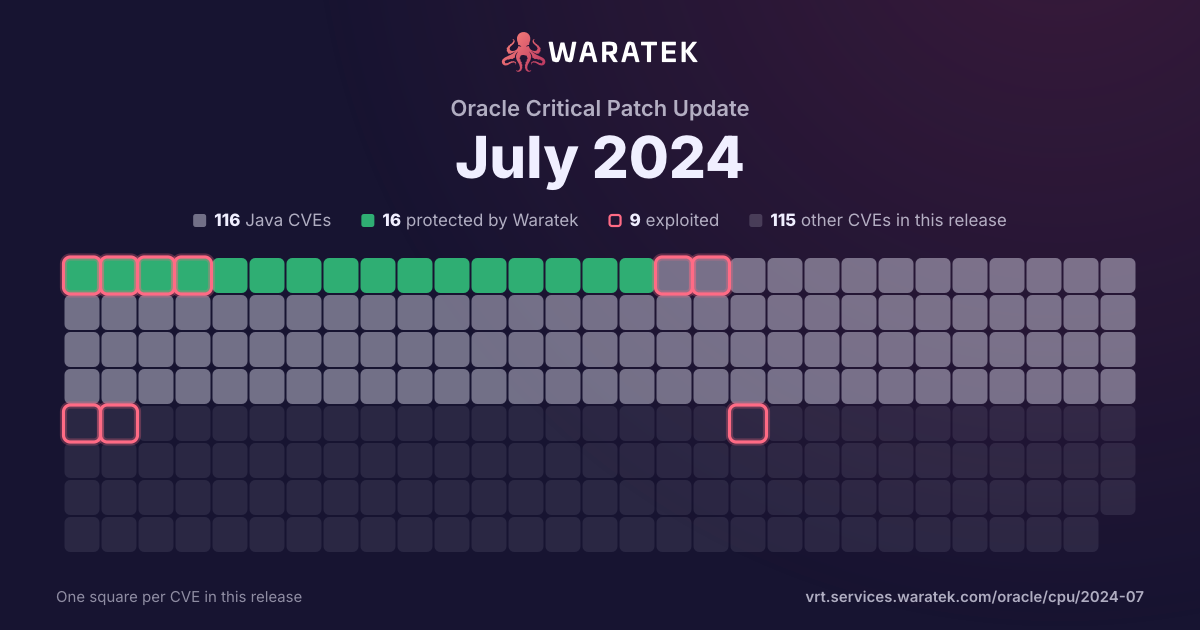
By status
16Protected by Waratek4Mitigation candidate96No exploit published18Outside Waratek scope97Not applicable
9Exploited, marked by the ring
No exploit published. For 35 of them, Oracle's security advisory is the source of public detail.
Protected by Waratek. Waratek RASP can block exploitation of these on systems that have not applied the patch yet.
Overview 8 matches · 0 in Waratek scope · 0 protected · 1 exploited · 0 CISA KEV · 1 public PoC · 0 EPSS ≥ 0.5
8matches
0in Waratek scope0.0%
0protected0.0%
1exploited12.5%
0CISA KEV0.0%
1public PoC12.5%
0EPSS ≥ 0.50.0%
Protected by Waratek
0
0.0%
Rule in development
0
0.0%
Mitigation candidate
0
0.0%
No exploit published
0
0.0%
Outside Waratek scope
0
0.0%
Not applicable
8
100.0%
Withdrawn CVE
0
0.0%
blocked by ARMR today
0
0.0%
partly blocked
0
0.0%
not blocked
8
100.0%
not established
0
0.0%
unrecorded
0
0.0%
Exploited
1
12.5%
Working exploit published
0
0.0%
Proof of concept only
1
12.5%
Forecast only
0
0.0%
No public exploit
6
75.0%
split by
peak 3 / quarter
Q1 211
Not applicable1
Critical1
not blocked1
No public exploit1
Q2 210
Q3 210
Q4 210
Q1 220
Q2 220
Q3 221
Not applicable1
Critical1
not blocked1
Proof of concept only1
Q4 220
Q1 230
Q2 230
Q3 231
Not applicable1
Critical1
not blocked1
No public exploit1
Q4 233
Not applicable3
Critical3
not blocked3
Exploited1
No public exploit2
Q1 242
Not applicable2
Critical2
not blocked2
No public exploit2
Q1 21Q3 21Q1 22Q3 22Q1 23Q3 23Q1 24
| CVE | Severity | Published▾ | Status | Exploitation | Description |
|---|---|---|---|---|---|
| CVE-2024-23807 | Critical | 2024-02-29 | Not applicable | No public exploit | The Apache Xerces C++ XML parser on versions 3.0.0 before 3.2.5 contains a use-after-free error triggered during the scanning of external DTDs. Users are recommended to upgrade to version 3.2.5 which fixes the issue, or mitigate the issue by disabling DTD processing. This can be accomplished via the DOM using a standard parser feature, or via SAX using the XERCES_DISABLE_DTD environment variable. This issue has been disclosed before as CVE-2018-1311, but unfortunately that advisory incorrectly stated the issue would be fixed in version 3.2.3 or 3.2.4. |
| CVE-2022-34381 | Critical | 2024-02-02 | Not applicable | No public exploit | Dell BSAFE SSL-J version 7.0 and all versions prior to 6.5, and Dell BSAFE Crypto-J versions prior to 6.2.6.1 contain an unmaintained third-party component vulnerability. An unauthenticated remote attacker could potentially exploit this vulnerability, leading to the compromise of the impacted system. This is a Critical vulnerability and Dell recommends customers to upgrade at the earliest opportunity. |
| CVE-2023-47248 | Critical | 2023-11-09 | Not applicable | Exploited | Deserialization of untrusted data in IPC and Parquet readers in PyArrow versions 0.14.0 to 14.0.0 allows arbitrary code execution. An application is vulnerable if it reads Arrow IPC, Feather or Parquet data from untrusted sources (for example user-supplied input files). This vulnerability only affects PyArrow, not other Apache Arrow implementations or bindings. It is recommended that users of PyArrow upgrade to 14.0.1. Similarly, it is recommended that downstream libraries upgrade their dependency requirements to PyArrow 14.0.1 or later. PyPI packages are already available, and we hope that conda-forge packages will be available soon. If it is not possible to upgrade, we provide a separate package `pyarrow-hotfix` that disables the vulnerability on older PyArrow versions. See https://pypi.org/project/pyarrow-hotfix/ for instructions. |
| CVE-2023-39332 | Critical | 2023-10-18 | Not applicable | No public exploit | Various `node:fs` functions allow specifying paths as either strings or `Uint8Array` objects. In Node.js environments, the `Buffer` class extends the `Uint8Array` class. Node.js prevents path traversal through strings (see CVE-2023-30584) and `Buffer` objects (see CVE-2023-32004), but not through non-`Buffer` `Uint8Array` objects. This is distinct from CVE-2023-32004 which only referred to `Buffer` objects. However, the vulnerability follows the same pattern using `Uint8Array` instead of `Buffer`. Please note that at the time this CVE was issued, the permission model is an experimental feature of Node.js. |
| CVE-2023-45853 | Critical | 2023-10-14 | Not applicable | No public exploit | MiniZip in zlib through 1.3 has an integer overflow and resultant heap-based buffer overflow in zipOpenNewFileInZip4_64 via a long filename, comment, or extra field. NOTE: MiniZip is not a supported part of the zlib product. NOTE: pyminizip through 0.2.6 is also vulnerable because it bundles an affected zlib version, and exposes the applicable MiniZip code through its compress API. |
| CVE-2022-48174 | Critical | 2023-08-22 | Not applicable | No public exploit | There is a stack overflow vulnerability in ash.c:6030 in busybox before 1.35. In the environment of Internet of Vehicles, this vulnerability can be executed from command to arbitrary code execution. |
| CVE-2022-21797 | Critical | 2022-09-26 | Not applicable | Proof of concept only | The package joblib from 0 and before 1.2.0 are vulnerable to Arbitrary Code Execution via the pre_dispatch flag in Parallel() class due to the eval() statement. |
| CVE-2021-24112 | Critical | 2021-02-25 | Not applicable | No public exploit | .NET Core Remote Code Execution Vulnerability |