
Oracle Critical Patch Update July 2024
Released July 2024 · Oracle's advisory ↗ · ← Critical Patch Update, April 2024 · Critical Patch Update, October 2024 →
231 CVEs in this release, one square each
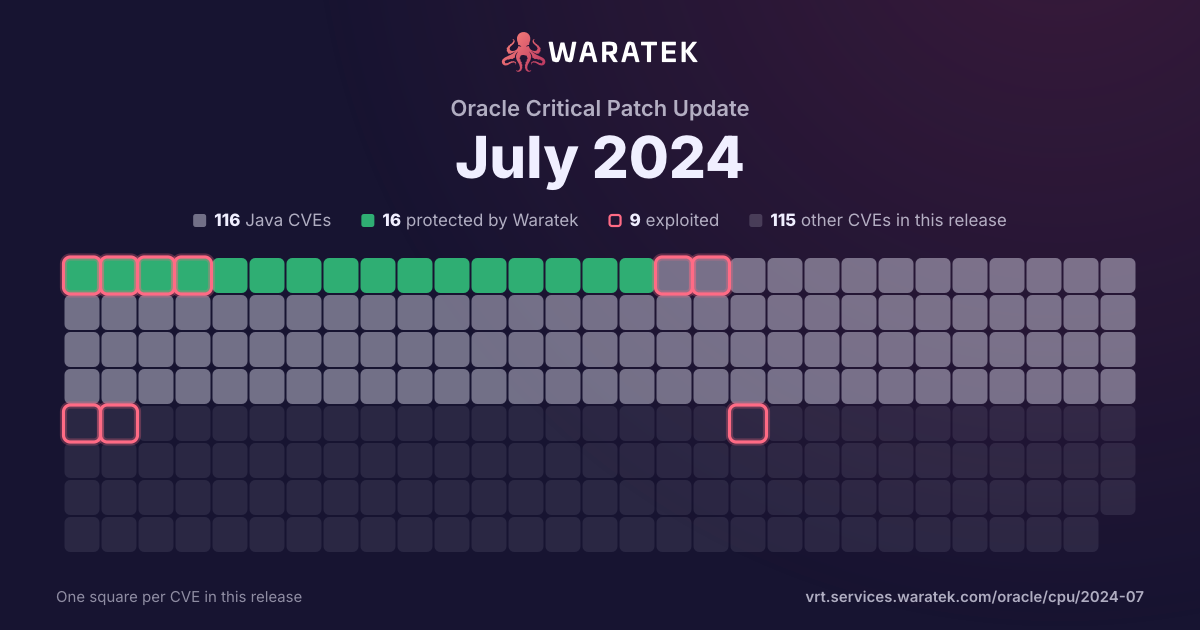
By status
16Protected by Waratek4Mitigation candidate96No exploit published18Outside Waratek scope97Not applicable
9Exploited, marked by the ring
No exploit published. For 35 of them, Oracle's security advisory is the source of public detail.
Protected by Waratek. Waratek RASP can block exploitation of these on systems that have not applied the patch yet.
Overview 13 matches · 6 in Waratek scope · 2 protected · 4 exploited · 1 CISA KEV · 6 EPSS ≥ 0.5
Protected by Waratek
2
15.4%
Rule in development
0
0.0%
Mitigation candidate
4
30.8%
No exploit published
0
0.0%
Outside Waratek scope
2
15.4%
Not applicable
5
38.5%
Withdrawn CVE
0
0.0%
blocked by ARMR today
2
15.4%
partly blocked
0
0.0%
not blocked
11
84.6%
not established
0
0.0%
unrecorded
0
0.0%
Exploited
4
30.8%
Working exploit published
1
7.7%
Proof of concept only
8
61.5%
Forecast only
0
0.0%
No public exploit
0
0.0%
split by
peak 6 / quarter
Q3 222
Protected by Waratek1
Mitigation candidate1
High2
blocked by ARMR today1
not blocked1
Proof of concept only2
Q4 221
Not applicable1
High1
not blocked1
Proof of concept only1
Q1 230
Q2 230
Q3 230
Q4 231
Mitigation candidate1
High1
not blocked1
Exploited1
Q1 242
Mitigation candidate1
Not applicable1
High2
not blocked2
Proof of concept only2
Q2 246
Mitigation candidate1
Outside Waratek scope2
Not applicable3
High6
not blocked6
Exploited2
Working exploit published1
Proof of concept only3
Q3 241
Protected by Waratek1
High1
blocked by ARMR today1
Exploited1
Q3 22Q4 22Q1 23Q2 23Q3 23Q4 23Q1 24Q2 24Q3 24
| CVE | Severity | Published▾ | Status | Exploitation | Description |
|---|---|---|---|---|---|
| CVE-2024-21136 | High | 2024-07-16 | Protected by Waratek | Exploited | Vulnerability in the Oracle Retail Xstore Office product of Oracle Retail Applications (component: Security). Supported versions that are affected are 19.0.5, 20.0.3, 20.0.4, 22.0.0 and 23.0.1. Easily exploitable vulnerability allows unauthenticated attacker with network access via HTTP to compromise Oracle Retail Xstore Office. While the vulnerability is in Oracle Retail Xstore Office, attacks may significantly impact additional products (scope change). Successful attacks of this vulnerability can result in unauthorized access to critical data or complete access to all Oracle Retail Xstore Office accessible data. CVSS 3.1 Base Score 8.6 (Confidentiality impacts). CVSS Vector: (CVSS:3.1/AV:N/AC:L/PR:N/UI:N/S:C/C:H/I:N/A:N). |
| CVE-2024-34069 | High | 2024-05-06 | Not applicable | Working exploit published | Werkzeug is a comprehensive WSGI web application library. The debugger in affected versions of Werkzeug can allow an attacker to execute code on a developer's machine under some circumstances. This requires the attacker to get the developer to interact with a domain and subdomain they control, and enter the debugger PIN, but if they are successful it allows access to the debugger even if it is only running on localhost. This also requires the attacker to guess a URL in the developer's application that will trigger the debugger. This vulnerability is fixed in 3.0.3. |
| CVE-2024-32114 | High | 2024-05-02 | Mitigation candidate | Exploited | In Apache ActiveMQ 6.x, the default configuration doesn't secure the API web context (where the Jolokia JMX REST API and the Message REST API are located). It means that anyone can use these layers without any required authentication. Potentially, anyone can interact with the broker (using Jolokia JMX REST API) and/or produce/consume messages or purge/delete destinations (using the Message REST API). To mitigate, users can update the default conf/jetty.xml configuration file to add authentication requirement: <bean id="securityConstraintMapping" class="org.eclipse.jetty.security.ConstraintMapping"> <property name="constraint" ref="securityConstraint" /> <property name="pathSpec" value="/" /> </bean> Or we encourage users to upgrade to Apache ActiveMQ 6.1.2 where the default configuration has been updated with authentication by default. |
| CVE-2024-2961 | High | 2024-04-17 | Outside Waratek scope | Exploited | The iconv() function in the GNU C Library versions 2.39 and older may overflow the output buffer passed to it by up to 4 bytes when converting strings to the ISO-2022-CN-EXT character set, which may be used to crash an application or overwrite a neighbouring variable. |
| CVE-2024-27983 | High | 2024-04-09 | Not applicable | Proof of concept only | An attacker can make the Node.js HTTP/2 server completely unavailable by sending a small amount of HTTP/2 frames packets with a few HTTP/2 frames inside. It is possible to leave some data in nghttp2 memory after reset when headers with HTTP/2 CONTINUATION frame are sent to the server and then a TCP connection is abruptly closed by the client triggering the Http2Session destructor while header frames are still being processed (and stored in memory) causing a race condition. |
| CVE-2024-27316 | High | 2024-04-04 | Not applicable | Proof of concept only | HTTP/2 incoming headers exceeding the limit are temporarily buffered in nghttp2 in order to generate an informative HTTP 413 response. If a client does not stop sending headers, this leads to memory exhaustion. |
| CVE-2023-38709 | High | 2024-04-04 | Outside Waratek scope | Proof of concept only | Faulty input validation in the core of Apache allows malicious or exploitable backend/content generators to split HTTP responses. This issue affects Apache HTTP Server: through 2.4.58. |
| CVE-2024-24549 | High | 2024-03-13 | Mitigation candidate | Proof of concept only | Denial of Service due to improper input validation vulnerability for HTTP/2 requests in Apache Tomcat. When processing an HTTP/2 request, if the request exceeded any of the configured limits for headers, the associated HTTP/2 stream was not reset until after all of the headers had been processed.This issue affects Apache Tomcat: from 11.0.0-M1 through 11.0.0-M16, from 10.1.0-M1 through 10.1.18, from 9.0.0-M1 through 9.0.85, from 8.5.0 through 8.5.98. Other, older, EOL versions may also be affected. Users are recommended to upgrade to version 11.0.0-M17, 10.1.19, 9.0.86 or 8.5.99 which fix the issue. |
| CVE-2024-22243 | High | 2024-02-23 | Not applicable | Proof of concept only | Applications that use UriComponentsBuilder to parse an externally provided URL (e.g. through a query parameter) AND perform validation checks on the host of the parsed URL may be vulnerable to a open redirect https://cwe.mitre.org/data/definitions/601.html attack or to a SSRF attack if the URL is used after passing validation checks. |
| CVE-2023-44487 | High | 2023-10-10 | Mitigation candidate | Exploited | The HTTP/2 protocol allows a denial of service (server resource consumption) because request cancellation can reset many streams quickly, as exploited in the wild in August through October 2023. |
| CVE-2022-3786 | High | 2022-11-01 | Not applicable | Proof of concept only | A buffer overrun can be triggered in X.509 certificate verification, specifically in name constraint checking. Note that this occurs after certificate chain signature verification and requires either a CA to have signed a malicious certificate or for an application to continue certificate verification despite failure to construct a path to a trusted issuer. An attacker can craft a malicious email address in a certificate to overflow an arbitrary number of bytes containing the `.' character (decimal 46) on the stack. This buffer overflow could result in a crash (causing a denial of service). In a TLS client, this can be triggered by connecting to a malicious server. In a TLS server, this can be triggered if the server requests client authentication and a malicious client connects. |
| CVE-2022-40146 | High | 2022-09-22 | Mitigation candidate | Proof of concept only | Server-Side Request Forgery (SSRF) vulnerability in Batik of Apache XML Graphics allows an attacker to access files using a Jar url. This issue affects Apache XML Graphics Batik 1.14. |
| CVE-2022-34169 | High | 2022-07-19 | Protected by Waratek | Proof of concept only | The Apache Xalan Java XSLT library is vulnerable to an integer truncation issue when processing malicious XSLT stylesheets. This can be used to corrupt Java class files generated by the internal XSLTC compiler and execute arbitrary Java bytecode. Users are recommended to update to version 2.7.3 or later. Note: Java runtimes (such as OpenJDK) include repackaged copies of Xalan. |