
Oracle Critical Patch Update July 2024
Released July 2024 · Oracle's advisory ↗ · ← Critical Patch Update, April 2024 · Critical Patch Update, October 2024 →
231 CVEs in this release, one square each
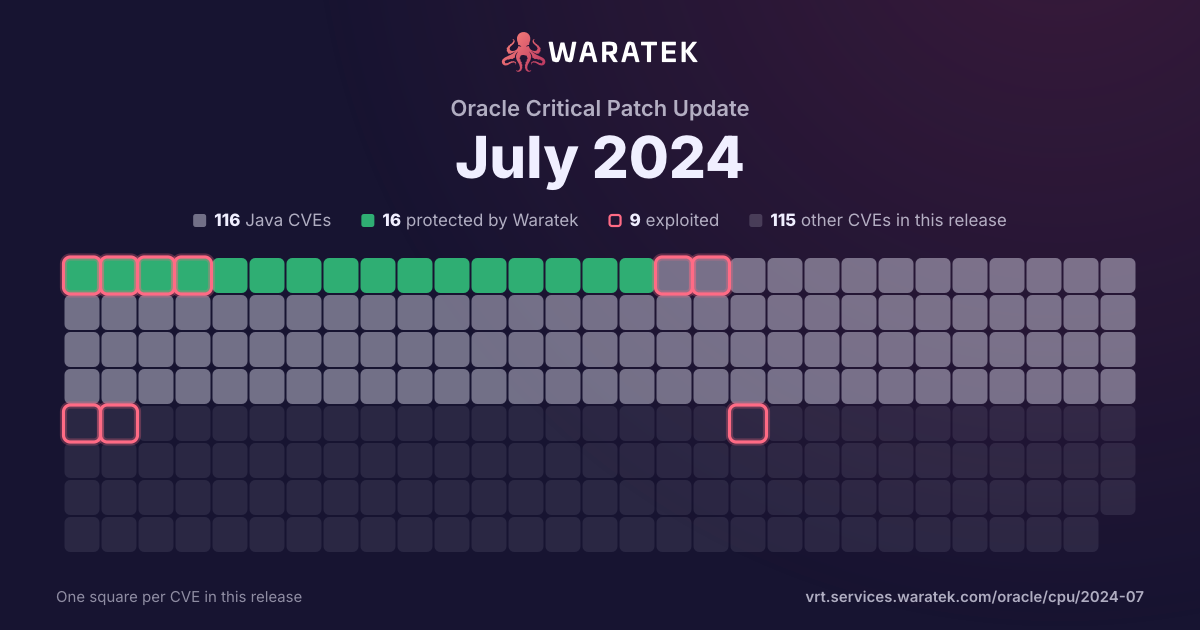
By status
16Protected by Waratek4Mitigation candidate96No exploit published18Outside Waratek scope97Not applicable
9Exploited, marked by the ring
No exploit published. For 35 of them, Oracle's security advisory is the source of public detail.
Protected by Waratek. Waratek RASP can block exploitation of these on systems that have not applied the patch yet.
Overview 5 matches · 3 in Waratek scope · 3 protected · 3 exploited · 2 CISA KEV · 3 EPSS ≥ 0.5
Protected by Waratek
3
60.0%
Rule in development
0
0.0%
Mitigation candidate
0
0.0%
No exploit published
0
0.0%
Outside Waratek scope
1
20.0%
Not applicable
1
20.0%
Withdrawn CVE
0
0.0%
blocked by ARMR today
3
60.0%
partly blocked
0
0.0%
not blocked
2
40.0%
not established
0
0.0%
unrecorded
0
0.0%
Exploited
3
60.0%
Working exploit published
0
0.0%
Proof of concept only
2
40.0%
Forecast only
0
0.0%
No public exploit
0
0.0%
split by
peak 2 / quarter
Q2 222
Protected by Waratek1
Outside Waratek scope1
Critical2
blocked by ARMR today1
not blocked1
Exploited1
Proof of concept only1
Q3 221
Protected by Waratek1
Critical1
blocked by ARMR today1
Proof of concept only1
Q4 220
Q1 230
Q2 230
Q3 230
Q4 231
Not applicable1
Critical1
not blocked1
Exploited1
Q1 241
Protected by Waratek1
Critical1
blocked by ARMR today1
Exploited1
Q2 22Q3 22Q4 22Q1 23Q2 23Q3 23Q4 23Q1 24
| CVE | Severity | Published▾ | Status | Exploitation | Description |
|---|---|---|---|---|---|
| CVE-2024-23897 | Critical | 2024-01-24 | Protected by Waratek | Exploited | Jenkins 2.441 and earlier, LTS 2.426.2 and earlier does not disable a feature of its CLI command parser that replaces an '@' character followed by a file path in an argument with the file's contents, allowing unauthenticated attackers to read arbitrary files on the Jenkins controller file system. |
| CVE-2023-47248 | Critical | 2023-11-09 | Not applicable | Exploited | Deserialization of untrusted data in IPC and Parquet readers in PyArrow versions 0.14.0 to 14.0.0 allows arbitrary code execution. An application is vulnerable if it reads Arrow IPC, Feather or Parquet data from untrusted sources (for example user-supplied input files). This vulnerability only affects PyArrow, not other Apache Arrow implementations or bindings. It is recommended that users of PyArrow upgrade to 14.0.1. Similarly, it is recommended that downstream libraries upgrade their dependency requirements to PyArrow 14.0.1 or later. PyPI packages are already available, and we hope that conda-forge packages will be available soon. If it is not possible to upgrade, we provide a separate package `pyarrow-hotfix` that disables the vulnerability on older PyArrow versions. See https://pypi.org/project/pyarrow-hotfix/ for instructions. |
| CVE-2022-36944 | Critical | 2022-09-23 | Protected by Waratek | Proof of concept only | Scala 2.13.x before 2.13.9 has a Java deserialization chain in its JAR file. On its own, it cannot be exploited. There is only a risk in conjunction with Java object deserialization within an application. In such situations, it allows attackers to erase contents of arbitrary files, make network connections, or possibly run arbitrary code (specifically, Function0 functions) via a gadget chain. |
| CVE-2022-1292 | Critical | 2022-05-03 | Outside Waratek scope | Proof of concept only | The c_rehash script does not properly sanitise shell metacharacters to prevent command injection. This script is distributed by some operating systems in a manner where it is automatically executed. On such operating systems, an attacker could execute arbitrary commands with the privileges of the script. Use of the c_rehash script is considered obsolete and should be replaced by the OpenSSL rehash command line tool. Fixed in OpenSSL 3.0.3 (Affected 3.0.0,3.0.1,3.0.2). Fixed in OpenSSL 1.1.1o (Affected 1.1.1-1.1.1n). Fixed in OpenSSL 1.0.2ze (Affected 1.0.2-1.0.2zd). |
| CVE-2022-22965 | Critical | 2022-04-01 | Protected by Waratek | Exploited | A Spring MVC or Spring WebFlux application running on JDK 9+ may be vulnerable to remote code execution (RCE) via data binding. The specific exploit requires the application to run on Tomcat as a WAR deployment. If the application is deployed as a Spring Boot executable jar, i.e. the default, it is not vulnerable to the exploit. However, the nature of the vulnerability is more general, and there may be other ways to exploit it. |