
Oracle Critical Patch Update July 2024
Released July 2024 · Oracle's advisory ↗ · ← Critical Patch Update, April 2024 · Critical Patch Update, October 2024 →
231 CVEs in this release, one square each
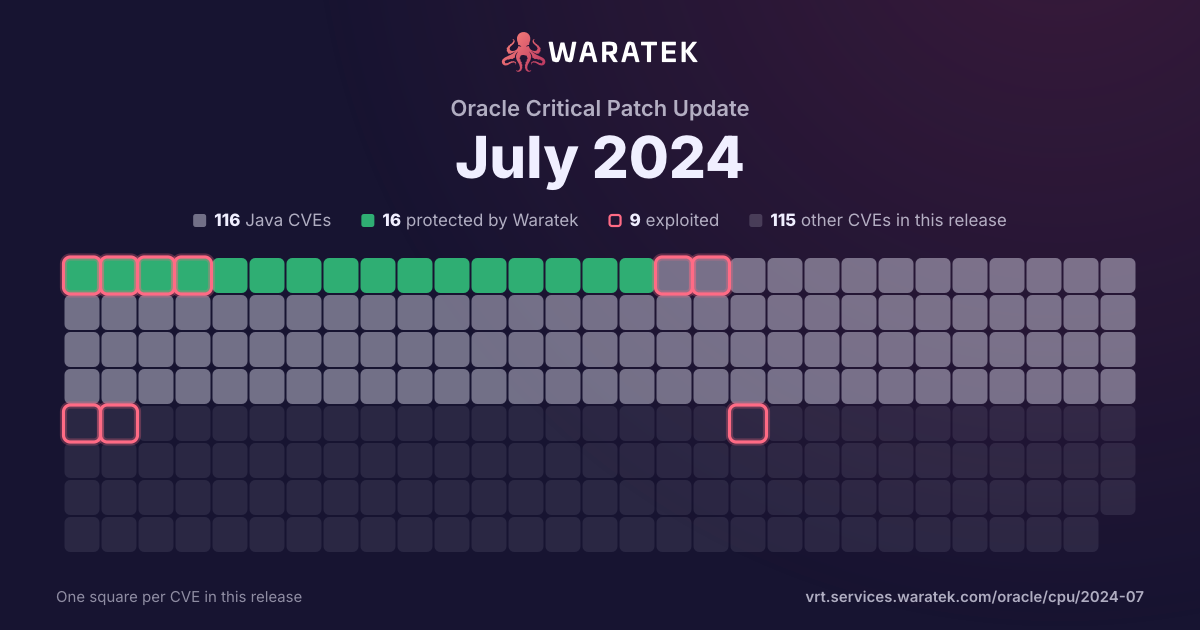
By status
15Protected by Waratek6Mitigation candidate100No exploit published6Outside Waratek scope104Not applicable
9Exploited, marked by the ring
No exploit published. For 25 of them, Oracle's security advisory is the source of public detail.
Protected by Waratek. Waratek RASP can block exploitation of these on systems that have not applied the patch yet.
Overview 15 matches · 0 protected · 0 exploited · 0 CISA KEV · 0 public PoC · 0 EPSS ≥ 0.5
15matches
0protected0.0%
0exploited0.0%
0CISA KEV0.0%
0public PoC0.0%
0EPSS ≥ 0.50.0%
Protected by Waratek
0
0.0%
Rule in development
0
0.0%
Mitigation candidate
0
0.0%
No exploit published
15
100.0%
blocked by ARMR today
0
0.0%
partly blocked
0
0.0%
not blocked
15
100.0%
not established
0
0.0%
unrecorded
0
0.0%
Exploited
0
0.0%
Working exploit published
0
0.0%
Proof of concept only
0
0.0%
Forecast only
0
0.0%
No public exploit
15
100.0%
| CVE | Severity | Published▾ | Status | Exploitation | Description |
|---|---|---|---|---|---|
| CVE-2023-5685 | High | 2024-03-22 | No exploit published | No public exploit | A flaw was found in XNIO. The XNIO NotifierState that can cause a Stack Overflow Exception when the chain of notifier states becomes problematically large can lead to uncontrolled resource management and a possible denial of service (DoS). |
| CVE-2024-29133 | Medium | 2024-03-21 | No exploit published | No public exploit | Out-of-bounds Write vulnerability in Apache Commons Configuration.This issue affects Apache Commons Configuration: from 2.0 before 2.10.1. Users are recommended to upgrade to version 2.10.1, which fixes the issue. |
| CVE-2024-29131 | High | 2024-03-21 | No exploit published | No public exploit | Out-of-bounds Write vulnerability in Apache Commons Configuration.This issue affects Apache Commons Configuration: from 2.0 before 2.10.1. Users are recommended to upgrade to version 2.10.1, which fixes the issue. |
| CVE-2024-22257 | High | 2024-03-18 | No exploit published | No public exploit | In Spring Security, versions 5.7.x prior to 5.7.12, 5.8.x prior to 5.8.11, versions 6.0.x prior to 6.0.9, versions 6.1.x prior to 6.1.8, versions 6.2.x prior to 6.2.3, an application is possible vulnerable to broken access control when it directly uses the AuthenticatedVoter#vote passing a null Authentication parameter. |
| CVE-2024-22259 | High | 2024-03-16 | No exploit published | No public exploit | Applications that use UriComponentsBuilder in Spring Framework to parse an externally provided URL (e.g. through a query parameter) AND perform validation checks on the host of the parsed URL may be vulnerable to a open redirect https://cwe.mitre.org/data/definitions/601.html attack or to a SSRF attack if the URL is used after passing validation checks. This is the same as CVE-2024-22243 https://spring.io/security/cve-2024-22243 , but with different input. |
| CVE-2024-28752 | Critical | 2024-03-15 | No exploit published | No public exploit | A SSRF vulnerability using the Aegis DataBinding in versions of Apache CXF before 4.0.4, 3.6.3 and 3.5.8 allows an attacker to perform SSRF style attacks on webservices that take at least one parameter of any type. Users of other data bindings (including the default databinding) are not impacted. |
| CVE-2024-23944 | Medium | 2024-03-15 | No exploit published | No public exploit | Information disclosure in persistent watchers handling in Apache ZooKeeper due to missing ACL check. It allows an attacker to monitor child znodes by attaching a persistent watcher (addWatch command) to a parent which the attacker has already access to. ZooKeeper server doesn't do ACL check when the persistent watcher is triggered and as a consequence, the full path of znodes that a watch event gets triggered upon is exposed to the owner of the watcher. It's important to note that only the path is exposed by this vulnerability, not the data of znode, but since znode path can contain sensitive information like user name or login ID, this issue is potentially critical. Users are recommended to upgrade to version 3.9.2, 3.8.4 which fixes the issue. |
| CVE-2024-23672 | Medium | 2024-03-13 | No exploit published | No public exploit | Denial of Service via incomplete cleanup vulnerability in Apache Tomcat. It was possible for WebSocket clients to keep WebSocket connections open leading to increased resource consumption.This issue affects Apache Tomcat: from 11.0.0-M1 through 11.0.0-M16, from 10.1.0-M1 through 10.1.18, from 9.0.0-M1 through 9.0.85, from 8.5.0 through 8.5.98. Older, EOL versions may also be affected. Users are recommended to upgrade to version 11.0.0-M17, 10.1.19, 9.0.86 or 8.5.99 which fix the issue. |
| CVE-2024-21742 | Medium | 2024-02-27 | No exploit published | No public exploit | Improper input validation allows for header injection in MIME4J library when using MIME4J DOM for composing message. This can be exploited by an attacker to add unintended headers to MIME messages. |
| CVE-2024-22234 | High | 2024-02-20 | No exploit published | No public exploit | In Spring Security, versions 6.1.x prior to 6.1.7 and versions 6.2.x prior to 6.2.2, an application is vulnerable to broken access control when it directly uses the AuthenticationTrustResolver.isFullyAuthenticated(Authentication) method. Specifically, an application is vulnerable if: * The application uses AuthenticationTrustResolver.isFullyAuthenticated(Authentication) directly and a null authentication parameter is passed to it resulting in an erroneous true return value. An application is not vulnerable if any of the following is true: * The application does not use AuthenticationTrustResolver.isFullyAuthenticated(Authentication) directly. * The application does not pass null to AuthenticationTrustResolver.isFullyAuthenticated * The application only uses isFullyAuthenticated via Method Security https://docs.spring.io/spring-security/reference/servlet/authorization/method-security.html or HTTP Request Security https://docs.spring.io/spring-security/reference/servlet/authorization/authorize-http-requests.html |
| CVE-2024-26308 | Medium | 2024-02-19 | No exploit published | No public exploit | Allocation of Resources Without Limits or Throttling vulnerability in Apache Commons Compress.This issue affects Apache Commons Compress: from 1.21 before 1.26. Users are recommended to upgrade to version 1.26, which fixes the issue. |
| CVE-2024-25710 | High | 2024-02-19 | No exploit published | No public exploit | Loop with Unreachable Exit Condition ('Infinite Loop') vulnerability in Apache Commons Compress.This issue affects Apache Commons Compress: from 1.3 through 1.25.0. Users are recommended to upgrade to version 1.26.0 which fixes the issue. |
| CVE-2023-52428 | High | 2024-02-11 | No exploit published | No public exploit | In Connect2id Nimbus JOSE+JWT before 9.37.2, an attacker can cause a denial of service (resource consumption) via a large JWE p2c header value (aka iteration count) for the PasswordBasedDecrypter (PBKDF2) component. |
| CVE-2024-23635 | Medium | 2024-02-02 | No exploit published | No public exploit | AntiSamy is a library for performing fast, configurable cleansing of HTML coming from untrusted sources. Prior to 1.7.5, there is a potential for a mutation XSS (mXSS) vulnerability in AntiSamy caused by flawed parsing of the HTML being sanitized. To be subject to this vulnerability the `preserveComments` directive must be enabled in your policy file. As a result, certain crafty inputs can result in elements in comment tags being interpreted as executable when using AntiSamy's sanitized output. Patched in AntiSamy 1.7.5 and later. |
| CVE-2024-23898 | High | 2024-01-24 | No exploit published | No public exploit | Jenkins 2.217 through 2.441 (both inclusive), LTS 2.222.1 through 2.426.2 (both inclusive) does not perform origin validation of requests made through the CLI WebSocket endpoint, resulting in a cross-site WebSocket hijacking (CSWSH) vulnerability, allowing attackers to execute CLI commands on the Jenkins controller. |