
Oracle Critical Patch Update July 2024
Released July 2024 · Oracle's advisory ↗ · ← Critical Patch Update, April 2024 · Critical Patch Update, October 2024 →
231 CVEs in this release, one square each
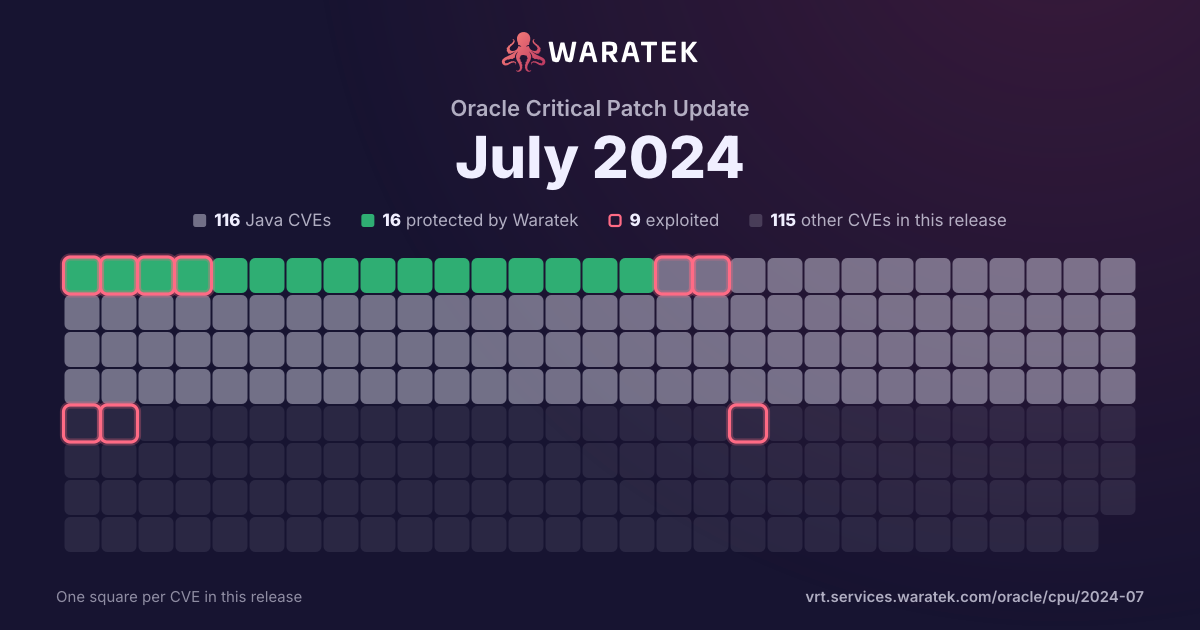
By status
16Protected by Waratek4Mitigation candidate96No exploit published18Outside Waratek scope97Not applicable
9Exploited, marked by the ring
No exploit published. For 35 of them, Oracle's security advisory is the source of public detail.
Protected by Waratek. Waratek RASP can block exploitation of these on systems that have not applied the patch yet.
Overview 37 matches · 16 in Waratek scope · 4 protected · 0 exploited · 0 CISA KEV · 12 public PoC · 5 EPSS ≥ 0.5
37matches
16in Waratek scope43.2%
4protected10.8%
0exploited0.0%
0CISA KEV0.0%
12public PoC32.4%
5EPSS ≥ 0.513.5%
Protected by Waratek
4
10.8%
Rule in development
0
0.0%
Mitigation candidate
2
5.4%
No exploit published
10
27.0%
Outside Waratek scope
5
13.5%
Not applicable
16
43.2%
Withdrawn CVE
0
0.0%
blocked by ARMR today
4
10.8%
partly blocked
0
0.0%
not blocked
33
89.2%
not established
0
0.0%
unrecorded
0
0.0%
Exploited
0
0.0%
Working exploit published
0
0.0%
Proof of concept only
37
100.0%
Forecast only
0
0.0%
No public exploit
0
0.0%
split by
peak 8 / quarter
Q4 211
Outside Waratek scope1
Medium1
not blocked1
Proof of concept only1
Q1 221
Protected by Waratek1
Critical1
blocked by ARMR today1
Proof of concept only1
Q2 221
Outside Waratek scope1
Critical1
not blocked1
Proof of concept only1
Q3 228
Protected by Waratek3
Mitigation candidate1
No exploit published1
Outside Waratek scope2
Not applicable1
Critical3
High3
Medium2
blocked by ARMR today3
not blocked5
Proof of concept only8
Q4 224
No exploit published3
Not applicable1
High3
Medium1
not blocked4
Proof of concept only4
Q1 233
No exploit published2
Not applicable1
High2
Medium1
not blocked3
Proof of concept only3
Q2 230
Q3 230
Q4 237
No exploit published1
Not applicable6
High3
Medium4
not blocked7
Proof of concept only7
Q1 248
Mitigation candidate1
No exploit published3
Not applicable4
High3
Medium5
not blocked8
Proof of concept only8
Q2 244
Outside Waratek scope1
Not applicable3
High4
not blocked4
Proof of concept only4
Q4 21Q1 22Q2 22Q3 22Q4 22Q1 23Q2 23Q3 23Q4 23Q1 24Q2 24
| CVE | Severity | Published▾ | Status | Exploitation | Description |
|---|---|---|---|---|---|
| CVE-2024-34459 | High | 2024-05-14 | Not applicable | Proof of concept only | An issue was discovered in xmllint (from libxml2) before 2.11.8 and 2.12.x before 2.12.7. Formatting error messages with xmllint --htmlout can result in a buffer over-read in xmlHTMLPrintFileContext in xmllint.c. |
| CVE-2024-27983 | High | 2024-04-09 | Not applicable | Proof of concept only | An attacker can make the Node.js HTTP/2 server completely unavailable by sending a small amount of HTTP/2 frames packets with a few HTTP/2 frames inside. It is possible to leave some data in nghttp2 memory after reset when headers with HTTP/2 CONTINUATION frame are sent to the server and then a TCP connection is abruptly closed by the client triggering the Http2Session destructor while header frames are still being processed (and stored in memory) causing a race condition. |
| CVE-2024-27316 | High | 2024-04-04 | Not applicable | Proof of concept only | HTTP/2 incoming headers exceeding the limit are temporarily buffered in nghttp2 in order to generate an informative HTTP 413 response. If a client does not stop sending headers, this leads to memory exhaustion. |
| CVE-2023-38709 | High | 2024-04-04 | Outside Waratek scope | Proof of concept only | Faulty input validation in the core of Apache allows malicious or exploitable backend/content generators to split HTTP responses. This issue affects Apache HTTP Server: through 2.4.58. |
| CVE-2024-29025 | Medium | 2024-03-25 | No exploit published | Proof of concept only | Netty is an asynchronous event-driven network application framework for rapid development of maintainable high performance protocol servers & clients. The `HttpPostRequestDecoder` can be tricked to accumulate data. While the decoder can store items on the disk if configured so, there are no limits to the number of fields the form can have, an attacher can send a chunked post consisting of many small fields that will be accumulated in the `bodyListHttpData` list. The decoder cumulates bytes in the `undecodedChunk` buffer until it can decode a field, this field can cumulate data without limits. This vulnerability is fixed in 4.1.108.Final. |
| CVE-2024-0450 | Medium | 2024-03-19 | Not applicable | Proof of concept only | An issue was found in the CPython `zipfile` module affecting versions 3.12.1, 3.11.7, 3.10.13, 3.9.18, and 3.8.18 and prior. The zipfile module is vulnerable to “quoted-overlap” zip-bombs which exploit the zip format to create a zip-bomb with a high compression ratio. The fixed versions of CPython makes the zipfile module reject zip archives which overlap entries in the archive. |
| CVE-2024-28849 | Medium | 2024-03-14 | Not applicable | Proof of concept only | follow-redirects is an open source, drop-in replacement for Node's `http` and `https` modules that automatically follows redirects. In affected versions follow-redirects only clears authorization header during cross-domain redirect, but keep the proxy-authentication header which contains credentials too. This vulnerability may lead to credentials leak, but has been addressed in version 1.15.6. Users are advised to upgrade. There are no known workarounds for this vulnerability. |
| CVE-2024-24549 | High | 2024-03-13 | Mitigation candidate | Proof of concept only | Denial of Service due to improper input validation vulnerability for HTTP/2 requests in Apache Tomcat. When processing an HTTP/2 request, if the request exceeded any of the configured limits for headers, the associated HTTP/2 stream was not reset until after all of the headers had been processed.This issue affects Apache Tomcat: from 11.0.0-M1 through 11.0.0-M16, from 10.1.0-M1 through 10.1.18, from 9.0.0-M1 through 9.0.85, from 8.5.0 through 8.5.98. Other, older, EOL versions may also be affected. Users are recommended to upgrade to version 11.0.0-M17, 10.1.19, 9.0.86 or 8.5.99 which fix the issue. |
| CVE-2023-51775 | Medium | 2024-02-29 | No exploit published | Proof of concept only | The jose4j component before 0.9.4 for Java allows attackers to cause a denial of service (CPU consumption) via a large p2c (aka PBES2 Count) value. |
| CVE-2024-22201 | High | 2024-02-26 | No exploit published | Proof of concept only | Jetty is a Java based web server and servlet engine. An HTTP/2 SSL connection that is established and TCP congested will be leaked when it times out. An attacker can cause many connections to end up in this state, and the server may run out of file descriptors, eventually causing the server to stop accepting new connections from valid clients. The vulnerability is patched in 9.4.54, 10.0.20, 11.0.20, and 12.0.6. |
| CVE-2024-22243 | High | 2024-02-23 | Not applicable | Proof of concept only | Applications that use UriComponentsBuilder to parse an externally provided URL (e.g. through a query parameter) AND perform validation checks on the host of the parsed URL may be vulnerable to a open redirect https://cwe.mitre.org/data/definitions/601.html attack or to a SSRF attack if the URL is used after passing validation checks. |
| CVE-2024-0853 | Medium | 2024-02-03 | Not applicable | Proof of concept only | curl inadvertently kept the SSL session ID for connections in its cache even when the verify status (*OCSP stapling*) test failed. A subsequent transfer to the same hostname could then succeed if the session ID cache was still fresh, which then skipped the verify status check. |
| CVE-2023-46750 | Medium | 2023-12-14 | No exploit published | Proof of concept only | URL Redirection to Untrusted Site ('Open Redirect') vulnerability when "form" authentication is used in Apache Shiro. Mitigation: Update to Apache Shiro 1.13.0+ or 2.0.0-alpha-4+. |
| CVE-2023-46219 | Medium | 2023-12-12 | Not applicable | Proof of concept only | When saving HSTS data to an excessively long file name, curl could end up removing all contents, making subsequent requests using that file unaware of the HSTS status they should otherwise use. |
| CVE-2023-46218 | Medium | 2023-12-07 | Not applicable | Proof of concept only | This flaw allows a malicious HTTP server to set "super cookies" in curl that are then passed back to more origins than what is otherwise allowed or possible. This allows a site to set cookies that then would get sent to different and unrelated sites and domains. It could do this by exploiting a mixed case flaw in curl's function that verifies a given cookie domain against the Public Suffix List (PSL). For example a cookie could be set with `domain=co.UK` when the URL used a lower case hostname `curl.co.uk`, even though `co.uk` is listed as a PSL domain. |
| CVE-2023-49081 | High | 2023-11-30 | Not applicable | Proof of concept only | aiohttp is an asynchronous HTTP client/server framework for asyncio and Python. Improper validation made it possible for an attacker to modify the HTTP request (e.g. to insert a new header) or create a new HTTP request if the attacker controls the HTTP version. The vulnerability only occurs if the attacker can control the HTTP version of the request. This issue has been patched in version 3.9.0. |
| CVE-2023-49083 | High | 2023-11-29 | Not applicable | Proof of concept only | cryptography is a package designed to expose cryptographic primitives and recipes to Python developers. Calling `load_pem_pkcs7_certificates` or `load_der_pkcs7_certificates` could lead to a NULL-pointer dereference and segfault. Exploitation of this vulnerability poses a serious risk of Denial of Service (DoS) for any application attempting to deserialize a PKCS7 blob/certificate. The consequences extend to potential disruptions in system availability and stability. This vulnerability has been patched in version 41.0.6. |
| CVE-2023-49082 | Medium | 2023-11-29 | Not applicable | Proof of concept only | aiohttp is an asynchronous HTTP client/server framework for asyncio and Python. Improper validation makes it possible for an attacker to modify the HTTP request (e.g. insert a new header) or even create a new HTTP request if the attacker controls the HTTP method. The vulnerability occurs only if the attacker can control the HTTP method (GET, POST etc.) of the request. If the attacker can control the HTTP version of the request it will be able to modify the request (request smuggling). This issue has been patched in version 3.9.0. |
| CVE-2023-47627 | High | 2023-11-14 | Not applicable | Proof of concept only | aiohttp is an asynchronous HTTP client/server framework for asyncio and Python. The HTTP parser in AIOHTTP has numerous problems with header parsing, which could lead to request smuggling. This parser is only used when AIOHTTP_NO_EXTENSIONS is enabled (or not using a prebuilt wheel). These bugs have been addressed in commit `d5c12ba89` which has been included in release version 3.8.6. Users are advised to upgrade. There are no known workarounds for these issues. |
| CVE-2023-21036 | Medium | 2023-03-24 | Not applicable | Proof of concept only | In BitmapExport.java, there is a possible failure to truncate images due to a logic error in the code.Product: AndroidVersions: Android kernelAndroid ID: A-264261868References: N/A |
| CVE-2023-1436 | High | 2023-03-22 | No exploit published | Proof of concept only | An infinite recursion is triggered in Jettison when constructing a JSONArray from a Collection that contains a self-reference in one of its elements. This leads to a StackOverflowError exception being thrown. |
| CVE-2023-1370 | High | 2023-03-22 | No exploit published | Proof of concept only | [Json-smart](https://netplex.github.io/json-smart/) is a performance focused, JSON processor lib. When reaching a ‘[‘ or ‘{‘ character in the JSON input, the code parses an array or an object respectively. It was discovered that the code does not have any limit to the nesting of such arrays or objects. Since the parsing of nested arrays and objects is done recursively, nesting too many of them can cause a stack exhaustion (stack overflow) and crash the software. |
| CVE-2022-45693 | High | 2022-12-13 | No exploit published | Proof of concept only | Jettison before v1.5.2 was discovered to contain a stack overflow via the map parameter. This vulnerability allows attackers to cause a Denial of Service (DoS) via a crafted string. |
| CVE-2022-41915 | Medium | 2022-12-13 | No exploit published | Proof of concept only | Netty project is an event-driven asynchronous network application framework. Starting in version 4.1.83.Final and prior to 4.1.86.Final, when calling `DefaultHttpHeadesr.set` with an _iterator_ of values, header value validation was not performed, allowing malicious header values in the iterator to perform HTTP Response Splitting. This issue has been patched in version 4.1.86.Final. Integrators can work around the issue by changing the `DefaultHttpHeaders.set(CharSequence, Iterator<?>)` call, into a `remove()` call, and call `add()` in a loop over the iterator of values. |
| CVE-2022-41881 | High | 2022-12-12 | No exploit published | Proof of concept only | Netty project is an event-driven asynchronous network application framework. In versions prior to 4.1.86.Final, a StackOverflowError can be raised when parsing a malformed crafted message due to an infinite recursion. This issue is patched in version 4.1.86.Final. There is no workaround, except using a custom HaProxyMessageDecoder. |
| CVE-2022-3786 | High | 2022-11-01 | Not applicable | Proof of concept only | A buffer overrun can be triggered in X.509 certificate verification, specifically in name constraint checking. Note that this occurs after certificate chain signature verification and requires either a CA to have signed a malicious certificate or for an application to continue certificate verification despite failure to construct a path to a trusted issuer. An attacker can craft a malicious email address in a certificate to overflow an arbitrary number of bytes containing the `.' character (decimal 46) on the stack. This buffer overflow could result in a crash (causing a denial of service). In a TLS client, this can be triggered by connecting to a malicious server. In a TLS server, this can be triggered if the server requests client authentication and a malicious client connects. |
| CVE-2022-21797 | Critical | 2022-09-26 | Not applicable | Proof of concept only | The package joblib from 0 and before 1.2.0 are vulnerable to Arbitrary Code Execution via the pre_dispatch flag in Parallel() class due to the eval() statement. |
| CVE-2022-36944 | Critical | 2022-09-23 | Protected by Waratek | Proof of concept only | Scala 2.13.x before 2.13.9 has a Java deserialization chain in its JAR file. On its own, it cannot be exploited. There is only a risk in conjunction with Java object deserialization within an application. In such situations, it allows attackers to erase contents of arbitrary files, make network connections, or possibly run arbitrary code (specifically, Function0 functions) via a gadget chain. |
| CVE-2022-40146 | High | 2022-09-22 | Mitigation candidate | Proof of concept only | Server-Side Request Forgery (SSRF) vulnerability in Batik of Apache XML Graphics allows an attacker to access files using a Jar url. This issue affects Apache XML Graphics Batik 1.14. |
| CVE-2022-40152 | High | 2022-09-16 | No exploit published | Proof of concept only | Those using Woodstox to parse XML data may be vulnerable to Denial of Service attacks (DOS) if DTD support is enabled. If the parser is running on user supplied input, an attacker may supply content that causes the parser to crash by stackoverflow. This effect may support a denial of service attack. |
| CVE-2022-36033 | Medium | 2022-08-29 | Protected by Waratek | Proof of concept only | jsoup is a Java HTML parser, built for HTML editing, cleaning, scraping, and cross-site scripting (XSS) safety. jsoup may incorrectly sanitize HTML including `javascript:` URL expressions, which could allow XSS attacks when a reader subsequently clicks that link. If the non-default `SafeList.preserveRelativeLinks` option is enabled, HTML including `javascript:` URLs that have been crafted with control characters will not be sanitized. If the site that this HTML is published on does not set a Content Security Policy, an XSS attack is then possible. This issue is patched in jsoup 1.15.3. Users should upgrade to this version. Additionally, as the unsanitized input may have been persisted, old content should be cleaned again using the updated version. To remediate this issue without immediately upgrading: - disable `SafeList.preserveRelativeLinks`, which will rewrite input URLs as absolute URLs - ensure an appropriate [Content Security Policy](https://developer.mozilla.org/en-US/docs/Web/HTTP/CSP) is defined. (This should be used regardless of upgrading, as a defence-in-depth best practice.) |
| CVE-2022-37434 | Critical | 2022-08-05 | Outside Waratek scope | Proof of concept only | zlib through 1.2.12 has a heap-based buffer over-read or buffer overflow in inflate in inflate.c via a large gzip header extra field. NOTE: only applications that call inflateGetHeader are affected. Some common applications bundle the affected zlib source code but may be unable to call inflateGetHeader (e.g., see the nodejs/node reference). |
| CVE-2022-31160 | Medium | 2022-07-20 | Outside Waratek scope | Proof of concept only | jQuery UI is a curated set of user interface interactions, effects, widgets, and themes built on top of jQuery. Versions prior to 1.13.2 are potentially vulnerable to cross-site scripting. Initializing a checkboxradio widget on an input enclosed within a label makes that parent label contents considered as the input label. Calling `.checkboxradio( "refresh" )` on such a widget and the initial HTML contained encoded HTML entities will make them erroneously get decoded. This can lead to potentially executing JavaScript code. The bug has been patched in jQuery UI 1.13.2. To remediate the issue, someone who can change the initial HTML can wrap all the non-input contents of the `label` in a `span`. |
| CVE-2022-34169 | High | 2022-07-19 | Protected by Waratek | Proof of concept only | The Apache Xalan Java XSLT library is vulnerable to an integer truncation issue when processing malicious XSLT stylesheets. This can be used to corrupt Java class files generated by the internal XSLTC compiler and execute arbitrary Java bytecode. Users are recommended to update to version 2.7.3 or later. Note: Java runtimes (such as OpenJDK) include repackaged copies of Xalan. |
| CVE-2022-1292 | Critical | 2022-05-03 | Outside Waratek scope | Proof of concept only | The c_rehash script does not properly sanitise shell metacharacters to prevent command injection. This script is distributed by some operating systems in a manner where it is automatically executed. On such operating systems, an attacker could execute arbitrary commands with the privileges of the script. Use of the c_rehash script is considered obsolete and should be replaced by the OpenSSL rehash command line tool. Fixed in OpenSSL 3.0.3 (Affected 3.0.0,3.0.1,3.0.2). Fixed in OpenSSL 1.1.1o (Affected 1.1.1-1.1.1n). Fixed in OpenSSL 1.0.2ze (Affected 1.0.2-1.0.2zd). |
| CVE-2022-0239 | Critical | 2022-01-17 | Protected by Waratek | Proof of concept only | corenlp is vulnerable to Improper Restriction of XML External Entity Reference |
| CVE-2021-41184 | Medium | 2021-10-26 | Outside Waratek scope | Proof of concept only | jQuery-UI is the official jQuery user interface library. Prior to version 1.13.0, accepting the value of the `of` option of the `.position()` util from untrusted sources may execute untrusted code. The issue is fixed in jQuery UI 1.13.0. Any string value passed to the `of` option is now treated as a CSS selector. A workaround is to not accept the value of the `of` option from untrusted sources. |