
Oracle Critical Patch Update July 2024
Released July 2024 · Oracle's advisory ↗ · ← Critical Patch Update, April 2024 · Critical Patch Update, October 2024 →
231 CVEs in this release, one square each
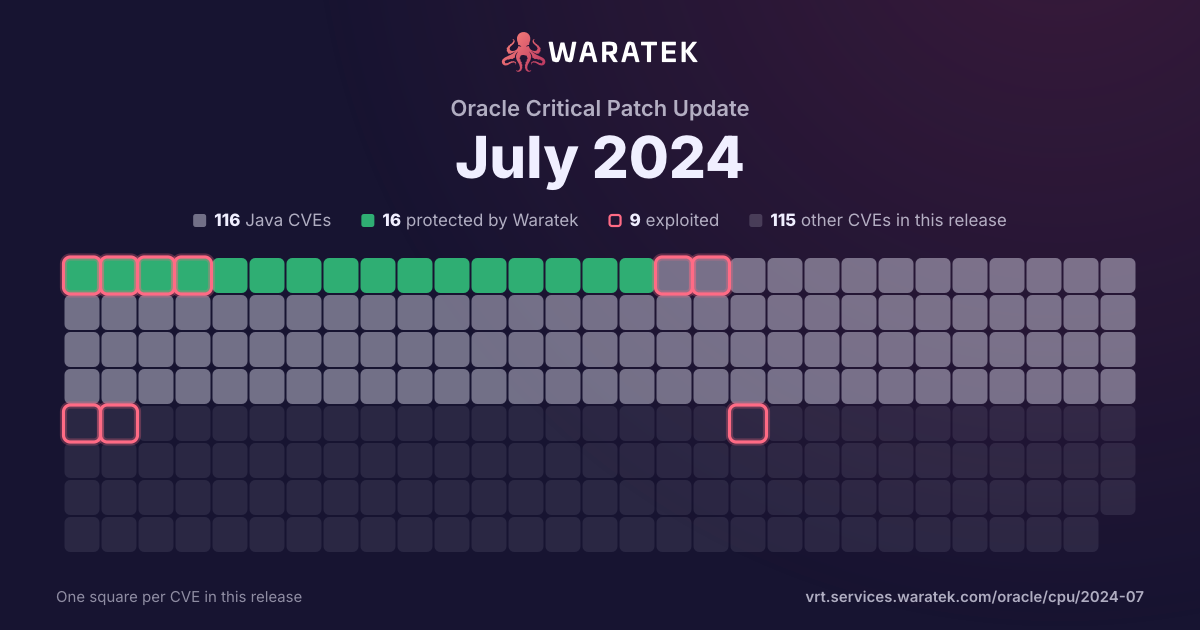
By status
16Protected by Waratek6Mitigation candidate99No exploit published6Outside Waratek scope104Not applicable
9Exploited, marked by the ring
No exploit published. For 34 of them, Oracle's security advisory is the source of public detail.
Protected by Waratek. Waratek RASP can block exploitation of these on systems that have not applied the patch yet.
Overview 22 matches · 8 in Waratek scope · 0 protected · 0 exploited · 0 CISA KEV · 6 public PoC · 2 EPSS ≥ 0.5
22matches
8in Waratek scope36.4%
0protected0.0%
0exploited0.0%
0CISA KEV0.0%
6public PoC27.3%
2EPSS ≥ 0.59.1%
Protected by Waratek
0
0.0%
Rule in development
0
0.0%
Mitigation candidate
2
9.1%
No exploit published
6
27.3%
Outside Waratek scope
0
0.0%
Not applicable
14
63.6%
Withdrawn CVE
0
0.0%
blocked by ARMR today
0
0.0%
partly blocked
0
0.0%
not blocked
22
100.0%
not established
0
0.0%
unrecorded
0
0.0%
Exploited
0
0.0%
Working exploit published
0
0.0%
Proof of concept only
22
100.0%
Forecast only
0
0.0%
No public exploit
0
0.0%
split by
peak 4 / month
Mar 233
No exploit published2
Not applicable1
High2
Medium1
not blocked3
Proof of concept only3
Apr 230
May 230
Jun 230
Jul 230
Aug 230
Sep 230
Oct 230
Nov 234
Not applicable4
High3
Medium1
not blocked4
Proof of concept only4
Dec 233
No exploit published1
Not applicable2
Medium3
not blocked3
Proof of concept only3
Jan 240
Feb 244
Mitigation candidate1
No exploit published2
Not applicable1
High2
Medium2
not blocked4
Proof of concept only4
Mar 244
Mitigation candidate1
No exploit published1
Not applicable2
High1
Medium3
not blocked4
Proof of concept only4
Apr 243
Not applicable3
High3
not blocked3
Proof of concept only3
May 241
Not applicable1
High1
not blocked1
Proof of concept only1
Mar 23May 23Jul 23Sep 23Nov 23Jan 24Mar 24May 24
| CVE | Severity | Published▾ | Status | Exploitation | Description |
|---|---|---|---|---|---|
| CVE-2024-34459 | High | 2024-05-14 | Not applicable | Proof of concept only | An issue was discovered in xmllint (from libxml2) before 2.11.8 and 2.12.x before 2.12.7. Formatting error messages with xmllint --htmlout can result in a buffer over-read in xmlHTMLPrintFileContext in xmllint.c. |
| CVE-2024-27983 | High | 2024-04-09 | Not applicable | Proof of concept only | An attacker can make the Node.js HTTP/2 server completely unavailable by sending a small amount of HTTP/2 frames packets with a few HTTP/2 frames inside. It is possible to leave some data in nghttp2 memory after reset when headers with HTTP/2 CONTINUATION frame are sent to the server and then a TCP connection is abruptly closed by the client triggering the Http2Session destructor while header frames are still being processed (and stored in memory) causing a race condition. |
| CVE-2024-27316 | High | 2024-04-04 | Not applicable | Proof of concept only | HTTP/2 incoming headers exceeding the limit are temporarily buffered in nghttp2 in order to generate an informative HTTP 413 response. If a client does not stop sending headers, this leads to memory exhaustion. |
| CVE-2023-38709 | High | 2024-04-04 | Not applicable | Proof of concept only | Faulty input validation in the core of Apache allows malicious or exploitable backend/content generators to split HTTP responses. This issue affects Apache HTTP Server: through 2.4.58. |
| CVE-2024-29025 | Medium | 2024-03-25 | No exploit published | Proof of concept only | Netty is an asynchronous event-driven network application framework for rapid development of maintainable high performance protocol servers & clients. The `HttpPostRequestDecoder` can be tricked to accumulate data. While the decoder can store items on the disk if configured so, there are no limits to the number of fields the form can have, an attacher can send a chunked post consisting of many small fields that will be accumulated in the `bodyListHttpData` list. The decoder cumulates bytes in the `undecodedChunk` buffer until it can decode a field, this field can cumulate data without limits. This vulnerability is fixed in 4.1.108.Final. |
| CVE-2024-0450 | Medium | 2024-03-19 | Not applicable | Proof of concept only | An issue was found in the CPython `zipfile` module affecting versions 3.12.1, 3.11.7, 3.10.13, 3.9.18, and 3.8.18 and prior. The zipfile module is vulnerable to “quoted-overlap” zip-bombs which exploit the zip format to create a zip-bomb with a high compression ratio. The fixed versions of CPython makes the zipfile module reject zip archives which overlap entries in the archive. |
| CVE-2024-28849 | Medium | 2024-03-14 | Not applicable | Proof of concept only | follow-redirects is an open source, drop-in replacement for Node's `http` and `https` modules that automatically follows redirects. In affected versions follow-redirects only clears authorization header during cross-domain redirect, but keep the proxy-authentication header which contains credentials too. This vulnerability may lead to credentials leak, but has been addressed in version 1.15.6. Users are advised to upgrade. There are no known workarounds for this vulnerability. |
| CVE-2024-24549 | High | 2024-03-13 | Mitigation candidate | Proof of concept only | Denial of Service due to improper input validation vulnerability for HTTP/2 requests in Apache Tomcat. When processing an HTTP/2 request, if the request exceeded any of the configured limits for headers, the associated HTTP/2 stream was not reset until after all of the headers had been processed.This issue affects Apache Tomcat: from 11.0.0-M1 through 11.0.0-M16, from 10.1.0-M1 through 10.1.18, from 9.0.0-M1 through 9.0.85, from 8.5.0 through 8.5.98. Other, older, EOL versions may also be affected. Users are recommended to upgrade to version 11.0.0-M17, 10.1.19, 9.0.86 or 8.5.99 which fix the issue. |
| CVE-2023-51775 | Medium | 2024-02-29 | No exploit published | Proof of concept only | The jose4j component before 0.9.4 for Java allows attackers to cause a denial of service (CPU consumption) via a large p2c (aka PBES2 Count) value. |
| CVE-2024-22201 | High | 2024-02-26 | No exploit published | Proof of concept only | Jetty is a Java based web server and servlet engine. An HTTP/2 SSL connection that is established and TCP congested will be leaked when it times out. An attacker can cause many connections to end up in this state, and the server may run out of file descriptors, eventually causing the server to stop accepting new connections from valid clients. The vulnerability is patched in 9.4.54, 10.0.20, 11.0.20, and 12.0.6. |
| CVE-2024-22243 | High | 2024-02-23 | Mitigation candidate | Proof of concept only | Applications that use UriComponentsBuilder to parse an externally provided URL (e.g. through a query parameter) AND perform validation checks on the host of the parsed URL may be vulnerable to a open redirect https://cwe.mitre.org/data/definitions/601.html attack or to a SSRF attack if the URL is used after passing validation checks. |
| CVE-2024-0853 | Medium | 2024-02-03 | Not applicable | Proof of concept only | curl inadvertently kept the SSL session ID for connections in its cache even when the verify status (*OCSP stapling*) test failed. A subsequent transfer to the same hostname could then succeed if the session ID cache was still fresh, which then skipped the verify status check. |
| CVE-2023-46750 | Medium | 2023-12-14 | No exploit published | Proof of concept only | URL Redirection to Untrusted Site ('Open Redirect') vulnerability when "form" authentication is used in Apache Shiro. Mitigation: Update to Apache Shiro 1.13.0+ or 2.0.0-alpha-4+. |
| CVE-2023-46219 | Medium | 2023-12-12 | Not applicable | Proof of concept only | When saving HSTS data to an excessively long file name, curl could end up removing all contents, making subsequent requests using that file unaware of the HSTS status they should otherwise use. |
| CVE-2023-46218 | Medium | 2023-12-07 | Not applicable | Proof of concept only | This flaw allows a malicious HTTP server to set "super cookies" in curl that are then passed back to more origins than what is otherwise allowed or possible. This allows a site to set cookies that then would get sent to different and unrelated sites and domains. It could do this by exploiting a mixed case flaw in curl's function that verifies a given cookie domain against the Public Suffix List (PSL). For example a cookie could be set with `domain=co.UK` when the URL used a lower case hostname `curl.co.uk`, even though `co.uk` is listed as a PSL domain. |
| CVE-2023-49081 | High | 2023-11-30 | Not applicable | Proof of concept only | aiohttp is an asynchronous HTTP client/server framework for asyncio and Python. Improper validation made it possible for an attacker to modify the HTTP request (e.g. to insert a new header) or create a new HTTP request if the attacker controls the HTTP version. The vulnerability only occurs if the attacker can control the HTTP version of the request. This issue has been patched in version 3.9.0. |
| CVE-2023-49083 | High | 2023-11-29 | Not applicable | Proof of concept only | cryptography is a package designed to expose cryptographic primitives and recipes to Python developers. Calling `load_pem_pkcs7_certificates` or `load_der_pkcs7_certificates` could lead to a NULL-pointer dereference and segfault. Exploitation of this vulnerability poses a serious risk of Denial of Service (DoS) for any application attempting to deserialize a PKCS7 blob/certificate. The consequences extend to potential disruptions in system availability and stability. This vulnerability has been patched in version 41.0.6. |
| CVE-2023-49082 | Medium | 2023-11-29 | Not applicable | Proof of concept only | aiohttp is an asynchronous HTTP client/server framework for asyncio and Python. Improper validation makes it possible for an attacker to modify the HTTP request (e.g. insert a new header) or even create a new HTTP request if the attacker controls the HTTP method. The vulnerability occurs only if the attacker can control the HTTP method (GET, POST etc.) of the request. If the attacker can control the HTTP version of the request it will be able to modify the request (request smuggling). This issue has been patched in version 3.9.0. |
| CVE-2023-47627 | High | 2023-11-14 | Not applicable | Proof of concept only | aiohttp is an asynchronous HTTP client/server framework for asyncio and Python. The HTTP parser in AIOHTTP has numerous problems with header parsing, which could lead to request smuggling. This parser is only used when AIOHTTP_NO_EXTENSIONS is enabled (or not using a prebuilt wheel). These bugs have been addressed in commit `d5c12ba89` which has been included in release version 3.8.6. Users are advised to upgrade. There are no known workarounds for these issues. |
| CVE-2023-21036 | Medium | 2023-03-24 | Not applicable | Proof of concept only | In BitmapExport.java, there is a possible failure to truncate images due to a logic error in the code.Product: AndroidVersions: Android kernelAndroid ID: A-264261868References: N/A |
| CVE-2023-1436 | High | 2023-03-22 | No exploit published | Proof of concept only | An infinite recursion is triggered in Jettison when constructing a JSONArray from a Collection that contains a self-reference in one of its elements. This leads to a StackOverflowError exception being thrown. |
| CVE-2023-1370 | High | 2023-03-22 | No exploit published | Proof of concept only | [Json-smart](https://netplex.github.io/json-smart/) is a performance focused, JSON processor lib. When reaching a ‘[‘ or ‘{‘ character in the JSON input, the code parses an array or an object respectively. It was discovered that the code does not have any limit to the nesting of such arrays or objects. Since the parsing of nested arrays and objects is done recursively, nesting too many of them can cause a stack exhaustion (stack overflow) and crash the software. |