
Oracle Critical Patch Update July 2024
Released July 2024 · Oracle's advisory ↗ · ← Critical Patch Update, April 2024 · Critical Patch Update, October 2024 →
231 CVEs in this release, one square each
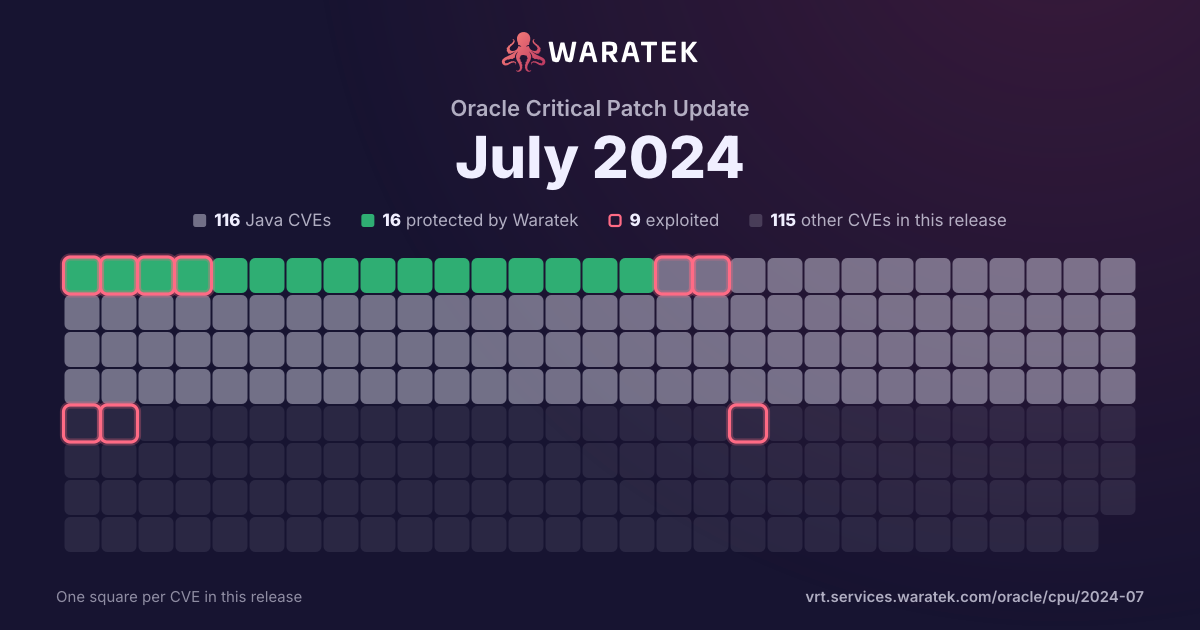
By status
16Protected by Waratek4Mitigation candidate96No exploit published18Outside Waratek scope97Not applicable
9Exploited, marked by the ring
No exploit published. For 35 of them, Oracle's security advisory is the source of public detail.
Protected by Waratek. Waratek RASP can block exploitation of these on systems that have not applied the patch yet.
Overview 2 matches · 0 protected · 1 CISA KEV · 1 EPSS ≥ 0.5
Protected by Waratek
0
0.0%
Rule in development
0
0.0%
Mitigation candidate
2
100.0%
No exploit published
0
0.0%
blocked by ARMR today
0
0.0%
partly blocked
0
0.0%
not blocked
2
100.0%
not established
0
0.0%
unrecorded
0
0.0%
Exploited
2
100.0%
Working exploit published
0
0.0%
Proof of concept only
0
0.0%
Forecast only
0
0.0%
No public exploit
0
0.0%
split by
peak 1 / month
Oct 23Nov 23Dec 23Jan 24Feb 24Mar 24Apr 24May 24
| CVE | Severity | Published▾ | Status | Exploitation | Description |
|---|---|---|---|---|---|
| CVE-2024-32114 | High | 2024-05-02 | Mitigation candidate | Exploited | In Apache ActiveMQ 6.x, the default configuration doesn't secure the API web context (where the Jolokia JMX REST API and the Message REST API are located). It means that anyone can use these layers without any required authentication. Potentially, anyone can interact with the broker (using Jolokia JMX REST API) and/or produce/consume messages or purge/delete destinations (using the Message REST API). To mitigate, users can update the default conf/jetty.xml configuration file to add authentication requirement: <bean id="securityConstraintMapping" class="org.eclipse.jetty.security.ConstraintMapping"> <property name="constraint" ref="securityConstraint" /> <property name="pathSpec" value="/" /> </bean> Or we encourage users to upgrade to Apache ActiveMQ 6.1.2 where the default configuration has been updated with authentication by default. |
| CVE-2023-44487 | High | 2023-10-10 | Mitigation candidate | Exploited | The HTTP/2 protocol allows a denial of service (server resource consumption) because request cancellation can reset many streams quickly, as exploited in the wild in August through October 2023. |