
Oracle Critical Patch Update July 2024
Released July 2024 · Oracle's advisory ↗ · ← Critical Patch Update, April 2024 · Critical Patch Update, October 2024 →
231 CVEs in this release, one square each
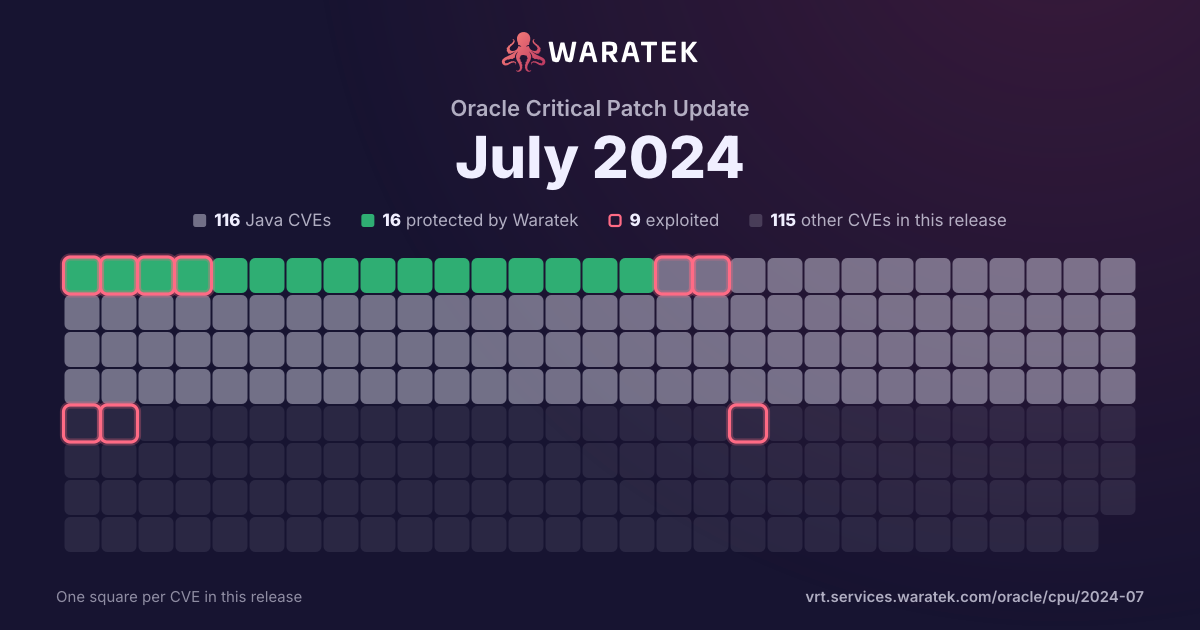
By status
15Protected by Waratek4Mitigation candidate98No exploit published6Outside Waratek scope108Not applicable
9Exploited, marked by the ring
No exploit published. For 25 of them, Oracle's security advisory is the source of public detail.
Protected by Waratek. Waratek RASP can block exploitation of these on systems that have not applied the patch yet.
Overview 5 matches · 2 protected · 1 exploited · 1 CISA KEV · 1 public PoC · 1 EPSS ≥ 0.5
Protected by Waratek
2
40.0%
Rule in development
0
0.0%
Mitigation candidate
0
0.0%
No exploit published
3
60.0%
blocked by ARMR today
2
40.0%
partly blocked
0
0.0%
not blocked
3
60.0%
not established
0
0.0%
unrecorded
0
0.0%
Exploited
1
20.0%
Working exploit published
0
0.0%
Proof of concept only
0
0.0%
Forecast only
0
0.0%
No public exploit
4
80.0%
split by
peak 1 / quarter
Q4 191
No exploit published1
Critical1
not blocked1
No public exploit1
Q1 200
Q2 200
Q3 200
Q4 200
Q1 211
Protected by Waratek1
Critical1
blocked by ARMR today1
No public exploit1
Q2 210
Q3 210
Q4 210
Q1 220
Q2 221
Protected by Waratek1
Critical1
blocked by ARMR today1
Exploited1
Q3 220
Q4 221
No exploit published1
Critical1
not blocked1
No public exploit1
Q1 230
Q2 230
Q3 231
No exploit published1
Critical1
not blocked1
No public exploit1
Q1 20Q3 20Q1 21Q3 21Q1 22Q3 22Q1 23Q3 23
| CVE | Severity | Published▾ | Status | Exploitation | Description |
|---|---|---|---|---|---|
| CVE-2023-34034 | Critical | 2023-07-19 | No exploit published | No public exploit | Using "**" as a pattern in Spring Security configuration for WebFlux creates a mismatch in pattern matching between Spring Security and Spring WebFlux, and the potential for a security bypass. |
| CVE-2022-45378 | Critical | 2022-11-14 | No exploit published | No public exploit | In the default configuration of Apache SOAP, an RPCRouterServlet is available without authentication. This gives an attacker the possibility to invoke methods on the classpath that meet certain criteria. Depending on what classes are available on the classpath this might even lead to arbitrary remote code execution. NOTE: This vulnerability only affects products that are no longer supported by the maintainer. |
| CVE-2022-22965 | Critical | 2022-04-01 | Protected by Waratek | Exploited | A Spring MVC or Spring WebFlux application running on JDK 9+ may be vulnerable to remote code execution (RCE) via data binding. The specific exploit requires the application to run on Tomcat as a WAR deployment. If the application is deployed as a Spring Boot executable jar, i.e. the default, it is not vulnerable to the exploit. However, the nature of the vulnerability is more general, and there may be other ways to exploit it. |
| CVE-2021-23926 | Critical | 2021-01-14 | Protected by Waratek | No public exploit | The XML parsers used by XMLBeans up to version 2.6.0 did not set the properties needed to protect the user from malicious XML input. Vulnerabilities include possibilities for XML Entity Expansion attacks. Affects XMLBeans up to and including v2.6.0. |
| CVE-2019-17267 | Critical | 2019-10-07 | No exploit published | No public exploit | A Polymorphic Typing issue was discovered in FasterXML jackson-databind before 2.9.10. It is related to net.sf.ehcache.hibernate.EhcacheJtaTransactionManagerLookup. |