
Oracle Critical Patch Update July 2024
Released July 2024 · Oracle's advisory ↗ · ← Critical Patch Update, April 2024 · Critical Patch Update, October 2024 →
231 CVEs in this release, one square each
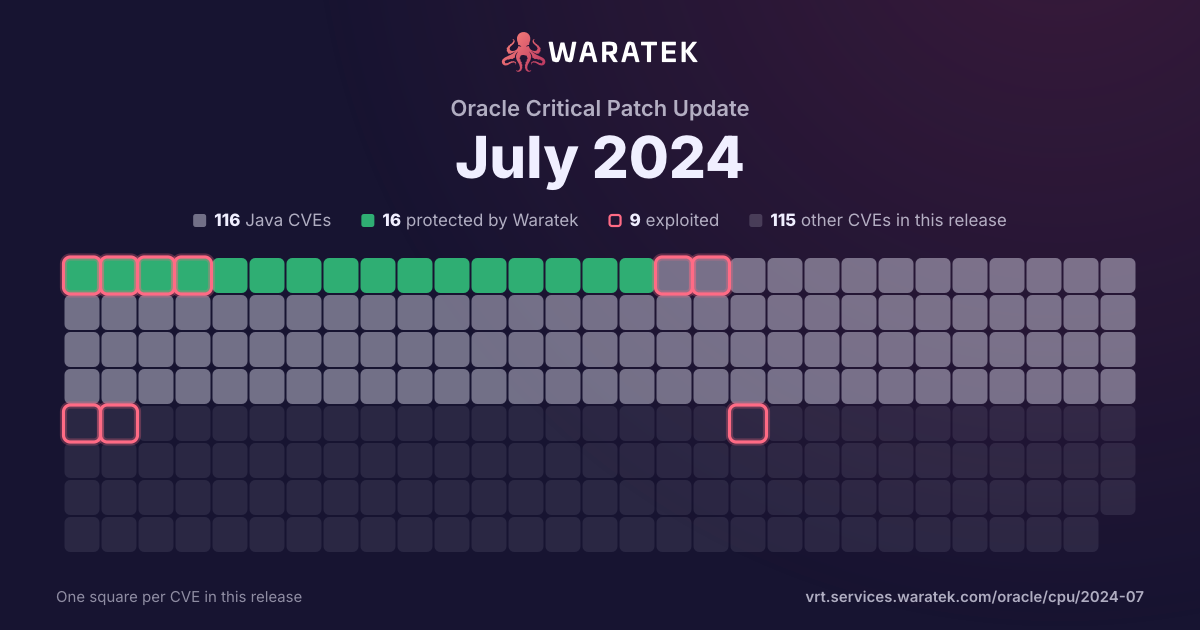
By status
15Protected by Waratek4Mitigation candidate98No exploit published6Outside Waratek scope108Not applicable
9Exploited, marked by the ring
No exploit published. For 25 of them, Oracle's security advisory is the source of public detail.
Protected by Waratek. Waratek RASP can block exploitation of these on systems that have not applied the patch yet.
Overview 5 matches · 1 protected · 0 exploited · 0 CISA KEV · 0 public PoC · 0 EPSS ≥ 0.5
Protected by Waratek
1
20.0%
Rule in development
0
0.0%
Mitigation candidate
0
0.0%
No exploit published
4
80.0%
blocked by ARMR today
1
20.0%
partly blocked
0
0.0%
not blocked
4
80.0%
not established
0
0.0%
unrecorded
0
0.0%
Exploited
0
0.0%
Working exploit published
0
0.0%
Proof of concept only
0
0.0%
Forecast only
0
0.0%
No public exploit
5
100.0%
split by
peak 4 / month
Apr 24May 24
| CVE | Severity | Published▾ | Status | Exploitation | Description |
|---|---|---|---|---|---|
| CVE-2024-30172 | High | 2024-05-14 | No exploit published | No public exploit | An issue was discovered in Bouncy Castle Java Cryptography APIs before 1.78. An Ed25519 verification code infinite loop can occur via a crafted signature and public key. |
| CVE-2024-30171 | Medium | 2024-05-14 | No exploit published | No public exploit | An issue was discovered in Bouncy Castle Java TLS API and JSSE Provider before 1.78. Timing-based leakage may occur in RSA based handshakes because of exception processing. |
| CVE-2024-29857 | High | 2024-05-14 | No exploit published | No public exploit | An issue was discovered in ECCurve.java and ECCurve.cs in Bouncy Castle Java (BC Java) before 1.78, BC Java LTS before 2.73.6, BC-FJA before 1.0.2.5, and BC C# .Net before 2.3.1. Importing an EC certificate with crafted F2m parameters can lead to excessive CPU consumption during the evaluation of the curve parameters. |
| CVE-2024-34447 | High | 2024-05-03 | No exploit published | No public exploit | An issue was discovered in the Bouncy Castle Crypto Package For Java before BC TLS Java 1.0.19 (ships with BC Java 1.78, BC Java (LTS) 2.73.6) and before BC FIPS TLS Java 1.0.19. When endpoint identification is enabled in the BCJSSE and an SSL socket is created without an explicit hostname (as happens with HttpsURLConnection), hostname verification could be performed against a DNS-resolved IP address in some situations, opening up a possibility of DNS poisoning. |
| CVE-2024-22262 | High | 2024-04-16 | Protected by Waratek | No public exploit | Applications that use UriComponentsBuilder to parse an externally provided URL (e.g. through a query parameter) AND perform validation checks on the host of the parsed URL may be vulnerable to a open redirect https://cwe.mitre.org/data/definitions/601.html attack or to a SSRF attack if the URL is used after passing validation checks. This is the same as CVE-2024-22259 https://spring.io/security/cve-2024-22259 and CVE-2024-22243 https://spring.io/security/cve-2024-22243 , but with different input. |