
Oracle Critical Patch Update July 2024
Released July 2024 · Oracle's advisory ↗ · ← Critical Patch Update, April 2024 · Critical Patch Update, October 2024 →
231 CVEs in this release, one square each
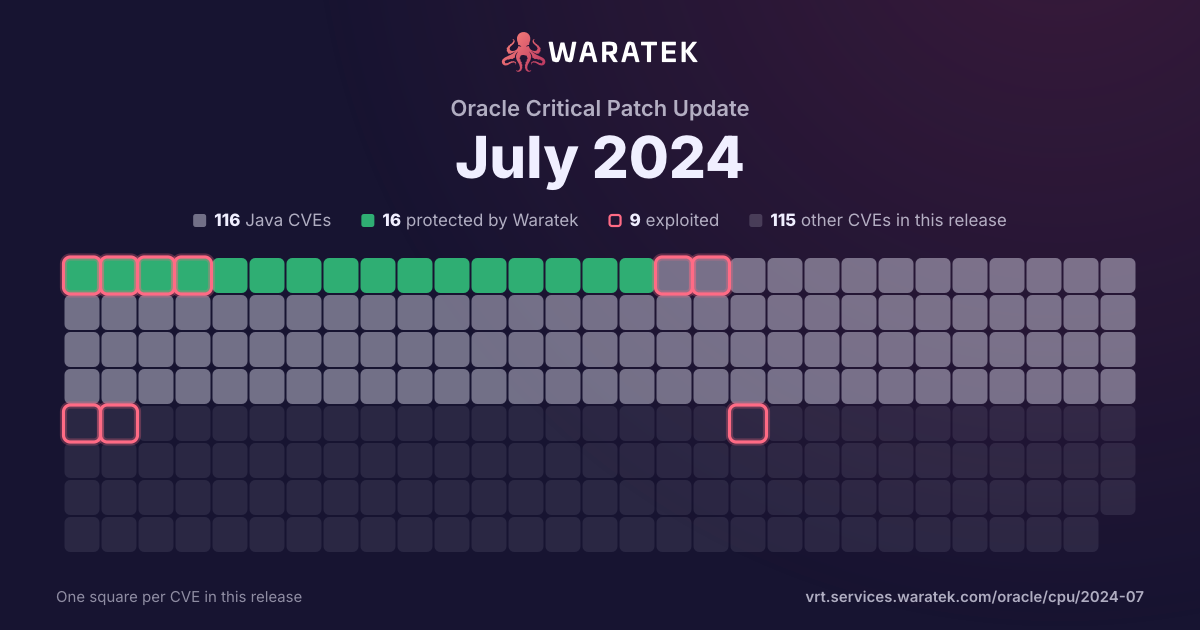
By status
15Protected by Waratek4Mitigation candidate98No exploit published6Outside Waratek scope108Not applicable
9Exploited, marked by the ring
No exploit published. For 25 of them, Oracle's security advisory is the source of public detail.
Protected by Waratek. Waratek RASP can block exploitation of these on systems that have not applied the patch yet.
Overview 17 matches · 1 protected · 0 exploited · 0 CISA KEV · 0 public PoC · 0 EPSS ≥ 0.5
Protected by Waratek
1
5.9%
Rule in development
0
0.0%
Mitigation candidate
0
0.0%
No exploit published
16
94.1%
blocked by ARMR today
1
5.9%
partly blocked
0
0.0%
not blocked
16
94.1%
not established
0
0.0%
unrecorded
0
0.0%
Exploited
0
0.0%
Working exploit published
0
0.0%
Proof of concept only
0
0.0%
Forecast only
0
0.0%
No public exploit
17
100.0%
split by
peak 5 / month
Feb 244
No exploit published4
High2
Medium2
not blocked4
No public exploit4
Mar 243
No exploit published3
Critical1
High2
not blocked3
No public exploit3
Apr 241
Protected by Waratek1
High1
blocked by ARMR today1
No public exploit1
May 244
No exploit published4
High3
Medium1
not blocked4
No public exploit4
Jun 240
Jul 245
No exploit published5
Critical2
High1
Medium1
Low1
not blocked5
No public exploit5
Feb 24Mar 24Apr 24May 24Jun 24Jul 24
| CVE | Severity | Published▾ | Status | Exploitation | Description |
|---|---|---|---|---|---|
| CVE-2024-21183 | High | 2024-07-16 | No exploit published | No public exploit | Vulnerability in the Oracle WebLogic Server product of Oracle Fusion Middleware (component: Core). Supported versions that are affected are 12.2.1.4.0 and 14.1.1.0.0. Easily exploitable vulnerability allows unauthenticated attacker with network access via T3, IIOP to compromise Oracle WebLogic Server. Successful attacks of this vulnerability can result in unauthorized access to critical data or complete access to all Oracle WebLogic Server accessible data. CVSS 3.1 Base Score 7.5 (Confidentiality impacts). CVSS Vector: (CVSS:3.1/AV:N/AC:L/PR:N/UI:N/S:U/C:H/I:N/A:N). |
| CVE-2024-21181 | Critical | 2024-07-16 | No exploit published | No public exploit | Vulnerability in the Oracle WebLogic Server product of Oracle Fusion Middleware (component: Core). Supported versions that are affected are 12.2.1.4.0 and 14.1.1.0.0. Easily exploitable vulnerability allows unauthenticated attacker with network access via T3, IIOP to compromise Oracle WebLogic Server. Successful attacks of this vulnerability can result in takeover of Oracle WebLogic Server. CVSS 3.1 Base Score 9.8 (Confidentiality, Integrity and Availability impacts). CVSS Vector: (CVSS:3.1/AV:N/AC:L/PR:N/UI:N/S:U/C:H/I:H/A:H). |
| CVE-2024-21175 | Critical | 2024-07-16 | No exploit published | No public exploit | Vulnerability in the Oracle WebLogic Server product of Oracle Fusion Middleware (component: Core). Supported versions that are affected are 12.2.1.4.0 and 14.1.1.0.0. Easily exploitable vulnerability allows unauthenticated attacker with network access via HTTP to compromise Oracle WebLogic Server. Successful attacks of this vulnerability can result in unauthorized creation, deletion or modification access to critical data or all Oracle WebLogic Server accessible data. CVSS 3.1 Base Score 7.5 (Integrity impacts). CVSS Vector: (CVSS:3.1/AV:N/AC:L/PR:N/UI:N/S:U/C:N/I:H/A:N). |
| CVE-2024-21133 | Medium | 2024-07-16 | No exploit published | No public exploit | Vulnerability in the Oracle Reports Developer product of Oracle Fusion Middleware (component: Servlet). Supported versions that are affected are 12.2.1.4.0 and 12.2.1.19.0. Easily exploitable vulnerability allows unauthenticated attacker with network access via HTTP to compromise Oracle Reports Developer. Successful attacks require human interaction from a person other than the attacker and while the vulnerability is in Oracle Reports Developer, attacks may significantly impact additional products (scope change). Successful attacks of this vulnerability can result in unauthorized update, insert or delete access to some of Oracle Reports Developer accessible data as well as unauthorized read access to a subset of Oracle Reports Developer accessible data. CVSS 3.1 Base Score 6.1 (Confidentiality and Integrity impacts). CVSS Vector: (CVSS:3.1/AV:N/AC:L/PR:N/UI:R/S:C/C:L/I:L/A:N). |
| CVE-2024-21131 | Low | 2024-07-16 | No exploit published | No public exploit | Vulnerability in the Oracle Java SE, Oracle GraalVM for JDK, Oracle GraalVM Enterprise Edition product of Oracle Java SE (component: Hotspot). Supported versions that are affected are Oracle Java SE: 8u411, 8u411-perf, 11.0.23, 17.0.11, 21.0.3, 22.0.1; Oracle GraalVM for JDK: 17.0.11, 21.0.3, 22.0.1; Oracle GraalVM Enterprise Edition: 20.3.14 and 21.3.10. Difficult to exploit vulnerability allows unauthenticated attacker with network access via multiple protocols to compromise Oracle Java SE, Oracle GraalVM for JDK, Oracle GraalVM Enterprise Edition. Successful attacks of this vulnerability can result in unauthorized update, insert or delete access to some of Oracle Java SE, Oracle GraalVM for JDK, Oracle GraalVM Enterprise Edition accessible data. Note: This vulnerability can be exploited by using APIs in the specified Component, e.g., through a web service which supplies data to the APIs. This vulnerability also applies to Java deployments, typically in clients running sandboxed Java Web Start applications or sandboxed Java applets, that load and run untrusted code (e.g., code that comes from the internet) and rely on the Java sandbox for security. CVSS 3.1 Base Score 3.7 (Integrity impacts). CVSS Vector: (CVSS:3.1/AV:N/AC:H/PR:N/UI:N/S:U/C:N/I:L/A:N). |
| CVE-2024-30172 | High | 2024-05-14 | No exploit published | No public exploit | An issue was discovered in Bouncy Castle Java Cryptography APIs before 1.78. An Ed25519 verification code infinite loop can occur via a crafted signature and public key. |
| CVE-2024-30171 | Medium | 2024-05-14 | No exploit published | No public exploit | An issue was discovered in Bouncy Castle Java TLS API and JSSE Provider before 1.78. Timing-based leakage may occur in RSA based handshakes because of exception processing. |
| CVE-2024-29857 | High | 2024-05-14 | No exploit published | No public exploit | An issue was discovered in ECCurve.java and ECCurve.cs in Bouncy Castle Java (BC Java) before 1.78, BC Java LTS before 2.73.6, BC-FJA before 1.0.2.5, and BC C# .Net before 2.3.1. Importing an EC certificate with crafted F2m parameters can lead to excessive CPU consumption during the evaluation of the curve parameters. |
| CVE-2024-34447 | High | 2024-05-03 | No exploit published | No public exploit | An issue was discovered in the Bouncy Castle Crypto Package For Java before BC TLS Java 1.0.19 (ships with BC Java 1.78, BC Java (LTS) 2.73.6) and before BC FIPS TLS Java 1.0.19. When endpoint identification is enabled in the BCJSSE and an SSL socket is created without an explicit hostname (as happens with HttpsURLConnection), hostname verification could be performed against a DNS-resolved IP address in some situations, opening up a possibility of DNS poisoning. |
| CVE-2024-22262 | High | 2024-04-16 | Protected by Waratek | No public exploit | Applications that use UriComponentsBuilder to parse an externally provided URL (e.g. through a query parameter) AND perform validation checks on the host of the parsed URL may be vulnerable to a open redirect https://cwe.mitre.org/data/definitions/601.html attack or to a SSRF attack if the URL is used after passing validation checks. This is the same as CVE-2024-22259 https://spring.io/security/cve-2024-22259 and CVE-2024-22243 https://spring.io/security/cve-2024-22243 , but with different input. |
| CVE-2024-29131 | High | 2024-03-21 | No exploit published | No public exploit | Out-of-bounds Write vulnerability in Apache Commons Configuration.This issue affects Apache Commons Configuration: from 2.0 before 2.10.1. Users are recommended to upgrade to version 2.10.1, which fixes the issue. |
| CVE-2024-22259 | High | 2024-03-16 | No exploit published | No public exploit | Applications that use UriComponentsBuilder in Spring Framework to parse an externally provided URL (e.g. through a query parameter) AND perform validation checks on the host of the parsed URL may be vulnerable to a open redirect https://cwe.mitre.org/data/definitions/601.html attack or to a SSRF attack if the URL is used after passing validation checks. This is the same as CVE-2024-22243 https://spring.io/security/cve-2024-22243 , but with different input. |
| CVE-2024-28752 | Critical | 2024-03-15 | No exploit published | No public exploit | A SSRF vulnerability using the Aegis DataBinding in versions of Apache CXF before 4.0.4, 3.6.3 and 3.5.8 allows an attacker to perform SSRF style attacks on webservices that take at least one parameter of any type. Users of other data bindings (including the default databinding) are not impacted. |
| CVE-2024-26308 | Medium | 2024-02-19 | No exploit published | No public exploit | Allocation of Resources Without Limits or Throttling vulnerability in Apache Commons Compress.This issue affects Apache Commons Compress: from 1.21 before 1.26. Users are recommended to upgrade to version 1.26, which fixes the issue. |
| CVE-2024-25710 | High | 2024-02-19 | No exploit published | No public exploit | Loop with Unreachable Exit Condition ('Infinite Loop') vulnerability in Apache Commons Compress.This issue affects Apache Commons Compress: from 1.3 through 1.25.0. Users are recommended to upgrade to version 1.26.0 which fixes the issue. |
| CVE-2023-52428 | High | 2024-02-11 | No exploit published | No public exploit | In Connect2id Nimbus JOSE+JWT before 9.37.2, an attacker can cause a denial of service (resource consumption) via a large JWE p2c header value (aka iteration count) for the PasswordBasedDecrypter (PBKDF2) component. |
| CVE-2024-23635 | Medium | 2024-02-02 | No exploit published | No public exploit | AntiSamy is a library for performing fast, configurable cleansing of HTML coming from untrusted sources. Prior to 1.7.5, there is a potential for a mutation XSS (mXSS) vulnerability in AntiSamy caused by flawed parsing of the HTML being sanitized. To be subject to this vulnerability the `preserveComments` directive must be enabled in your policy file. As a result, certain crafty inputs can result in elements in comment tags being interpreted as executable when using AntiSamy's sanitized output. Patched in AntiSamy 1.7.5 and later. |