
Oracle Critical Patch Update July 2024
Released July 2024 · Oracle's advisory ↗ · ← Critical Patch Update, April 2024 · Critical Patch Update, October 2024 →
231 CVEs in this release, one square each
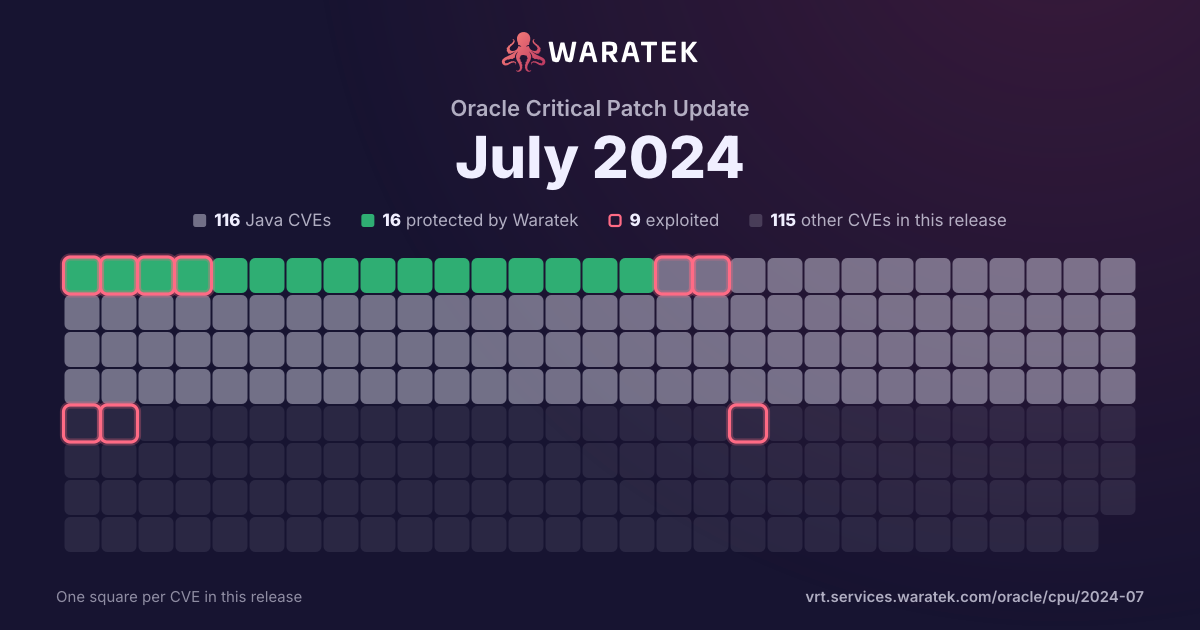
By status
16Protected by Waratek4Mitigation candidate96No exploit published18Outside Waratek scope97Not applicable
9Exploited, marked by the ring
No exploit published. For 35 of them, Oracle's security advisory is the source of public detail.
Protected by Waratek. Waratek RASP can block exploitation of these on systems that have not applied the patch yet.
Overview 4 matches · 0 in Waratek scope · 0 protected · 0 exploited · 0 CISA KEV · 3 public PoC
Protected by Waratek
0
0.0%
Rule in development
0
0.0%
Mitigation candidate
0
0.0%
No exploit published
0
0.0%
Outside Waratek scope
0
0.0%
Not applicable
4
100.0%
Withdrawn CVE
0
0.0%
blocked by ARMR today
0
0.0%
partly blocked
0
0.0%
not blocked
4
100.0%
not established
0
0.0%
unrecorded
0
0.0%
Exploited
0
0.0%
Working exploit published
0
0.0%
Proof of concept only
3
75.0%
Forecast only
1
25.0%
No public exploit
0
0.0%
split by
peak 3 / month
Dec 22Feb 23Apr 23Jun 23Aug 23Oct 23Dec 23Feb 24Apr 24
| CVE | Severity | Published▾ | Status | Exploitation | Description |
|---|---|---|---|---|---|
| CVE-2024-27983 | High | 2024-04-09 | Not applicable | Proof of concept only | An attacker can make the Node.js HTTP/2 server completely unavailable by sending a small amount of HTTP/2 frames packets with a few HTTP/2 frames inside. It is possible to leave some data in nghttp2 memory after reset when headers with HTTP/2 CONTINUATION frame are sent to the server and then a TCP connection is abruptly closed by the client triggering the Http2Session destructor while header frames are still being processed (and stored in memory) causing a race condition. |
| CVE-2024-28182 | Medium | 2024-04-04 | Not applicable | Forecast only | nghttp2 is an implementation of the Hypertext Transfer Protocol version 2 in C. The nghttp2 library prior to version 1.61.0 keeps reading the unbounded number of HTTP/2 CONTINUATION frames even after a stream is reset to keep HPACK context in sync. This causes excessive CPU usage to decode HPACK stream. nghttp2 v1.61.0 mitigates this vulnerability by limiting the number of CONTINUATION frames it accepts per stream. There is no workaround for this vulnerability. |
| CVE-2024-27316 | High | 2024-04-04 | Not applicable | Proof of concept only | HTTP/2 incoming headers exceeding the limit are temporarily buffered in nghttp2 in order to generate an informative HTTP 413 response. If a client does not stop sending headers, this leads to memory exhaustion. |
| CVE-2022-3786 | High | 2022-11-01 | Not applicable | Proof of concept only | A buffer overrun can be triggered in X.509 certificate verification, specifically in name constraint checking. Note that this occurs after certificate chain signature verification and requires either a CA to have signed a malicious certificate or for an application to continue certificate verification despite failure to construct a path to a trusted issuer. An attacker can craft a malicious email address in a certificate to overflow an arbitrary number of bytes containing the `.' character (decimal 46) on the stack. This buffer overflow could result in a crash (causing a denial of service). In a TLS client, this can be triggered by connecting to a malicious server. In a TLS server, this can be triggered if the server requests client authentication and a malicious client connects. |