
Oracle Critical Patch Update July 2024
Released July 2024 · Oracle's advisory ↗ · ← Critical Patch Update, April 2024 · Critical Patch Update, October 2024 →
231 CVEs in this release, one square each
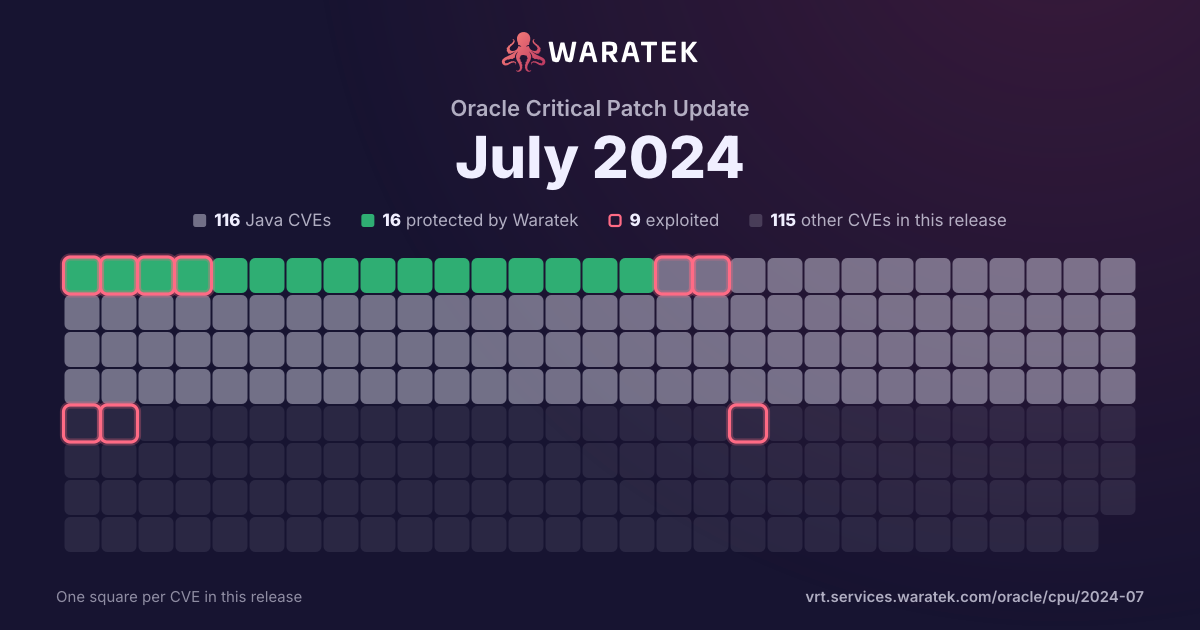
By status
16Protected by Waratek4Mitigation candidate96No exploit published18Outside Waratek scope97Not applicable
9Exploited, marked by the ring
No exploit published. For 35 of them, Oracle's security advisory is the source of public detail.
Protected by Waratek. Waratek RASP can block exploitation of these on systems that have not applied the patch yet.
Overview 24 matches · 12 in Waratek scope · 5 protected · 3 exploited · 2 CISA KEV · 5 public PoC · 3 EPSS ≥ 0.5
24matches
12in Waratek scope50.0%
5protected20.8%
3exploited12.5%
2CISA KEV8.3%
5public PoC20.8%
3EPSS ≥ 0.512.5%
Protected by Waratek
5
20.8%
Rule in development
0
0.0%
Mitigation candidate
0
0.0%
No exploit published
7
29.2%
Outside Waratek scope
4
16.7%
Not applicable
8
33.3%
Withdrawn CVE
0
0.0%
blocked by ARMR today
5
20.8%
partly blocked
0
0.0%
not blocked
19
79.2%
not established
0
0.0%
unrecorded
0
0.0%
Exploited
3
12.5%
Working exploit published
0
0.0%
Proof of concept only
5
20.8%
Forecast only
0
0.0%
No public exploit
16
66.7%
split by
peak 4 / quarter
Q4 191
No exploit published1
Critical1
not blocked1
No public exploit1
Q1 200
Q2 200
Q3 200
Q4 200
Q1 212
Protected by Waratek1
Not applicable1
Critical2
blocked by ARMR today1
not blocked1
No public exploit2
Q2 210
Q3 210
Q4 210
Q1 222
Protected by Waratek1
No exploit published1
Critical2
blocked by ARMR today1
not blocked1
Proof of concept only1
No public exploit1
Q2 222
Protected by Waratek1
Outside Waratek scope1
Critical2
blocked by ARMR today1
not blocked1
Exploited1
Proof of concept only1
Q3 223
Protected by Waratek1
Outside Waratek scope1
Not applicable1
Critical3
blocked by ARMR today1
not blocked2
Proof of concept only3
Q4 221
No exploit published1
Critical1
not blocked1
No public exploit1
Q1 230
Q2 230
Q3 233
No exploit published1
Outside Waratek scope1
Not applicable1
Critical3
not blocked3
No public exploit3
Q4 233
Not applicable3
Critical3
not blocked3
Exploited1
No public exploit2
Q1 244
Protected by Waratek1
No exploit published1
Not applicable2
Critical4
blocked by ARMR today1
not blocked3
Exploited1
No public exploit3
Q2 240
Q3 242
No exploit published2
Critical2
not blocked2
No public exploit2
Q4 241
Outside Waratek scope1
Critical1
not blocked1
No public exploit1
Q4 19Q2 20Q4 20Q2 21Q4 21Q2 22Q4 22Q2 23Q4 23Q2 24Q4 24
| CVE | Severity | Published▾ | Status | Exploitation | Description |
|---|---|---|---|---|---|
| CVE-2024-4741 | Critical | 2024-11-13 | Outside Waratek scope | No public exploit | Issue summary: Calling the OpenSSL API function SSL_free_buffers may cause memory to be accessed that was previously freed in some situations Impact summary: A use after free can have a range of potential consequences such as the corruption of valid data, crashes or execution of arbitrary code. However, only applications that directly call the SSL_free_buffers function are affected by this issue. Applications that do not call this function are not vulnerable. Our investigations indicate that this function is rarely used by applications. The SSL_free_buffers function is used to free the internal OpenSSL buffer used when processing an incoming record from the network. The call is only expected to succeed if the buffer is not currently in use. However, two scenarios have been identified where the buffer is freed even when still in use. The first scenario occurs where a record header has been received from the network and processed by OpenSSL, but the full record body has not yet arrived. In this case calling SSL_free_buffers will succeed even though a record has only been partially processed and the buffer is still in use. The second scenario occurs where a full record containing application data has been received and processed by OpenSSL but the application has only read part of this data. Again a call to SSL_free_buffers will succeed even though the buffer is still in use. While these scenarios could occur accidentally during normal operation a malicious attacker could attempt to engineer a stituation where this occurs. We are not aware of this issue being actively exploited. The FIPS modules in 3.3, 3.2, 3.1 and 3.0 are not affected by this issue. |
| CVE-2024-21181 | Critical | 2024-07-16 | No exploit published | No public exploit | Vulnerability in the Oracle WebLogic Server product of Oracle Fusion Middleware (component: Core). Supported versions that are affected are 12.2.1.4.0 and 14.1.1.0.0. Easily exploitable vulnerability allows unauthenticated attacker with network access via T3, IIOP to compromise Oracle WebLogic Server. Successful attacks of this vulnerability can result in takeover of Oracle WebLogic Server. CVSS 3.1 Base Score 9.8 (Confidentiality, Integrity and Availability impacts). CVSS Vector: (CVSS:3.1/AV:N/AC:L/PR:N/UI:N/S:U/C:H/I:H/A:H). |
| CVE-2024-21175 | Critical | 2024-07-16 | No exploit published | No public exploit | Vulnerability in the Oracle WebLogic Server product of Oracle Fusion Middleware (component: Core). Supported versions that are affected are 12.2.1.4.0 and 14.1.1.0.0. Easily exploitable vulnerability allows unauthenticated attacker with network access via HTTP to compromise Oracle WebLogic Server. Successful attacks of this vulnerability can result in unauthorized creation, deletion or modification access to critical data or all Oracle WebLogic Server accessible data. CVSS 3.1 Base Score 7.5 (Integrity impacts). CVSS Vector: (CVSS:3.1/AV:N/AC:L/PR:N/UI:N/S:U/C:N/I:H/A:N). |
| CVE-2024-28752 | Critical | 2024-03-15 | No exploit published | No public exploit | A SSRF vulnerability using the Aegis DataBinding in versions of Apache CXF before 4.0.4, 3.6.3 and 3.5.8 allows an attacker to perform SSRF style attacks on webservices that take at least one parameter of any type. Users of other data bindings (including the default databinding) are not impacted. |
| CVE-2024-23807 | Critical | 2024-02-29 | Not applicable | No public exploit | The Apache Xerces C++ XML parser on versions 3.0.0 before 3.2.5 contains a use-after-free error triggered during the scanning of external DTDs. Users are recommended to upgrade to version 3.2.5 which fixes the issue, or mitigate the issue by disabling DTD processing. This can be accomplished via the DOM using a standard parser feature, or via SAX using the XERCES_DISABLE_DTD environment variable. This issue has been disclosed before as CVE-2018-1311, but unfortunately that advisory incorrectly stated the issue would be fixed in version 3.2.3 or 3.2.4. |
| CVE-2022-34381 | Critical | 2024-02-02 | Not applicable | No public exploit | Dell BSAFE SSL-J version 7.0 and all versions prior to 6.5, and Dell BSAFE Crypto-J versions prior to 6.2.6.1 contain an unmaintained third-party component vulnerability. An unauthenticated remote attacker could potentially exploit this vulnerability, leading to the compromise of the impacted system. This is a Critical vulnerability and Dell recommends customers to upgrade at the earliest opportunity. |
| CVE-2024-23897 | Critical | 2024-01-24 | Protected by Waratek | Exploited | Jenkins 2.441 and earlier, LTS 2.426.2 and earlier does not disable a feature of its CLI command parser that replaces an '@' character followed by a file path in an argument with the file's contents, allowing unauthenticated attackers to read arbitrary files on the Jenkins controller file system. |
| CVE-2023-47248 | Critical | 2023-11-09 | Not applicable | Exploited | Deserialization of untrusted data in IPC and Parquet readers in PyArrow versions 0.14.0 to 14.0.0 allows arbitrary code execution. An application is vulnerable if it reads Arrow IPC, Feather or Parquet data from untrusted sources (for example user-supplied input files). This vulnerability only affects PyArrow, not other Apache Arrow implementations or bindings. It is recommended that users of PyArrow upgrade to 14.0.1. Similarly, it is recommended that downstream libraries upgrade their dependency requirements to PyArrow 14.0.1 or later. PyPI packages are already available, and we hope that conda-forge packages will be available soon. If it is not possible to upgrade, we provide a separate package `pyarrow-hotfix` that disables the vulnerability on older PyArrow versions. See https://pypi.org/project/pyarrow-hotfix/ for instructions. |
| CVE-2023-39332 | Critical | 2023-10-18 | Not applicable | No public exploit | Various `node:fs` functions allow specifying paths as either strings or `Uint8Array` objects. In Node.js environments, the `Buffer` class extends the `Uint8Array` class. Node.js prevents path traversal through strings (see CVE-2023-30584) and `Buffer` objects (see CVE-2023-32004), but not through non-`Buffer` `Uint8Array` objects. This is distinct from CVE-2023-32004 which only referred to `Buffer` objects. However, the vulnerability follows the same pattern using `Uint8Array` instead of `Buffer`. Please note that at the time this CVE was issued, the permission model is an experimental feature of Node.js. |
| CVE-2023-45853 | Critical | 2023-10-14 | Not applicable | No public exploit | MiniZip in zlib through 1.3 has an integer overflow and resultant heap-based buffer overflow in zipOpenNewFileInZip4_64 via a long filename, comment, or extra field. NOTE: MiniZip is not a supported part of the zlib product. NOTE: pyminizip through 0.2.6 is also vulnerable because it bundles an affected zlib version, and exposes the applicable MiniZip code through its compress API. |
| CVE-2022-48174 | Critical | 2023-08-22 | Not applicable | No public exploit | There is a stack overflow vulnerability in ash.c:6030 in busybox before 1.35. In the environment of Internet of Vehicles, this vulnerability can be executed from command to arbitrary code execution. |
| CVE-2023-37920 | Critical | 2023-07-25 | Outside Waratek scope | No public exploit | Certifi is a curated collection of Root Certificates for validating the trustworthiness of SSL certificates while verifying the identity of TLS hosts. Certifi prior to version 2023.07.22 recognizes "e-Tugra" root certificates. e-Tugra's root certificates were subject to an investigation prompted by reporting of security issues in their systems. Certifi 2023.07.22 removes root certificates from "e-Tugra" from the root store. |
| CVE-2023-34034 | Critical | 2023-07-19 | No exploit published | No public exploit | Using "**" as a pattern in Spring Security configuration for WebFlux creates a mismatch in pattern matching between Spring Security and Spring WebFlux, and the potential for a security bypass. |
| CVE-2022-45378 | Critical | 2022-11-14 | No exploit published | No public exploit | In the default configuration of Apache SOAP, an RPCRouterServlet is available without authentication. This gives an attacker the possibility to invoke methods on the classpath that meet certain criteria. Depending on what classes are available on the classpath this might even lead to arbitrary remote code execution. NOTE: This vulnerability only affects products that are no longer supported by the maintainer. |
| CVE-2022-21797 | Critical | 2022-09-26 | Not applicable | Proof of concept only | The package joblib from 0 and before 1.2.0 are vulnerable to Arbitrary Code Execution via the pre_dispatch flag in Parallel() class due to the eval() statement. |
| CVE-2022-36944 | Critical | 2022-09-23 | Protected by Waratek | Proof of concept only | Scala 2.13.x before 2.13.9 has a Java deserialization chain in its JAR file. On its own, it cannot be exploited. There is only a risk in conjunction with Java object deserialization within an application. In such situations, it allows attackers to erase contents of arbitrary files, make network connections, or possibly run arbitrary code (specifically, Function0 functions) via a gadget chain. |
| CVE-2022-37434 | Critical | 2022-08-05 | Outside Waratek scope | Proof of concept only | zlib through 1.2.12 has a heap-based buffer over-read or buffer overflow in inflate in inflate.c via a large gzip header extra field. NOTE: only applications that call inflateGetHeader are affected. Some common applications bundle the affected zlib source code but may be unable to call inflateGetHeader (e.g., see the nodejs/node reference). |
| CVE-2022-1292 | Critical | 2022-05-03 | Outside Waratek scope | Proof of concept only | The c_rehash script does not properly sanitise shell metacharacters to prevent command injection. This script is distributed by some operating systems in a manner where it is automatically executed. On such operating systems, an attacker could execute arbitrary commands with the privileges of the script. Use of the c_rehash script is considered obsolete and should be replaced by the OpenSSL rehash command line tool. Fixed in OpenSSL 3.0.3 (Affected 3.0.0,3.0.1,3.0.2). Fixed in OpenSSL 1.1.1o (Affected 1.1.1-1.1.1n). Fixed in OpenSSL 1.0.2ze (Affected 1.0.2-1.0.2zd). |
| CVE-2022-22965 | Critical | 2022-04-01 | Protected by Waratek | Exploited | A Spring MVC or Spring WebFlux application running on JDK 9+ may be vulnerable to remote code execution (RCE) via data binding. The specific exploit requires the application to run on Tomcat as a WAR deployment. If the application is deployed as a Spring Boot executable jar, i.e. the default, it is not vulnerable to the exploit. However, the nature of the vulnerability is more general, and there may be other ways to exploit it. |
| CVE-2021-44550 | Critical | 2022-02-24 | No exploit published | No public exploit | An Incorrect Access Control vulnerability exists in CoreNLP 4.3.2 via the classifier in NERServlet.java (lines 158 and 159). |
| CVE-2022-0239 | Critical | 2022-01-17 | Protected by Waratek | Proof of concept only | corenlp is vulnerable to Improper Restriction of XML External Entity Reference |
| CVE-2021-24112 | Critical | 2021-02-25 | Not applicable | No public exploit | .NET Core Remote Code Execution Vulnerability |
| CVE-2021-23926 | Critical | 2021-01-14 | Protected by Waratek | No public exploit | The XML parsers used by XMLBeans up to version 2.6.0 did not set the properties needed to protect the user from malicious XML input. Vulnerabilities include possibilities for XML Entity Expansion attacks. Affects XMLBeans up to and including v2.6.0. |
| CVE-2019-17267 | Critical | 2019-10-07 | No exploit published | No public exploit | A Polymorphic Typing issue was discovered in FasterXML jackson-databind before 2.9.10. It is related to net.sf.ehcache.hibernate.EhcacheJtaTransactionManagerLookup. |