
Oracle Critical Patch Update July 2024
Released July 2024 · Oracle's advisory ↗ · ← Critical Patch Update, April 2024 · Critical Patch Update, October 2024 →
231 CVEs in this release, one square each
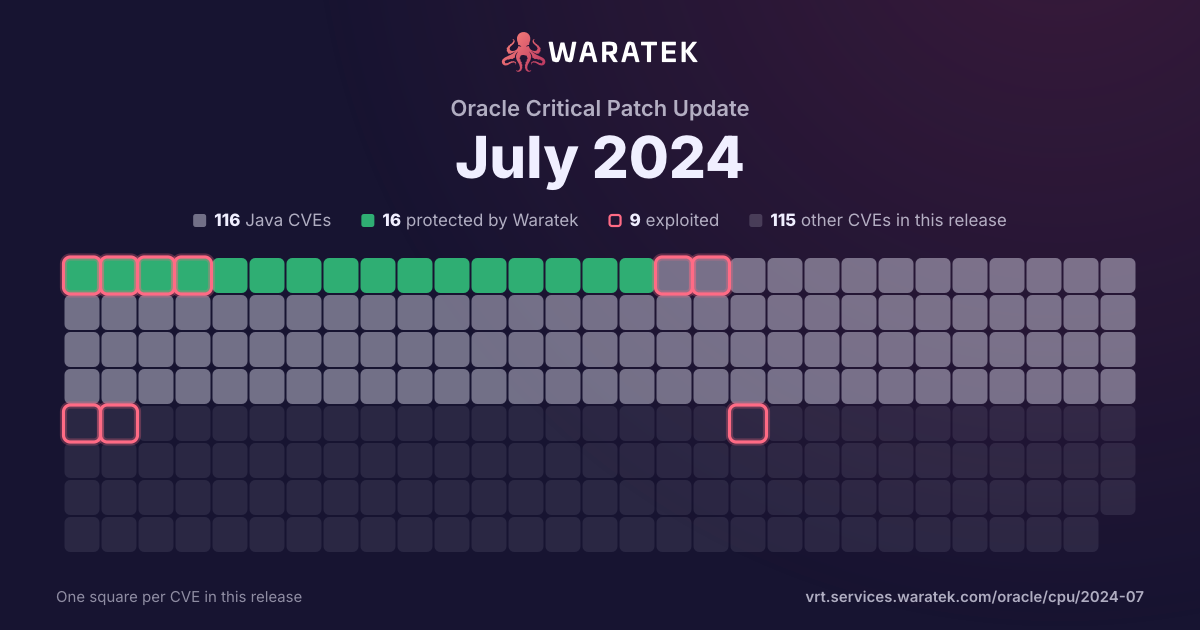
By status
16Protected by Waratek4Mitigation candidate96No exploit published18Outside Waratek scope97Not applicable
9Exploited, marked by the ring
No exploit published. For 35 of them, Oracle's security advisory is the source of public detail.
Protected by Waratek. Waratek RASP can block exploitation of these on systems that have not applied the patch yet.
Overview 181 matches · 93 in Waratek scope · 8 protected · 0 exploited · 0 CISA KEV · 0 public PoC · 0 EPSS ≥ 0.5
181matches
93in Waratek scope51.4%
8protected4.4%
0exploited0.0%
0CISA KEV0.0%
0public PoC0.0%
0EPSS ≥ 0.50.0%
Protected by Waratek
8
4.4%
Rule in development
0
0.0%
Mitigation candidate
0
0.0%
No exploit published
85
47.0%
Outside Waratek scope
10
5.5%
Not applicable
78
43.1%
Withdrawn CVE
0
0.0%
blocked by ARMR today
8
4.4%
partly blocked
0
0.0%
not blocked
173
95.6%
not established
0
0.0%
unrecorded
0
0.0%
Exploited
0
0.0%
Working exploit published
0
0.0%
Proof of concept only
0
0.0%
Forecast only
0
0.0%
No public exploit
181
100.0%
split by
peak 61 / quarter
Q3 191
Protected by Waratek1
High1
blocked by ARMR today1
No public exploit1
Q4 191
No exploit published1
Critical1
not blocked1
No public exploit1
Q1 200
Q2 201
Outside Waratek scope1
Medium1
not blocked1
No public exploit1
Q3 200
Q4 201
Outside Waratek scope1
Medium1
not blocked1
No public exploit1
Q1 214
Protected by Waratek2
No exploit published1
Not applicable1
Critical2
High1
Medium1
blocked by ARMR today2
not blocked2
No public exploit4
Q2 212
Protected by Waratek1
Outside Waratek scope1
High1
Medium1
blocked by ARMR today1
not blocked1
No public exploit2
Q3 213
No exploit published3
High1
Medium2
not blocked3
No public exploit3
Q4 212
Outside Waratek scope2
Medium2
not blocked2
No public exploit2
Q1 221
No exploit published1
Critical1
not blocked1
No public exploit1
Q2 224
Protected by Waratek1
No exploit published3
Medium3
Low1
blocked by ARMR today1
not blocked3
No public exploit4
Q3 224
No exploit published4
High2
Medium2
not blocked4
No public exploit4
Q4 226
No exploit published6
Critical1
High4
Medium1
not blocked6
No public exploit6
Q1 234
No exploit published2
Not applicable2
High1
Medium3
not blocked4
No public exploit4
Q2 232
No exploit published2
High1
Medium1
not blocked2
No public exploit2
Q3 2314
Protected by Waratek1
No exploit published7
Outside Waratek scope1
Not applicable5
Critical3
High2
Medium8
Low1
blocked by ARMR today1
not blocked13
No public exploit14
Q4 2320
No exploit published8
Outside Waratek scope1
Not applicable11
Critical2
High10
Medium8
not blocked20
No public exploit20
Q1 2436
Protected by Waratek1
No exploit published13
Not applicable22
Critical3
High15
Medium18
blocked by ARMR today1
not blocked35
No public exploit36
Q2 2412
Protected by Waratek1
No exploit published6
Outside Waratek scope1
Not applicable4
High6
Medium5
Low1
blocked by ARMR today1
not blocked11
No public exploit12
Q3 2461
No exploit published28
Outside Waratek scope1
Not applicable32
Critical2
High9
Medium43
Low7
not blocked61
No public exploit61
Q4 241
Outside Waratek scope1
Critical1
not blocked1
No public exploit1
Q1 251
Not applicable1
High1
not blocked1
No public exploit1
Q3 19Q1 20Q3 20Q1 21Q3 21Q1 22Q3 22Q1 23Q3 23Q1 24Q3 24Q1 25
| CVE | Severity | Published▾ | Status | Exploitation | Description |
|---|---|---|---|---|---|
| CVE-2024-27980 | High | 2025-01-09 | Not applicable | No public exploit | Due to the improper handling of batch files in child_process.spawn / child_process.spawnSync, a malicious command line argument can inject arbitrary commands and achieve code execution even if the shell option is not enabled. |
| CVE-2024-4741 | Critical | 2024-11-13 | Outside Waratek scope | No public exploit | Issue summary: Calling the OpenSSL API function SSL_free_buffers may cause memory to be accessed that was previously freed in some situations Impact summary: A use after free can have a range of potential consequences such as the corruption of valid data, crashes or execution of arbitrary code. However, only applications that directly call the SSL_free_buffers function are affected by this issue. Applications that do not call this function are not vulnerable. Our investigations indicate that this function is rarely used by applications. The SSL_free_buffers function is used to free the internal OpenSSL buffer used when processing an incoming record from the network. The call is only expected to succeed if the buffer is not currently in use. However, two scenarios have been identified where the buffer is freed even when still in use. The first scenario occurs where a record header has been received from the network and processed by OpenSSL, but the full record body has not yet arrived. In this case calling SSL_free_buffers will succeed even though a record has only been partially processed and the buffer is still in use. The second scenario occurs where a full record containing application data has been received and processed by OpenSSL but the application has only read part of this data. Again a call to SSL_free_buffers will succeed even though the buffer is still in use. While these scenarios could occur accidentally during normal operation a malicious attacker could attempt to engineer a stituation where this occurs. We are not aware of this issue being actively exploited. The FIPS modules in 3.3, 3.2, 3.1 and 3.0 are not affected by this issue. |
| CVE-2024-21188 | Medium | 2024-07-16 | No exploit published | No public exploit | Vulnerability in the Oracle Financial Services Revenue Management and Billing product of Oracle Financial Services Applications (component: Chatbot). Supported versions that are affected are 6.0.0.0.0 and 6.1.0.0.0. Easily exploitable vulnerability allows unauthenticated attacker with network access via HTTP to compromise Oracle Financial Services Revenue Management and Billing. Successful attacks require human interaction from a person other than the attacker and while the vulnerability is in Oracle Financial Services Revenue Management and Billing, attacks may significantly impact additional products (scope change). Successful attacks of this vulnerability can result in unauthorized update, insert or delete access to some of Oracle Financial Services Revenue Management and Billing accessible data as well as unauthorized read access to a subset of Oracle Financial Services Revenue Management and Billing accessible data. CVSS 3.1 Base Score 6.1 (Confidentiality and Integrity impacts). CVSS Vector: (CVSS:3.1/AV:N/AC:L/PR:N/UI:R/S:C/C:L/I:L/A:N). |
| CVE-2024-21185 | Medium | 2024-07-16 | Not applicable | No public exploit | Vulnerability in the MySQL Server product of Oracle MySQL (component: InnoDB). Supported versions that are affected are 8.0.38, 8.4.1 and 9.0.0. Easily exploitable vulnerability allows high privileged attacker with network access via multiple protocols to compromise MySQL Server. Successful attacks of this vulnerability can result in unauthorized ability to cause a hang or frequently repeatable crash (complete DOS) of MySQL Server. CVSS 3.1 Base Score 4.9 (Availability impacts). CVSS Vector: (CVSS:3.1/AV:N/AC:L/PR:H/UI:N/S:U/C:N/I:N/A:H). |
| CVE-2024-21184 | High | 2024-07-16 | Not applicable | No public exploit | Vulnerability in the Oracle Database RDBMS Security component of Oracle Database Server. Supported versions that are affected are 19.3-19.23. Easily exploitable vulnerability allows high privileged attacker having Execute on SYS.XS_DIAG privilege with network access via Oracle Net to compromise Oracle Database RDBMS Security. Successful attacks of this vulnerability can result in takeover of Oracle Database RDBMS Security. CVSS 3.1 Base Score 7.2 (Confidentiality, Integrity and Availability impacts). CVSS Vector: (CVSS:3.1/AV:N/AC:L/PR:H/UI:N/S:U/C:H/I:H/A:H). |
| CVE-2024-21183 | High | 2024-07-16 | No exploit published | No public exploit | Vulnerability in the Oracle WebLogic Server product of Oracle Fusion Middleware (component: Core). Supported versions that are affected are 12.2.1.4.0 and 14.1.1.0.0. Easily exploitable vulnerability allows unauthenticated attacker with network access via T3, IIOP to compromise Oracle WebLogic Server. Successful attacks of this vulnerability can result in unauthorized access to critical data or complete access to all Oracle WebLogic Server accessible data. CVSS 3.1 Base Score 7.5 (Confidentiality impacts). CVSS Vector: (CVSS:3.1/AV:N/AC:L/PR:N/UI:N/S:U/C:H/I:N/A:N). |
| CVE-2024-21181 | Critical | 2024-07-16 | No exploit published | No public exploit | Vulnerability in the Oracle WebLogic Server product of Oracle Fusion Middleware (component: Core). Supported versions that are affected are 12.2.1.4.0 and 14.1.1.0.0. Easily exploitable vulnerability allows unauthenticated attacker with network access via T3, IIOP to compromise Oracle WebLogic Server. Successful attacks of this vulnerability can result in takeover of Oracle WebLogic Server. CVSS 3.1 Base Score 9.8 (Confidentiality, Integrity and Availability impacts). CVSS Vector: (CVSS:3.1/AV:N/AC:L/PR:N/UI:N/S:U/C:H/I:H/A:H). |
| CVE-2024-21180 | Medium | 2024-07-16 | No exploit published | No public exploit | Vulnerability in the PeopleSoft Enterprise PeopleTools product of Oracle PeopleSoft (component: OpenSearch Dashboards). Supported versions that are affected are 8.59, 8.60 and 8.61. Easily exploitable vulnerability allows low privileged attacker with network access via HTTP to compromise PeopleSoft Enterprise PeopleTools. Successful attacks require human interaction from a person other than the attacker and while the vulnerability is in PeopleSoft Enterprise PeopleTools, attacks may significantly impact additional products (scope change). Successful attacks of this vulnerability can result in unauthorized read access to a subset of PeopleSoft Enterprise PeopleTools accessible data. CVSS 3.1 Base Score 4.1 (Confidentiality impacts). CVSS Vector: (CVSS:3.1/AV:N/AC:L/PR:L/UI:R/S:C/C:L/I:N/A:N). |
| CVE-2024-21179 | Medium | 2024-07-16 | Not applicable | No public exploit | Vulnerability in the MySQL Server product of Oracle MySQL (component: InnoDB). Supported versions that are affected are 8.0.37 and prior and 8.4.0 and prior. Easily exploitable vulnerability allows high privileged attacker with network access via multiple protocols to compromise MySQL Server. Successful attacks of this vulnerability can result in unauthorized ability to cause a hang or frequently repeatable crash (complete DOS) of MySQL Server. CVSS 3.1 Base Score 4.9 (Availability impacts). CVSS Vector: (CVSS:3.1/AV:N/AC:L/PR:H/UI:N/S:U/C:N/I:N/A:H). |
| CVE-2024-21178 | Medium | 2024-07-16 | No exploit published | No public exploit | Vulnerability in the PeopleSoft Enterprise PeopleTools product of Oracle PeopleSoft (component: Portal). Supported versions that are affected are 8.59, 8.60 and 8.61. Easily exploitable vulnerability allows unauthenticated attacker with network access via HTTP to compromise PeopleSoft Enterprise PeopleTools. Successful attacks require human interaction from a person other than the attacker and while the vulnerability is in PeopleSoft Enterprise PeopleTools, attacks may significantly impact additional products (scope change). Successful attacks of this vulnerability can result in unauthorized update, insert or delete access to some of PeopleSoft Enterprise PeopleTools accessible data as well as unauthorized read access to a subset of PeopleSoft Enterprise PeopleTools accessible data. CVSS 3.1 Base Score 6.1 (Confidentiality and Integrity impacts). CVSS Vector: (CVSS:3.1/AV:N/AC:L/PR:N/UI:R/S:C/C:L/I:L/A:N). |
| CVE-2024-21177 | Medium | 2024-07-16 | Not applicable | No public exploit | Vulnerability in the MySQL Server product of Oracle MySQL (component: Server: Optimizer). Supported versions that are affected are 8.0.37 and prior and 8.4.0 and prior. Easily exploitable vulnerability allows low privileged attacker with network access via multiple protocols to compromise MySQL Server. Successful attacks of this vulnerability can result in unauthorized ability to cause a hang or frequently repeatable crash (complete DOS) of MySQL Server. CVSS 3.1 Base Score 6.5 (Availability impacts). CVSS Vector: (CVSS:3.1/AV:N/AC:L/PR:L/UI:N/S:U/C:N/I:N/A:H). |
| CVE-2024-21176 | Medium | 2024-07-16 | Not applicable | No public exploit | Vulnerability in the MySQL Server product of Oracle MySQL (component: Server: Thread Pooling). Supported versions that are affected are 8.4.0 and prior. Difficult to exploit vulnerability allows low privileged attacker with network access via multiple protocols to compromise MySQL Server. Successful attacks of this vulnerability can result in unauthorized ability to cause a hang or frequently repeatable crash (complete DOS) of MySQL Server. CVSS 3.1 Base Score 5.3 (Availability impacts). CVSS Vector: (CVSS:3.1/AV:N/AC:H/PR:L/UI:N/S:U/C:N/I:N/A:H). |
| CVE-2024-21175 | Critical | 2024-07-16 | No exploit published | No public exploit | Vulnerability in the Oracle WebLogic Server product of Oracle Fusion Middleware (component: Core). Supported versions that are affected are 12.2.1.4.0 and 14.1.1.0.0. Easily exploitable vulnerability allows unauthenticated attacker with network access via HTTP to compromise Oracle WebLogic Server. Successful attacks of this vulnerability can result in unauthorized creation, deletion or modification access to critical data or all Oracle WebLogic Server accessible data. CVSS 3.1 Base Score 7.5 (Integrity impacts). CVSS Vector: (CVSS:3.1/AV:N/AC:L/PR:N/UI:N/S:U/C:N/I:H/A:N). |
| CVE-2024-21174 | Low | 2024-07-16 | Not applicable | No public exploit | Vulnerability in the Java VM component of Oracle Database Server. Supported versions that are affected are 19.3-19.23, 21.3-21.14 and 23.4. Difficult to exploit vulnerability allows low privileged attacker having Create Session, Create Procedure privilege with network access via Oracle Net to compromise Java VM. Successful attacks of this vulnerability can result in unauthorized ability to cause a partial denial of service (partial DOS) of Java VM. CVSS 3.1 Base Score 3.1 (Availability impacts). CVSS Vector: (CVSS:3.1/AV:N/AC:H/PR:L/UI:N/S:U/C:N/I:N/A:L). |
| CVE-2024-21173 | Medium | 2024-07-16 | Not applicable | No public exploit | Vulnerability in the MySQL Server product of Oracle MySQL (component: InnoDB). Supported versions that are affected are 8.0.37 and prior and 8.4.0 and prior. Easily exploitable vulnerability allows high privileged attacker with network access via multiple protocols to compromise MySQL Server. Successful attacks of this vulnerability can result in unauthorized ability to cause a hang or frequently repeatable crash (complete DOS) of MySQL Server. CVSS 3.1 Base Score 4.9 (Availability impacts). CVSS Vector: (CVSS:3.1/AV:N/AC:L/PR:H/UI:N/S:U/C:N/I:N/A:H). |
| CVE-2024-21171 | Medium | 2024-07-16 | Not applicable | No public exploit | Vulnerability in the MySQL Server product of Oracle MySQL (component: Server: Optimizer). Supported versions that are affected are 8.0.37 and prior and 8.4.0 and prior. Easily exploitable vulnerability allows low privileged attacker with network access via multiple protocols to compromise MySQL Server. Successful attacks of this vulnerability can result in unauthorized ability to cause a hang or frequently repeatable crash (complete DOS) of MySQL Server. CVSS 3.1 Base Score 6.5 (Availability impacts). CVSS Vector: (CVSS:3.1/AV:N/AC:L/PR:L/UI:N/S:U/C:N/I:N/A:H). |
| CVE-2024-21170 | Medium | 2024-07-16 | Not applicable | No public exploit | Vulnerability in the MySQL Connectors product of Oracle MySQL (component: Connector/Python). Supported versions that are affected are 8.4.0 and prior. Easily exploitable vulnerability allows low privileged attacker with network access via multiple protocols to compromise MySQL Connectors. Successful attacks of this vulnerability can result in unauthorized update, insert or delete access to some of MySQL Connectors accessible data as well as unauthorized read access to a subset of MySQL Connectors accessible data and unauthorized ability to cause a partial denial of service (partial DOS) of MySQL Connectors. CVSS 3.1 Base Score 6.3 (Confidentiality, Integrity and Availability impacts). CVSS Vector: (CVSS:3.1/AV:N/AC:L/PR:L/UI:N/S:U/C:L/I:L/A:L). |
| CVE-2024-21169 | Medium | 2024-07-16 | No exploit published | No public exploit | Vulnerability in the Oracle Marketing product of Oracle E-Business Suite (component: Partners). Supported versions that are affected are 12.2.3-12.2.13. Easily exploitable vulnerability allows unauthenticated attacker with network access via HTTP to compromise Oracle Marketing. Successful attacks of this vulnerability can result in unauthorized update, insert or delete access to some of Oracle Marketing accessible data as well as unauthorized read access to a subset of Oracle Marketing accessible data. CVSS 3.1 Base Score 6.5 (Confidentiality and Integrity impacts). CVSS Vector: (CVSS:3.1/AV:N/AC:L/PR:N/UI:N/S:U/C:L/I:L/A:N). |
| CVE-2024-21168 | Medium | 2024-07-16 | No exploit published | No public exploit | Vulnerability in the JD Edwards EnterpriseOne Orchestrator product of Oracle JD Edwards (component: E1 IOT Orchestrator Security). Supported versions that are affected are Prior to 9.2.8.3. Easily exploitable vulnerability allows low privileged attacker with network access via HTTP to compromise JD Edwards EnterpriseOne Orchestrator. Successful attacks of this vulnerability can result in unauthorized access to critical data or complete access to all JD Edwards EnterpriseOne Orchestrator accessible data. CVSS 3.1 Base Score 6.5 (Confidentiality impacts). CVSS Vector: (CVSS:3.1/AV:N/AC:L/PR:L/UI:N/S:U/C:H/I:N/A:N). |
| CVE-2024-21167 | High | 2024-07-16 | No exploit published | No public exploit | Vulnerability in the Oracle Trading Community product of Oracle E-Business Suite (component: Party Search UI). Supported versions that are affected are 12.2.3-12.2.13. Easily exploitable vulnerability allows low privileged attacker with network access via HTTP to compromise Oracle Trading Community. Successful attacks of this vulnerability can result in unauthorized creation, deletion or modification access to critical data or all Oracle Trading Community accessible data as well as unauthorized access to critical data or complete access to all Oracle Trading Community accessible data. CVSS 3.1 Base Score 8.1 (Confidentiality and Integrity impacts). CVSS Vector: (CVSS:3.1/AV:N/AC:L/PR:L/UI:N/S:U/C:H/I:H/A:N). |
| CVE-2024-21166 | Medium | 2024-07-16 | Not applicable | No public exploit | Vulnerability in the MySQL Server product of Oracle MySQL (component: InnoDB). Supported versions that are affected are 8.0.36 and prior and 8.3.0 and prior. Difficult to exploit vulnerability allows high privileged attacker with network access via multiple protocols to compromise MySQL Server. Successful attacks of this vulnerability can result in unauthorized creation, deletion or modification access to critical data or all MySQL Server accessible data and unauthorized ability to cause a hang or frequently repeatable crash (complete DOS) of MySQL Server. CVSS 3.1 Base Score 5.9 (Integrity and Availability impacts). CVSS Vector: (CVSS:3.1/AV:N/AC:H/PR:H/UI:N/S:U/C:N/I:H/A:H). |
| CVE-2024-21165 | Medium | 2024-07-16 | Not applicable | No public exploit | Vulnerability in the MySQL Server product of Oracle MySQL (component: Server: Pluggable Auth). Supported versions that are affected are 8.0.37 and prior. Easily exploitable vulnerability allows high privileged attacker with network access via multiple protocols to compromise MySQL Server. Successful attacks of this vulnerability can result in unauthorized ability to cause a hang or frequently repeatable crash (complete DOS) of MySQL Server. CVSS 3.1 Base Score 4.9 (Availability impacts). CVSS Vector: (CVSS:3.1/AV:N/AC:L/PR:H/UI:N/S:U/C:N/I:N/A:H). |
| CVE-2024-21164 | Low | 2024-07-16 | Not applicable | No public exploit | Vulnerability in the Oracle VM VirtualBox product of Oracle Virtualization (component: Core). Supported versions that are affected are Prior to 7.0.20. Difficult to exploit vulnerability allows high privileged attacker with logon to the infrastructure where Oracle VM VirtualBox executes to compromise Oracle VM VirtualBox. While the vulnerability is in Oracle VM VirtualBox, attacks may significantly impact additional products (scope change). Successful attacks of this vulnerability can result in unauthorized read access to a subset of Oracle VM VirtualBox accessible data. CVSS 3.1 Base Score 2.5 (Confidentiality impacts). CVSS Vector: (CVSS:3.1/AV:L/AC:H/PR:H/UI:N/S:C/C:L/I:N/A:N). |
| CVE-2024-21163 | Medium | 2024-07-16 | Not applicable | No public exploit | Vulnerability in the MySQL Server product of Oracle MySQL (component: Server: Optimizer). Supported versions that are affected are 8.0.37 and prior and 8.4.0 and prior. Easily exploitable vulnerability allows high privileged attacker with network access via multiple protocols to compromise MySQL Server. Successful attacks of this vulnerability can result in unauthorized ability to cause a hang or frequently repeatable crash (complete DOS) of MySQL Server as well as unauthorized update, insert or delete access to some of MySQL Server accessible data. CVSS 3.1 Base Score 5.5 (Integrity and Availability impacts). CVSS Vector: (CVSS:3.1/AV:N/AC:L/PR:H/UI:N/S:U/C:N/I:L/A:H). |
| CVE-2024-21162 | Medium | 2024-07-16 | Not applicable | No public exploit | Vulnerability in the MySQL Server product of Oracle MySQL (component: Server: Optimizer). Supported versions that are affected are 8.0.37 and prior and 8.4.0 and prior. Easily exploitable vulnerability allows high privileged attacker with network access via multiple protocols to compromise MySQL Server. Successful attacks of this vulnerability can result in unauthorized ability to cause a hang or frequently repeatable crash (complete DOS) of MySQL Server. CVSS 3.1 Base Score 4.9 (Availability impacts). CVSS Vector: (CVSS:3.1/AV:N/AC:L/PR:H/UI:N/S:U/C:N/I:N/A:H). |
| CVE-2024-21161 | Medium | 2024-07-16 | Not applicable | No public exploit | Vulnerability in the Oracle VM VirtualBox product of Oracle Virtualization (component: Core). Supported versions that are affected are Prior to 7.0.20. Easily exploitable vulnerability allows low privileged attacker with logon to the infrastructure where Oracle VM VirtualBox executes to compromise Oracle VM VirtualBox. Successful attacks of this vulnerability can result in unauthorized ability to cause a hang or frequently repeatable crash (complete DOS) of Oracle VM VirtualBox. Note: This vulnerability applies to Linux hosts only. CVSS 3.1 Base Score 5.5 (Availability impacts). CVSS Vector: (CVSS:3.1/AV:L/AC:L/PR:L/UI:N/S:U/C:N/I:N/A:H). |
| CVE-2024-21160 | Medium | 2024-07-16 | Not applicable | No public exploit | Vulnerability in the MySQL Server product of Oracle MySQL (component: InnoDB). Supported versions that are affected are 8.0.36 and prior and 8.3.0 and prior. Easily exploitable vulnerability allows high privileged attacker with network access via multiple protocols to compromise MySQL Server. Successful attacks of this vulnerability can result in unauthorized ability to cause a hang or frequently repeatable crash (complete DOS) of MySQL Server. CVSS 3.1 Base Score 4.9 (Availability impacts). CVSS Vector: (CVSS:3.1/AV:N/AC:L/PR:H/UI:N/S:U/C:N/I:N/A:H). |
| CVE-2024-21159 | Medium | 2024-07-16 | Not applicable | No public exploit | Vulnerability in the MySQL Server product of Oracle MySQL (component: InnoDB). Supported versions that are affected are 8.0.36 and prior and 8.3.0 and prior. Easily exploitable vulnerability allows high privileged attacker with network access via multiple protocols to compromise MySQL Server. Successful attacks of this vulnerability can result in unauthorized ability to cause a hang or frequently repeatable crash (complete DOS) of MySQL Server. CVSS 3.1 Base Score 4.9 (Availability impacts). CVSS Vector: (CVSS:3.1/AV:N/AC:L/PR:H/UI:N/S:U/C:N/I:N/A:H). |
| CVE-2024-21158 | Medium | 2024-07-16 | No exploit published | No public exploit | Vulnerability in the PeopleSoft Enterprise PeopleTools product of Oracle PeopleSoft (component: Portal). Supported versions that are affected are 8.59, 8.60 and 8.61. Easily exploitable vulnerability allows low privileged attacker with network access via HTTP to compromise PeopleSoft Enterprise PeopleTools. While the vulnerability is in PeopleSoft Enterprise PeopleTools, attacks may significantly impact additional products (scope change). Successful attacks of this vulnerability can result in unauthorized update, insert or delete access to some of PeopleSoft Enterprise PeopleTools accessible data as well as unauthorized read access to a subset of PeopleSoft Enterprise PeopleTools accessible data. CVSS 3.1 Base Score 6.4 (Confidentiality and Integrity impacts). CVSS Vector: (CVSS:3.1/AV:N/AC:L/PR:L/UI:N/S:C/C:L/I:L/A:N). |
| CVE-2024-21157 | Medium | 2024-07-16 | Not applicable | No public exploit | Vulnerability in the MySQL Server product of Oracle MySQL (component: InnoDB). Supported versions that are affected are 8.0.36 and prior and 8.4.0 and prior. Easily exploitable vulnerability allows high privileged attacker with network access via multiple protocols to compromise MySQL Server. Successful attacks of this vulnerability can result in unauthorized ability to cause a hang or frequently repeatable crash (complete DOS) of MySQL Server. CVSS 3.1 Base Score 4.9 (Availability impacts). CVSS Vector: (CVSS:3.1/AV:N/AC:L/PR:H/UI:N/S:U/C:N/I:N/A:H). |
| CVE-2024-21155 | Medium | 2024-07-16 | Not applicable | No public exploit | Vulnerability in the Oracle ZFS Storage Appliance Kit product of Oracle Systems (component: User Interface). The supported version that is affected is 8.8. Easily exploitable vulnerability allows unauthenticated attacker with network access via HTTP to compromise Oracle ZFS Storage Appliance Kit. Successful attacks require human interaction from a person other than the attacker and while the vulnerability is in Oracle ZFS Storage Appliance Kit, attacks may significantly impact additional products (scope change). Successful attacks of this vulnerability can result in unauthorized read access to a subset of Oracle ZFS Storage Appliance Kit accessible data. CVSS 3.1 Base Score 4.7 (Confidentiality impacts). CVSS Vector: (CVSS:3.1/AV:N/AC:L/PR:N/UI:R/S:C/C:L/I:N/A:N). |
| CVE-2024-21154 | Medium | 2024-07-16 | No exploit published | No public exploit | Vulnerability in the PeopleSoft Enterprise HCM Human Resources product of Oracle PeopleSoft (component: Human Resources). The supported version that is affected is 9.2. Easily exploitable vulnerability allows low privileged attacker with network access via HTTP to compromise PeopleSoft Enterprise HCM Human Resources. Successful attacks of this vulnerability can result in unauthorized read access to a subset of PeopleSoft Enterprise HCM Human Resources accessible data. CVSS 3.1 Base Score 4.3 (Confidentiality impacts). CVSS Vector: (CVSS:3.1/AV:N/AC:L/PR:L/UI:N/S:U/C:L/I:N/A:N). |
| CVE-2024-21153 | High | 2024-07-16 | No exploit published | No public exploit | Vulnerability in the Oracle Process Manufacturing Product Development product of Oracle E-Business Suite (component: Quality Management Specs). The supported version that is affected is 12.2.13. Easily exploitable vulnerability allows low privileged attacker with network access via HTTP to compromise Oracle Process Manufacturing Product Development. Successful attacks of this vulnerability can result in unauthorized creation, deletion or modification access to critical data or all Oracle Process Manufacturing Product Development accessible data as well as unauthorized access to critical data or complete access to all Oracle Process Manufacturing Product Development accessible data. CVSS 3.1 Base Score 8.1 (Confidentiality and Integrity impacts). CVSS Vector: (CVSS:3.1/AV:N/AC:L/PR:L/UI:N/S:U/C:H/I:H/A:N). |
| CVE-2024-21152 | High | 2024-07-16 | No exploit published | No public exploit | Vulnerability in the Oracle Process Manufacturing Financials product of Oracle E-Business Suite (component: Allocation Rules). Supported versions that are affected are 12.2.12-12.2.13. Easily exploitable vulnerability allows low privileged attacker with network access via HTTP to compromise Oracle Process Manufacturing Financials. Successful attacks of this vulnerability can result in unauthorized creation, deletion or modification access to critical data or all Oracle Process Manufacturing Financials accessible data as well as unauthorized access to critical data or complete access to all Oracle Process Manufacturing Financials accessible data. CVSS 3.1 Base Score 8.1 (Confidentiality and Integrity impacts). CVSS Vector: (CVSS:3.1/AV:N/AC:L/PR:L/UI:N/S:U/C:H/I:H/A:N). |
| CVE-2024-21151 | Low | 2024-07-16 | Not applicable | No public exploit | Vulnerability in the Oracle Solaris product of Oracle Systems (component: Filesystem). The supported version that is affected is 11. Easily exploitable vulnerability allows low privileged attacker with logon to the infrastructure where Oracle Solaris executes to compromise Oracle Solaris. Successful attacks of this vulnerability can result in unauthorized ability to cause a partial denial of service (partial DOS) of Oracle Solaris. CVSS 3.1 Base Score 3.3 (Availability impacts). CVSS Vector: (CVSS:3.1/AV:L/AC:L/PR:L/UI:N/S:U/C:N/I:N/A:L). |
| CVE-2024-21150 | Medium | 2024-07-16 | No exploit published | No public exploit | Vulnerability in the JD Edwards EnterpriseOne Tools product of Oracle JD Edwards (component: Web Runtime SEC). Supported versions that are affected are Prior to 9.2.8.2. Easily exploitable vulnerability allows unauthenticated attacker with network access via HTTP to compromise JD Edwards EnterpriseOne Tools. Successful attacks require human interaction from a person other than the attacker and while the vulnerability is in JD Edwards EnterpriseOne Tools, attacks may significantly impact additional products (scope change). Successful attacks of this vulnerability can result in unauthorized update, insert or delete access to some of JD Edwards EnterpriseOne Tools accessible data as well as unauthorized read access to a subset of JD Edwards EnterpriseOne Tools accessible data. CVSS 3.1 Base Score 6.1 (Confidentiality and Integrity impacts). CVSS Vector: (CVSS:3.1/AV:N/AC:L/PR:N/UI:R/S:C/C:L/I:L/A:N). |
| CVE-2024-21149 | High | 2024-07-16 | No exploit published | No public exploit | Vulnerability in the Oracle Enterprise Asset Management product of Oracle E-Business Suite (component: Work Definition Issues). Supported versions that are affected are 12.2.11-12.2.13. Easily exploitable vulnerability allows low privileged attacker with network access via HTTP to compromise Oracle Enterprise Asset Management. Successful attacks of this vulnerability can result in unauthorized creation, deletion or modification access to critical data or all Oracle Enterprise Asset Management accessible data as well as unauthorized access to critical data or complete access to all Oracle Enterprise Asset Management accessible data. CVSS 3.1 Base Score 8.1 (Confidentiality and Integrity impacts). CVSS Vector: (CVSS:3.1/AV:N/AC:L/PR:L/UI:N/S:U/C:H/I:H/A:N). |
| CVE-2024-21148 | Medium | 2024-07-16 | No exploit published | No public exploit | Vulnerability in the Oracle Applications Framework product of Oracle E-Business Suite (component: Personalization). Supported versions that are affected are 12.2.3-12.2.13. Easily exploitable vulnerability allows high privileged attacker with network access via HTTP to compromise Oracle Applications Framework. Successful attacks require human interaction from a person other than the attacker and while the vulnerability is in Oracle Applications Framework, attacks may significantly impact additional products (scope change). Successful attacks of this vulnerability can result in unauthorized update, insert or delete access to some of Oracle Applications Framework accessible data as well as unauthorized read access to a subset of Oracle Applications Framework accessible data. CVSS 3.1 Base Score 4.8 (Confidentiality and Integrity impacts). CVSS Vector: (CVSS:3.1/AV:N/AC:L/PR:H/UI:R/S:C/C:L/I:L/A:N). |
| CVE-2024-21147 | High | 2024-07-16 | No exploit published | No public exploit | Vulnerability in the Oracle Java SE, Oracle GraalVM for JDK, Oracle GraalVM Enterprise Edition product of Oracle Java SE (component: Hotspot). Supported versions that are affected are Oracle Java SE: 8u411, 8u411-perf, 11.0.23, 17.0.11, 21.0.3, 22.0.1; Oracle GraalVM for JDK: 17.0.11, 21.0.3, 22.0.1; Oracle GraalVM Enterprise Edition: 20.3.14 and 21.3.10. Difficult to exploit vulnerability allows unauthenticated attacker with network access via multiple protocols to compromise Oracle Java SE, Oracle GraalVM for JDK, Oracle GraalVM Enterprise Edition. Successful attacks of this vulnerability can result in unauthorized creation, deletion or modification access to critical data or all Oracle Java SE, Oracle GraalVM for JDK, Oracle GraalVM Enterprise Edition accessible data as well as unauthorized access to critical data or complete access to all Oracle Java SE, Oracle GraalVM for JDK, Oracle GraalVM Enterprise Edition accessible data. Note: This vulnerability can be exploited by using APIs in the specified Component, e.g., through a web service which supplies data to the APIs. This vulnerability also applies to Java deployments, typically in clients running sandboxed Java Web Start applications or sandboxed Java applets, that load and run untrusted code (e.g., code that comes from the internet) and rely on the Java sandbox for security. CVSS 3.1 Base Score 7.4 (Confidentiality and Integrity impacts). CVSS Vector: (CVSS:3.1/AV:N/AC:H/PR:N/UI:N/S:U/C:H/I:H/A:N). |
| CVE-2024-21146 | High | 2024-07-16 | No exploit published | No public exploit | Vulnerability in the Oracle Trade Management product of Oracle E-Business Suite (component: GL Accounts). Supported versions that are affected are 12.2.3-12.2.13. Easily exploitable vulnerability allows low privileged attacker with network access via HTTP to compromise Oracle Trade Management. Successful attacks of this vulnerability can result in unauthorized creation, deletion or modification access to critical data or all Oracle Trade Management accessible data as well as unauthorized access to critical data or complete access to all Oracle Trade Management accessible data. CVSS 3.1 Base Score 8.1 (Confidentiality and Integrity impacts). CVSS Vector: (CVSS:3.1/AV:N/AC:L/PR:L/UI:N/S:U/C:H/I:H/A:N). |
| CVE-2024-21145 | Medium | 2024-07-16 | No exploit published | No public exploit | Vulnerability in the Oracle Java SE, Oracle GraalVM for JDK, Oracle GraalVM Enterprise Edition product of Oracle Java SE (component: 2D). Supported versions that are affected are Oracle Java SE: 8u411, 8u411-perf, 11.0.23, 17.0.11, 21.0.3, 22.0.1; Oracle GraalVM for JDK: 17.0.11, 21.0.3, 22.0.1; Oracle GraalVM Enterprise Edition: 20.3.14 and 21.3.10. Difficult to exploit vulnerability allows unauthenticated attacker with network access via multiple protocols to compromise Oracle Java SE, Oracle GraalVM for JDK, Oracle GraalVM Enterprise Edition. Successful attacks of this vulnerability can result in unauthorized update, insert or delete access to some of Oracle Java SE, Oracle GraalVM for JDK, Oracle GraalVM Enterprise Edition accessible data as well as unauthorized read access to a subset of Oracle Java SE, Oracle GraalVM for JDK, Oracle GraalVM Enterprise Edition accessible data. Note: This vulnerability can be exploited by using APIs in the specified Component, e.g., through a web service which supplies data to the APIs. This vulnerability also applies to Java deployments, typically in clients running sandboxed Java Web Start applications or sandboxed Java applets, that load and run untrusted code (e.g., code that comes from the internet) and rely on the Java sandbox for security. CVSS 3.1 Base Score 4.8 (Confidentiality and Integrity impacts). CVSS Vector: (CVSS:3.1/AV:N/AC:H/PR:N/UI:N/S:U/C:L/I:L/A:N). |
| CVE-2024-21144 | Low | 2024-07-16 | Outside Waratek scope | No public exploit | Vulnerability in the Oracle Java SE, Oracle GraalVM Enterprise Edition product of Oracle Java SE (component: Concurrency). Supported versions that are affected are Oracle Java SE: 8u411, 8u411-perf, 11.0.23; Oracle GraalVM Enterprise Edition: 20.3.14 and 21.3.10. Difficult to exploit vulnerability allows unauthenticated attacker with network access via multiple protocols to compromise Oracle Java SE, Oracle GraalVM Enterprise Edition. Successful attacks of this vulnerability can result in unauthorized ability to cause a partial denial of service (partial DOS) of Oracle Java SE, Oracle GraalVM Enterprise Edition. Note: This vulnerability applies to Java deployments, typically in clients running sandboxed Java Web Start applications or sandboxed Java applets, that load and run untrusted code (e.g., code that comes from the internet) and rely on the Java sandbox for security. This vulnerability does not apply to Java deployments, typically in servers, that load and run only trusted code (e.g., code installed by an administrator). CVSS 3.1 Base Score 3.7 (Availability impacts). CVSS Vector: (CVSS:3.1/AV:N/AC:H/PR:N/UI:N/S:U/C:N/I:N/A:L). |
| CVE-2024-21143 | Medium | 2024-07-16 | No exploit published | No public exploit | Vulnerability in the Oracle iStore product of Oracle E-Business Suite (component: User Management). Supported versions that are affected are 12.2.3-12.2.13. Easily exploitable vulnerability allows unauthenticated attacker with network access via HTTP to compromise Oracle iStore. Successful attacks of this vulnerability can result in unauthorized read access to a subset of Oracle iStore accessible data. CVSS 3.1 Base Score 5.3 (Confidentiality impacts). CVSS Vector: (CVSS:3.1/AV:N/AC:L/PR:N/UI:N/S:U/C:L/I:N/A:N). |
| CVE-2024-21142 | Medium | 2024-07-16 | Not applicable | No public exploit | Vulnerability in the MySQL Server product of Oracle MySQL (component: Server: Security: Privileges). Supported versions that are affected are 8.0.37 and prior and 8.4.0 and prior. Easily exploitable vulnerability allows high privileged attacker with network access via multiple protocols to compromise MySQL Server. Successful attacks of this vulnerability can result in unauthorized ability to cause a hang or frequently repeatable crash (complete DOS) of MySQL Server. CVSS 3.1 Base Score 4.9 (Availability impacts). CVSS Vector: (CVSS:3.1/AV:N/AC:L/PR:H/UI:N/S:U/C:N/I:N/A:H). |
| CVE-2024-21141 | High | 2024-07-16 | Not applicable | No public exploit | Vulnerability in the Oracle VM VirtualBox product of Oracle Virtualization (component: Core). Supported versions that are affected are Prior to 7.0.20. Easily exploitable vulnerability allows high privileged attacker with logon to the infrastructure where Oracle VM VirtualBox executes to compromise Oracle VM VirtualBox. While the vulnerability is in Oracle VM VirtualBox, attacks may significantly impact additional products (scope change). Successful attacks of this vulnerability can result in takeover of Oracle VM VirtualBox. CVSS 3.1 Base Score 8.2 (Confidentiality, Integrity and Availability impacts). CVSS Vector: (CVSS:3.1/AV:L/AC:L/PR:H/UI:N/S:C/C:H/I:H/A:H). |
| CVE-2024-21140 | Medium | 2024-07-16 | No exploit published | No public exploit | Vulnerability in the Oracle Java SE, Oracle GraalVM for JDK, Oracle GraalVM Enterprise Edition product of Oracle Java SE (component: Hotspot). Supported versions that are affected are Oracle Java SE: 8u411, 8u411-perf, 11.0.23, 17.0.11, 21.0.3, 22.0.1; Oracle GraalVM for JDK: 17.0.11, 21.0.3, 22.0.1; Oracle GraalVM Enterprise Edition: 20.3.14 and 21.3.10. Difficult to exploit vulnerability allows unauthenticated attacker with network access via multiple protocols to compromise Oracle Java SE, Oracle GraalVM for JDK, Oracle GraalVM Enterprise Edition. Successful attacks of this vulnerability can result in unauthorized update, insert or delete access to some of Oracle Java SE, Oracle GraalVM for JDK, Oracle GraalVM Enterprise Edition accessible data as well as unauthorized read access to a subset of Oracle Java SE, Oracle GraalVM for JDK, Oracle GraalVM Enterprise Edition accessible data. Note: This vulnerability can be exploited by using APIs in the specified Component, e.g., through a web service which supplies data to the APIs. This vulnerability also applies to Java deployments, typically in clients running sandboxed Java Web Start applications or sandboxed Java applets, that load and run untrusted code (e.g., code that comes from the internet) and rely on the Java sandbox for security. CVSS 3.1 Base Score 4.8 (Confidentiality and Integrity impacts). CVSS Vector: (CVSS:3.1/AV:N/AC:H/PR:N/UI:N/S:U/C:L/I:L/A:N). |
| CVE-2024-21139 | Medium | 2024-07-16 | No exploit published | No public exploit | Vulnerability in the Oracle Business Intelligence Enterprise Edition product of Oracle Analytics (component: Analytics Web Answers). Supported versions that are affected are 7.0.0.0.0, 7.6.0.0.0 and 12.2.1.4.0. Easily exploitable vulnerability allows low privileged attacker with network access via HTTP to compromise Oracle Business Intelligence Enterprise Edition. Successful attacks require human interaction from a person other than the attacker and while the vulnerability is in Oracle Business Intelligence Enterprise Edition, attacks may significantly impact additional products (scope change). Successful attacks of this vulnerability can result in unauthorized update, insert or delete access to some of Oracle Business Intelligence Enterprise Edition accessible data as well as unauthorized read access to a subset of Oracle Business Intelligence Enterprise Edition accessible data. CVSS 3.1 Base Score 5.4 (Confidentiality and Integrity impacts). CVSS Vector: (CVSS:3.1/AV:N/AC:L/PR:L/UI:R/S:C/C:L/I:L/A:N). |
| CVE-2024-21138 | Low | 2024-07-16 | No exploit published | No public exploit | Vulnerability in the Oracle Java SE, Oracle GraalVM for JDK, Oracle GraalVM Enterprise Edition product of Oracle Java SE (component: Hotspot). Supported versions that are affected are Oracle Java SE: 8u411, 8u411-perf, 11.0.23, 17.0.11, 21.0.3, 22.0.1; Oracle GraalVM for JDK: 17.0.11, 21.0.3, 22.0.1; Oracle GraalVM Enterprise Edition: 20.3.14 and 21.3.10. Difficult to exploit vulnerability allows unauthenticated attacker with network access via multiple protocols to compromise Oracle Java SE, Oracle GraalVM for JDK, Oracle GraalVM Enterprise Edition. Successful attacks of this vulnerability can result in unauthorized ability to cause a partial denial of service (partial DOS) of Oracle Java SE, Oracle GraalVM for JDK, Oracle GraalVM Enterprise Edition. Note: This vulnerability can be exploited by using APIs in the specified Component, e.g., through a web service which supplies data to the APIs. This vulnerability also applies to Java deployments, typically in clients running sandboxed Java Web Start applications or sandboxed Java applets, that load and run untrusted code (e.g., code that comes from the internet) and rely on the Java sandbox for security. CVSS 3.1 Base Score 3.7 (Availability impacts). CVSS Vector: (CVSS:3.1/AV:N/AC:H/PR:N/UI:N/S:U/C:N/I:N/A:L). |
| CVE-2024-21137 | Medium | 2024-07-16 | Not applicable | No public exploit | Vulnerability in the MySQL Server product of Oracle MySQL (component: Server: Optimizer). Supported versions that are affected are 8.0.35 and prior and 8.2.0 and prior. Easily exploitable vulnerability allows high privileged attacker with network access via multiple protocols to compromise MySQL Server. Successful attacks of this vulnerability can result in unauthorized ability to cause a hang or frequently repeatable crash (complete DOS) of MySQL Server. CVSS 3.1 Base Score 4.9 (Availability impacts). CVSS Vector: (CVSS:3.1/AV:N/AC:L/PR:H/UI:N/S:U/C:N/I:N/A:H). |
| CVE-2024-21135 | Medium | 2024-07-16 | Not applicable | No public exploit | Vulnerability in the MySQL Server product of Oracle MySQL (component: Server: Optimizer). Supported versions that are affected are 8.0.36 and prior and 8.3.0 and prior. Easily exploitable vulnerability allows high privileged attacker with network access via multiple protocols to compromise MySQL Server. Successful attacks of this vulnerability can result in unauthorized ability to cause a hang or frequently repeatable crash (complete DOS) of MySQL Server. CVSS 3.1 Base Score 4.9 (Availability impacts). CVSS Vector: (CVSS:3.1/AV:N/AC:L/PR:H/UI:N/S:U/C:N/I:N/A:H). |
| CVE-2024-21134 | Medium | 2024-07-16 | Not applicable | No public exploit | Vulnerability in the MySQL Server product of Oracle MySQL (component: Server: Connection Handling). Supported versions that are affected are 8.0.37 and prior and 8.4.0 and prior. Easily exploitable vulnerability allows low privileged attacker with network access via multiple protocols to compromise MySQL Server. Successful attacks of this vulnerability can result in unauthorized ability to cause a partial denial of service (partial DOS) of MySQL Server. CVSS 3.1 Base Score 4.3 (Availability impacts). CVSS Vector: (CVSS:3.1/AV:N/AC:L/PR:L/UI:N/S:U/C:N/I:N/A:L). |
| CVE-2024-21133 | Medium | 2024-07-16 | No exploit published | No public exploit | Vulnerability in the Oracle Reports Developer product of Oracle Fusion Middleware (component: Servlet). Supported versions that are affected are 12.2.1.4.0 and 12.2.1.19.0. Easily exploitable vulnerability allows unauthenticated attacker with network access via HTTP to compromise Oracle Reports Developer. Successful attacks require human interaction from a person other than the attacker and while the vulnerability is in Oracle Reports Developer, attacks may significantly impact additional products (scope change). Successful attacks of this vulnerability can result in unauthorized update, insert or delete access to some of Oracle Reports Developer accessible data as well as unauthorized read access to a subset of Oracle Reports Developer accessible data. CVSS 3.1 Base Score 6.1 (Confidentiality and Integrity impacts). CVSS Vector: (CVSS:3.1/AV:N/AC:L/PR:N/UI:R/S:C/C:L/I:L/A:N). |
| CVE-2024-21132 | Medium | 2024-07-16 | No exploit published | No public exploit | Vulnerability in the Oracle Purchasing product of Oracle E-Business Suite (component: Approvals). Supported versions that are affected are 12.2.3-12.2.13. Easily exploitable vulnerability allows low privileged attacker with network access via HTTP to compromise Oracle Purchasing. Successful attacks require human interaction from a person other than the attacker and while the vulnerability is in Oracle Purchasing, attacks may significantly impact additional products (scope change). Successful attacks of this vulnerability can result in unauthorized update, insert or delete access to some of Oracle Purchasing accessible data as well as unauthorized read access to a subset of Oracle Purchasing accessible data. CVSS 3.1 Base Score 5.4 (Confidentiality and Integrity impacts). CVSS Vector: (CVSS:3.1/AV:N/AC:L/PR:L/UI:R/S:C/C:L/I:L/A:N). |
| CVE-2024-21131 | Low | 2024-07-16 | No exploit published | No public exploit | Vulnerability in the Oracle Java SE, Oracle GraalVM for JDK, Oracle GraalVM Enterprise Edition product of Oracle Java SE (component: Hotspot). Supported versions that are affected are Oracle Java SE: 8u411, 8u411-perf, 11.0.23, 17.0.11, 21.0.3, 22.0.1; Oracle GraalVM for JDK: 17.0.11, 21.0.3, 22.0.1; Oracle GraalVM Enterprise Edition: 20.3.14 and 21.3.10. Difficult to exploit vulnerability allows unauthenticated attacker with network access via multiple protocols to compromise Oracle Java SE, Oracle GraalVM for JDK, Oracle GraalVM Enterprise Edition. Successful attacks of this vulnerability can result in unauthorized update, insert or delete access to some of Oracle Java SE, Oracle GraalVM for JDK, Oracle GraalVM Enterprise Edition accessible data. Note: This vulnerability can be exploited by using APIs in the specified Component, e.g., through a web service which supplies data to the APIs. This vulnerability also applies to Java deployments, typically in clients running sandboxed Java Web Start applications or sandboxed Java applets, that load and run untrusted code (e.g., code that comes from the internet) and rely on the Java sandbox for security. CVSS 3.1 Base Score 3.7 (Integrity impacts). CVSS Vector: (CVSS:3.1/AV:N/AC:H/PR:N/UI:N/S:U/C:N/I:L/A:N). |
| CVE-2024-21130 | Medium | 2024-07-16 | Not applicable | No public exploit | Vulnerability in the MySQL Server product of Oracle MySQL (component: Server: Optimizer). Supported versions that are affected are 8.0.37 and prior and 8.4.0 and prior. Easily exploitable vulnerability allows high privileged attacker with network access via multiple protocols to compromise MySQL Server. Successful attacks of this vulnerability can result in unauthorized ability to cause a hang or frequently repeatable crash (complete DOS) of MySQL Server. CVSS 3.1 Base Score 4.9 (Availability impacts). CVSS Vector: (CVSS:3.1/AV:N/AC:L/PR:H/UI:N/S:U/C:N/I:N/A:H). |
| CVE-2024-21129 | Medium | 2024-07-16 | Not applicable | No public exploit | Vulnerability in the MySQL Server product of Oracle MySQL (component: Server: DDL). Supported versions that are affected are 8.0.37 and prior and 8.4.0 and prior. Easily exploitable vulnerability allows high privileged attacker with network access via multiple protocols to compromise MySQL Server. Successful attacks of this vulnerability can result in unauthorized ability to cause a hang or frequently repeatable crash (complete DOS) of MySQL Server. CVSS 3.1 Base Score 4.9 (Availability impacts). CVSS Vector: (CVSS:3.1/AV:N/AC:L/PR:H/UI:N/S:U/C:N/I:N/A:H). |
| CVE-2024-21128 | Medium | 2024-07-16 | No exploit published | No public exploit | Vulnerability in the Oracle Application Object Library product of Oracle E-Business Suite (component: APIs). Supported versions that are affected are 12.2.6-12.2.13. Easily exploitable vulnerability allows low privileged attacker with network access via HTTP to compromise Oracle Application Object Library. Successful attacks require human interaction from a person other than the attacker and while the vulnerability is in Oracle Application Object Library, attacks may significantly impact additional products (scope change). Successful attacks of this vulnerability can result in unauthorized update, insert or delete access to some of Oracle Application Object Library accessible data as well as unauthorized read access to a subset of Oracle Application Object Library accessible data. CVSS 3.1 Base Score 5.4 (Confidentiality and Integrity impacts). CVSS Vector: (CVSS:3.1/AV:N/AC:L/PR:L/UI:R/S:C/C:L/I:L/A:N). |
| CVE-2024-21127 | Medium | 2024-07-16 | Not applicable | No public exploit | Vulnerability in the MySQL Server product of Oracle MySQL (component: Server: DDL). Supported versions that are affected are 8.0.37 and prior and 8.4.0 and prior. Easily exploitable vulnerability allows high privileged attacker with network access via multiple protocols to compromise MySQL Server. Successful attacks of this vulnerability can result in unauthorized ability to cause a hang or frequently repeatable crash (complete DOS) of MySQL Server. CVSS 3.1 Base Score 4.9 (Availability impacts). CVSS Vector: (CVSS:3.1/AV:N/AC:L/PR:H/UI:N/S:U/C:N/I:N/A:H). |
| CVE-2024-21126 | Medium | 2024-07-16 | Not applicable | No public exploit | Vulnerability in the Oracle Database Portable Clusterware component of Oracle Database Server. Supported versions that are affected are 19.3-19.23 and 21.3-21.14. Easily exploitable vulnerability allows unauthenticated attacker with network access via DNS to compromise Oracle Database Portable Clusterware. While the vulnerability is in Oracle Database Portable Clusterware, attacks may significantly impact additional products (scope change). Successful attacks of this vulnerability can result in unauthorized ability to cause a partial denial of service (partial DOS) of Oracle Database Portable Clusterware. CVSS 3.1 Base Score 5.8 (Availability impacts). CVSS Vector: (CVSS:3.1/AV:N/AC:L/PR:N/UI:N/S:C/C:N/I:N/A:L). |
| CVE-2024-21125 | Medium | 2024-07-16 | Not applicable | No public exploit | Vulnerability in the MySQL Server product of Oracle MySQL (component: Server: FTS). Supported versions that are affected are 8.0.37 and prior and 8.4.0 and prior. Easily exploitable vulnerability allows high privileged attacker with network access via multiple protocols to compromise MySQL Server. Successful attacks of this vulnerability can result in unauthorized ability to cause a hang or frequently repeatable crash (complete DOS) of MySQL Server. CVSS 3.1 Base Score 4.9 (Availability impacts). CVSS Vector: (CVSS:3.1/AV:N/AC:L/PR:H/UI:N/S:U/C:N/I:N/A:H). |
| CVE-2024-21123 | Low | 2024-07-16 | Not applicable | No public exploit | Vulnerability in the Oracle Database Core component of Oracle Database Server. Supported versions that are affected are 19.3-19.23. Easily exploitable vulnerability allows high privileged attacker having SYSDBA privilege with logon to the infrastructure where Oracle Database Core executes to compromise Oracle Database Core. Successful attacks of this vulnerability can result in unauthorized update, insert or delete access to some of Oracle Database Core accessible data. CVSS 3.1 Base Score 2.3 (Integrity impacts). CVSS Vector: (CVSS:3.1/AV:L/AC:L/PR:H/UI:N/S:U/C:N/I:L/A:N). |
| CVE-2024-21122 | Medium | 2024-07-16 | No exploit published | No public exploit | Vulnerability in the PeopleSoft Enterprise HCM Shared Components product of Oracle PeopleSoft (component: Text Catalog). The supported version that is affected is 9.2. Easily exploitable vulnerability allows low privileged attacker with network access via HTTP to compromise PeopleSoft Enterprise HCM Shared Components. Successful attacks require human interaction from a person other than the attacker and while the vulnerability is in PeopleSoft Enterprise HCM Shared Components, attacks may significantly impact additional products (scope change). Successful attacks of this vulnerability can result in unauthorized update, insert or delete access to some of PeopleSoft Enterprise HCM Shared Components accessible data as well as unauthorized read access to a subset of PeopleSoft Enterprise HCM Shared Components accessible data. CVSS 3.1 Base Score 5.4 (Confidentiality and Integrity impacts). CVSS Vector: (CVSS:3.1/AV:N/AC:L/PR:L/UI:R/S:C/C:L/I:L/A:N). |
| CVE-2024-20996 | Medium | 2024-07-16 | Not applicable | No public exploit | Vulnerability in the MySQL Server product of Oracle MySQL (component: InnoDB). Supported versions that are affected are 8.0.37 and prior and 8.4.0 and prior. Easily exploitable vulnerability allows high privileged attacker with network access via multiple protocols to compromise MySQL Server. Successful attacks of this vulnerability can result in unauthorized ability to cause a hang or frequently repeatable crash (complete DOS) of MySQL Server. CVSS 3.1 Base Score 4.9 (Availability impacts). CVSS Vector: (CVSS:3.1/AV:N/AC:L/PR:H/UI:N/S:U/C:N/I:N/A:H). |
| CVE-2024-6162 | High | 2024-06-20 | No exploit published | No public exploit | A vulnerability was found in Undertow, where URL-encoded request paths can be mishandled during concurrent requests on the AJP listener. This issue arises because the same buffer is used to decode the paths for multiple requests simultaneously, leading to incorrect path information being processed. As a result, the server may attempt to access the wrong path, causing errors such as "404 Not Found" or other application failures. This flaw can potentially lead to a denial of service, as legitimate resources become inaccessible due to the path mix-up. |
| CVE-2024-0397 | High | 2024-06-17 | Not applicable | No public exploit | A defect was discovered in the Python “ssl” module where there is a memory race condition with the ssl.SSLContext methods “cert_store_stats()” and “get_ca_certs()”. The race condition can be triggered if the methods are called at the same time as certificates are loaded into the SSLContext, such as during the TLS handshake with a certificate directory configured. This issue is fixed in CPython 3.10.14, 3.11.9, 3.12.3, and 3.13.0a5. |
| CVE-2024-4603 | Medium | 2024-05-16 | Not applicable | No public exploit | Issue summary: Checking excessively long DSA keys or parameters may be very slow. Impact summary: Applications that use the functions EVP_PKEY_param_check() or EVP_PKEY_public_check() to check a DSA public key or DSA parameters may experience long delays. Where the key or parameters that are being checked have been obtained from an untrusted source this may lead to a Denial of Service. The functions EVP_PKEY_param_check() or EVP_PKEY_public_check() perform various checks on DSA parameters. Some of those computations take a long time if the modulus (`p` parameter) is too large. Trying to use a very large modulus is slow and OpenSSL will not allow using public keys with a modulus which is over 10,000 bits in length for signature verification. However the key and parameter check functions do not limit the modulus size when performing the checks. An application that calls EVP_PKEY_param_check() or EVP_PKEY_public_check() and supplies a key or parameters obtained from an untrusted source could be vulnerable to a Denial of Service attack. These functions are not called by OpenSSL itself on untrusted DSA keys so only applications that directly call these functions may be vulnerable. Also vulnerable are the OpenSSL pkey and pkeyparam command line applications when using the `-check` option. The OpenSSL SSL/TLS implementation is not affected by this issue. The OpenSSL 3.0 and 3.1 FIPS providers are affected by this issue. |
| CVE-2024-30172 | High | 2024-05-14 | No exploit published | No public exploit | An issue was discovered in Bouncy Castle Java Cryptography APIs before 1.78. An Ed25519 verification code infinite loop can occur via a crafted signature and public key. |
| CVE-2024-30171 | Medium | 2024-05-14 | No exploit published | No public exploit | An issue was discovered in Bouncy Castle Java TLS API and JSSE Provider before 1.78. Timing-based leakage may occur in RSA based handshakes because of exception processing. |
| CVE-2024-29857 | High | 2024-05-14 | No exploit published | No public exploit | An issue was discovered in ECCurve.java and ECCurve.cs in Bouncy Castle Java (BC Java) before 1.78, BC Java LTS before 2.73.6, BC-FJA before 1.0.2.5, and BC C# .Net before 2.3.1. Importing an EC certificate with crafted F2m parameters can lead to excessive CPU consumption during the evaluation of the curve parameters. |
| CVE-2024-27982 | Medium | 2024-05-07 | Not applicable | No public exploit | The team has identified a critical vulnerability in the http server of the most recent version of Node, where malformed headers can lead to HTTP request smuggling. Specifically, if a space is placed before a content-length header, it is not interpreted correctly, enabling attackers to smuggle in a second request within the body of the first. |
| CVE-2024-34064 | Medium | 2024-05-06 | Not applicable | No public exploit | Jinja is an extensible templating engine. The `xmlattr` filter in affected versions of Jinja accepts keys containing non-attribute characters. XML/HTML attributes cannot contain spaces, `/`, `>`, or `=`, as each would then be interpreted as starting a separate attribute. If an application accepts keys (as opposed to only values) as user input, and renders these in pages that other users see as well, an attacker could use this to inject other attributes and perform XSS. The fix for CVE-2024-22195 only addressed spaces but not other characters. Accepting keys as user input is now explicitly considered an unintended use case of the `xmlattr` filter, and code that does so without otherwise validating the input should be flagged as insecure, regardless of Jinja version. Accepting _values_ as user input continues to be safe. This vulnerability is fixed in 3.1.4. |
| CVE-2024-34447 | High | 2024-05-03 | No exploit published | No public exploit | An issue was discovered in the Bouncy Castle Crypto Package For Java before BC TLS Java 1.0.19 (ships with BC Java 1.78, BC Java (LTS) 2.73.6) and before BC FIPS TLS Java 1.0.19. When endpoint identification is enabled in the BCJSSE and an SSL socket is created without an explicit hostname (as happens with HttpsURLConnection), hostname verification could be performed against a DNS-resolved IP address in some situations, opening up a possibility of DNS poisoning. |
| CVE-2024-22262 | High | 2024-04-16 | Protected by Waratek | No public exploit | Applications that use UriComponentsBuilder to parse an externally provided URL (e.g. through a query parameter) AND perform validation checks on the host of the parsed URL may be vulnerable to a open redirect https://cwe.mitre.org/data/definitions/601.html attack or to a SSRF attack if the URL is used after passing validation checks. This is the same as CVE-2024-22259 https://spring.io/security/cve-2024-22259 and CVE-2024-22243 https://spring.io/security/cve-2024-22243 , but with different input. |
| CVE-2024-21098 | Low | 2024-04-16 | No exploit published | No public exploit | Vulnerability in the Oracle GraalVM for JDK, Oracle GraalVM Enterprise Edition product of Oracle Java SE (component: Compiler). Supported versions that are affected are Oracle GraalVM for JDK: 17.0.10, 21.0.2, 22; Oracle GraalVM Enterprise Edition: 20.3.13 and 21.3.9. Difficult to exploit vulnerability allows unauthenticated attacker with network access via multiple protocols to compromise Oracle GraalVM for JDK, Oracle GraalVM Enterprise Edition. Successful attacks of this vulnerability can result in unauthorized ability to cause a partial denial of service (partial DOS) of Oracle GraalVM for JDK, Oracle GraalVM Enterprise Edition. CVSS 3.1 Base Score 3.7 (Availability impacts). CVSS Vector: (CVSS:3.1/AV:N/AC:H/PR:N/UI:N/S:U/C:N/I:N/A:L). |
| CVE-2024-24795 | Medium | 2024-04-04 | Outside Waratek scope | No public exploit | HTTP Response splitting in multiple modules in Apache HTTP Server allows an attacker that can inject malicious response headers into backend applications to cause an HTTP desynchronization attack. Users are recommended to upgrade to version 2.4.59, which fixes this issue. |
| CVE-2024-29881 | Medium | 2024-03-26 | Not applicable | No public exploit | TinyMCE is an open source rich text editor. A cross-site scripting (XSS) vulnerability was discovered in TinyMCE’s content loading and content inserting code. A SVG image could be loaded though an `object` or `embed` element and that image could potentially contain a XSS payload. This vulnerability is fixed in 6.8.1 and 7.0.0. |
| CVE-2024-29203 | Medium | 2024-03-26 | Not applicable | No public exploit | TinyMCE is an open source rich text editor. A cross-site scripting (XSS) vulnerability was discovered in TinyMCE’s content insertion code. This allowed `iframe` elements containing malicious code to execute when inserted into the editor. These `iframe` elements are restricted in their permissions by same-origin browser protections, but could still trigger operations such as downloading of malicious assets. This vulnerability is fixed in 6.8.1. |
| CVE-2024-29041 | Medium | 2024-03-25 | Not applicable | No public exploit | Express.js minimalist web framework for node. Versions of Express.js prior to 4.19.0 and all pre-release alpha and beta versions of 5.0 are affected by an open redirect vulnerability using malformed URLs. When a user of Express performs a redirect using a user-provided URL Express performs an encode [using `encodeurl`](https://github.com/pillarjs/encodeurl) on the contents before passing it to the `location` header. This can cause malformed URLs to be evaluated in unexpected ways by common redirect allow list implementations in Express applications, leading to an Open Redirect via bypass of a properly implemented allow list. The main method impacted is `res.location()` but this is also called from within `res.redirect()`. The vulnerability is fixed in 4.19.2 and 5.0.0-beta.3. |
| CVE-2023-5685 | High | 2024-03-22 | No exploit published | No public exploit | A flaw was found in XNIO. The XNIO NotifierState that can cause a Stack Overflow Exception when the chain of notifier states becomes problematically large can lead to uncontrolled resource management and a possible denial of service (DoS). |
| CVE-2024-29133 | Medium | 2024-03-21 | No exploit published | No public exploit | Out-of-bounds Write vulnerability in Apache Commons Configuration.This issue affects Apache Commons Configuration: from 2.0 before 2.10.1. Users are recommended to upgrade to version 2.10.1, which fixes the issue. |
| CVE-2024-29131 | High | 2024-03-21 | No exploit published | No public exploit | Out-of-bounds Write vulnerability in Apache Commons Configuration.This issue affects Apache Commons Configuration: from 2.0 before 2.10.1. Users are recommended to upgrade to version 2.10.1, which fixes the issue. |
| CVE-2024-22025 | Medium | 2024-03-19 | Not applicable | No public exploit | A vulnerability in Node.js has been identified, allowing for a Denial of Service (DoS) attack through resource exhaustion when using the fetch() function to retrieve content from an untrusted URL. The vulnerability stems from the fact that the fetch() function in Node.js always decodes Brotli, making it possible for an attacker to cause resource exhaustion when fetching content from an untrusted URL. An attacker controlling the URL passed into fetch() can exploit this vulnerability to exhaust memory, potentially leading to process termination, depending on the system configuration. |
| CVE-2023-6597 | High | 2024-03-19 | Not applicable | No public exploit | An issue was found in the CPython `tempfile.TemporaryDirectory` class affecting versions 3.12.1, 3.11.7, 3.10.13, 3.9.18, and 3.8.18 and prior. The tempfile.TemporaryDirectory class would dereference symlinks during cleanup of permissions-related errors. This means users which can run privileged programs are potentially able to modify permissions of files referenced by symlinks in some circumstances. |
| CVE-2024-22257 | High | 2024-03-18 | No exploit published | No public exploit | In Spring Security, versions 5.7.x prior to 5.7.12, 5.8.x prior to 5.8.11, versions 6.0.x prior to 6.0.9, versions 6.1.x prior to 6.1.8, versions 6.2.x prior to 6.2.3, an application is possible vulnerable to broken access control when it directly uses the AuthenticatedVoter#vote passing a null Authentication parameter. |
| CVE-2024-22259 | High | 2024-03-16 | Protected by Waratek | No public exploit | Applications that use UriComponentsBuilder in Spring Framework to parse an externally provided URL (e.g. through a query parameter) AND perform validation checks on the host of the parsed URL may be vulnerable to a open redirect https://cwe.mitre.org/data/definitions/601.html attack or to a SSRF attack if the URL is used after passing validation checks. This is the same as CVE-2024-22243 https://spring.io/security/cve-2024-22243 , but with different input. |
| CVE-2024-28752 | Critical | 2024-03-15 | No exploit published | No public exploit | A SSRF vulnerability using the Aegis DataBinding in versions of Apache CXF before 4.0.4, 3.6.3 and 3.5.8 allows an attacker to perform SSRF style attacks on webservices that take at least one parameter of any type. Users of other data bindings (including the default databinding) are not impacted. |
| CVE-2024-23944 | Medium | 2024-03-15 | No exploit published | No public exploit | Information disclosure in persistent watchers handling in Apache ZooKeeper due to missing ACL check. It allows an attacker to monitor child znodes by attaching a persistent watcher (addWatch command) to a parent which the attacker has already access to. ZooKeeper server doesn't do ACL check when the persistent watcher is triggered and as a consequence, the full path of znodes that a watch event gets triggered upon is exposed to the owner of the watcher. It's important to note that only the path is exposed by this vulnerability, not the data of znode, but since znode path can contain sensitive information like user name or login ID, this issue is potentially critical. Users are recommended to upgrade to version 3.9.2, 3.8.4 which fixes the issue. |
| CVE-2024-23672 | Medium | 2024-03-13 | No exploit published | No public exploit | Denial of Service via incomplete cleanup vulnerability in Apache Tomcat. It was possible for WebSocket clients to keep WebSocket connections open leading to increased resource consumption.This issue affects Apache Tomcat: from 11.0.0-M1 through 11.0.0-M16, from 10.1.0-M1 through 10.1.18, from 9.0.0-M1 through 9.0.85, from 8.5.0 through 8.5.98. Older, EOL versions may also be affected. Users are recommended to upgrade to version 11.0.0-M17, 10.1.19, 9.0.86 or 8.5.99 which fix the issue. |
| CVE-2024-28757 | High | 2024-03-10 | Not applicable | No public exploit | libexpat through 2.6.1 allows an XML Entity Expansion attack when there is isolated use of external parsers (created via XML_ExternalEntityParserCreate). |
| CVE-2024-23807 | Critical | 2024-02-29 | Not applicable | No public exploit | The Apache Xerces C++ XML parser on versions 3.0.0 before 3.2.5 contains a use-after-free error triggered during the scanning of external DTDs. Users are recommended to upgrade to version 3.2.5 which fixes the issue, or mitigate the issue by disabling DTD processing. This can be accomplished via the DOM using a standard parser feature, or via SAX using the XERCES_DISABLE_DTD environment variable. This issue has been disclosed before as CVE-2018-1311, but unfortunately that advisory incorrectly stated the issue would be fixed in version 3.2.3 or 3.2.4. |
| CVE-2024-21742 | Medium | 2024-02-27 | No exploit published | No public exploit | Improper input validation allows for header injection in MIME4J library when using MIME4J DOM for composing message. This can be exploited by an attacker to add unintended headers to MIME messages. |
| CVE-2024-26130 | High | 2024-02-21 | Not applicable | No public exploit | cryptography is a package designed to expose cryptographic primitives and recipes to Python developers. Starting in version 38.0.0 and prior to version 42.0.4, if `pkcs12.serialize_key_and_certificates` is called with both a certificate whose public key did not match the provided private key and an `encryption_algorithm` with `hmac_hash` set (via `PrivateFormat.PKCS12.encryption_builder().hmac_hash(...)`, then a NULL pointer dereference would occur, crashing the Python process. This has been resolved in version 42.0.4, the first version in which a `ValueError` is properly raised. |
| CVE-2024-22234 | High | 2024-02-20 | No exploit published | No public exploit | In Spring Security, versions 6.1.x prior to 6.1.7 and versions 6.2.x prior to 6.2.2, an application is vulnerable to broken access control when it directly uses the AuthenticationTrustResolver.isFullyAuthenticated(Authentication) method. Specifically, an application is vulnerable if: * The application uses AuthenticationTrustResolver.isFullyAuthenticated(Authentication) directly and a null authentication parameter is passed to it resulting in an erroneous true return value. An application is not vulnerable if any of the following is true: * The application does not use AuthenticationTrustResolver.isFullyAuthenticated(Authentication) directly. * The application does not pass null to AuthenticationTrustResolver.isFullyAuthenticated * The application only uses isFullyAuthenticated via Method Security https://docs.spring.io/spring-security/reference/servlet/authorization/method-security.html or HTTP Request Security https://docs.spring.io/spring-security/reference/servlet/authorization/authorize-http-requests.html |
| CVE-2024-22019 | High | 2024-02-20 | Not applicable | No public exploit | A vulnerability in Node.js HTTP servers allows an attacker to send a specially crafted HTTP request with chunked encoding, leading to resource exhaustion and denial of service (DoS). The server reads an unbounded number of bytes from a single connection, exploiting the lack of limitations on chunk extension bytes. The issue can cause CPU and network bandwidth exhaustion, bypassing standard safeguards like timeouts and body size limits. |
| CVE-2024-21892 | High | 2024-02-20 | Not applicable | No public exploit | On Linux, Node.js ignores certain environment variables if those may have been set by an unprivileged user while the process is running with elevated privileges with the only exception of CAP_NET_BIND_SERVICE. Due to a bug in the implementation of this exception, Node.js incorrectly applies this exception even when certain other capabilities have been set. This allows unprivileged users to inject code that inherits the process's elevated privileges. |
| CVE-2024-26308 | Medium | 2024-02-19 | No exploit published | No public exploit | Allocation of Resources Without Limits or Throttling vulnerability in Apache Commons Compress.This issue affects Apache Commons Compress: from 1.21 before 1.26. Users are recommended to upgrade to version 1.26, which fixes the issue. |
| CVE-2024-25710 | High | 2024-02-19 | No exploit published | No public exploit | Loop with Unreachable Exit Condition ('Infinite Loop') vulnerability in Apache Commons Compress.This issue affects Apache Commons Compress: from 1.3 through 1.25.0. Users are recommended to upgrade to version 1.26.0 which fixes the issue. |
| CVE-2023-52428 | High | 2024-02-11 | No exploit published | No public exploit | In Connect2id Nimbus JOSE+JWT before 9.37.2, an attacker can cause a denial of service (resource consumption) via a large JWE p2c header value (aka iteration count) for the PasswordBasedDecrypter (PBKDF2) component. |
| CVE-2024-24816 | Medium | 2024-02-07 | Not applicable | No public exploit | CKEditor4 is an open source what-you-see-is-what-you-get HTML editor. A cross-site scripting vulnerability vulnerability has been discovered in versions prior to 4.24.0-lts in samples that use the `preview` feature. All integrators that use these samples in the production code can be affected. The vulnerability allows an attacker to execute JavaScript code by abusing the misconfigured preview feature. It affects all users using the CKEditor 4 at version < 4.24.0-lts with affected samples used in a production environment. A fix is available in version 4.24.0-lts. |
| CVE-2024-24815 | Medium | 2024-02-07 | Not applicable | No public exploit | CKEditor4 is an open source what-you-see-is-what-you-get HTML editor. A cross-site scripting vulnerability has been discovered in the core HTML parsing module in versions of CKEditor4 prior to 4.24.0-lts. It may affect all editor instances that enabled full-page editing mode or enabled CDATA elements in Advanced Content Filtering configuration (defaults to `script` and `style` elements). The vulnerability allows attackers to inject malformed HTML content bypassing Advanced Content Filtering mechanism, which could result in executing JavaScript code. An attacker could abuse faulty CDATA content detection and use it to prepare an intentional attack on the editor. A fix is available in version 4.24.0-lts. |