
Oracle Critical Patch Update July 2024
Released July 2024 · Oracle's advisory ↗ · ← Critical Patch Update, April 2024 · Critical Patch Update, October 2024 →
231 CVEs in this release, one square each
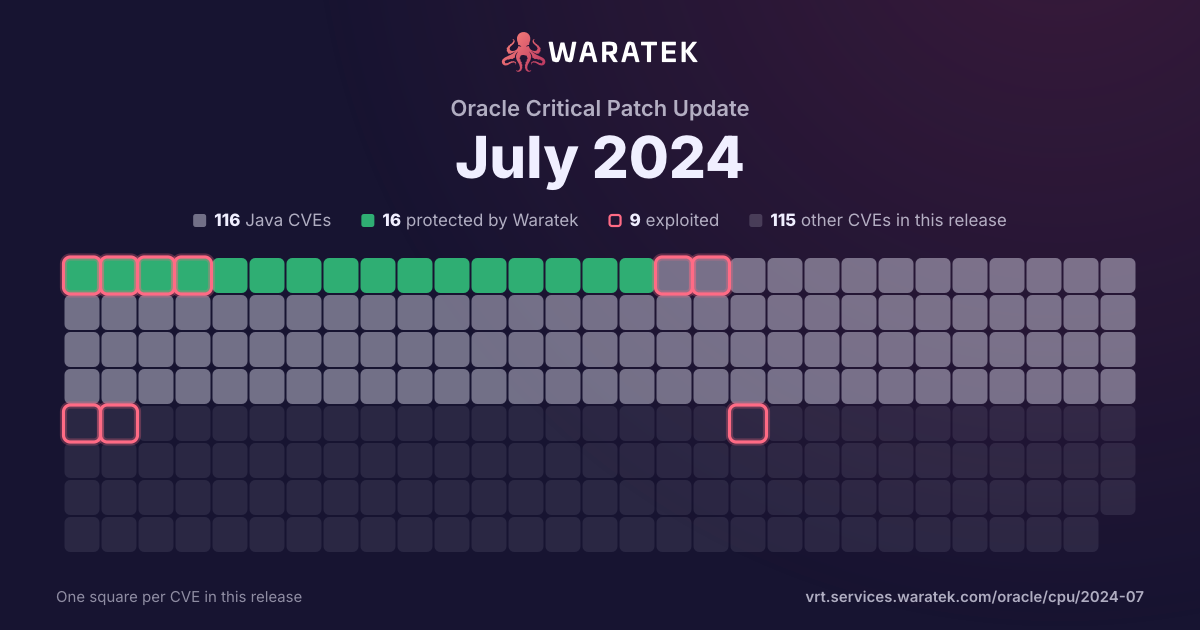
By status
16Protected by Waratek4Mitigation candidate96No exploit published18Outside Waratek scope97Not applicable
9Exploited, marked by the ring
No exploit published. For 35 of them, Oracle's security advisory is the source of public detail.
Protected by Waratek. Waratek RASP can block exploitation of these on systems that have not applied the patch yet.
Overview 14 matches · 6 in Waratek scope · 4 protected · 6 exploited · 4 CISA KEV · 10 public PoC
Protected by Waratek
4
28.6%
Rule in development
0
0.0%
Mitigation candidate
1
7.1%
No exploit published
1
7.1%
Outside Waratek scope
4
28.6%
Not applicable
4
28.6%
Withdrawn CVE
0
0.0%
blocked by ARMR today
4
28.6%
partly blocked
0
0.0%
not blocked
10
71.4%
not established
0
0.0%
unrecorded
0
0.0%
Exploited
6
42.9%
Working exploit published
0
0.0%
Proof of concept only
5
35.7%
Forecast only
3
21.4%
No public exploit
0
0.0%
split by
peak 5 / quarter
Q2 222
Protected by Waratek1
Outside Waratek scope1
Critical2
blocked by ARMR today1
not blocked1
Exploited1
Proof of concept only1
Q3 221
Protected by Waratek1
High1
blocked by ARMR today1
Proof of concept only1
Q4 221
Not applicable1
High1
not blocked1
Proof of concept only1
Q1 230
Q2 230
Q3 230
Q4 232
Mitigation candidate1
Outside Waratek scope1
High1
Medium1
not blocked2
Exploited2
Q1 242
Protected by Waratek1
No exploit published1
Critical1
High1
blocked by ARMR today1
not blocked1
Exploited1
Forecast only1
Q2 245
Outside Waratek scope2
Not applicable3
High3
Medium2
not blocked5
Exploited1
Proof of concept only2
Forecast only2
Q3 241
Protected by Waratek1
High1
blocked by ARMR today1
Exploited1
Q2 22Q3 22Q4 22Q1 23Q2 23Q3 23Q4 23Q1 24Q2 24Q3 24
| CVE | Severity | Published▾ | Status | Exploitation | Description |
|---|---|---|---|---|---|
| CVE-2024-21182 | High | 2024-07-16 | Protected by Waratek | Exploited | Vulnerability in the Oracle WebLogic Server product of Oracle Fusion Middleware (component: Core). Supported versions that are affected are 12.2.1.4.0 and 14.1.1.0.0. Easily exploitable vulnerability allows unauthenticated attacker with network access via T3, IIOP to compromise Oracle WebLogic Server. Successful attacks of this vulnerability can result in unauthorized access to critical data or complete access to all Oracle WebLogic Server accessible data. CVSS 3.1 Base Score 7.5 (Confidentiality impacts). CVSS Vector: (CVSS:3.1/AV:N/AC:L/PR:N/UI:N/S:U/C:H/I:N/A:N). |
| CVE-2024-2961 | High | 2024-04-17 | Outside Waratek scope | Exploited | The iconv() function in the GNU C Library versions 2.39 and older may overflow the output buffer passed to it by up to 4 bytes when converting strings to the ISO-2022-CN-EXT character set, which may be used to crash an application or overwrite a neighbouring variable. |
| CVE-2024-27983 | High | 2024-04-09 | Not applicable | Proof of concept only | An attacker can make the Node.js HTTP/2 server completely unavailable by sending a small amount of HTTP/2 frames packets with a few HTTP/2 frames inside. It is possible to leave some data in nghttp2 memory after reset when headers with HTTP/2 CONTINUATION frame are sent to the server and then a TCP connection is abruptly closed by the client triggering the Http2Session destructor while header frames are still being processed (and stored in memory) causing a race condition. |
| CVE-2024-2511 | Medium | 2024-04-08 | Outside Waratek scope | Forecast only | Issue summary: Some non-default TLS server configurations can cause unbounded memory growth when processing TLSv1.3 sessions Impact summary: An attacker may exploit certain server configurations to trigger unbounded memory growth that would lead to a Denial of Service This problem can occur in TLSv1.3 if the non-default SSL_OP_NO_TICKET option is being used (but not if early_data support is also configured and the default anti-replay protection is in use). In this case, under certain conditions, the session cache can get into an incorrect state and it will fail to flush properly as it fills. The session cache will continue to grow in an unbounded manner. A malicious client could deliberately create the scenario for this failure to force a Denial of Service. It may also happen by accident in normal operation. This issue only affects TLS servers supporting TLSv1.3. It does not affect TLS clients. The FIPS modules in 3.2, 3.1 and 3.0 are not affected by this issue. OpenSSL 1.0.2 is also not affected by this issue. |
| CVE-2024-28182 | Medium | 2024-04-04 | Not applicable | Forecast only | nghttp2 is an implementation of the Hypertext Transfer Protocol version 2 in C. The nghttp2 library prior to version 1.61.0 keeps reading the unbounded number of HTTP/2 CONTINUATION frames even after a stream is reset to keep HPACK context in sync. This causes excessive CPU usage to decode HPACK stream. nghttp2 v1.61.0 mitigates this vulnerability by limiting the number of CONTINUATION frames it accepts per stream. There is no workaround for this vulnerability. |
| CVE-2024-27316 | High | 2024-04-04 | Not applicable | Proof of concept only | HTTP/2 incoming headers exceeding the limit are temporarily buffered in nghttp2 in order to generate an informative HTTP 413 response. If a client does not stop sending headers, this leads to memory exhaustion. |
| CVE-2024-23898 | High | 2024-01-24 | No exploit published | Forecast only | Jenkins 2.217 through 2.441 (both inclusive), LTS 2.222.1 through 2.426.2 (both inclusive) does not perform origin validation of requests made through the CLI WebSocket endpoint, resulting in a cross-site WebSocket hijacking (CSWSH) vulnerability, allowing attackers to execute CLI commands on the Jenkins controller. |
| CVE-2024-23897 | Critical | 2024-01-24 | Protected by Waratek | Exploited | Jenkins 2.441 and earlier, LTS 2.426.2 and earlier does not disable a feature of its CLI command parser that replaces an '@' character followed by a file path in an argument with the file's contents, allowing unauthenticated attackers to read arbitrary files on the Jenkins controller file system. |
| CVE-2023-48795 | Medium | 2023-12-18 | Outside Waratek scope | Exploited | The SSH transport protocol with certain OpenSSH extensions, found in OpenSSH before 9.6 and other products, allows remote attackers to bypass integrity checks such that some packets are omitted (from the extension negotiation message), and a client and server may consequently end up with a connection for which some security features have been downgraded or disabled, aka a Terrapin attack. This occurs because the SSH Binary Packet Protocol (BPP), implemented by these extensions, mishandles the handshake phase and mishandles use of sequence numbers. For example, there is an effective attack against SSH's use of ChaCha20-Poly1305 (and CBC with Encrypt-then-MAC). The bypass occurs in chacha20-poly1305@openssh.com and (if CBC is used) the -etm@openssh.com MAC algorithms. This also affects Maverick Synergy Java SSH API before 3.1.0-SNAPSHOT, Dropbear through 2022.83, Ssh before 5.1.1 in Erlang/OTP, PuTTY before 0.80, AsyncSSH before 2.14.2, golang.org/x/crypto before 0.17.0, libssh before 0.10.6, libssh2 through 1.11.0, Thorn Tech SFTP Gateway before 3.4.6, Tera Term before 5.1, Paramiko before 3.4.0, jsch before 0.2.15, SFTPGo before 2.5.6, Netgate pfSense Plus through 23.09.1, Netgate pfSense CE through 2.7.2, HPN-SSH through 18.2.0, ProFTPD before 1.3.8b (and before 1.3.9rc2), ORYX CycloneSSH before 2.3.4, NetSarang XShell 7 before Build 0144, CrushFTP before 10.6.0, ConnectBot SSH library before 2.2.22, Apache MINA sshd through 2.11.0, sshj through 0.37.0, TinySSH through 20230101, trilead-ssh2 6401, LANCOM LCOS and LANconfig, FileZilla before 3.66.4, Nova before 11.8, PKIX-SSH before 14.4, SecureCRT before 9.4.3, Transmit5 before 5.10.4, Win32-OpenSSH before 9.5.0.0p1-Beta, WinSCP before 6.2.2, Bitvise SSH Server before 9.32, Bitvise SSH Client before 9.33, KiTTY through 0.76.1.13, the net-ssh gem 7.2.0 for Ruby, the mscdex ssh2 module before 1.15.0 for Node.js, the thrussh library before 0.35.1 for Rust, and the Russh crate before 0.40.2 for Rust. |
| CVE-2023-44487 | High | 2023-10-10 | Mitigation candidate | Exploited | The HTTP/2 protocol allows a denial of service (server resource consumption) because request cancellation can reset many streams quickly, as exploited in the wild in August through October 2023. |
| CVE-2022-3786 | High | 2022-11-01 | Not applicable | Proof of concept only | A buffer overrun can be triggered in X.509 certificate verification, specifically in name constraint checking. Note that this occurs after certificate chain signature verification and requires either a CA to have signed a malicious certificate or for an application to continue certificate verification despite failure to construct a path to a trusted issuer. An attacker can craft a malicious email address in a certificate to overflow an arbitrary number of bytes containing the `.' character (decimal 46) on the stack. This buffer overflow could result in a crash (causing a denial of service). In a TLS client, this can be triggered by connecting to a malicious server. In a TLS server, this can be triggered if the server requests client authentication and a malicious client connects. |
| CVE-2022-34169 | High | 2022-07-19 | Protected by Waratek | Proof of concept only | The Apache Xalan Java XSLT library is vulnerable to an integer truncation issue when processing malicious XSLT stylesheets. This can be used to corrupt Java class files generated by the internal XSLTC compiler and execute arbitrary Java bytecode. Users are recommended to update to version 2.7.3 or later. Note: Java runtimes (such as OpenJDK) include repackaged copies of Xalan. |
| CVE-2022-1292 | Critical | 2022-05-03 | Outside Waratek scope | Proof of concept only | The c_rehash script does not properly sanitise shell metacharacters to prevent command injection. This script is distributed by some operating systems in a manner where it is automatically executed. On such operating systems, an attacker could execute arbitrary commands with the privileges of the script. Use of the c_rehash script is considered obsolete and should be replaced by the OpenSSL rehash command line tool. Fixed in OpenSSL 3.0.3 (Affected 3.0.0,3.0.1,3.0.2). Fixed in OpenSSL 1.1.1o (Affected 1.1.1-1.1.1n). Fixed in OpenSSL 1.0.2ze (Affected 1.0.2-1.0.2zd). |
| CVE-2022-22965 | Critical | 2022-04-01 | Protected by Waratek | Exploited | A Spring MVC or Spring WebFlux application running on JDK 9+ may be vulnerable to remote code execution (RCE) via data binding. The specific exploit requires the application to run on Tomcat as a WAR deployment. If the application is deployed as a Spring Boot executable jar, i.e. the default, it is not vulnerable to the exploit. However, the nature of the vulnerability is more general, and there may be other ways to exploit it. |