
Oracle Critical Patch Update April 2024
Released April 2024 · Oracle's advisory ↗ · ← Critical Patch Update, January 2024 · Critical Patch Update, July 2024 →
312 CVEs in this release, one square each
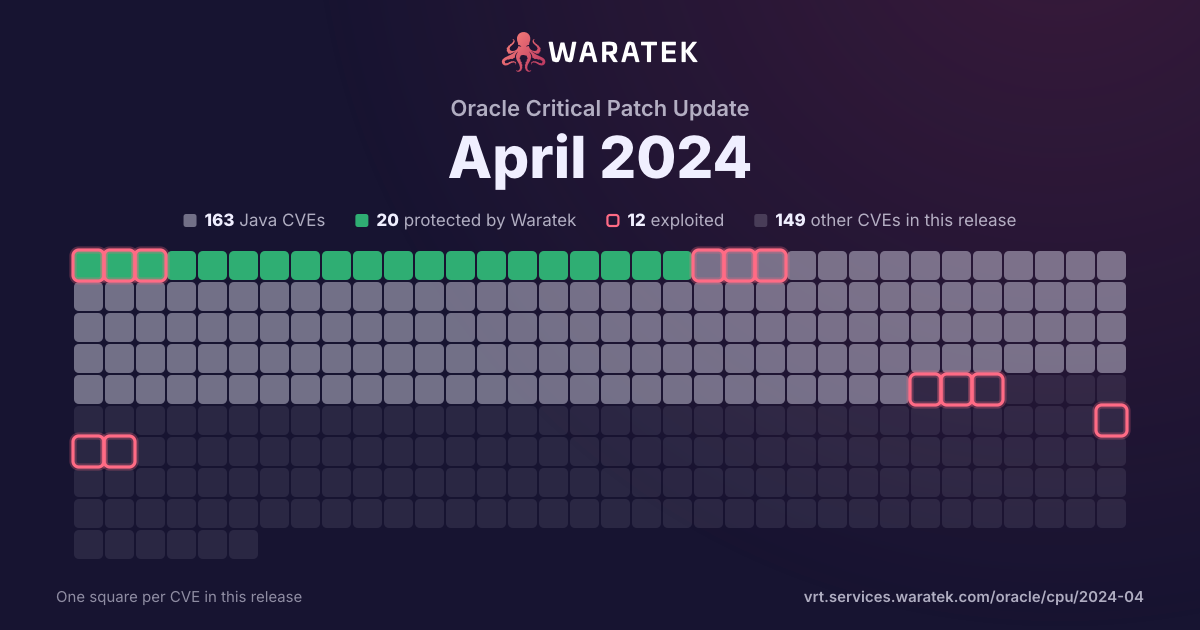
By status
20Protected by Waratek6Mitigation candidate137No exploit published40Outside Waratek scope108Not applicable1Withdrawn CVE
12Exploited, marked by the ring
No exploit published. For 82 of them, Oracle's security advisory is the source of public detail.
Protected by Waratek. Waratek RASP can block exploitation of these on systems that have not applied the patch yet.
Overview 2 matches · 0 protected · 1 exploited · 0 CISA KEV · 1 public PoC · 0 EPSS ≥ 0.5
Protected by Waratek
0
0.0%
Rule in development
0
0.0%
Mitigation candidate
2
100.0%
No exploit published
0
0.0%
blocked by ARMR today
0
0.0%
partly blocked
0
0.0%
not blocked
2
100.0%
not established
0
0.0%
unrecorded
0
0.0%
Exploited
1
50.0%
Working exploit published
0
0.0%
Proof of concept only
1
50.0%
Forecast only
0
0.0%
No public exploit
0
0.0%
split by
peak 1 / month
Dec 22Feb 23Apr 23Jun 23Aug 23Oct 23Dec 23Feb 24
| CVE | Severity | Published▾ | Status | Exploitation | Description |
|---|---|---|---|---|---|
| CVE-2024-1597 | Critical | 2024-02-19 | Mitigation candidate | Exploited | pgjdbc, the PostgreSQL JDBC Driver, allows attacker to inject SQL if using PreferQueryMode=SIMPLE. Note this is not the default. In the default mode there is no vulnerability. A placeholder for a numeric value must be immediately preceded by a minus. There must be a second placeholder for a string value after the first placeholder; both must be on the same line. By constructing a matching string payload, the attacker can inject SQL to alter the query,bypassing the protections that parameterized queries bring against SQL Injection attacks. Versions before 42.7.2, 42.6.1, 42.5.5, 42.4.4, 42.3.9, and 42.2.28 are affected. |
| CVE-2022-46364 | Critical | 2022-12-13 | Mitigation candidate | Proof of concept only | A SSRF vulnerability in parsing the href attribute of XOP:Include in MTOM requests in versions of Apache CXF before 3.5.5 and 3.4.10 allows an attacker to perform SSRF style attacks on webservices that take at least one parameter of any type. |