
Oracle Critical Patch Update April 2024
Released April 2024 · Oracle's advisory ↗ · ← Critical Patch Update, January 2024 · Critical Patch Update, July 2024 →
312 CVEs in this release, one square each
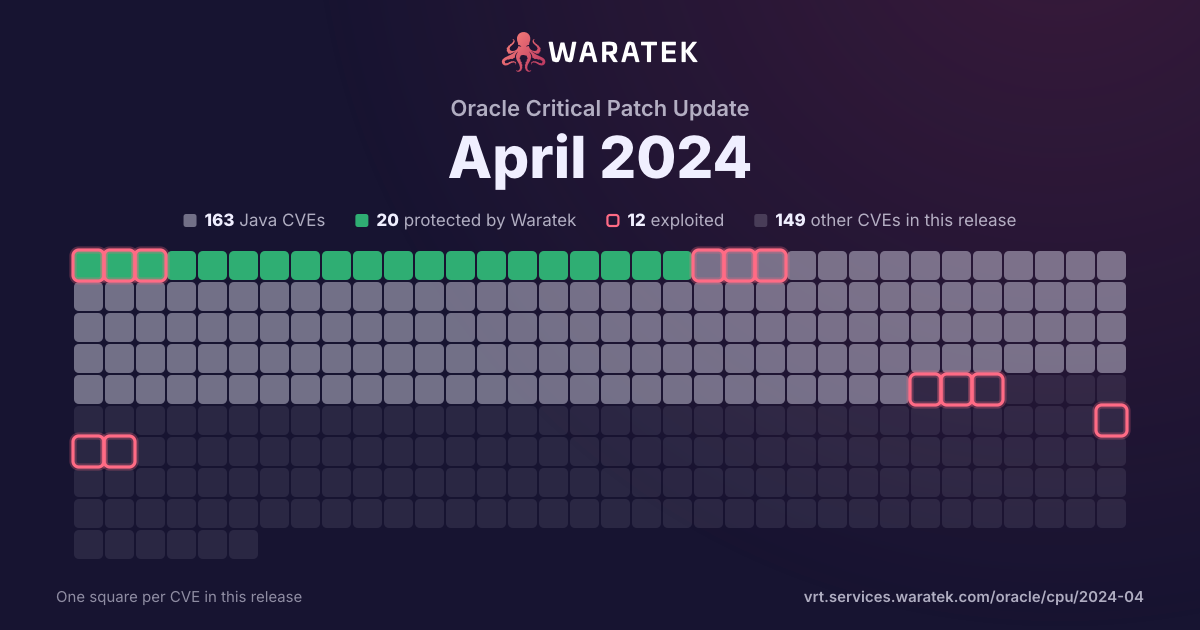
By status
20Protected by Waratek6Mitigation candidate137No exploit published40Outside Waratek scope108Not applicable1Withdrawn CVE
12Exploited, marked by the ring
No exploit published. For 82 of them, Oracle's security advisory is the source of public detail.
Protected by Waratek. Waratek RASP can block exploitation of these on systems that have not applied the patch yet.
Overview 9 matches · 0 protected · 1 exploited · 0 CISA KEV · 1 public PoC · 0 EPSS ≥ 0.5
Protected by Waratek
0
0.0%
Rule in development
0
0.0%
Mitigation candidate
2
22.2%
No exploit published
7
77.8%
blocked by ARMR today
0
0.0%
partly blocked
0
0.0%
not blocked
9
100.0%
not established
0
0.0%
unrecorded
0
0.0%
Exploited
1
11.1%
Working exploit published
0
0.0%
Proof of concept only
1
11.1%
Forecast only
0
0.0%
No public exploit
7
77.8%
split by
peak 2 / quarter
Q3 222
No exploit published2
Critical2
not blocked2
No public exploit2
Q4 222
Mitigation candidate1
No exploit published1
Critical2
not blocked2
Proof of concept only1
No public exploit1
Q1 230
Q2 230
Q3 230
Q4 232
No exploit published2
Critical2
not blocked2
No public exploit2
Q1 241
Mitigation candidate1
Critical1
not blocked1
Exploited1
Q2 242
No exploit published2
Critical2
not blocked2
No public exploit2
Q3 22Q4 22Q1 23Q2 23Q3 23Q4 23Q1 24Q2 24
| CVE | Severity | Published▾ | Status | Exploitation | Description |
|---|---|---|---|---|---|
| CVE-2024-21082 | Critical | 2024-04-16 | No exploit published | No public exploit | Vulnerability in the Oracle BI Publisher product of Oracle Analytics (component: XML Services). Supported versions that are affected are 7.0.0.0.0 and 12.2.1.4.0. Easily exploitable vulnerability allows unauthenticated attacker with network access via HTTP to compromise Oracle BI Publisher. Successful attacks of this vulnerability can result in takeover of Oracle BI Publisher. CVSS 3.1 Base Score 9.8 (Confidentiality, Integrity and Availability impacts). CVSS Vector: (CVSS:3.1/AV:N/AC:L/PR:N/UI:N/S:U/C:H/I:H/A:H). |
| CVE-2024-21071 | Critical | 2024-04-16 | No exploit published | No public exploit | Vulnerability in the Oracle Workflow product of Oracle E-Business Suite (component: Admin Screens and Grants UI). Supported versions that are affected are 12.2.3-12.2.13. Easily exploitable vulnerability allows high privileged attacker with network access via HTTP to compromise Oracle Workflow. While the vulnerability is in Oracle Workflow, attacks may significantly impact additional products (scope change). Successful attacks of this vulnerability can result in takeover of Oracle Workflow. CVSS 3.1 Base Score 9.1 (Confidentiality, Integrity and Availability impacts). CVSS Vector: (CVSS:3.1/AV:N/AC:L/PR:H/UI:N/S:C/C:H/I:H/A:H). |
| CVE-2024-1597 | Critical | 2024-02-19 | Mitigation candidate | Exploited | pgjdbc, the PostgreSQL JDBC Driver, allows attacker to inject SQL if using PreferQueryMode=SIMPLE. Note this is not the default. In the default mode there is no vulnerability. A placeholder for a numeric value must be immediately preceded by a minus. There must be a second placeholder for a string value after the first placeholder; both must be on the same line. By constructing a matching string payload, the attacker can inject SQL to alter the query,bypassing the protections that parameterized queries bring against SQL Injection attacks. Versions before 42.7.2, 42.6.1, 42.5.5, 42.4.4, 42.3.9, and 42.2.28 are affected. |
| CVE-2022-46337 | Critical | 2023-11-20 | No exploit published | No public exploit | A cleverly devised username might bypass LDAP authentication checks. In LDAP-authenticated Derby installations, this could let an attacker fill up the disk by creating junk Derby databases. In LDAP-authenticated Derby installations, this could also allow the attacker to execute malware which was visible to and executable by the account which booted the Derby server. In LDAP-protected databases which weren't also protected by SQL GRANT/REVOKE authorization, this vulnerability could also let an attacker view and corrupt sensitive data and run sensitive database functions and procedures. Mitigation: Users should upgrade to Java 21 and Derby 10.17.1.0. Alternatively, users who wish to remain on older Java versions should build their own Derby distribution from one of the release families to which the fix was backported: 10.16, 10.15, and 10.14. Those are the releases which correspond, respectively, with Java LTS versions 17, 11, and 8. |
| CVE-2023-44981 | Critical | 2023-10-11 | No exploit published | No public exploit | Authorization Bypass Through User-Controlled Key vulnerability in Apache ZooKeeper. If SASL Quorum Peer authentication is enabled in ZooKeeper (quorum.auth.enableSasl=true), the authorization is done by verifying that the instance part in SASL authentication ID is listed in zoo.cfg server list. The instance part in SASL auth ID is optional and if it's missing, like 'eve@EXAMPLE.COM', the authorization check will be skipped. As a result an arbitrary endpoint could join the cluster and begin propagating counterfeit changes to the leader, essentially giving it complete read-write access to the data tree. Quorum Peer authentication is not enabled by default. Users are recommended to upgrade to version 3.9.1, 3.8.3, 3.7.2, which fixes the issue. Alternately ensure the ensemble election/quorum communication is protected by a firewall as this will mitigate the issue. See the documentation for more details on correct cluster administration. |
| CVE-2022-46364 | Critical | 2022-12-13 | Mitigation candidate | Proof of concept only | A SSRF vulnerability in parsing the href attribute of XOP:Include in MTOM requests in versions of Apache CXF before 3.5.5 and 3.4.10 allows an attacker to perform SSRF style attacks on webservices that take at least one parameter of any type. |
| CVE-2022-45378 | Critical | 2022-11-14 | No exploit published | No public exploit | In the default configuration of Apache SOAP, an RPCRouterServlet is available without authentication. This gives an attacker the possibility to invoke methods on the classpath that meet certain criteria. Depending on what classes are available on the classpath this might even lead to arbitrary remote code execution. NOTE: This vulnerability only affects products that are no longer supported by the maintainer. |
| CVE-2020-35166 | Critical | 2022-07-11 | No exploit published | No public exploit | Dell BSAFE Crypto-C Micro Edition, versions before 4.1.5, and Dell BSAFE Micro Edition Suite, versions before 4.6, contain an Observable Timing Discrepancy Vulnerability. |
| CVE-2020-29508 | Critical | 2022-07-11 | No exploit published | No public exploit | Dell BSAFE Crypto-C Micro Edition, versions before 4.1.5, and Dell BSAFE Micro Edition Suite, versions before 4.6, contain an Improper Input Validation Vulnerability. |