
Oracle Critical Patch Update April 2024
Released April 2024 · Oracle's advisory ↗ · ← Critical Patch Update, January 2024 · Critical Patch Update, July 2024 →
312 CVEs in this release, one square each
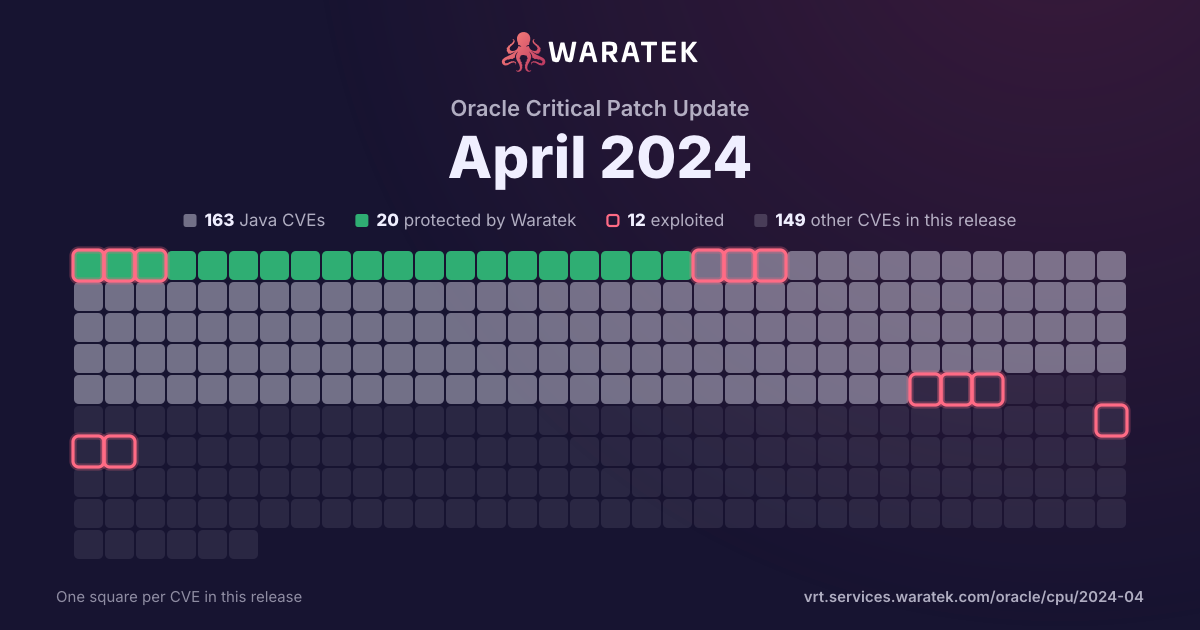
By status
19Protected by Waratek7Mitigation candidate138No exploit published16Outside Waratek scope131Not applicable1Withdrawn CVE
12Exploited, marked by the ring
No exploit published. For 69 of them, Oracle's security advisory is the source of public detail.
Protected by Waratek. Waratek RASP can block exploitation of these on systems that have not applied the patch yet.
Overview 8 matches · 4 in Waratek scope · 0 protected · 0 exploited · 0 CISA KEV · 2 public PoC · 0 EPSS ≥ 0.5
8matches
4in Waratek scope50.0%
0protected0.0%
0exploited0.0%
0CISA KEV0.0%
2public PoC25.0%
0EPSS ≥ 0.50.0%
Protected by Waratek
0
0.0%
Rule in development
0
0.0%
Mitigation candidate
2
25.0%
No exploit published
2
25.0%
Outside Waratek scope
0
0.0%
Not applicable
4
50.0%
Withdrawn CVE
0
0.0%
blocked by ARMR today
0
0.0%
partly blocked
0
0.0%
not blocked
8
100.0%
not established
0
0.0%
unrecorded
0
0.0%
Exploited
0
0.0%
Working exploit published
0
0.0%
Proof of concept only
8
100.0%
Forecast only
0
0.0%
No public exploit
0
0.0%
split by
peak 5 / month
Jan 24Feb 24Mar 24Apr 24
| CVE | Severity | Published▾ | Status | Exploitation | Description |
|---|---|---|---|---|---|
| CVE-2024-21006 | High | 2024-04-16 | Mitigation candidate | Proof of concept only | Vulnerability in the Oracle WebLogic Server product of Oracle Fusion Middleware (component: Core). Supported versions that are affected are 12.2.1.4.0 and 14.1.1.0.0. Easily exploitable vulnerability allows unauthenticated attacker with network access via T3, IIOP to compromise Oracle WebLogic Server. Successful attacks of this vulnerability can result in unauthorized access to critical data or complete access to all Oracle WebLogic Server accessible data. CVSS 3.1 Base Score 7.5 (Confidentiality impacts). CVSS Vector: (CVSS:3.1/AV:N/AC:L/PR:N/UI:N/S:U/C:H/I:N/A:N). |
| CVE-2023-51775 | Medium | 2024-02-29 | No exploit published | Proof of concept only | The jose4j component before 0.9.4 for Java allows attackers to cause a denial of service (CPU consumption) via a large p2c (aka PBES2 Count) value. |
| CVE-2024-22201 | High | 2024-02-26 | No exploit published | Proof of concept only | Jetty is a Java based web server and servlet engine. An HTTP/2 SSL connection that is established and TCP congested will be leaked when it times out. An attacker can cause many connections to end up in this state, and the server may run out of file descriptors, eventually causing the server to stop accepting new connections from valid clients. The vulnerability is patched in 9.4.54, 10.0.20, 11.0.20, and 12.0.6. |
| CVE-2024-22243 | High | 2024-02-23 | Mitigation candidate | Proof of concept only | Applications that use UriComponentsBuilder to parse an externally provided URL (e.g. through a query parameter) AND perform validation checks on the host of the parsed URL may be vulnerable to a open redirect https://cwe.mitre.org/data/definitions/601.html attack or to a SSRF attack if the URL is used after passing validation checks. |
| CVE-2023-50782 | High | 2024-02-05 | Not applicable | Proof of concept only | A flaw was found in the python-cryptography package. This issue may allow a remote attacker to decrypt captured messages in TLS servers that use RSA key exchanges, which may lead to exposure of confidential or sensitive data. |
| CVE-2024-0853 | Medium | 2024-02-03 | Not applicable | Proof of concept only | curl inadvertently kept the SSL session ID for connections in its cache even when the verify status (*OCSP stapling*) test failed. A subsequent transfer to the same hostname could then succeed if the session ID cache was still fresh, which then skipped the verify status check. |
| CVE-2023-6780 | Medium | 2024-01-31 | Not applicable | Proof of concept only | An integer overflow was found in the __vsyslog_internal function of the glibc library. This function is called by the syslog and vsyslog functions. This issue occurs when these functions are called with a very long message, leading to an incorrect calculation of the buffer size to store the message, resulting in undefined behavior. This issue affects glibc 2.37 and newer. |
| CVE-2023-51257 | High | 2024-01-16 | Not applicable | Proof of concept only | An invalid memory write issue in Jasper-Software Jasper v.4.1.1 and before allows a local attacker to execute arbitrary code. |