
Oracle Critical Patch Update April 2024
Released April 2024 · Oracle's advisory ↗ · ← Critical Patch Update, January 2024 · Critical Patch Update, July 2024 →
312 CVEs in this release, one square each
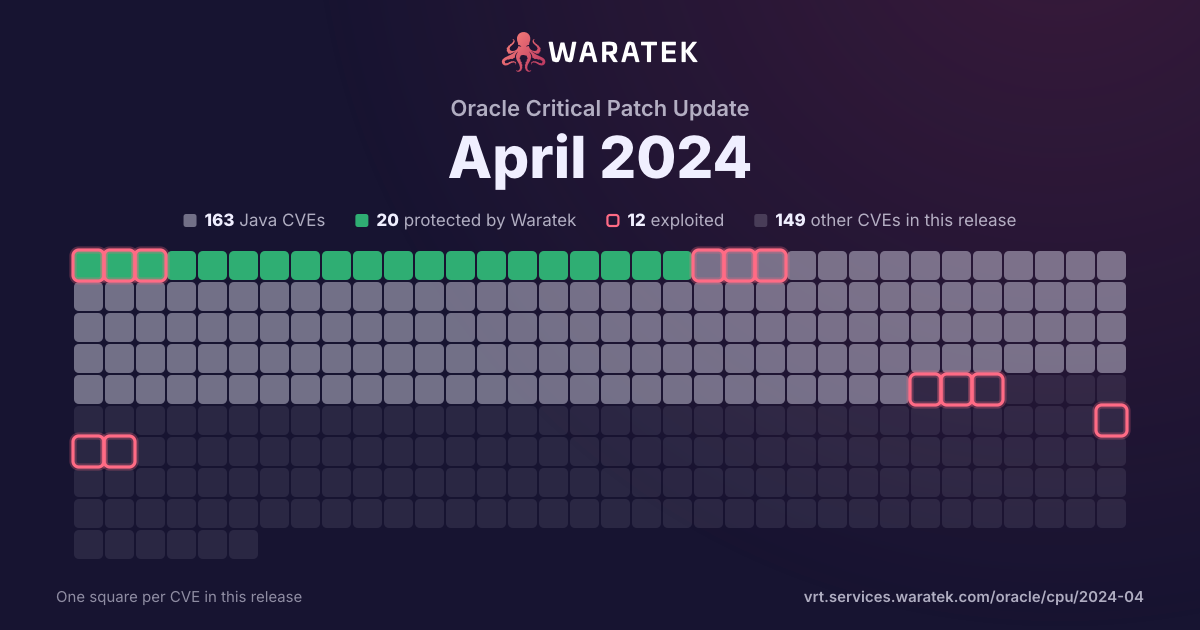
By status
19Protected by Waratek1Rule in development6Mitigation candidate138No exploit published15Outside Waratek scope132Not applicable1Withdrawn CVE
12Exploited, marked by the ring
No exploit published. For 69 of them, Oracle's security advisory is the source of public detail.
Protected by Waratek. Waratek RASP can block exploitation of these on systems that have not applied the patch yet.
Overview 11 matches · 1 protected · 0 exploited · 0 CISA KEV · 0 public PoC · 0 EPSS ≥ 0.5
Protected by Waratek
1
9.1%
Rule in development
0
0.0%
Mitigation candidate
0
0.0%
No exploit published
10
90.9%
blocked by ARMR today
1
9.1%
partly blocked
0
0.0%
not blocked
10
90.9%
not established
0
0.0%
unrecorded
0
0.0%
Exploited
0
0.0%
Working exploit published
0
0.0%
Proof of concept only
2
18.2%
Forecast only
0
0.0%
No public exploit
9
81.8%
split by
peak 6 / month
Dec 232
No exploit published2
High1
Medium1
not blocked2
No public exploit2
Jan 241
No exploit published1
High1
not blocked1
No public exploit1
Feb 246
Protected by Waratek1
No exploit published5
High3
Medium3
blocked by ARMR today1
not blocked5
Proof of concept only2
No public exploit4
Mar 242
No exploit published2
High2
not blocked2
No public exploit2
Dec 23Jan 24Feb 24Mar 24
| CVE | Severity | Published▾ | Status | Exploitation | Description |
|---|---|---|---|---|---|
| CVE-2024-22257 | High | 2024-03-18 | No exploit published | No public exploit | In Spring Security, versions 5.7.x prior to 5.7.12, 5.8.x prior to 5.8.11, versions 6.0.x prior to 6.0.9, versions 6.1.x prior to 6.1.8, versions 6.2.x prior to 6.2.3, an application is possible vulnerable to broken access control when it directly uses the AuthenticatedVoter#vote passing a null Authentication parameter. |
| CVE-2024-22259 | High | 2024-03-16 | No exploit published | No public exploit | Applications that use UriComponentsBuilder in Spring Framework to parse an externally provided URL (e.g. through a query parameter) AND perform validation checks on the host of the parsed URL may be vulnerable to a open redirect https://cwe.mitre.org/data/definitions/601.html attack or to a SSRF attack if the URL is used after passing validation checks. This is the same as CVE-2024-22243 https://spring.io/security/cve-2024-22243 , but with different input. |
| CVE-2023-51775 | Medium | 2024-02-29 | No exploit published | Proof of concept only | The jose4j component before 0.9.4 for Java allows attackers to cause a denial of service (CPU consumption) via a large p2c (aka PBES2 Count) value. |
| CVE-2024-22201 | High | 2024-02-26 | No exploit published | Proof of concept only | Jetty is a Java based web server and servlet engine. An HTTP/2 SSL connection that is established and TCP congested will be leaked when it times out. An attacker can cause many connections to end up in this state, and the server may run out of file descriptors, eventually causing the server to stop accepting new connections from valid clients. The vulnerability is patched in 9.4.54, 10.0.20, 11.0.20, and 12.0.6. |
| CVE-2024-26308 | Medium | 2024-02-19 | No exploit published | No public exploit | Allocation of Resources Without Limits or Throttling vulnerability in Apache Commons Compress.This issue affects Apache Commons Compress: from 1.21 before 1.26. Users are recommended to upgrade to version 1.26, which fixes the issue. |
| CVE-2024-25710 | High | 2024-02-19 | No exploit published | No public exploit | Loop with Unreachable Exit Condition ('Infinite Loop') vulnerability in Apache Commons Compress.This issue affects Apache Commons Compress: from 1.3 through 1.25.0. Users are recommended to upgrade to version 1.26.0 which fixes the issue. |
| CVE-2024-1635 | High | 2024-02-19 | No exploit published | No public exploit | A vulnerability was found in Undertow. This vulnerability impacts a server that supports the wildfly-http-client protocol. Whenever a malicious user opens and closes a connection with the HTTP port of the server and then closes the connection immediately, the server will end with both memory and open file limits exhausted at some point, depending on the amount of memory available. At HTTP upgrade to remoting, the WriteTimeoutStreamSinkConduit leaks connections if RemotingConnection is closed by Remoting ServerConnectionOpenListener. Because the remoting connection originates in Undertow as part of the HTTP upgrade, there is an external layer to the remoting connection. This connection is unaware of the outermost layer when closing the connection during the connection opening procedure. Hence, the Undertow WriteTimeoutStreamSinkConduit is not notified of the closed connection in this scenario. Because WriteTimeoutStreamSinkConduit creates a timeout task, the whole dependency tree leaks via that task, which is added to XNIO WorkerThread. So, the workerThread points to the Undertow conduit, which contains the connections and causes the leak. |
| CVE-2024-1459 | Medium | 2024-02-12 | Protected by Waratek | No public exploit | A path traversal vulnerability was found in Undertow. This issue may allow a remote attacker to append a specially-crafted sequence to an HTTP request for an application deployed to JBoss EAP, which may permit access to privileged or restricted files and directories. |
| CVE-2024-22233 | High | 2024-01-22 | No exploit published | No public exploit | In Spring Framework versions 6.0.15 and 6.1.2, it is possible for a user to provide specially crafted HTTP requests that may cause a denial-of-service (DoS) condition. Specifically, an application is vulnerable when all of the following are true: * the application uses Spring MVC * Spring Security 6.1.6+ or 6.2.1+ is on the classpath Typically, Spring Boot applications need the org.springframework.boot:spring-boot-starter-web and org.springframework.boot:spring-boot-starter-security dependencies to meet all conditions. |
| CVE-2023-51074 | Medium | 2023-12-27 | No exploit published | No public exploit | json-path v2.8.0 was discovered to contain a stack overflow via the Criteria.parse() method. |
| CVE-2023-5379 | High | 2023-12-12 | No exploit published | No public exploit | A flaw was found in Undertow. When an AJP request is sent that exceeds the max-header-size attribute in ajp-listener, JBoss EAP is marked in an error state by mod_cluster in httpd, causing JBoss EAP to close the TCP connection without returning an AJP response. This happens because mod_proxy_cluster marks the JBoss EAP instance as an error worker when the TCP connection is closed from the backend after sending the AJP request without receiving an AJP response, and stops forwarding. This issue could allow a malicious user could to repeatedly send requests that exceed the max-header-size, causing a Denial of Service (DoS). |